
Playing the Indian Card

Showing posts with label constructivism. Show all posts

Wednesday, March 20, 2024

Fallacies We Live By


I have special difficulty explaining to students the ad populum fallacy and the ad temperantiam fallacy. The problem is that public discourse as a whole is largely currently founded on these two fallacies. Pointing them out causes major cognitive dissonance. They tend to do a double take, and at first be incredulous. 

This is precisely why it is vital to teach them. The fact that we do not teach the logical fallacies in every school is profoundly sinister. It allows us to be manipulated.

The “ad populum” fallacy is the notion that truth is a majority mandate. If everyone thinks something is true, that proves it is true: “everybody knows.” This is the very premise of “constructivism,” the currently dominant educational philosophy. Constructivism holds that all truth is “socially constructed.” Truth is whatever the majority of any given social group says it is, and accordingly varies between cultures. Which is why we get “cultural relativism” and the insistence that all cultures must be accepted to be equal. It is also why we get transsexualism: according to constructivism, if an interest group can just get everyone to agree that a man can become a woman, it is a fact. For this very reason, dissent cannot be tolerated.

This is why classroom teachers always want to break into small groups. They cannot teach; the group must decide. The current Vatican synod on synodality seems to be based on the same dynamic: there is no truth other than whatever the people in the pews want to hear. We all get to vote on whether the sun goes around the earth, or vice versa. In fact, until the time of Copernicus, according to this theory, the sun DID go around the earth. Galileo was dead wrong. Einstein was a lunatic. Slavery was perfectly moral in the US South until those meddling Yankees got involved. 

Interestingly, based on constructivism, a bridge built in India by Scottish engineers, would probably collapse. Scottish mathematics and physics cannot work in India.

The “ad temperantiam” fallacy holds that, whenever there are two opposing views, the truth must lie in the middle. A popular view, as old as Delphi, but also already exploded in ancient times. This fallacy is implicit whenever people object to “extremists”; as if holding a view strongly proves it is wrong. This is perfectly illogical. 

The “ad temperantiam” fallacy is also implied when people demand an immediate ceasefire and a negotiated settlement for, say, the war in Gaza or the war in Ukraine. As though the problem is always a refusal of both or either side to compromise.

If two people hold opposing views strongly, there is no reason to think that a position in the middle between the two, which perhaps no one holds or would argue, is more correct than either of them. If some people think the sky is blue, and some people think the sky is red, this is not proof that the sky is purple. If teacher thinks 2 + 2 = 4, and little Johnny thinks 2 + 2 = 7, this does not prove that 2 + 2 = 5.5. If some people believe the sun goes around the earth, and others that the earth goes around the sun, it does not follow that the heavenly bodies dance around each other. If one country invades another, it does not prove that they have a legitimate grievance, and their opponent is equally responsible for the war in pig-headedly defending themselves.

In the natural course of things, if there is a disagreement between two parties or two positions, one position is probably wrong, in error, and the other correct.


Sunday, March 10, 2024

The Need for Smaller Class Sizes


A new study suggests that classroom size does not affect student results: smaller classrooms are not better. But this has been known for years. Many previous studies have shown the same. It is an eternal surprise only because teachers’ unions eternally assert the opposite.

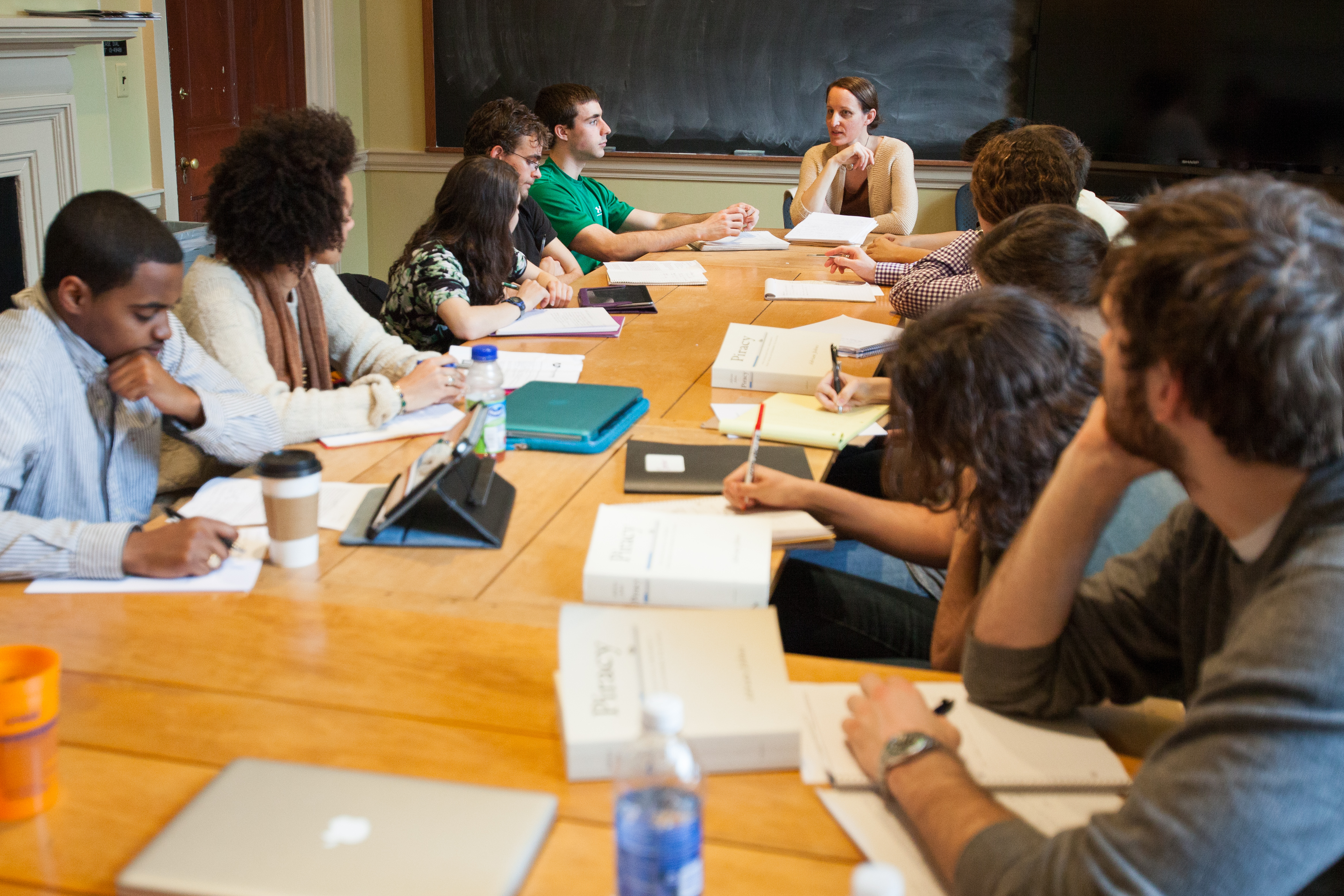
They do so, I imagine, because a larger class demands the lecture format, whereas a small enough class can be run as a seminar, a group discussion.

The currently fashionable education philosophy, “constructivism,” holds that truth is not a constant, there is no objective truth. Knowledge is “constructed” in groups, making the seminar approach mandatory. If the group decides that China is in Europe, then it is in Europe. If they decide the sun goes around the Earth, then the sun goes around the Earth.

Constructivism does not account for what happens if groups in contact with one another arrive at different conclusions. Might makes right seems the inevitable, necessary approach: you pass a law or fight a war and force submission.

This is how fascism works. And this is how our schools currently work. Increasingly, under the influence of the schools and constructivism, this is how our society works.

The attraction for the teaching tribe, however, is that running a seminar takes no effort on their part. There is no need for them to either actually know anything about the subject, or know how to explain it. They just get to sit in judgement over the conclusions the students come up with in their seminar. And on what basis can they judge, given that there is no truth? The only possibility is to object if any group comes to an opinion that differs from that of the teacher. Meaning the teacher has no responsibilities, but gets to be the absolute dictator in the classroom.

It's a good life, as long as the money keeps pouring in.


Sunday, March 22, 2020

Another Pandemic Altogether


It is hard, in the midst of a historic pandemic, to write about anything other than the coronavirus. About which, unfortunately, I have no expertise to offer. But there is another virus, more dangerous, to which I have recently been exposed.

The subject my student is studying in her grad program, “Critical Pedagogy,” is a Marxist take on “constructivism.” It is the dominant philosophy now in all branches of “education,” from kindergarten through the ed schools, up to doctoral level, and far enough afield from there to include the language schools.

The basic premise is that knowledge is “constructed,” as opposed to discovered. Learning is, in the words of the present paper, “a process of collaboratively constructed knowledge.”

It follows that the teacher cannot actually teach anything. The paper criticizes traditional education for seeing students as “empty agents who receive knowledge from teachers.” An image often used is of the learner as a passive empty glass that the teacher, in the bad, old way, is filling up with knowledge.

This sounds good. But that is not how traditional education worked at all. Genuinely traditional education means the Socratic method—that is, asking questions to provoke the student to think, rather than feeding him facts. And Bacon’s scientific method: don’t take anyone’s word for it, do the experiment. Nor is this true only of the West. Confucius said, “I show a student one corner of the problem. If he cannot discover the other three corners himself, I have no more I can do for him.” His collected sayings, which we call “The Analects,” model this method. Nothing is said plainly; they all require consideration and interpretation. They are hints.

Jesus did the same, of course, with parables. He might well be ranked as a third great teacher.
Traditional education used this method precisely because they did not see truth or reality as an arbitrary construct. Plato, our source for Socrates, understood all knowledge as innate; we are born with it, or we could not recognize it in the sensory world. Accordingly, all the teacher need really do is jar the memory.

But even without this “Platonic” view, which Confucius clearly shared, so long as objective reality exists in any form, the teacher’s job remains to teach the student how to reason, how to learn, how to discover things for himself.

Traditional education, accordingly, taught debate, logic, rhetoric, parliamentary procedure, mathematics, and the scientific method: ways to think, ways to arrive at knowledge.

Constructivism yanks this rug right out from under the enterprise. If, as it asserts, all truth is arbitrary, there is nothing at all to teach or to learn. One simply decides what one wants to be true. No role here for education at all. No role for anything but pouring things into empty vessels—indoctrination.
For of course, in a classroom, each individual student cannot be allowed to make their own reality; those realities will conflict. So what is one to do?

Here’s where the “collaborative” bit comes in. The stock constructivist response is that everyone in class must agree on the same reality.

This is at best a stopgap—the students will, sooner or later, need to leave the classroom, and their shared reality will not conform with the equally arbitrary shared reality of any given larger group.
But even within the class, on what basis, given that all realities are arbitrary, is one proposed reality to be preferred to another? On what basis does one come to a consensus?

Critical pedagogy, and constructivism generally, masks this with an implicit appeal to democracy: it is decided by majority vote. This is, in philosophical terms, the ad populum fallacy: majority opinion is no indication of truth. But even that is irrelevant; if truth itself is arbitrary, the only basis for preferring majority over minority truth in the first place is might makes right: the majority has the power to suppress the minority if it dissents.

It is significant that constructivism never gives any thought to parliamentary procedure or to how consensus is to be arrived at. For after all, if all realities are arbitrary, there is simply no room for debate. The biggest bully gets their way.

Of course, in a real constructivist classroom, it is the teacher who has ultimate power. It is the teacher’s chosen reality that will prevail, under the guise of “consensus.”

One begins to see why constructivism in various forms has become so popular among teachers. It gives them the most absolute power possible over the students in their class, and imposes no actual obligations on them to do anything they do not choose to do. It makes the classroom model a totalitarian dictatorship of Orwellian dimensions.

It is interesting, and alarming, that the essay my student was assigned was actually authored by two professors at the Islamic Azad University in Iran. That suggests how pervasive this ideology is: it dominates even in a supposedly Islamist university in a supposedly theocratic state.


Sunday, October 09, 2016

A Tour by Handcart of Babel, Bedlam, and the Land of Nod Beyond


The City of Tomorrow

U of T psychology professor Jordan Peterson is under fire. A campus rally last Wednesday called for his firing. His offense was to publicly insist on the right to continue to use the English third person singular subject pronouns: he, she, it. A lesson I happen to be teaching to a Chinese student today. What I am still teaching as simply correct grammar, is now a risky political position in Canada.

Doesn’t that strike anyone as a bit odd?

Chris Selley rushes to Dr. Peterson’s defense in the National Post. Sort of. He accepts the professor’s insistence on using standard grammar as a legitimate exercise of freedom of speech. But he does call Peterson a “total jerk” for it. He asks “what kind of jerk refuses to refer to someone as he, she or they would like? They’re human beings, not issues.”

The point is, of course, that some people who are objectively male now demand the right to be referred to as “she,” some who are objectively female now insist on “he,” and some who insist they are neither the one nor the other, or both at once, demand to be referred to now as “ze,” or “xe,”or something else.

While the matter might in itself seem trivial, forcing everyone to acquiesce to this right to choose one’s own personal pronouns forces two other people, each time, to accept and consent to two dubious and dangerous assertions: that the rules of language and grammar are a personal possession, and that one’s sex is a matter of free choice. The problem with the first contention is that, if each of us may impose our own vocabulary and grammar on anyone speaking about us, communication is no longer possible. Language ceases to be as soon as it is not shared. It cannot by its nature be a personal possession.

The problem with the second contention is greater: by it not only words, but things, are subjective and infinitely fungible. Physical sex is not a matter of opinion or preference, in any sense that height, age, or eye colour are not. It is encoded as ROM in every cell. Can I declare myself twenty-five? Many would like to. How about making myself aboriginal, and so qualifying for various federal subsidies? Can I say I’m seven feet tall, and angle for a basketball scholarship? Can my new IQ be 200?

It all sounds lovely on its face. To begin with, I could be invisible and fly. It’s almost like a dream come true. One can see the attraction. But a lot else follows once we decide that a firm personal belief determines reality, even against the evince of the senses. It is all the stuff conventionally called insanity.

And I am not talking here of slippery slopes. It is not that accepting that sex is up for grabs might one day lead to all the rest. All the rest is already here, in some circles, and has been for some time. You already read it in Marcuse in the drug-soaked sixties; you read it in the seventies in the Teachings of Don Juan. It was the self-actualization movement. It is postmodernism. There is no objective truth. “Reality is a function of belief.”

First person and second person discuss third person, holding the oar, in the fifth circle of hell.


We are instantly at the bottom of this slope; or rather, as soon as we plant our mental handcart on it, it dissolves beneath us, and we find ourselves in the nether regions. Where is the logical difference, the possible distinction, between a man who feels in his deepest heart that he is really a woman, and a man who feels in his deepest heart that he is Napoleon Bonaparte?

If there is to be no objective check on our beliefs, anything is possible. And anything possible is real.

The defenders of this new postmodern theory of reality will no doubt point out that it is possible to make a distinction between personal fantasies that harm no one else, and those that do. The former ought fairly to be indulged, while the latter can be opposed.

But they have already violated that principle, in demanding that everyone else accept each individuals inner conviction of their own sex. Why does the third person in every conversation have the right to his, her, or its own reality, but not the first person or the second person? If C gets to tell A and B what to do, is the rule not already violated?

There is no way to square this circle. Postmodernism is founded on the notion that two mutually contradictory truths can happily coexist. They cannot; and the a priori truth that they cannot is, as Aristotle pointed out, the basis of all logic. Accept this idea of the malleability of reality based on belief, and all possibility of logic or reasoned discernment is lost. That is no small matter.

Among so many other things, this means that no classic distinction between my rights and yours can any longer be maintained. We can no longer say that what you believe is only your business so long as it does not harm me. What, for example, if my heart tells me that I am actually you, and you are me? What if it tells me, with a deep Buddhist profundity, that we are all one? Where is the possible distinction between my beliefs and yours then? And what if it tells me you are working with the CIA, or with sinister alien beings, and are secretly trying to control me with your radioactive brainwaves? Surely, the right of self-defense allows me to act accordingly. What if my heart tells me that what you consider harm is actually to your benefit. What if I believe you would be better off without a head?

Bethlehem Royal Hospital, 1735. Yonge and Bloor, 2016.


But why even bother with these relatively strenuous mental contortions? What is left to save any distinction anyway between the moral good and evil, between right and wrong? If there is no truth, why prefer the one over the other? Isn’t it all just another matter of personal choice?

That is just what postmodernism, constructivism, and “cultural relativism” argues already. Welcome to the bottom.

Given this path we have apparently already civilizationally chosen, no laws, no social contracts, no contracts of any kind, and no social institutions, will have any predictable or reliable results. It must, in the end, be total civilizational collapse. And not in the long run. In the very short run.

The only question then is whether another civilization has the moral strength to take over.


Or is there perhaps a chance to preserve something in remote monasteries?