Playing the Indian Card

Showing posts with label Mary. Show all posts

Monday, November 10, 2025

There's Something about Mary


Many traditionalists are angered by the recent document from the Dicastery for the Doctrine of the Faith, “Mater Populi Fidelis.” They call it insulting to Mary, because it discourages use of the titles “Co-Redemptrix” and “Mediatrix of all Graces.”

On this issue, I am entirely in agreement with the Dicastery and the Vatican. It feels good to say that.

I have always been disturbed by those very titles. “Co-Redemptrix” sounds blasphemous to me. Jesus is uniquely our redeemer. It sounds like a feminist attempt to subvert this truth. “Mediatrix of all Graces”? So the saints must petition her, and have no direct line to God? Did she mediate the graces she herself received? We are to go to her of necessity instead of Christ?

No; this is paganism.

Mary is the paradigm of the perfect disciple soul. Elevating her to some more active role violates her immaculate nature. Subservience is her essence, and it is this she models for us. “Let it be done unto me according to thy word.”

Thank you for the clarification, Pope Leo.

Saturday, February 27, 2021

Mary and Islam


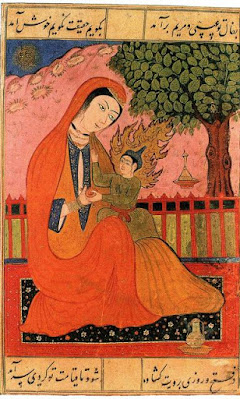
A Muslim (Persian) depiction of Mary with Jesus


Nobody gets religion; on the left or on the right.

A piece from PJ Media claims the Vatican has “betrayed” Mary by saying she is a bridge among Jews, Christians, and Muslims. They object to the claim in a Vatican document that she was “a Jewish, Christian and Muslim woman.” After all, how could she have been a Muslim -- “A religion that came into being 600 years after Mary died.”

Bad theology there, pal. Mary did not die, in the conventional sense. The term is “dormition.” She ascended bodily into heaven. At least, that is what Catholics believe. Even if she hadn’t, she, like all the saints, is alive in heaven. Accordingly, why couldn’t she have become a Muslim at some point after 622 AD?

This further supposes, falsely, that Islam began with Muhammad, as Christianity began with Jesus Christ. By that assumption, when did Judaism begin? “Islam”” means “submission”: that is, submission to the one true God. Accordingly, as far as Muslims are concerned, there were Muslims long before Muhammed, including Abraham, Moses, Jesus, and, of course, Mary. They would have thought and believed all the same things Muhammed thought. Muhammed did not come to change anything, but to restore the true faith, and place a seal on it.

The article’s second objection is that “Islam presents Mary, the Mother of Christ, as ‘married’ to and ‘copulating’ with Muhammad in paradise.” Shocking? Why? Did you suppose God was against sex?

Ah, but, the article says, this claim violates the Christian doctrine that she was eternally a virgin.

That is not the Christian doctrine. That is the Catholic and Orthodox doctrine. If this fatally alienates Islam from Christianity, it equally divides Christianity. 

Moreover, the Muslim claim is actually compatible with Mary being eternally a virgin. In fact, Islam believes she was. They are closer to Catholicism here than Protestantism is. Marriage in heaven is necessarily a very different matter from marriage on earth. The article makes the point that the Arabic word implies copulation, not some Platonic relationship. Fine—but imagine how “sex” works in heaven, given that in heaven one does not, until the resurrection, have a body. Perhaps Mary, uniquely, does; even if so, Muhammed does not. Does this really contradict the concept of Mary’s virginity? How exactly?

Third, even if this hadith were controversial for Christians, it is not an article of faith for Muslims. A hadith is a tradition about Muhammed, not something from the Quran, and all hadiths are not equal. The chain of authority behind this particular hadith, according to a Muslim site, is “weak.” Any Muslim is free to take it or leave it.

Undeniably, there are differences between Christianity and Islam. But there is a tendency to exaggerate them. 


Tuesday, June 23, 2020

Black Lies Matter


Traditional Ethiopian portrayal of Jesus..

The inevitable call has come, from Shaun King, a media heavy in residence at Harvard, with ties to Black Lives Matter: smash all the images of Jesus and Mary. Smash all the stained glass windows.

This, of course, was the target all along: God.

The premise, of course, is that Jesus is always portrayed as “European,” and this is racist.

"Yes, I think the statues of the white European they claim is Jesus should also come down. They are a form of white supremacy. Always have been."

"In the Bible, when the family of Jesus wanted to hide, and blend in, guess where they went? EGYPT! Not Denmark. Tear them down."

This is nonsensical on its face. He refers to statues. How can one really distinguish, in an unpainted statue, whether the figure portrayed is from some European country or from a Hellenized area of northern Palestine? A slight difference in skin tone? We do not even know whether the skin tone would be different.

And on an unpainted statue?

Why did Mary and Joseph flee to Egypt, and not to Denmark? It may have had something to do with Denmark not yet existing. Egypt, on the other hand, aside from being the country next door, had the ancient world’s largest Jewish population outside Palestine. Two of Alexandria’s seven districts were Jewish—traders, mostly, no doubt, often coming and going. I think the holy family indeed had a decent chance of blending in.

Not that other Egyptians looked very different from either Palestinian Jews or European Greeks. There were a lot of Greeks in Egypt too. Cleopatra was Greek.

You would think a Harvard man would know such things. That would have been so, long ago.

The conventional image of Jesus comes from fairly early models. There is at least some warrant to think it is accurate. And he could indeed probably pass for a modern Lebanese, say.

If there are some blond Jesuses, racism is an implausible explanation for it. Rather, this is a natural consequence of the artists being themselves European, having only European models to work from, and having little idea or reason to care what a Palestinian of the First Century looked like. Black hair is rare in Northern Europe. For the same reason, in Ethiopia, Jesus is distinctly African in appearance. 

Our Lsdy of the Gate of Dawn, Vilnius, Lithuania


There are no comparable ancient standards for portraying Mary, and her images are far more variable. Mary is often portrayed in Europe as blonde or a red-head--just as she is shown with Asian features in Asia, or with indigenous features at Guadaloupe, her most popular shrine. A non-racist might nevertheless have noticed that even in Europe, “Black Madonnas” are given special veneration. There are famous examples, sites of major pilgrimages, in France, Belgium, Czechia, Germany, Ireland, Lithuania, Russia, Sweden; rather white countries, on the whole. Perhaps most famously at CzÄ™stochowa in Poland and at Montserrat in Spain. Whatever reason this is so, it cannot be due to any notion of white supremacy or anti-black racism. 

Our Lady of Guadalupe.


The real problem for King and his acolytes can only be, not that these beautiful works of art show Jesus or Mary as European, but that they are beautiful works of art. Worse, they are beautiful works of art made by Europeans. Worse still, they imply some fundamental truth and the moral law.

Make no mistake. What we are seeing in America now is the battle of good and evil. And all the racism is on the side complaining of racism.


Saturday, May 25, 2019

Ane Ballat of Our Lady


A modern rendition of an icon reputedly originally by St. Luke.

A free translation from the Old Scots. Another product of the recent blackout.


Empress of peace, imperatrice
Bright polished precious stone
Victrix of vice, High genetrix
Of the crucified on his throne
 Protect our wits from enemies
Against the fiend’s parade
Oratrix, mediatrix, salvatrix
Godmaiden, swift to aid.
 Ave Maria, full of grace
Hail, stern meridian!
Fragrant bloom of paradise
That fruited the precious grain.


--Willie Dunbar; Stephen K. Roney, trans.


Saturday, June 17, 2017

Miriam Umm Eisa Mosque


Mary's new mosque.

You want good news? Here’s good news. As of last Wednesday, The Sheikh Zayed Mosque in Abu Dhabi, capital of the UAE has been renamed Mary, the Mother of Jesus Mosque.

This is no small gesture on the part of the government of the UAE. The Sheikh Zayed mosque was formerly named for the UAE’s founder. Almost like renaming the Washington Monument.

Interior.

And this was done by the UAE government in the name of harmony among the world’s faiths. It is a reminder of what Christians and Muslims share.

Maria Kannon, Tacloban

Mary also unites Christians and Buddhists. In the Philippines, there are several memorial gardens to Maria Kannon or "Madonna of Japan," donated by Japanese Buddhists. The premise is that Filipinos and Japanese are united by their love of Mary, here and often elsewhere identified with the most important Buddhist Bodhisattva, Kannon (Japanese), Kuan Yin (Chinese), Kwanseum (Korean) or Avlokitesvara (Sanskrit). As a matter of fact, I think there is a strong historical argument that they really are one and the same person.

Ave, Maria!

Shrine of Maria Kannon, Corregidor.


Monday, November 21, 2016

Leonard Loves Mary


Cohen's Marian bracelet, it seems, was not just a casual or one-off thing. These images, found at random, are well separated in both time and space. New Zealand, Leeds, England, and so forth. It is visible in all of them.

Apologies for grabbing other people's photos here. Fair use: purposes of research.


Sunday, November 20, 2016

What's That on His Wrist?


A photo of Leonard Cohen found on the Internet. Does anyone else recognize what he is wearing on his wrist, and know its significance?

It'a a devotional bracelet to Mary. I have two just like it.

Beats a razor blade.

Ave, Leonard!


Mary Pokes the Devil in the Eye


You're welcome.


Sunday, July 08, 2012

Tota Pulchra Es

Our Lady of the Gate of Dawn, Vilnius, Lithuania

Tota pulchra es, Maria,
et macula originalis non est in te.
Vestimentum tuum candidum quasi nix, et facies tua sicut sol.
Tota pulchra es, Maria,
et macula originalis non est in te.
Tu gloria Jerusalem, tu laetitia Israel, tu honorificentia populi nostri.
Tota pulchra es, Maria.

You are all beautiful, Mary,
and the original stain [of sin] is not in you.
Your clothing is white as snow, and your face is like the sun.
You are all beautiful, Mary,
and the original stain [of sin] is not in you.
You are the glory of Jerusalem, you are the joy of Israel, you give honour to our people.
You are all beautiful, Mary.

--traditional prayer to Mary, dating at least to the 4th century AD.


One of the things non-Catholics always get wrong about Catholicism is the Immaculate Conception. Typically, the uncatechised assume it refers to Jesus being conceived without sex. Wrong on two counts. It refers to Mary being conceived without original sin.

If Mary was conceived without original sin, as according to definitive Catholic dogma she was, that leads to certain other fascinating possibilities. Death came into the world through sin, for example--”the wages of sin is death.” If Mary was conceived without original sin, and never sinned personally, it follows that she never died. Hence the doctrine of the Assumption, that she ascended into heaven body and soul.

So far, so doctrinally certain.

The grotto at Lourdes. The inscription features Mary's first words to St. Bernadette, in the local dialect: "I am the Immaculate Conception."


But this also implies something else, suggested in the ancient prayer above. Nature fell with man. If Mary never fell, her physical nature also never fell. Her body, too, was the one one would have in Eden. Hence a body fit for heaven.

Unfallen, it would be a perfect body, as originally intended by God. This is what is suggested in the ancient prayer quoted above: her earthly clothing would be immaculate too, her face like the sun.

Would Mary not have been, therefore, necessarily, the perfection of feminine beauty?

After all, as Plato rightly points out, there are in out experience three transcendent values; three things that are divine and eternal, a priori values that give value to all else: the Good, the True, and the Beautiful.

God, as supreme being, must necessarily be, by his nature, perfect truth, i.e., perfect reality or being, perfect good, i.e., all-good in a moral sense, and perfectly beautiful. We tend to forget the last, for some reason, but it is there from the beginning. “Too late, O ancient beauty, have I loved thee,” lamented St. Augustine.

Because God is perfectly good, anything he created must also be perfectly good, and perfectly beautiful. He would not create anything with a flaw. Therefore, his creation as well, in its own nature, would necessarily be good, and beautiful, prior to the fall of man. If not, as Descartes pointed out, God would not be perfectly good, and he is by definition.

The Assumption; from the National Museum of Catalan Art, Barcelona.


God's own beauty is a spiritual beauty, the beauty of the Logos: the beauty we experience in an elegant mathematical equation or logical deduction. God is spirit.

But Mary, as his one never-fallen creation, represents perfect physical beauty.

No wonder she is such a popular subject for visual artists. In principle, she is the ultimate subject for the visual arts.

Why is it, then, you may ask, that Mary is not famous for her beauty in the way Cleopatra or Helen of Troy were? Why is it that great wars were not fought over her, and a thousand ships launched? Why did successive Emperors not court her? Instead, she found at her door only an old carpenter from Nazareth. An old carpenter who was content never to have sex with her, in the end.

A good question. But consider this: for the past two thousand years, artists of all kinds have sought to portray her. Following the standard of the ancient prayer, they have as a matter of course sought to portray her as the most beautiful woman their imaginations and their craft could achieve.

And yet, how many men, gazing on a statue or a painting of Mary, have feelings of lust? How many think of her sexually?

A beautiful body is one thing. A beautiful body combined with a beautiful spirit, even implied, is something else. That enters the realm of art.

And that is one way to understand Mary: as the great Muse. She personifies what all art aspires to be: perfect physical beauty combined with perfect spiritual beauty.