
Playing the Indian Card

Showing posts with label Hong Kong protests. Show all posts

Friday, December 06, 2019

Hong Kong Is Not Tiananmen


I have seen exactly one media report that the protests in Hong Kong have now spread to Guangdong Province.

I have waited a few days for someone else to confirm this, but no one has.

It is probably not true. There are often sporadic protests in China; what this reporter saw or heard may only have been business as usual.

What I hear from foreigners in Guangdong is that the mainland Chinese strongly support the government against the Hong Kong protesters, whom they see as a foreign element. Despite the blood ties, and the longtime insistence on “one nation.”

This makes matters grim for Hong Kong.

Tiananmen was a serious risk to the CCP, because of the danger that their troops might refuse to fire on their own countrymen. This is how revolutions start; when the military turns. But so long as the typical mainland Chinese sees Hong Kong Chinese as other, Hong Kong can be crushed at any moment by troops sent in. Word is that this is already happening: the Hong Kong police have stealthily been replaced by People’s Army regulars wearing the same uniforms.

If the spirit of resistance in Hong Kong really were to spread into Guangdong, the consequences would be dire for the Party. Guangdong is China’s economic hub; it is crowded with migrants who have streamed in from every part of China for better prospects. If the government were to brutally suppress a rebellion there, everyone else in China would likely see their own relatives in that crowd. Moreover, if the authorities successfully crushed a rebellion in Guangdong, they would likely disperse all these migrants back to their original homes—spreading the fires of rebellion far and wide.

And, of course, Guangdong being China’s economic hub, the financial consequences of disruption there would be critical.

Which brings us back to Hong Kong.

It seems likely the only reason the Chinese government is hesitating to crush Hong Kong is the fear of the economic fallout. China’s economy is already looking vulnerable. If Hong Kong was toppled from its roost as a world banking and trading centre, and sanctions and bad PR in reaction to a brutal suppression caused other businesses to pull investments throughout China, the danger to the regime might be greater than the danger from these continuing protests.

Put these things together, and the Chinese government itself must feel itself very vulnerable. It is caught on a knife edge, and struggling to keep its balance.


Saturday, June 22, 2019

The Spirit Moves in Admiralty


Those watching video of the recent upheaval in the streets of Hong Kong may have been intrigued—or, in my case, electrified—by hearing the old Evangelical chant “Sing Hallelujah to the Lord.” Why are they all singing a Christian hymn? Is something going on religiously that we should know about?

And the usual media, the MSM, were as usual basically silent on this. Religion is anathema to them.

A piece in The Federalist, by an author who was born in China, seems to explain. The authorities had called the protesters “an angry mob,” justifying sending in muscle to clear the streets. According to Hong Kong’s basic law, religious gatherings are protected. So, make it a religious gathering.

And, I can say from personal experience, outdoor Christian gatherings are familiar in Hong Kong. I walked through the downtown core on a Sunday once. The streets were otherwise silent, but in every park or open space were the Filipina ayahs, singing and “Bible sharing.” It was a thing of beauty.

Apparently, the Hong Kong Chinese were watching.

So the protesters, although most of them were not Christian, took their cue from the Christian practice. Their assemblies were the model. No doubt they took up this particular hymn because it is easy to learn and to sing. Simple as that.

Or maybe not. The same Federalist author lauds the protesters for how remarkably orderly they were. Young protesters stayed late to clean up. At one point they parted like the Red Sea to let an ambulance through.

I had just watched, only hours before, a new video by a South African YouTuber lamenting at how the Chinese—mainland Chinese—showed no civic responsibility; how they spit and do other broadly unmentionable business in the street. He has seen someone distraught or assaulted, obviously in need of aid, and nobody would come to their aid. 


The contrast with the Hong Kong protests could not be more dramatic. What made the difference?

What else, but the example of Christianity? Not just from the many Filipinas who live among them, and own the city of a Sunday morning. The missionaries, too, have long been resident. Most Hong Kongers have gone to Christian schools. The difference we see here between the Hong Kong protests and the mainland is the difference between the social ethos promoted by Communism and Confucianism, on the one hand, and Christianity on the other.

There is a reason why China is a “low trust” society, and Canada and other Christian nations are “high trust.” According to traditional Chinese values, the family is everything. You do not care about those with whom you do not have some formal relationship. You owe them nothing.

Christianity stands apart from all other systems in believing in the brotherhood of man. Islam arguably does as well—but Islam tends to restrict brotherhood to fellow Muslims. Only Christianity has the parable of the Good Samaritan.

It really does matter. It is, as many Chinese seem to be realizing, the foundation for our generally far more orderly and better-functioning civil society. In which the weak are not abandoned or exploited.

There are indeed signs that ordinary China may be moving in general to Christianity. When I taught in China, students asked to come to church with me. When I taught Chinese teachers in Canada, the first thing many wanted to know was how they could get in contact with a local church.

Over the few generations since World War II, Korea has become 30% Christian—Christianity is now the single largest religion there.

If the lid came off, it looks as though the same thing might happen in culturally-similar China. We might have 450,000,000 additional Christians in the world, and China become the world’s largest Christian nation.

At the very moment Europe and America are taking a wrecking ball to their culture, and destroying their advantage.

Sing Hallelujah to the Lord.


Saturday, June 15, 2019

Wild in the Streets in Hong Kong


The current situation in Hong Kong seems another example of the world gone mad.

When the Arab Spring protests arose, it was unpredictable. Governments were only engaged in oppression as usual. Yet this outburst looks provoked. Anyone could have seen the Hong Kong general public would be outraged by the new extradition measure.

But then, equally mad is China’s recent rattling of sabres over the South China Sea.

China has been steadily rising in both economic and in military power. And so the calculation should be simple: war is against her interests. Given only peace, she holds a winning hand. And war tomorrow is likely to be more successful than war today, on into the indefinite future. Accordingly, the sensible strategy would have been to keep smiling at everybody, bowing nicely, and looking as non-threatening as possible.


There can really be only one explanation for the Chinese government’s current conduct; and it is the same that explains Justin Trudeau’s recent conduct, or that of high-tech firms like Google.

The Chinese leadership knows something that convinces them that, in fact, for them, the future will not be better than the past. If they delay their drive for regional hegemony, they will soon be in a worse, not a better, position for war. And, if they do not brave these mass protests in Hong Kong today, protests in the foreseeable future will be far worse. They feel they will need this draconian weapon they are now demanding.

The Chinese government expects collapse.


Sunday, September 28, 2014

Chinese Fuse Lit


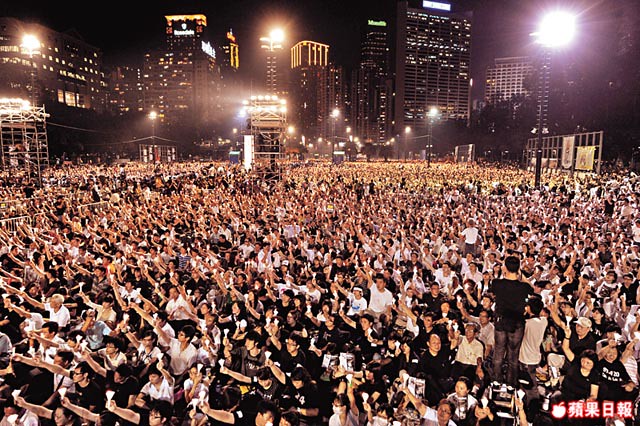
A Hong Kong demonstration back in quieter days.

Something is happening in Hong Kong which may be more important than we yet realize. For the last week, there have been massive street protests demanding democracy.

Let's be frank. It is not really possible for the Chinese government to grant Hong Kong full democracy, any more than it would have been for the British in their day. To grant a colony full democracy is to grant it independence. The mother regime, in this case not itself a democracy, must retain some say, or it simply loses Hong Kong. Yet the protestors say this is unacceptable.

So what is going to happen? Every day the Hong Kong protests continue, there is a risk that they will spill over into mainland China. We saw how quickly social media can make this kind of thing happen, in the recent “Arab Spring.” Then things could get quickly beyond the Chinese government's ability to control.

It looks as if they have no choice but to crack down hard on the Hong Kong demonstrations if they continue. But if they do, it would make Tiananmen Square look trivial by comparison: this would be in full view of the world, and it would change the nature of Hong Kong suddenly and dramatically.

One way or another, I will not be surprised if all hell breaks loose.