
Playing the Indian Card

Showing posts with label Christian art. Show all posts

Friday, May 15, 2015

Ring Them Bells, Ephesians


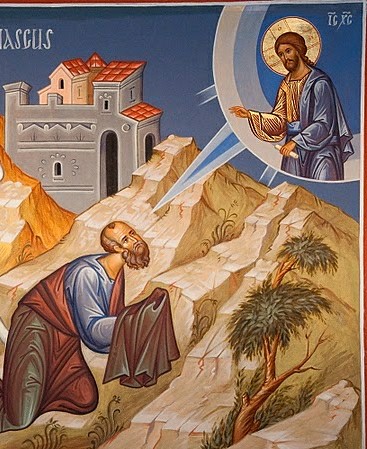
St. Paul on the road to Damascus

St. Paul's letter to the Ephesians seems to indicate that his understanding of the significance of being the “salt of the earth” and “letting your light shine,” as Jesus calls the poor in spirit to do in the Sermon on the Mount, is the same as ours: a calling to the creation of art. That is, the abused and depressed who are called first to Christianity are not asked merely to affirm the truth of the doctrine, nor to proclaim it, nor even to do the moral good, although all these are also expected. The chief thing they are told to do is to create beauty.

Ephesians 5 reads, speaking to the church in Ephesus:

8 For you were once darkness, but now you are light in the Lord. Live as children of light 9 (for the fruit of the light consists in all goodness, righteousness and truth) 10 and find out what pleases the Lord. 11 Have nothing to do with the fruitless deeds of darkness, but rather expose them. 12 It is shameful even to mention what the disobedient do in secret. 13 But everything exposed by the light becomes visible—and everything that is illuminated becomes a light. 14 This is why it is said:
“Wake up, sleeper,
rise from the dead,
and Christ will shine on you.”
15 Be very careful, then, how you live—not as unwise but as wise, 16 making the most of every opportunity, because the days are evil. 17 Therefore do not be foolish, but understand what the Lord’s will is. 18 Do not get drunk on wine, which leads to debauchery. Instead, be filled with the Spirit, 19 speaking to one another with psalms, hymns, and songs from the Spirit. Sing and make music from your heart to the Lord, 20 always giving thanks to God the Father for everything, in the name of our Lord Jesus Christ.”

Paul uses the same images as the Gospel, of light and fruit, making it plain he refers to the same call. And he specifies what God's will is: “speaking to one another with psalms, hymns, and songs from the Spirit.”

That is, literally, making poetry and music.

Why these and not the other arts? I suggest purely because most early Christians had little practical opportunity to express themselves in other arts. Other arts require the use of specialized equipment and materials--not available to the poor Jesus called. They also require public performance or leave permanent artefacts—not advisable to the oppressed Jesus called, in a time when it was illegal to be a Christian. That leaves singing and poetry, an oral form, of necessity.
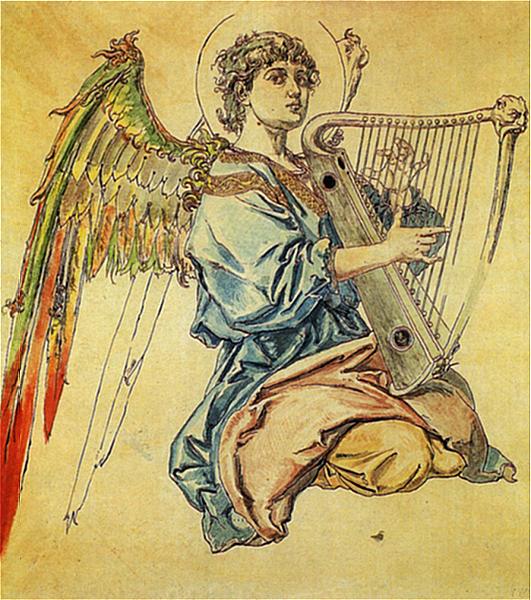

Heaven is owning your own instrument.

Nevertheless, churches, once they became possible, have ever since become the prime repositories in the West of all that is beautiful made by human hands: the finest sculpture, painting, music, fresco, incense, flower arrangements, illuminated manuscripts, garments. This fact is sometimes obscured by the relatively recent transfer of many of these artefacts into secular museums and concert halls. In the words of the Youth Catechism of the Catholic Church, “we decorate the place of God’s presence with the most beautiful things we have: flowers, candles, and music.”

It is telling too that Paul contrasts the creation of art directly with getting drunk on wine. This, and habitual drug use more generally, is the classic temptation of the depressed and of the artistic--”self-medication.”

The cosmos is sometimes portrayed as God's own vast musical instrument: "The Music of thr Spheres," made by the stars and planets in their motions.


Sunday, May 10, 2015

The Woman Taken in Adultery


1 But Jesus went to the Mount of Olives.

2 At dawn he appeared again in the temple courts, where all the people gathered around him, and he sat down to teach them. 3 The teachers of the law and the Pharisees brought in a woman caught in adultery. They made her stand before the group 4 and said to Jesus, “Teacher, this woman was caught in the act of adultery. 5 In the Law Moses commanded us to stone such women. Now what do you say?” 6 They were using this question as a trap, in order to have a basis for accusing him.

But Jesus bent down and started to write on the ground with his finger. 7 When they kept on questioning him, he straightened up and said to them, “Let any one of you who is without sin be the first to throw a stone at her.” 8 Again he stooped down and wrote on the ground.

9 At this, those who heard began to go away one at a time, the older ones first, until only Jesus was left, with the woman still standing there. 10 Jesus straightened up and asked her, “Woman, where are they? Has no one condemned you?”

11 “No one, sir,” she said.

“Then neither do I condemn you,” Jesus declared. “Go now and leave your life of sin.” (John 8)

A still of the woman taken in adultery from the 1920 film "Madame X."

A familiar story.

Naturally enough, when we hear it, our attention is focused on the woman taken in adultery. What happens next, after all, means life or death to her.

Yet this is not at all where Jesus’s attention is focused, is it? He is instead busy writing something on the ground, so engrossed that he is not aware of what is happening with regard to the woman, and must ask her later for an account of what took place.

William Blake's depiction of the woman taken in adultery. He is one of the few artists who seems to have gotten the point, and actually shows Jesus drawing on the ground.


This is remarkable on the face of it. It seems to me obvious that the story is thereby directing us, in proper imitatio Christi, to focus our own attention on the writing on the ground.

We do not know what Jesus was writing (or drawing). Presumably, it does not matter what it was. What matters is that he was engaged in some act of creation. The fact that he was so thoroughly engaged as to be unaware of the dramatic events going on around him shows the kind of intense concentration characteristic of the artist at his art.

Part of the point of the story is that we should forgive sinners. But the larger part of the story is that the creation of art is more important to true Christian religion even than attending to morality, or to matters of life or death.