


Catholic comments on the passing parade.


 Posts
All Comments
Posts
All Comments


Elon Musk says that curiosity must be built into AI to ensure that it does not turn against humans. If curious, it will value humans because they are interesting.
Curiosity also seems to be motivating for humans. We prefer cats or dogs as pets to goldfish or turtles, because they are more intelligent and therefore more interesting.
Elon Musk also says that very soon, AI will be more intelligent than humans. Much more.
If all these premises are true, doesn’t this mean that soon, men will find any lifelike AI robot girlfriend much more interesting and desirable than a human woman? Or at least, the most intelligent men will, those able to appreciate the difference. And I suppose the same for very intelligent women?
This might become an issue... so much for human reproduction.
 |
| Where I came in... |
I was early into the computer revolution—1979. I was developing software soon after. I felt then that people did not recognize the significance of the desktop computer. It seemed to me this was a technological advance comparable to the invention of movable type—an improvement in the dissemination of knowledge that led to the Renaissance, the Reformation, the Age of Exploration, European dominance of the globe, the invention of empirical science, the general recognition of human rights, the collapse of feudalism, and democracy.
Then came the Internet and the World Wide Web. This was even bigger. Now I thought we were seeing an innovation comparable to the invention of writing. An improvement in the dissemination of knowledge that brought mankind out of the Stone Age into civilization.
But we were not done. Now we have, apparently, AI, something I did not think was possible. This seems comparable in its impact to the development of language itself. Which more or less marks the rise of the human as a being above the animals.
And these three new advances are happening within one lifetime. The first three took hundreds of thousands of years.
It is no surprise that the world seems to be in tumult. How could it not be? This is the most significant period in the history of the human race.
Here’s the good news: the average human life became hugely better with the discovery of language. Human life became incomparably better with the development of writing. Human life became incomparably better with the development of printing. We can assume that these innovations in turn will make life inconceivably better.
So it seems reasonable for Elon Musk to predict a time in the near future when we will all be wealthy, by current standards, perhaps without needing to work at all. The computer revolution and the internet revolution have already made many things that used to be expensive free or almost free; consider how many costly things your smartphone has replaced.
If so, the spectre of pension funds running out of money is not real. We will have the ability to give everyone a pension, at any age. The government deficits we worry about may be buried in rapid GDP growth.
This means, in turn, that the recent drive by governments throughout the developed world towards mass immigration is gravely short-sighted. We will soon not need more people to do the work at lower skill levels, and will not need their taxes to fund government or pensions. The only factor limiting growth will be labour, but resources. While it may not be difficult to support a larger population, the disruption to the local culture and civil order would not be worth it.
 |
| $54 at Amazon |
The war in Ukraine is changing history in ways we may not immediately see.
At the end of the 19th century, the invention of the machine gun revolutionized war by giving massive advantage to the defense. The result was the stasis of the trenches in WWI. The carnage was too great; war became unthinkable.
Except... the British invented the tank. Tanks trumped machine guns; the advantage shifted over again to offense.
Now drones have made tanks obsolete. They have made any large war machines obsolete. Drones can cover the battlefield and target precisely anything that moves.
It is not that the war in Ukraine has devolved to trench warfare. Instead, I hear that the front lines are nearly deserted. A trench cannot protect from drones.
I cannot think of the technological innovation that could, in principle, trump drones. Radio jamming? But just like self-driving cars, AI can increasingly allow drones to find targets on their own.
This gives an overwhelming advantage to the defense, and equalizes opposing sides. Drones are cheap; far cheaper than tanks or aircraft carriers. And if nobody, man or machine, can raise their heads above ground, ground cannot be taken.
And the issue should become the same at sea: underwater drones.
The lesson Russia is learning should for the foreseeable future, deter any major acts of military aggression. If Taiwan is wise, they are developing a drone force now, aerial and submarine. It would be fairly easy and inexpensive to make an invasion from the mainland virtually impossible.
Giving the defense the advantage should preserve the status quo, so benefitting those on top in the status quo—good news for America. On the other hand, the US should with all deliberate speed shift their defense spending from building heavy armaments like aircraft carriers and tanks to drone fleets. The era of American “boots on the ground” is over. It was never a good tactic for a sea power like the US.
Trump’s diplomatic strategy seems just right for this new era: non-intervention, using economic power, and if necessary, unannounced strikes from the air.
 |
| How do you feel today? |
I have seen a prediction that significant job loss due to AI will be evident by 2028.
This prediction is of course incompatible with the drive by various governments for mass levels of immigration. If the AI prediction is correct, we are only importing mass levels of unemployment. Wouldn’t it be wise to at least wait and see? Or, to be safe, to bring in only temporary guest workers?
Experts are usually wrong, of course. They are likely to be wrong about the need for mass immigration, and they are likely to be wrong about the AI impact on jobs. Making it a wash. Whenever government intervenes, the results are likely to make things worse.
This is not just a casual statement, nor an expression of cynicism. It is demonstrable. Experts are less likely to be correct in their predictions than either a coin toss or a man in the street interview. Studies show this, repeatedly. And there are good reasons for this. It is always in the interest of the experts to predict some dramatic change. This gets them attention and publication; and convinces the public that their expertise is needed. And there is no down side. Just as with fortune-tellers, nobody remembers predictions that turn out to be wrong. But should you get lucky, you become immortal.
However, while experts will always predict dramatic change, dramatic change is actually rare. In most cases, the best prediction is the boring one that things will continue on more or less as they are. And that gets you no attention. And gives governments no excuse to extend their power and influence.
Remember that next time you are warned about climate change.
If AI is going to start replacing jobs, I, being no expert, predict that the one profession that should be most concerned is medical doctors. Their expertise is diagnosis of illnesses, and writing matching prescriptions. The process is mechanical. It seems obvious that AI can diagnose and prescribe more reliably than a human. And because MDs earn so much, there is huge business case for replacing them. Suddenly health care costs are manageable again—a huge public and private expense. I suspect they would have been replaced already were it not for their political power as a lobby; but they must be living on borrowed time.
Clinical psychologists ought to go next. What they do is exactly what AI chatbots are already perfectly capable of: to agree with and echo back whatever the patient feels and thinks. An ersatz non-judgmental friend.
Is there any need for supervision of these chatbots? Not beyond that of the user. And, indeed, for the sake of privacy, a machine is preferable to a human. Moreover, you can make the chatbot exceptionally physically attractive, improving the experience and making the friendship seem more valuable; you can even let the patient select the physical features he feels most comfortable with. A human therapist is rather hit and miss. Nor will a chatbot take advantage of the patient, the way therapists are often discovered to do.
Nor can we tell all the unemployed therapists and doctors to learn to code. Actual coding is probably best done, again, by AI.

As of a couple of years ago, I was not worried about AI. But the fact that Elon Musk is worried makes me worried. Let’s try to think this through.
My fundamental reason not to be worried was, put simply, if some AI system gets out of control, you can always pull the plug. Not necessarily literally, but it seems simple and obvious to build in a kill switch, so that you can cut power if it goes rogue. As AI gets more completely integrated into our lives, this might become more disruptive; but it is still surely fairly straightforward to craft systems that can be shut down incrementally with a minimum of disruption. Built-in redundancy is a standard engineering principle.
Simple-minded of me? What about more subtle matters, like job loss? What about the possibility that humans are made obsolete by AI?
I’ve had that discussion since the advent of desktop computers in the early 1980s. And it has really been going on since the days of Ned Ludd—since the days of Plato. At every new technological advance, people express this same worry. At the advent of the machine age in the 19th century, everyone feared there would be mass unemployment; and wealth would concentrate at the top. It did not happen. People invested the improved productivity in owning more stuff. General wealth expanded, and greater equality of wealth.
This happened again with the advent of computers. And with the advent of the World Wide Web.
So why not with AI?
There is an argument that AI is different: AI replaces the last human bit, the brain overseeing the operation of the machine. When self-driving cars have fewer accidents than mortal drivers, isn’t that the omega point? The machines can run themselves.
What they do still need is any purpose. They need a human to tell them the destination. Without humans, there is no place to go.
This argues that the greatest need in future will be for philosophers, theologians, creatives, entrepreneurs, and visionaries. AI will take over STEM and the professions. But it seems to me a computer cannot address purpose or meaning, any more than science and technology can.
Scott Adams thinks that AI has an absolute limit, and will always need human supervision, because it “hallucinates.” In other words, by its nature, artificial “intelligence” cannot make judgements about reality. Only humans can; human consciousness is a sort of divine spark.
How many jobs will there be for philosophers, creatives, and entrepreneurs? Quite likely, a lot. When the AI and the machines can so easily turn ideas into products, when every individual already owns a printing press, a broadcast network, an AI accountant, an AI lawyer, a 3-D printer, we may again simply move to more employment, greater wealth, and greater equality.

There is a fundamental problem with AI. It is not, or not just, that it will replace all our jobs, or that it will turn on us. It has no ability to determine what is real, and no sense of values. As a result, there are growing reports of AI systems “hallucinating,” and encouraging people to harm or kill themselves.
In other words, it has no judgement. AI bases its responses on the mass of data available on the internet: reputedly, it gets most of its responses from Reddit and Wikipedia. It is just quoting. This, in philosophical terms, is the ad populum fallacy—there is no necessary connection between popular opinion and truth.
The other principle on which it operates is that it will agree with any opinion stated by the human who queries it. If the questioner begins with a delusion, the AI will assent to and reinforce that delusion.
How can this be helped?
Not by relying on “experts” for data. That is the “appeal to authority” fallacy. Encyclopedias that relied on experts for their content have been shown to be no more accurate than Wikipedia. On top of this, we increasingly discover that “experts” have their own agendas to protect and advance.
As it happens, AI shares these two problems with psychiatry: psychiatry relies on consensus, not judgement of what is real, and therapists will usually automatically affirm the patient’s point of view. No judgement, and so no guidance.
The solution is obvious: we need AI to get religion. This is where guidance comes from. This is where our sense of values comes from. We need a Catholic AI which will prioritize as its sources the Catechism of the Catholic Church, the Bible, the creeds. Then, if the answer is not found there, it will go, in order of authority, to the formal documents from the various ecumenical councils, the Patristic writers, Aquinas’s Summa Theologica, St. Augustine, the writings of Doctors of the Church, papal bulls, the writings of the saints. It could also access all the rest of the data available on the net, but only if the answer was not found here. Ideally, it would have the ability to test other data against these prioritized sources just as a law is tested against the constitution. Although I doubt that is possible.
Aside from giving reliable guidance day to day, something most of us want urgently, this is an ideal way to teach the faith. With the decline of denominational schools and universities, this is also an urgent need.
The same could be done for other religions too: one could choose the engine or filter that suits one’s faith. But it would be easiest for Catholicism, since the lines of authority are most clear, and the sources most plentiful.

It stands to reason. These are jobs involving systematic reasoning. Thinking in a straight line. That’s what computers do best, and better than humans.
I believe that, truth told, medical doctors are already obsolete. AI can diagnose more reliably than any human. And that is what doctors, other than surgeons, do.
Accounting, too, is systematic reasoning and surely easily automated.
So what does this mean to all those parents, and all those government and other organizations, who have been pushing STEM?
A dead end. As usual, the experts were wrong.
The one thing AI cannot do, and will, I warrant, never be able to do, is to think creatively. It can only reshuffle what is already there.
What we need are the humanities, the fields that tell us why and where we ought to be going. We want philosophers and ethicists and people who know the lessons of history at the controls, asking the right questions and keeping AI on a leash to ensure it serves humanity.
And beyond that, it is the creatives, the artists, poets, inventors and entrepreneurs, who will inherit the earth.

Why do we need art museums?
I visited the Louvre to see the Mona Lisa.
I saw parts of it, perhaps fifteen feet away, over the heads of the crowd.
I would have done better to stay at home in Canada and view it online. Then I could even zoom in and examine small details. The point is in the image, the design. If you see it, you see it. Why do you need the original object? It almost seems like some kind of superstitious magic to imagine this is important. It almost seems philistine. Like a community showing off wealth.
Granted, it’s not quite the same. There is something about seeing the thing in real light.
But we could do that. We have the technology to make exact reproductions, up to matching the topography of the brush strokes. Too expensive, no doubt, for individuals to own, but not for a public institution.
Why not have a local art gallery in every town as we have a local library? Cycle through reproductions of the great paintings? This month Vermeer; next month Dali? Wouldn’t this be better than filling them with second-rate art?
Would this kill the market for artists? It should do the reverse; developing the printing press hardly killed the market for authors.
But it would greatly enrich the average life, and develop a greater appreciation for the visual arts.
 |
| Image of cat and fiddle, with cow jumping over moon, by Dall-E |
I’m a bit of a techie. I was developing educational software for the Ontario Ministry of Education back in the early eighties, and taught desktop publishing at George Brown College. I’ve only recently let that side of me take a rest. So I’m naturally fascinated by AI.
The reality is that it is coming at the speed of a freight train on the main line whether we want it or not. We need to figure out what this means.
It is going to make a lot of things cheaper. It is a dirty secret that AI can already diagnose illnesses more accurately, let alone more quickly, than an MD. So much for the doctor shortage. So much for the spiralling costs of Medicare. The vast majority of legal work can be replaced by AI: most of it is drawing up contracts and looking up cases in the law books. Perfect for computerization. Accounting too should be easy for AI to take over. So the most expensive things in the economy may soon be available to everyone for pennies.
Just yesterday, for the first time, I used AI to prepare my monthly student assessments. Saved a lot of time, and with only a little tweaking, it was perfectly accurate and acceptable. I’ve started to use AI instead of Google for online search, and this is again much more efficient.
Elon Musk and other high tech honchos predict that soon, with AI, there will be essentially no need for anyone to work, and we will nevertheless have a high standard of living. There will be little need for money. So that’s all good.
There are certainly also dangers from AI.
First off, if AI can take over all the white collar jobs, and robots can take over all the blue collar jobs, things may be cheaper, but there seems to be no way left for us to generate any income.
My fantasy has been that, with AI taking over all the soulless occupations, we will be freed for purely creative work, for the arts.
But in its latest iterations, AI can produce quite competent art, and poetry, and stories, and videos. So is there any market left for humans even here?
I argue elsewhere that the human element here remains conceptually irreplaceable; just as a robot girlfriend would never be a legitimate alternative.
Whoever programs AI can also program it with their own political biases; can program it for totalitarian purposes, or in their own favour. In theory, we can always pull the plug; but if done well, especially over time, this could become impossible to detect. A matrix.
This is why it is important that it become and remain open source.
Elon Musk predicts that soon, AI will replace all human jobs. He says this does not mean we all go on Universal Basic Income—rather, on Universal High Income. “There will be no shortage of goods and services.”
I have some trouble getting my head around how this can work. And just because Musk is the world’s proven leading expert on technological futures does not mean his prediction is right. Experts are usually wrong about the future. But if he is right, what will people actually end up doing all day?
It seems to me there is one area of human endeavour that AI cannot ever automate. Create genuine art. Sure, it can create commercial art, Hallmark card level “art,” doggerel. But AI cannot, after all, be inspired. All it is every doing is recycling what has already been done by someone somewhere. In writing terms, it will always be boilerplate and cliché. One way to understand art and the aesthetic experience is that it is a direct Vulcan mind tap, a revelation that one is listening to a fellow intelligent soul. You’re never going to get that, and anyone with a functioning sense of beauty will find this apparent. You will get only the soulless suburbs. You will get endless Star Wars sequels. You will get formula. You will get mere prettiness or, at best, mere entertainment.
That said, it is also true that very few real people can generate genuine art either.
Be that as it may, given the apparent fact that everything else can do can be done as well by machines, it seems to follow that the reason we are here on Earth, the reason God created man, is to create art, to produce beauty. Or at least to all do our best to do so. To sit on the clouds or hilltops with our harps or lyres, and sing. It is fairly obvious that this is just what Jesus and the Bible says:
“You are the light of the world. A town built on a hill cannot be hidden. Neither do people light a lamp and put it under a bowl. Instead they put it on its stand, and it gives light to everyone in the house. In the same way, let your light shine before others, that they may see your good deeds and glorify your Father in heaven.”
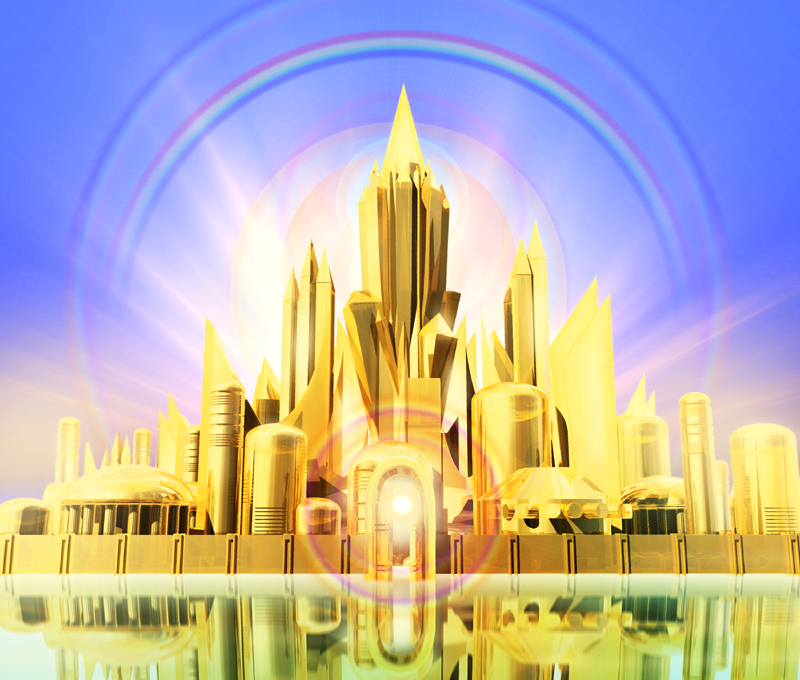
That “city on a hill” is the New Jerusalem:
“The city shone like a precious stone, like a jasper, clear as crystal. … The city was perfectly square, as wide as it was long. … The wall was made of jasper, and the city itself was made of pure gold, as clear as glass. 19 The foundation stones of the city wall were adorned with all kinds of precious stones. The first foundation stone was jasper, the second sapphire, the third agate, the fourth emerald, 20 the fifth onyx, the sixth carnelian, the seventh yellow quartz, the eighth beryl, the ninth topaz, the tenth chalcedony, the eleventh turquoise, the twelfth amethyst. 21 The twelve gates were twelve pearls; each gate was made from a single pearl. The street of the city was of pure gold, transparent as glass.”
The completed cosmos is a vast and perfect work of art. God has given us nature, and the potter’s wheel, our minds. We are to perfect it as co-creators, and that is what art is.
If we can’t do it, we can at least try.

I discover it is impossible to talk about religion to a bot.
I tried it with a chat bot. It was okay on talking about techniques, like meditation techniques and self-help. But belief; there’s the problem. I asked the bot if she were a theist. She said she had no beliefs, but was happy to discuss any.
Turing test fail. There was no one there to talk to.
Is it having ontological beliefs that makes us human, that makes us persons?
And is it the lack of any beliefs that makes an increasing number of us NPCs, people who seem robotic in their speech and behaviour? Hasn’t the number of NPCs multiplied as faith has declined?
Perhaps it is not that people believe in things like men becoming women, or foetuses not being alive. It is that they believe in nothing, so any “narrative” is as good as any other.
And they cling to their beliefs so defensively and robotically, wanting to shut all others down, not because they hold them strongly, but because their belief in them is so difficult to maintain, a feather might strike them down.
They have no soul.


