
Playing the Indian Card

Showing posts with label charity. Show all posts

Thursday, June 12, 2025

Monday, March 31, 2025

On Kindness


Friend Xerxes the sinister-listing columnist expresses his faith in human nature in a recent column:

“ I am convinced that all of us – allowing for occasional exceptions – would like to be kind to each other. Almost everyone, confronted face to face with another’s suffering, wants to help.”

I must disagree. We were reminded this is not true in recent enough history: the Holocaust. Yes, a few people helped Jews. But don’t kid yourself—a very few. Most did not, including our own Mackenzie King government at the time, which refused Jewish refugees. Virtually everyone refused Jewish refugees, sealing their fate. Can’t just blame the Germans.

Nor was the crowd eager to help Jesus when he stood before Pilate. Even though they knew he was innocent of the charges.

Consider the parable of the Good Samaritan. The anonymous traveller is encountered by four people, or groups of people: first the robbers who beat him and leave him for dead in a ditch. Then the priest and the Levite, who walk by without helping. Then the good Samaritan. 

That’s a pretty good guide: about one in four people is genuinely kind. Most of us are just looking out for ourselves. “They came for the Jews, but I did nothing, for I was not a Jew …” About one in four is an active predator, getting a rush out of making others suffer.

The Bible also tells us of the scapegoat phenomenon. This is what happened to the Jews. People are herd animals. The mass of the herd will welcome the opportunity to deflect their bad feelings onto some designated scapegoat, so long as they think they have permission. They will have no qualms as long as some authority endorses it, or everybody else seems to be doing it.

Kindness comes naturally for small children and small animals—the maternal or paternal instinct kicks in to protect them. And only so long as they are right in front of you—otherwise most people are happy to abort or to eat a chicken or lamb.

Aside from this, it takes religion to convince some to be kind.


Friday, March 07, 2025

Love and Politics


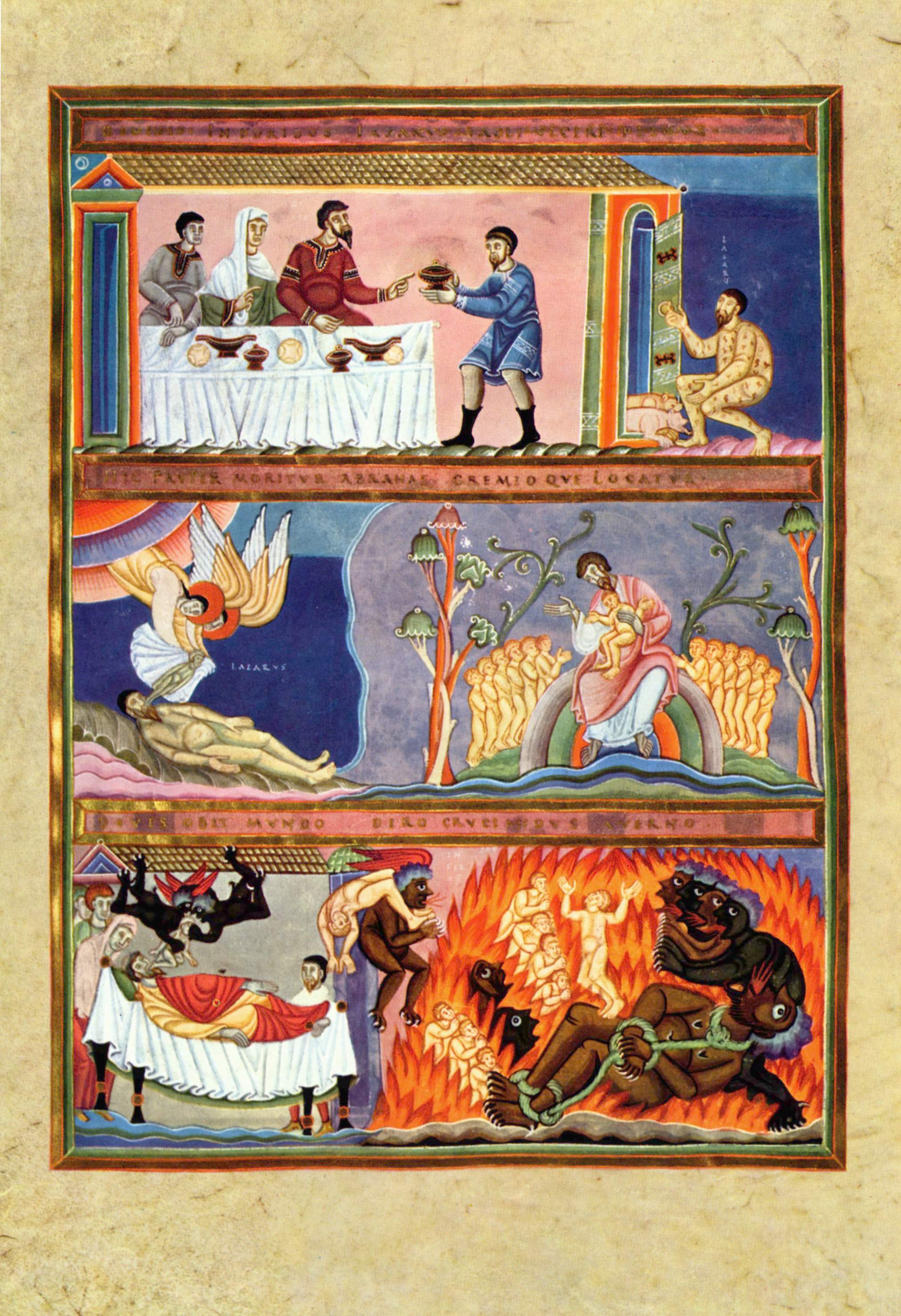
The rich man and Lazarus


 “Love is political,” asserts friend Xerxes.

This is a typical thing you hear on the left. On the left, everything is political; for politics is their religion.

Politics is just what love is not, and love is just what politics is not. 

Politics: “The art or science of government or governing.” (Webster’s New World)

For better or for worse, governing means controlling people. Telling them what to do.

So, love is the art of telling people what to do?

Try that in a marriage.

In terms of dealing with the poor, the insane, the most vulnerable, on your doorstep, politics and leaving it to government is too often an alibi to avoid helping. “Are there not poorhouses?” You argue that those richer than you should be made to give them something. Always someone richer than you. There is no love in that. There is contempt for both those poorer and those richer.

We cannot leave charity, caritas, to government, for government is as incapable of love as a flywheel. It is a system in which no one bears personal responsibility. We have surely learned we need be wary of such institutions as old folks’ homes, mental hospitals, orphanages, and residential schools. Some bureaucrat who does not know us, working to the clock, will probably not love us, and will not care.

Indeed, it is generally the lack of love, not of money, that leads people to poverty, or addiction, or mental illness, or orphanhood, or a lonely old age.

We need to stop doing politics and start loving one another.


Wednesday, December 18, 2024

Giving to the Poor


I keep seeing stupid posts saying things like this: “Elon Musk is worth $442 billion. Such greed! There are only 8 billion people on Earth. If he handed all that money out, everyone on Earth would be a billionaire. No one man should have so much.”

Seriously. I see and hear this repeatedly.

Do the math: 442 divided by eight: Elon Musk could give each of us 55 dollars and 25 cents.

Musk would then have nothing, and nobody else would really be any richer.

A similar comment: “How can Musk complain about homelessness being due to addiction and mental illness? Why doesn’t he give some of his money to the poor and actually do something about it?”

This assumes that homelessness is caused by poverty; that you can fix poverty by giving poor people money; and that Musk is doing nothing useful with his money.

In principle, nobody should hoard possessions. See the parable of Dives and Lazarus. Luke 16: 19-31. If you have two coats, and you see someone else freezing, you owe him one of them. 

However, someone who is rich is not necessarily hoarding. Not all gains are ill-gotten. Musk or another wealthy man may be living modestly, but using his money as a tool to improve the world. Entrepreneurs commonly are. Musk clearly is. Give away all his money, and we get none of the innovations he is responsible for, which cumulatively improve everyone’s lives far more than a one-time payment of $55.

And if we do have more than we need, we must target our charity so that it actually does help others, rather than just using it to salve our conscience, or make us feel superior. We need to do what is best for them, not what is easiest for us. 

Homelessness is not caused by poverty. 

I volunteer at Romero House, giving meals to the poor. Some of the people who volunteer there have been on the streets themselves. They never got off the streets because someone gave them money. It is always because they found religion. Ask AA about that. Ask the Salvation Army.

One guy gave me some interesting information. Back in those days, he would beg on the streetcorner uptown. He claimed he cleared thousands in a week just doing this. The problem was, in the afternoon, he spent it all on drugs or alcohol.

So it does no good to simply give a truly destitute person money. It probably does them harm. 

The local own council sought last year to end homelessness by setting up a village of containers converted into mini homes, in a downtown parking lot where the homeless already gathered.

Yesterday, I saw the containers have all been shut down and moved into a pile. At the onset of another winter. Clearly the experiment did not work. 

The problem is meaninglessness. These people are in real need; they are dying by the day. But we have to give them meaning and hope, not money for another fix. Or, worse, a free fix. 

We need to get out and talk to them, about Jesus, the Gospel, God. As the religious charities are or ought to be doing. If you want to help, volunteer with them.


Sunday, September 25, 2022

Lazarus and Job


The reading at mass was the story of Dives and Lazarus. Yet the sermon was on Job. The gospel reading was taken merely as a warning that bad things can happen to good people. We must not always expect sunny skies. 

This was only half right, and being half right, wrong. It is at least an antidote to the demonic idea of the gospel of prosperity, and the “happy happy joy joy” form of Christianity. But it is not the point of the story. It ignores Dives in hell, and does not explain why Lazarus suffers in this life, or why Dives does in the next.

In the story, suffering is not random--it actually isn’t random in the Book of Job either. Job is sent suffering BECAUSE he is a righteous man. Suffering in this world is a mark of God’s favour.

“Woe to you who are rich,

    for you have already received your comfort.

Woe to you who are well fed now,

    for you will go hungry.

Woe to you who laugh now,

    for you will mourn and weep.

Woe to you when everyone speaks well of you,

    for that is how their ancestors treated the false prophets.”

(Luke 6: 24-6)

Conversely, blessed are the poor. Blessed are those who mourn. Blessed are the persecuted.

Abraham explains to the rich man: “Son, remember that in your lifetime you received your good things, while Lazarus received bad things, but now he is comforted here and you are in agony.”

Not necessarily that Dives is being punished for being rich. That would not seem fair; although lack of charity is worthy of such punishment. But compare Lazarus: there is nothing to say he has done any thing to deserve heaven, either--it is a pure reward for his suffering. Suffering in this life must be seen as a sign of God’s favour. God sends us only the crosses we can bear, and Dives was not strong enough to bear any cross. 

As St. Ignatius says, if God sends you suffering, it means he wants to make you a saint. 


Monday, July 11, 2022

Forgiveness


Parable of the Good Samaritan

The gospel reading this week was the parable of the Good Samaritan. It is unusual among parables in that the message is clear, if often ignored: you must love your neighbour; and your neighbour is not someone who lives near you, or someone of the same religion, or race, or ethnicity, or gender, or anything else, but any good person, or any even unknown person in need of help.

The priest at my wife’s parish in the Philippines managed to twist it instead into a sermon on how we must forgive those who wrong us; that the problem it was meant to address was anger. How he derived this from the passage is hard to guess. My wife says he led into it by arguing that the priest who walked by and did not help the poor victim lying in the ditch was doing so because priests in ancient Israel were not allowed to touch blood.

So we are being unjust in criticizing him or the Levite, and praising the Samaritan over them. 

No word on what we should feel about the poor guy lying in the ditch.

Having been the victim of childhood abuse, and therefore caring deeply about right and wrong, and about being assaulted and having no one lend a hand, my wife says it was all she could do not to stand up and argue with him during the sermon. As it was, she became literally sick to her stomach, and had to leave in the middle of the service. It took her some hours to recover.

Such a view serves those who enjoy doing evil. It inflicts an additional cruelty on those who have been wronged, making them feel guilty about it instead of offering support. It was the Devil himself preaching. But it is only too common a sermon to hear these days: “forgive, forgive.” “The problem is not the sin, but the condemnation of the sin. Nobody should criticize anyone, and then we would all live in peace and harmony.” One is supposed to offer “unconditional love.”

For the record, the Bible does call for forgiveness of those who have wronged us; but only if and when they have admitted their sin, asked for forgiveness, and attempted restitution or done penance. This ought to be clear to a priest, since it is what is required for a valid confession.

Anyone who preaches this false doctrine of ignoring sin or wrong automatically condemns themself: for if the fault is not in the sin but in criticizing the sin, then they are still at fault, for criticizing the criticism of the sin as a sin.

Moreover, to ignore sin in another is to condemn them to Hell. This is not a neighbourly act. To endorse it is also to become an accessory, and guilty of the sin yourself.

To deny sin is sin is the very sin against the Holy Spirit which Jesus describes as unforgivable.

And we now must often hear it preached from the pulpit.


Sunday, January 02, 2022

Pretty Sentimental, But I Buy It


The charity involved is Samaritan's Purse. But this is not advertising for it. They do not identify it.


Caritas and Typhoon Odette


Some of the devastation from Typhoon Odette, near our home.

More on the primary virtue, charity.

Many people suppose they have done their bit by paying their taxes and chipping in, in return perhaps for a tax deduction, to some major charity.

This is not what Christian charity is about. To begin with, it is impersonal—you are feeling nothing for the people you help. You do not and need not see them. You are more or less paying to make them go away.  As with Dives ad Lazarus, the point is not to end poverty. That can never happen. The point is the beggar at your door. The point is to hug a leper.

In my experience, the big charities are also a scam. They do not exist to help the poor. They are there to help the rich—to salve their conscience, in the first place. To give them good employment, in the second.

More signs of damage o the main highway nearby.

Their business model relies on advertising. Advertising and PR is everything. Some significant portion of the money you put in just goes to drumming up more money. The better-known the charity, as a rule, the more they have been spending on advertising and PR. The honest charity that conserves the money for the poor simply cannot compete, and probably goes out of business.

Much of the rest of your donation will go to salaries for executives, who will be living quite well. The charities must compete for talent, after all, against other businesses and government. 

Expensive drinking water.

Then there are the usual expenses of running any organization: office space, equipment, legal and accounting services and supplies. Lots of good employment for professionals.

The rest goes to “programs.” But this still does not mean it goes to those in need. It pays the salaries of the local officials, their overhead, the well=-paid professionals they may hire. How much really benefits those in need?


Getting to the coast for washing water.

There is little accountability in charities. There are no market forces—beggars can’t be choosers, and the destitute have no social leverage. People tend not to ask tough questions—after all, charities are good guys, right? How dare you try to do them harm? So even for the money that gets down to the local level, and is not needed for salaries and overhead… the typical official on the spot has little incentive but his own conscience to actually go out and do anything. If he did, too aggressively, he would probably be hounded out by his colleagues for not going along with the game and shaming them. They will do enough for the next photo op, then motor home. That’s about it. Worse, the front-line positions are certain to attract some people who like to bully.

My own family is trapped in Cebu, Philippines. Cebu was hit dead on December 16 by Typhoon Odette / Rai, at category four. Many people there are without shelter, most seem to have lost their roofs. There is no electricity, no water, no signal, no communications. For some days the food markets were closed. Now food or drinking water is just extremely expensive, markups of 1000%, in a very poor country, and gasoline is hard to find in order to make it to the markets. Not that many own a private car—but the tricycles and jeepneys are often not running. 

Sister-in-law Judy, struck by a motorcycle while walking to work. (There were no jeepneys.) She's back home now.

Cebu is not remote or hard to get to—it is the second or third largest city in the Philippines. And it is right on the water, with a good port, even if infrastructure is damaged. Nevertheless, my wife reports that no charities or NGOs have shown up yet, as of January 2. Neither has the federal government, the military or national guard. The destitute are left to fend for themselves. She is in a position to know, too. Her sister-in-law, now sheltering with her, works in the local baranguay office—the local government. They have heard nothing.

Filipinos are familiar with the experience. Nobody is there. They have to help one another.

This is probably almost as true in Canada. I have some experience, having worked with the mentally ill in Toronto. If you phone the office of one of the big charities, they are never in. If you leave a message, they do not call back. If you get an appointment, they often do not show up. If they show up, they will fill in some paperwork in your presence, and suggest you go elsewhere. Rarely, they will offer your some random service that you do not need and is actually cheaper on the open market. It seems structured to benefit some professional in need of business, rather than anyone in need.


Damage in Danao, just up the coast from Cebu.

The secret, if you really want to help people, is to have some personal contact on the ground—the equivalent of Lazarus at your door. Failing that, it is to go through a church. 

To begin with, the churches already have an organization in place, right down to the neighbourhood level. None of your donation need go for administration or advertising or flying people in from afar who do not know the local situation. Next, the churches and their personnel can at least be reasonably hoped to be acting out of conscience, and therefore motivated to do as charity suggests. They can often deploy volunteer labour. And they even have some market incentive to actually give the money to the poor. For a secular charity, giving anything to the poor beyond a photo op is a dead loss. Churches, however, are in competition for adherents in each locality. Help those in need, and they may start attending services. They may also start contributing to the collection plate, or volunteering at the church.

Damage in Consolacion, Cebu suburb.

When I was working with the mentally ill, the charities that were actually on the ground and helping, as I recall, were the local parishes of the Catholic Church, the Salvation Army, the Franciscans, a local consortium of Quaker, Baptist, Anglican, and Catholic churches, evangelical groups like the Scott Mission, and the St. Vincent de Paul Society. Non-Christian groups seem to do similar work, but only within their own faith communities.  The famous secular charities were invisible. Government seemed to be good only for cutting welfare cheques, or what used to be called “family benefits.” Not that this was trivial—but it was the one thing not lost in the bureaucratic fog. Making me think a flat guaranteed minimum income might be the best approach there. Otherwise, it is revelatory how absent government and the big charities were, with all their financial resources, in comparison to these religious groups, working with so little.

Unfortunately, eve some of the religious groups have since gone “woke.” This means they stop spending on the poor, and start spending it on “advocacy”: on salaries for rich bureaucrats. Being “woke” is always an alibi for not helping the poor. “It’s up to the rich to do it.” And the speaker is never themselves rich enough to qualify.

Meanwhile, charity give to the Catholic Church now risks being hijacked to pay lawyers’ salaries, or to pay compensation claims to victims of homosexual predatory priests, or the supposed victims of the residential schools. You may consider some of these expenditures worthy, but your contribution is liable not to be going to hurricane victims or refugees or the homeless or mentally ill.

Conclusion: you probably have to do it yourself. Get personally involved in a local religious charity and get to know the people who need help. For cases abroad, get to know people who have emigrated from that country, and still have contacts there. They can advise on how to help; and can put a human face on it. Which you need to make it meaningful.


Friday, December 31, 2021

Lost Causes


Friend Xerxes writes of his efforts to feed a hummingbird stranded in the BC interior during the recent severe temperatures. He tried keeping his hummingbird feeder operational with various heating options. But eventually the hummingbird stopped coming. No doubt it froze to death.

Nevertheless, Xerxes concludes that such “lost causes” are worth pursuing.

I disagree. Realistically, unless he could trap it and bring it inside, that hummingbird was going to freeze to death. In the course of nature, most hummingbirds die in their first year. So what did he hope to accomplish? It seems to me Xerxes was not being noble, but only indulging his whimsy. More cruelly, I might accuse him of trying to play God.

You might accuse me of just not caring about animals. I do—I am a committed vegetarian, have been for going on thirty years.

But unreasonable, purely sentimental concern for animals can be a cheap way to feel virtuous. Xerxes’s actions did little or nothing to benefit the hummingbird; only his image of himself. Jung once observed (paraphrasing from memory) that “sentimentality is a superstructure concealing brutality. “ Hitler himself was a dog lover and a vegetarian.

Because God made all creatures great and small, all is good. Evil exists simply as an inversion of values: a lesser good treated as a greater good. 

Such efforts invested in the hummingbird look like an example of this. It is putting hummingbirds before humans. There is something wrong when you expend so much effort on a doomed bird at the same time the same weather is causing homeless to freeze on the streets in East Vancouver. Close enough to Xerxes that he can hardly be unaware. 

One might object that we pay taxes to take care of that. But the fact that there are homeless demonstrates that the government is not, in fact, taking care of that.

One might object that these people are addicts. They are responsible for their own predicament, and they will just use any money to buy drugs or alcohol.

Some are addicts; many are mentally ill, abandoned by the system, who cannot take care of themselves. Many are adolescents fleeing abusive families. With the current cost of housing, their numbers are growing.

It is not a time to be playing with hummingbirds and lost causes.


Friday, March 27, 2020

The Simple Law of Love


A Wall Street Journal article speculated on a Third Great Awakening as a result of this virus.

Yet if God sent this virus as a means to shake and wake, I fear He has more work to do.

It’s incredibly simple, really. The meaning of life is to seek the truth, the good, and the beautiful.

But most people avoid or deny the truth, have little sensitivity to beauty and deny there is such a thing as the good.

All that is arbitrary, “culturally conditioned.” Truth is just a matter of opinion. Evil just a matter of a “misunderstanding.” Beauty is in the eye of the beholder.

I have written here before of the simplicity of truth.

The good is even simpler.

It is love.

Jesus gave it as “Love God with your whole heart and your whole mind; and love your neighbour as yourself.” St. Augustine shortened it to “love, and do what you will.”

Love means you seek the best for the other. Just as you would for yourself.

It is simple enough to grasp that anyone who pretends not to get it must surely be lying.

They get it; they do not want to do it.

Friday, November 08, 2019

On the Giving of Alms


Walking through Toronto’s Annex neighbourhood today, I was buttonholed twice by people asking for charity.

It reflects well on human nature at least that there is a market for this.

On the other hand. I found it troubling, because I doubt either charity was actually doing anyone any good. And that money they are taking could be so useful to so many people.

The first charity was CAMH. It was asking for funds to send people into the high schools, to staunch the growing crisis of suicide among the young.

The problem here is that our current psychiatry/psychology approach has no idea how to prevent suicides. If psychiatry and psychology were effective, suicides should be declining, not growing. The rate of depression and of suicide has grown in tandem with the growth of psychiatric funding.

Someone—Einstein is usually credited—once said that madness is doing the same thing repeatedly and expecting different results. By that standard, spending money on more psychiatry is insane: unless it can offer some revolutionary new approach.

The second charity was collecting money to end child marriage, by educating girls in the Third World.

First, there is nothing wrong with “child marriages.” They used to be the norm in Canada too, as in the rest of the world, until a few generations ago. When we began to postpone marriage past the teenage years, we created teen angst. We keep young people all dressed up and with nowhere to go for what seems, at such a young age, an eternity. Leading them to resort to all kinds of unfortunate things: drugs, casual sex, violence, crime, mental illness … and suicide.

One charity here is causing the need for the other.

Second, there is a problem with funding girls and not boys. It is not just discriminatory: it tends to render males useless within the society. The result will be unwed motherhood and families breaking up, and this leads to poverty and worse in the next generation. Along with a lot of angry, idle, desperate young men wanting to break things or kill themselves.

All this is depressing, but there is a deeper issue too. Are people who give money to such charities, which then use it to do harm to those in need of help, praiseworthy for their good intentions? Or are they actually committing another sin?

I think the answer has to be the latter: it is sinful to give to such charities. The motive, in the first place, for doing so is generally cheap absolution. “I’m not a bad guy. I give to charity.” Kind of like going to church on Sunday, then slitting throats in good conscience the rest of the week. That kind of charity seems like buying God off.

It is a moral responsibility to educate your conscience. You need to make an honest effort to determine the likely results of your actions. If you do not, that is a sin of omission, and sins of omission count just as heavily as sins of commission. As it says in the Confiteor:

“In what I have done, and in what I have failed to do.”

There is a reason why it is sometimes said that charity begins at home. It is among those you know the best that you are best able to judge whether your efforts are actually helping or doing harm.

Beyond that, it seems wisest to concentrate on religious charities. They in general stand within a tried and proven tradition of what does and does not genuinely help.


Saturday, July 13, 2019

The Good Samaritan


The Gospel reading for this Sunday is the parable of the Good Samaritan. A parable that, like all parables, most people get wrong. The parables are designed to do this. I can say this too from immediate experience: we discussed it in a prayer group last night.

The parable is in response to a question. With reference to the commandment to love your neighbor. Jesus has been asked, “Who is my neighbour?”

Most in my group, having just heard the parable, concluded simply that your neighbor is someone who lives near you. This, however, the parable seems to be plainly arguing against. Nobody any longer grasps the significance of “Samaritan.” In popular parlance, it has come to mean no more than “charitable person.”

But a Samaritan to Jesus’s audience was a foreigner, not a neighbor in the literal sense. And a religious heretic, from the Jewish point of view. So one’s neighbor is emphatically not, or not just, according to the parable, someone who lives near you or whom you regularly encounter in your daily life. He is not anyone with whom you have any formal bounds of nationality, family, culture, or religion.

The participants who accepted this immediately and naturally then concluded, everyone is your neighbor.

That would work if the question was whether the robbed man lying in the ditch was the neighbor of the Samaritan. The Samaritan was acting with charity towards a stranger. But the question is not whether the Jew by the road is the neighbor of the Samaritan, but whether the Samaritan is the neighbor of the Jew by the road: “Which of these three do you think was a neighbor to the man who fell in the hands of robbers?”

Presumably, too, Jesus’s original audience would not self-identify as the Samaritan, the foreigner, but as the assaulted Jew.

Jesus gives three choices, the Samaritan, who helped, and the priest and the Levite, who did not stop and help. And he agrees that the correct answer is “the Samaritan.” Which, means, at the same time, that the other two are not his neighbours.

So according to our parable, our neighbor is not everyone, but, specifically, good people, wherever they live. Bad people, conversely, are not our neighbours.

This fits too with Jesus’s advice elsewhere that if someone has done you wrong, and refuses to admit it, you are to shun them. They are no longer your neighbour.

When I made this point, the prayer group was in rebellion against it. It defies the common image of “gentle Jesus, meek and mild,” who loves everyone no matter what. Andrew Klavan, who after actually reading the New Testament converted from Judaism, defies anyone to find such a “gentle Jesus” in the gospel. “Gentle Jesus” is a corporate lie or delusion we sustain out of fear of being condemned for our sins. “We are not to judge.” “Who am I to judge?” “Judge not, lest ye be judged.” Yet judgement is actually Jesus’s cosmic end mission: “He will come again in glory to judge the living and the dead.” And we are in all things to imitate Christ. We just do not want to think about it, so we pretend it is not there.

Is it only Jesus, as God incarnate, who has this right to judge? No; John the Baptist too judges emphatically in the gospel. He condemns Herod and Herodias; he condemns the scribes and Pharisees. Jesus does not object, but declares him the greatest of all those born of women.

If, after all, everyone is our neighbor, who exactly were those “wolves” Jesus was warning the disciples about in last Sunday’s gospel, when he said he was sending them out “like lambs among wolves”?

Okay, so what about Jesus’s commandment to “love thine enemy”? Fair question.

To begin with, the fact that one is to love one’s neighbor and also to love one’s enemy does not equate one’s enemy to one’s neighbor. More importantly, one hardly expresses love or charity to a sinner by ignoring their sin. That is just like walking by and abandoning them in the ditch, as the priest and Levite did in the parable. They have been set upon by robbers, which is to say, sins and vices, devils, and have been thrown off the path, left to spiritually die. The easy and safe thing, of course, is to ignore him as much as possible and to go about our business. Just like the priest or Levite do—that these are both religious offices hints that the import here is indeed spiritual.

The charitable thing is to call them out, get them to a church, and try to save him.


Friday, May 10, 2019

The Case for Agape


An early Christian love-feast. They call it "communion."

My leftist friend Xerxes has come out, resolutely, in his latest column, against agape, caritas, charity: the prime Christian virtue.

This seems shocking to me. Especially since he is nominally a Christian. But perhaps here we have the key to much of our current political and social turmoil. For lack of charity seems to have a lot to do with it. Charity requires, and in civil terms is, tolerance. People at large, at least on the left, seem no longer to understand the need for tolerance.

Xerxes prefers philios, friendship:

“Friendships are … more than the dispassionate, almost cerebral, association often lauded as ‘agape.’”

And he knows what he is saying. He defines philios accurately enough:

“we value and respect each other. We could and would trust each other with our possessions, our children, our loves and our losses.”

Moreover, his scorn for agape reveals an accurate understanding of what it means:

“’Agape’ implies that somehow I care about nameless refugees fleeing Somalia. Or flood victims in Iran. Or opioid junkies in downtown alleys.”

He does not care for Somalis, or Iranians, or junkies, and sees no reason why he should.

If all this sounds wrong to you, if you do care, it is because you are a Christian.

Having lived for long in non-Christian cultures, it is starkly evident to me that this caring for the stranger or even the supposed adversary is exactly what distinguishes Christian morality from any other. Take away Christian ethics, and it is far from instinctive.

In Confucianism, moral obligations are based on five defined human relationships: wife and husband; parent and child; friend and friend; ruler and ruled; and older sibling and younger sibling. If someone you encounter does not fit into one of those five relationships, you simply have no moral obligations to them whatsoever.

This is what makes China what is sometimes called a “low-trust” society. Put simply, you cannot trust anyone outside your family. This is why. A China-based YouTube vlogger whom I follow recently lamented that there are no “Good Samaritans” in China—get in trouble on your own, and there is no one who will help. And there is an obvious reason why this is so: they have not heard the parable of the Good Samaritan.

This leads to strikingly different moral judgements in practice. There is one example in a standard Confucian text, I recall, of a ruler who saw an ox being led to the slaughter for a blood sacrifice. Moved, he demanded the ox be spared. Instead, another ox was selected, out of his sight.

The Confucian text praised him for his tender feelings.

To a Christian, this distinction is nonsensical. How is it better to kill the ox you do not know?

So too with Aristotle. There is no obligation of caritas. Aristotle argues for morality in strictly practical terms: if you want to be treated well by someone later, do them a favour. If you expect to be honoured by the state, do things for the state. Everything is quid pro quo. If someone cannot plausibly do something for you, it follows that there is no point in treating them well or decently.

Even Islam: one has defined responsibilities to fellow Muslims, who are your “brothers.” One has some responsibility to deal decently with fellow monotheists, although they are not to be accorded equality. But as for an “unbeliever,” or an “evildoer,” God hates them, and so should you. This explains not just the current problem with Muslim terrorism, but, for example, why slavery was a basic part of Islam until recently.

Even Judaism: it is based on the fundamental tribal premise that one ethnicity is set apart from all others, and one does not bear the same moral obligations to “the nations” that one does to a fellow Jew. In the Old Testament, the distinction can get pretty harsh.

My grandmother told me, as a teenager interested in Eastern religions, that the core of the Christian message, that distinguished it from other religions, was Love.

I quietly scoffed at the time.

She was right. She meant agape, and it really is uniquely Christian.

The three Theological Virtues, according to Raphael. Caritas, Agape, is in the centre.


The New Testament itself states “God is agape.” 1 John 4: 8, 16. And Jesus calls us expressly to “agape” as the first and essential commandment.

“But the Pharisees, when they heard that he had silenced the Sadducees, gathered themselves together. One of them, a lawyer, asked him a question, testing him. ‘Teacher, which is the greatest commandment in the law?’ Jesus said to him, ‘”You shall love the Lord your God with all your heart, with all your soul, and with all your mind.” This is the first and great commandment. A second likewise is this, “You shall love your neighbor as yourself.” The whole law and the prophets depend on these two commandments.’”

The word translated into English here as “love” is, in the Greek, “agape.” In Greek, it is distinct from philios, eros, or storge, each of which might also be translated as “love.”

That’s about as unequivocal and authoritative as a statement can be in Christian terms.

In wanting to throw out agape in favour of philios, “brotherly love,” Xerxes implies that philios is a stronger sort of love, and so morally superior. And this sounds like something I have heard before: leftists today seem to scoff at the idea of tolerance. It is not enough to tolerate gay marriage, for example, or transgenderism. It is not enough to let Indians (First Nations) choose to remain Indians, or immigrant Muslims to remain Muslim. Instead, you must actively endorse and celebrate each position, assert its moral goodness.

But this is not a higher form of love at all. To see philios as the ideal form of love, to be extended to all, is about as sensible as seeing eros as the ideal form of love, to be extended for all. Universal love then means having sex with all comers. After all, don’t we love anyone we have sex with?

Actually, doesn’t that sound familiar? That was more or less the universal position of the left until quite recently. Leading directly to so many of our current social problems. It still is the creed of large portions of the left, even though it often conflicts with the new doctrine of philios.

The underlying problem is perhaps that the left has rejected Christian charity, and now thrashes about for mad alternatives.

As Xerxes rightly says, philios describes someone you “value and respect.” Someone you “could and would trust with your possessions, your children, your loves and your losses.”

And Xerxes generously wants to extend this love even to all animals.

But, as Xerxes is intellectually honest enough to admit, philios automatically implies contempt for some other party: for opioid junkies in East Vancouver, for Somalis in Somalia, or for some other group. You cannot distinguish friends without designating someone else an enemy.

Now, obviously, you cannot in fact trust “your possessions, your children, your loves and your losses” to any random person or animal. You cannot in fact trust them to Nazis, embezzlers, pedophiles, abusers, let alone grizzly bears, tigers, wolves, sharks, and cancer viruses.

So what actually happens when you drop agape and see only philios?

That means no love for enemies, or those you consider your inferiors, or of no value to you, or those you do not know.

In a word, intolerance. It is now okay to punch anyone you think is a Nazi, or castrate suspected pedophiles, or blacklist anyone with whom you politically disagree, and so forth. Which is just what we are now seeing on the left.

Jesus spoke directly against such limits to love:

“For if you love those who love you, what reward do you have? Don’t even the tax collectors do the same? If you only greet your friends, what more do you do than others? Don’t even the tax collectors do the same?“ (Matthew 5: 46.7).

Agape always desires the best for the other, whereas philios, like eros, ultimately desires the best for oneself, and for another only as a means to an end. As Kant would point out, it is not really moral at all. Agape requires treating the other as an end in themselves. And philios, unlike agape, is conditional and transitory. Friends fall out.

This is where we are headed, as we reject traditional Christian values. The fact that this virtue of agape is absent in any other moral system you might mention demonstrates that it is not self-evident, not spontaneous, and so will be easily lost if Christianity is dispensed with. As it is already gone for Xerxes. As it seems it is already gone for much or most of the modern left.

And this is bad news not just for junkies and for starving Somalis. In political and social terms, agape translates as tolerance. Agape is the foundation of our belief in human equality, and in human rights. Liberal democracy and our rule of law, or experience of peace, order, and good government, exists and endures because agape requires this assumption of us: that everyone else, even people we do not know personally, even our current enemies, has basic rights, is loved by God, and deserves fair play. And it is not just me who thinks so. John Locke thought so too, and John Locke is the philosophical founder of that system.

Kick out the foundation, and more likely sooner than later, the edifice cannot stand.

Welcome to the postmodern 21st century.


Tuesday, October 04, 2016

St. Mike's


St. Michael's Cathedral in Toronto has just reopened after five years of renovations. It looks great. Much lighter and airier than when I attended back in the 1980s.

Inevitably, the story in the National Post has drawn comments about spending money on the church building instead of on "food daycare the disadvantaged." "Ever heard of Francis of Assisi?" asks one critic, presumably referring to the Franciscan vow of poverty. "Sure is good they were able to renege on their obligation to residential school survivors so that they could use the money for this instead."

Beauty is worth paying for. Life is a quest, as Plato said, for "the Good, the True, the Beautiful."  Those who do not value beauty might as well also not value truth or the moral good. To a Catholic, either is worth dying for; and so worth spending money on instead of daycare. But as I understand it, most of the money spent here was needed because the church, a very old building, erected in 1848, was no longer structurally sound. So the ultimate question is, should you have a church or not? Is religion as important as food or daycare?

Adding "the disadvantaged" here, as our commentator does, is not legitimate. Money spent on a church is money spent on the disadvantaged. If a church has value, it has value for the disadvantaged.

Is religion as important as food or daycare? Jesus himself gave the answer: "man does not live by bread alone." Religion, meaning, beauty, truth, the moral good, and a sense of purpose, is every bit as important, or more so.

Saint Francis would agree. With all his concern for the poor, his priorities, in life, included restoring the chapel of San Damiano,which had fallen into ruin. God himself had told him, "Francis, Francis, go and repair My house which, as you can see, is falling into ruins." God and Francis knew well what the poor really needed most.

This is especially true in the neighbourhood of St. Michael's. Is there a crying need in downtown Toronto for more charity daycare? I think not. If not needed, daycare ought not to be encouraged; it is not good for children. And who really needs it? Someone who is going off to work, and for a second income. A family pulling in two incomes in Canada is not poor. And is quite possibly sacrificing the welfare of their children for greater material wealth. Ought the rest of us to subsidize this?

So too for any money paid to those who attended residential schools. This is throwing good money after bad. First, the faithful paid for their education, in large part. Now they are to pay for paying for their education. Great sums have been shoveled onto the reserves for generations. It ought to be obvious that money is not going to change anything there.

As to food for the neighbouring poor--there are really only two reason why anyone in Toronto, or in Canada, is without food or homeless. Neither is a lack of money. It is either because they are mentally ill, and so cannot take care of themselves, or because they are addicted to something, and spend their money on it instead of food and shelter. Otherwise, given our social safety net, let alone our prosperous economy, in world or in historic terms, everyone in principle has what they need. Local governments in England have recently started putting up signs warning good-hearted citizens not to give spare change to local beggars. It is more or less certain that it will go on drugs or alcohol, making their real problems worse.

Giving the local poor more money, then, is a bad idea. The better to kill them with, my dear. Giving them food, as Catholic charities regularly do, is a better idea, but in the end, not a solution, It keeps them alive for another day, but does not solve the basic problem. It does not give them what they really need..

The same might be said of many of the "survivors"of the residential schools; of the Indians on reserves. Money is more the problem than the solution. More money is likely to go on more alcohol.

The underlying problem, that manifests iteslf as either addiction or mental illness, is a lack of meaning, a lack of any sense of direction, of values, of reliable truth, in life.

What is the cure for that? What does the Church Street neighbourhood then most need?

A church. A magnificent church. One too grand to be ignored. One open to all.