Playing the Indian Card

Showing posts with label politics. Show all posts

Friday, March 07, 2025

Love and Politics


The rich man and Lazarus


 “Love is political,” asserts friend Xerxes.

This is a typical thing you hear on the left. On the left, everything is political; for politics is their religion.

Politics is just what love is not, and love is just what politics is not. 

Politics: “The art or science of government or governing.” (Webster’s New World)

For better or for worse, governing means controlling people. Telling them what to do.

So, love is the art of telling people what to do?

Try that in a marriage.

In terms of dealing with the poor, the insane, the most vulnerable, on your doorstep, politics and leaving it to government is too often an alibi to avoid helping. “Are there not poorhouses?” You argue that those richer than you should be made to give them something. Always someone richer than you. There is no love in that. There is contempt for both those poorer and those richer.

We cannot leave charity, caritas, to government, for government is as incapable of love as a flywheel. It is a system in which no one bears personal responsibility. We have surely learned we need be wary of such institutions as old folks’ homes, mental hospitals, orphanages, and residential schools. Some bureaucrat who does not know us, working to the clock, will probably not love us, and will not care.

Indeed, it is generally the lack of love, not of money, that leads people to poverty, or addiction, or mental illness, or orphanhood, or a lonely old age.

We need to stop doing politics and start loving one another.


Friday, January 13, 2023

Why Politics Still Matters


To be remembered, now and in days to come, wherever the maple leaf is flown.

Politics is downstream from culture; and culture is downstream from religion. This political world is in the hands of the Devil. So should we really care too much about politics? Does it even make a difference?

It does. Not usually. Usually, politics is just about reading the polls and running to the front of the parade. But when there is an exception, it is magnificent, and worth attention even as art. For a current example, Ukraine might not have held out against Russia in the early days of the war had Zelensky not been in charge. Another leader might have taken the offer from America of a quick flight to safety.  Zelensky went before the cameras instead, and said “I need ammunition, not a ride.” That alone is worth a statue in every town square. He has been similarly eloquent since in scaring up material support from the West. 

And the results of his speeches are likely to be profound for the future lives of citizens of Ukraine, of Russia, and quite possibly of China, Taiwan, Iran, and the rest of the world. The right man with the right words at the right time.

Churchill is a similar example. His speeches and his resolve during the Second World War held things together when another leader might have sought terms with Germany after Dunkirk. As Chamberlain did, and the French. Then where would we all be?

From these examples, we see that good politics is actually a form of art: rhetoric. Both Churchill and Zelensky are in fact certifiably artists, quite apart from politics. Churchill won the Nobel Prize for Literature. Zelensky was a popular television comic.

The military apparently knows this. A friend went through the American Air Force Academy’s officer training. He says the main emphasis was on giving a speech.

One can say that it is art, and not politics, that makes a difference. But then one must note that the best politics is itself art. One can miss a Ralph Klein, or a John Diefenbaker, or a Boris Johnson, just for the fun of watching them perform, quite apart from their policies.

Two things are necessary for good politics, rare as it is, and they are the same two things necessary for art: skill at communication, and principle. Or, put another way, something important to say, and the ability to say it well. This is the difference between art and mere craftsmanship. Or between being an artist and being a madman.

Pierre Poilievre excites me on the Canadian scene currently, because he has exceptional rhetorical skill. You can see it especially in his postings to social media. He may not hold to principle; but so far the prognosis looks good. The contrast with Erin O’Toole is dramatic. O’Toole seemed to have no principles, and then did not speak well. He was bad enough to be offensive, to insult one’s intelligence for having taken the time to listen. Andrew Scheer might have had principles, but who can tell? He was inarticulate when asked to express them.

Donald Trump in the US, and Boris Johnson in the UK, are interesting and tragic studies of just falling short. Both have immense rhetorical skills. This gave them great promise. Trump is given too little credit for his artistic talents. He can speak extempore for two hours, and hold an audience enthralled. His short epithets for opponents are, in their way, poetry.

Yet both fail on lacking clear principles, lacking a vision; making them mere craftsmen. Boris was great until Brexit was accomplished, and then floundered. He was all dressed up, with no idea of where to go. Trump was great at expressing the themes of “America First” and “drain the swamp,” yet he seems to have been ineffective at draining it; while his choice of foreign policy advisors seemed inconsistent. This may have been because of internal opposition; but I don’t buy it. The problem was that his true love was the art of making a deal. As part of this deal-making process, he would talk a hard and principled line, then compromise. The initial principle mattered less than getting the deal. Good business, but not good politics; because uninspiring. It leaves the impression of moral chaos.

A similar tragic failure is John Diefenbaker. He was wonderful to listen to, always entertaining, often compelling, often right, but he quickly came to exude the same sense of chaos as Trump and Johnson do. He was a heavy cannon, but a loose one. He managed the Canadian Bill of Rights, and then was not sure what to do.

Adolph Hitler and Benito Mussolini were also artists, and this was probably the source of their success. They knew how to communicate. Hitler’s speechifying was famous. But they were also lousy artists; and not just, like Johnson or Diefenbaker, because they lacked principles; although they did. William L. Shirer, who was there, noted that Hitler would say completely different things with equal conviction depending on his audience. For Mussolini, Fascism was mostly whatever the moment seemed to require. They were also bad at art, in the sense of relying on cliché and cheap thrills. As a visual artist, Hitler’s drawings were always cliched scenes, of the sort you might once have bought in a Woolworth’s painted on felt. Not good enough, famously, to get him into the Vienna Art Academy. Mussolini wrote short stories; but they are dime novel stuff, relying heavily on cheap thrills and lurid descriptions of violence. They were the sort of artists who do often achieve mass appeal with emotional junk: the drawers of paintings of kittens with big eyes and the writers of formula romances for Harlequin.

So too with their political rhetoric: full of sound and fury, signifying nothing.

Justin Trudeau is frighteningly cut from the same cloth: an incompetent wannabe actor. And his wife is, interestingly, a wannabe singer of about the same calibre. The class of wannabe artists is crowded with narcissists. The narcissist will naturally want to think of himself and be thought of as an artistic genius. But he will lack the necessary insight or self-knowledge. Indeed, he will be terrified of insight or self-knowledge.

Anothergreat political artist was Ronald Reagan. Reagan, of course, learned his craft as an actor, and a real, successful actor, not a poseur like Trudeau. Granted, he was a better politician than actor. Acting is harder and a higher-level skill than politics. But his skills helped bloodlessly end the Cold War, and ushered in a new golden age for America, after years of apparent decline.

Margaret Thatcher did about the same, at about the same time, for Britain. Again, it was largely due to attention to rhetorical skills as well as to firm principles. She worked hard at rhetoric, learning to lower her voice, for example, to sound more authoritative. She, or her speechwriters, are responsible for a number of lines that are now immortal, like “The lady’s not for turning.”

Acting ability and experience was the secret of John Paul II’s papacy as well. Pope Benedict, the more learned and the better-grounded man, really John Paul’s mentor, lacked this talent, and so sailed into controversy. Which sadly wore him down. Pope Francis, unfortunately, lacks both Benedict’s vision and John Paul’s acting skills.

Thomas D’Arcy McGee in Canada, and Daniel Patrick Moynihan in the US, are other examples of brilliant politicians. Neither rose to the very top of their profession. Yet this, I think, was because both were more interested in doing good than in personal power. Principled men, they would rather have been right, as they say, than president. This seems to be especially an Irish thing. One thinks also of Grattan O’Leary, Bryce Mackasey, Eugene McCarthy, or of W.B. Yeats’s political career.

Although too little credited, and still too little listened to, D'Arcy McGee invented Canada.

Pierre Trudeau was another brilliant politician, in contrast to his son. He himself once remarked that he saw the job primarily as that of an actor. He was magnificent on the principle of federalism and against separatism, although he lost direction once this matter seemed settled. As it happened, separatism was such a dominant issue during his political career that few in Central Canada noticed how erratic and frivolous he was on other topics. Folks out West did.

The mention of Moynihan, McCarthy and Trudeau, officially on the left, perhaps serves only to throw into relief the fact that most of the politicians I cite as great seem to come from the right side of the political spectrum. Is this bias on my part?

I think not. It is the principle thing. Pretty much by definition, to have enduring principles means to be conservative. To be “on the left” means, broadly, to be calling for change, being subject to whatever winds might blow. Anyone who still held sincerely to the beliefs of the left as they were thirty years ago would now be denounced by the left as an extreme right-winger. Ask Elon Musk, or Joe Rogan, or Jordan Peterson, or Ronald Reagan, or Joseph Ratzinger. So leftists might be rhetorically skillful, but almost by definition lack a consistent vision. “Change” is not a vision. It is a  kaleidoscope.

And if you lack a consistent vision, it is even hard to be rhetorically compelling. It is not just that people are liable to notice you were saying the opposite until recently. If it is really good, fellow leftists will remember it to condemn you for it a few years later.

This is one reason why, to look for any real change, we must look to the right.


Tuesday, November 15, 2022

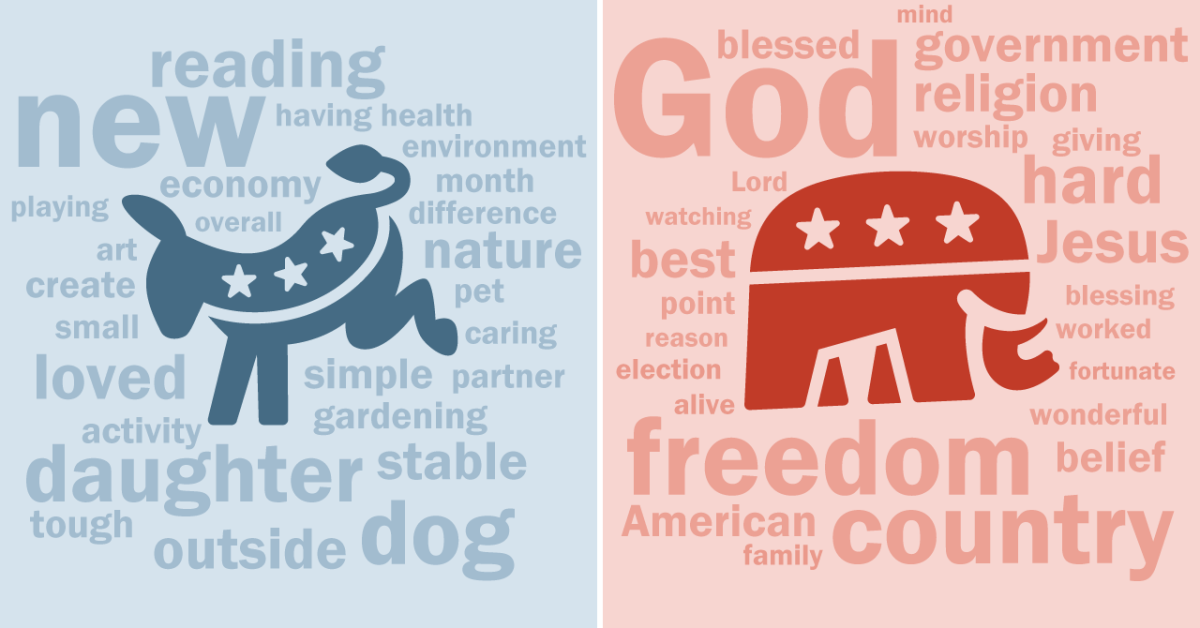
The Distinction between Republicans and Democrats: Two Views


The Political Zoo: Courtesy of Pew Research

Friend Xerxes introduces me to the work of Jonathan Haidt, who defines the innate tendencies of “liberals” and “conservatives.” Haidt found that what he called “liberal” voters were mainly influenced by two social values: “fairness” and “care”. Haidt’s “conservatives” had three core values: authority, purity, and loyalty.

Haidt’s analysis makes some sense, but not if you try to identify his “conservative” and “liberal” with current political parties in either the US or Canada. What Haidt calls “liberal” is really the Marxist-socialist position, and closer to classic conservatism than to classic liberalism. For “conservative,” Haidt is indeed describing the classic conservative position, but the modern Republican party, or the Conservative party in Canada, is actually more classically liberal. 

Pretty confusing, granted. Politics, as George Orwell noted, is largely about falsifying terms to get away with murder. We need to keep the terms straight to prevent this.

The modern Republican party is no respecter of authority. It is in more or less open rebellion against the “elites.” So too with Poilievre ‘s Conservatives in Canada. It is the Democrats, or the Liberals in Canada, who regularly appeal to authority and oppose questioning it. “Follow the science.” Don’t doubt the integrity of the mainstream media. Don’t doubt the integrity of the academics, or the climate scientists, or the teachers and ed schools; of the professions generally.

Purity? Nobody believes in racial purity as a value, but last time anyone did, it was the Democrats. Or, in Canada, the Liberals and Clear Grits. It is also the Democrats who are concerned with ideological purity: with “political correctness.” Political views in the Conservative or Republican parties are much more diverse, and diversity is much better tolerated.

If by “purity” Haidt actually means morality, he is right that morality is a classic conservative value, and it is also a modern Republican and Canadian Conservative value; and not a Democratic or Liberal value. Fair enough. But Christian morality is not “purity.” It is acknowledgement and remorse for sin when committed, not never sinning, and especially not claiming to have never sinned. Innocence ended in the Garden.

Loyalty? The Republican primary voters in 2016 rejected loyalty to their party leaders in nominating Trump. They were supposed to vote for Jeb Bush. In Canada, the Conservatives have ousted two leaders in about four years. Look, too, at the Conservatives in Britain.

By contrast, the Democratic primary voters obediently accepted the backroom deal to hand the nomination to Biden, four years after accepting the backroom deal handing the nomination to Hillary Clinton. The Democratic Party has always been the party of machine politics, party bosses, and client groups who will vote for a yellow dog out of party loyalty. Or are expected to, out of group loyalty, or “you ain’t black.” 

Haidt does not seem to even be aware of classic liberal values, but those are the values of the modern Republicans or Canadian Conservatives: freedom, the rights of the individual, free markets, equality. He misses half the political equation.


Monday, October 11, 2021

Do Facebook's Algorithms Pose a Public Threat?


Friend Xerxes is concerned about people falling into self-confirming information silos on the Internet, because of Facebook’s algorithms. The result, he fears, is that bizarre conspiracy theories are spread widely without ever being contradicted; and violence may result. He speaks of “A rising tide of people in this country [who] apparently believe … that they are called overthrow the established powers-that-be. By any means. Including physical insurrection.”

There does seem to be a general decline in civil discourse. Let’s assume the theory is true. 

Logically, people falling into limited information silos is equally likely on either the left or the right—or, for that matter, in the middle. At first glance, any of these is equally troublesome. 

But if we are talking of the potential for overthrowing the establishment and for violence, the bigger problem is on the left. “The right” is, by and large, conservative, and conservative means wanting to maintain traditions. Accordingly, the right is the one group least likely to attempt any kind of insurrection or radical change of government or how we are governed. They might want to throw the current rascals out, but it would be by established, constitutional means. If our form of government had changed recently, this might not be so—the right might then want to go back to an earlier constitution—but both the US and Canada have been stable for unusually long periods of time. There is not a constituency in the US for a return to the monarchy, or in Canada for a return to direct rule from London. Currently, as Xerxes himself notes, no visible group on the right wants an insurrection to change our system of government.

This is not true of the left. The left is by definition seeking change. Black Lives Matter wants a radical change in a society it calls “systemically racist.” Antifa does too; the advocates of critical race theory do. In my riding, last election, the ballot included candidates from both the Communist and the Marxist-Leninist parties. A bit quaint in 2021, but these leftist groups too, in principle, want to radically change our system of government, by violence if necessary.

So if the issue is social instability, to “overthrow the established powers,” the practical argument is entirely for breaking up silos on the left.

You might object that fascists are a counter-example, a rightist group that advocates overturning the establishment and violent revolution. But fascists are deader than Marley’s ghost. Unlike Communists, they do not appear on any ballots anywhere. And there is nothing actually placing them on the right. Historically, they are a Marxist movement, “right-wing” only in comparison to the Leninists. Others have called them the “radical centre.” Historically, the conservatives were their chief opposition, and they have many more views in common with the contemporary North American left than the contemporary North American right. Arguably, the present government of China is fascist.

The specific conspiracy theories Xerxes cites hearing in his daily rounds sound as though they come from left-wing sources. Something about the Queen, Hilary Clinton and Joe Biden being clones; that sounds like a garbled version of David Icke’s thesis that they and other world leaders are aliens. Icke is New Age, and was the national spokesman for the UK’s Green Party. Xerxes’s barber is against cops and immigrants. Being against cops is a position lately promoted aggressively by the left. Neither left nor right is against immigrants currently. This was historically more a left-wing position, as a supposed threat to labour; the current right wants to stop illegal immigration. Xerxes cited the anti-vaxxers. The anti-vaccine movement began on the left, and was primarily leftist as recently as a year ago. The right is anti-vaccine mandates currently, but only over the last few months. 

At a minimum, you are not going to stop any of these movements by breaking open the right-wing information silo. If they are not exclusively on the left, they are found in more than one silo. 

To be fair, there are conspiracy theories on the right: QAnon, Pizzagate. There are just a lot more on the left, and on the left they are more generally accepted: the idea that rich capitalists control everything, for example, or corporations, or “Big Oil,” or “Big Pharma,” or the “whites,” or the “patriarchy.”

The left is also more inclined to violence. Some PPC local official threw gravel at Justin Trudeau in the recent Canadian election; violence at a low level. Some people trespassed last January 6 in the US Capitol building. Nobody told them to do it, and their actions were immediately condemned on the right. Compare Maxine Waters, elected Democrat, calling on her supporters to “get more active, get more confrontational.” Compare Antifa, calling for physical assaults on “Fascists”—meaning, in reality, anyone they disagree with. Compare Black Lives Matter rioting, looting, burning, and killing last year; and Kamala Harris endorsing their actions, then bailing out those arrested. The PPC official, by contrast, was immediately expelled from his position.

So should we step in and shut down left-wing news outlets? This strikes me as exactly the wrong step. Conspiracy theories thrive in the absence of full information, as the “information silos” thesis itself suggests. Rumours take over. Reducing access to any news source therefore makes conspiracy theories more likely, and plausible. Perhaps the Facebook algorithm should be adjusted. While it is obviously desirable in general to try to predict what the audience wants to see—that is the whole point of a search engine--political slants might be omitted from the equation.

And if you stop and think, at worst, we are in a better situation than before the Internet. All of us were then trapped in the same information silo, without any choice, a silo determined by the fairness doctrine, the need for media corporations to appeal to the largest audience, and the relatively small number of people who work in the mainstream media. A smaller number than we perhaps realize: due to time pressures, social pressures within the profession, intellectual timidity, and a fear of taking risks, most media took their cue on any new story or controversy from a handful of outlets. 

This made it easy to manipulate the news, and popular opinion. Conspiracies were more possible, and conspiracy theories more plausible. 

Whether the algorithms automatically direct us there or not, we now have full access to any information source we choose. We can now, for the first time, hear all sides, not just some arbitrarily selected one or two, and make more informed decisions.

In sum, if civil society is becoming less civil, it is not because of the Internet.


Saturday, June 12, 2021

Laying Out the Cards Face-Up


July 14, 1789

Leftists have traditionally thought of themselves as occupying the moral high ground—they were on the side of the little guy against the established power structures. That is more or less what “left-wing” meant when the term was coined, in reference to the French National Assembly.

I know that well enough. Born on Bastille Day, I always in youth thought of myself as a leftist. Never the Marxist left; but in those days there was a liberal left. I was on the side of human equality and everyone getting a fair shake; I was in principle suspicious of any established power. Toryism was in established power then in Ontario—for an unbroken thirty years. Duplessisism had until recently long been in power in Quebec. 

If it were still true a few decades ago, or possibly true, that the left was for the poor and powerless against the rich and powerful right, it is obviously not true today. As we have increasingly seen, most of the visible rich capitalists are somewhere on the left: Bill Gates, Warren Buffett, Jeff Bezos, Mark Zuckerberg, Jimmy Dorsey. The professions and the bureaucrats who control the levers of power are on the left. The institutions are on the left: the schools, the media, the universities, the “mainline” Protestant churches. The big corporations are on the left.

If all or most of the established power structures are on the left, how is it tenable to claim that leftism is on the side of the little guy against the established power structures? Little guys broke into the US Capitol Building on January 6th, and the powerful left did not take it well. They clearly saw such ordinary folk as the enemy, and an unspeakably dangerous enemy. They roundly condemn “populism.”

Granted that the left favours subsidies and direct payments to the poor; more so than the right. But the very rich can afford such payments. Chump change. They can afford, in effect, to buy themselves a good public image with a little of their excess cash. They are not giving private charity here, but demanding that others carry much of the load. Higher taxes pinch harder on the only moderately well-off, and ensure they gather no excess capital to invest.

And such welfare, as opposed, say, to better education, or fewer regulations on starting a business or hiring people, works to keep the poor permanently poor, teaching dependency and punishing initiative. Preserving and deepening the divide between classes.

Then, passing beyond this issue of who is for the rich or for the poor, the powerful or the powerless, on every other issue the left seems to take a position no moral man could go along with. At some point, this has to outweigh their support for the poor in the mind of any decent person, even if this initial claim were true.

A few decades ago, it was possible to be opposed to abortion and be on the left. But more recently leftist parties have declared pro-life, anti-abortion positions heretical and cause for expulsion from the movement. Their choice. Abortion is as grave a moral and civilizational crisis as the Holocaust, or more so—the death toll is greater. 

Abortion advocates will object that it is not the same, that an unborn foetus is not a human being. That is the same claim the Nazis made to justify killing Jews. We do not conclude that this made the murders acceptable; we conclude this made them worse. Is conception an arbitrary point at which to say human life begins? One must designate such a point; and what other point is less arbitrary than this one? Conception is clearly less arbitrary than birth. It is obvious nonsense to say that a baby is not human one minute before the head emerges.

The next biggest fault of the left is the wholesale attempt, for decades, to end freedom of speech. This is a mark of guilt—because they know they are wrong on abortion. And this illustrates one reason why we need freedom of speech: because words are powerful, and can keep the powerful from doing wrong in secret. But as we are increasingly seeing, suppressing speech also makes democratic government and civil peace impossible. If matters cannot be discussed, matters must be imposed, by whomever holds the power to do so.

Next to that, and prior to that, is sexual libertinage and the uncoupling of coupling from baby-making. This has come to be systematically celebrated on the left, and having children condemned. Wrapped up in this is feminism, the idea of which, from which all else flows, is that nobody should waste time raising children. This is decadence and self-indulgence in its classic form. This is a perfect recipe for civilizational suicide. Besides the cruelty to the next generation, and the callous attitude to sex partners, this has led inevitably to the greater horror of abortion.

You want to argue that sexual libertinage is freedom? That it is a case of expanding human rights? It is not, and only recently have the two become confused. Freedom classically means freedom to do what you think is right, freedom of conscience. Someone who habitually indulges a vice is not free in any sense, but enslaved by it—think of an alcoholic. We should not want the state to intervene, but we certainly ought not to celebrate it.

And this naturally segues us to the attack on religion. Although there used to be a viable religious left, and the mainstream Protestant denominations are increasingly leftist, this has been at the cost of draining any moral codes out of them. Although Islam has so far been given a pass, otherwise, the left has grown openly hostile to any religion that implies a moral code. Intelligent Muslims must know they are on borrowed time; indeed, it was only a decade or so ago that the left was painting Islam as the greatest enemy, accusing it of repressing women, refusing them fashion choices, and mutilating their genitals. They can and inevitably will flip back to this stance just as quickly, once their immediate tactical objectives are achieved. 

The left hates ethical monotheism because it preaches against sexual libertinage and abortion. So the pressing desire to restrict, scapegoat, and discourage religion. This is profoundly harmful to mankind; people need religion, and despair without it. It is also most of the glue that holds society together.

Were all that not enough, the left is increasingly and openly racist. It sees everything in tribal terms: nobody is an individual, everyone exists and thinks only as a member of some “community” or tribe. These tribes are and must remain utterly apart; although they may form coalitions for temporary advantage, there can ultimately be no communion or common cause or even shared reality among them. They are in an eternal and inevitable struggle for power. 

This is the core of fascism and of Nazism. And the left is thundering in a handcart down this old track, once abandoned, even though we know where it leads.

Is there any social evil the left has not yet embraced? If so, they will no doubt find it, and do so.

At this point, if anyone claims they support the left because they want to help the poor, I think we have to assume duplicity. 


Tuesday, April 27, 2021

The Conservative Liberal Budget


Friend Xerxes summarizes the highlights of the new Canadian federal budget as “child care, a green economy, pandemic relief, increases to old age pensions, funding for improving the health of indigenous communities.”

Although introduced by the “Liberal Party,” this is a strikingly conservative set of priorities—conservative in the true sense.

The OED defines “liberalism” thus: “Support for or advocacy of individual rights, civil liberties, and reform tending towards individual freedom, democracy, or social equality; a political and social philosophy based on these principles.”

That is more or less what they call “libertarianism” in the US now. The Koch brothers are liberals. Maxime Bernier is a liberal, or was when he ran for the Conservative leadership.

“Conservatism” or “Toryism” sees this approach as soulless. The state, instead, is like a family. Equality is not the point; the point is everyone having responsibilities to everyone else.

Let’s go down the list of what the Liberal government wants:

Government-funded child care is classically conservative. The government as parent: this is an almost perfect expression of that concept.

A green economy: this is conservation, preservation of what is, conservatism by both definition and etymology.

Pandemic relief: Conservatives, seeing government as a parent, would of course issue relief. I assume, however, that any government would see this as their responsibility in an emergency. And all governments have, worldwide, in this pandemic.

Increases in old age pensions: in Canada or the UK, the old age pension was originally brought in by a Liberal government, but less as a matter of ideology than to co-opt the Marxist left. In world terms, the first old age pension was introduced by Bismarck in Germany, under a conservative regime. It can probably be justified by either ideology: as paternal care for a vulnerable group, or as just reward for labour.

Funding indigenous communities: a classic conservative position. Liberalism calls for social equality. Treating indigenous people differently is an obvious violation of that principle. Conservatism is more inclined to endorse such things; it sees the indigenous people as wards of the state, like children. Liberals would consider this an affront to human dignity.

Perhaps the most important distinction between the two philosophies is that conservatism seeks to preserve the status quo, with those in power preserved in power, while liberalism wants to open things up and, broadly, democratize. 

In this ultimate sense, too, the modern Canadian Liberal Party is conservative. It is the “natural governing party,” which represents and is supported by the big corporations, the government bureaucracy itself, the professions. It sees “populism,” unrestrained democracy, as its enemy.

Each philosophy might have an argument, but the important thing is to keep our terminology consistent. There is a danger is political speech to deceive by falsifying the meaning of terms. The general intent of much political language, Orwell warned, is “to make lies sound truthful and murder respectable, and to give an appearance of solidity to pure wind.”


Saturday, August 22, 2020

I'm a Leftist


Just for interest's sake, I once again recently took the "Political Compass" test online.

While I doubt the validity of some questions, it puts me just about where, on the political spectrum, I would put myself: moderately left-libertarian.

Of course, in the current insane political climate, I would probably be accused of being right-wing and authoritarian. But that is because what is currently called "left" is simply and accurately "insanity."

Your Political Compass

Economic Left/Right: -1.88
Social Libertarian/Authoritarian: -2.67

personalised chart

Friday, December 20, 2019

Politics


Why is politics intruding more and more into our lives? Why is everything now political? Even, say, the pronouns we use?

This too has to do with the decline of morality. Once morality is gone, all that is left is the struggle for power—in other words, politics.

The bad news is, this ends as a war of all against all.

The chilling thought emerges that Nazi Germany might only have been a dress rehearsal. The underlying civilizational currents that threw it up have only gained strength since.


Wednesday, December 18, 2019

Why Poetry Is So Bad


A man who should need no introduction.
We were discussing the other night, I and a prominent local poet, the sad fact that no one is interested in poetry any more.

“Even other writers,” she laments, “never come out for poetry readings.”

I remarked on the dramatic change from my youth, when perhaps a dozen poets were national celebrities, and everyone had read at least one of their poems. Irving Layton, Earle Birney, Margaret Atwood, Al Purdy, Dennis Lee, Milton Acorn, Leonard Cohen, F. R. Scott, P.K. Page, George Bowering, bpNichol ….

And we both immediately agreed on the problem: it is that poets in Canada now write only to impress one another, and not for the general public. It had become, in proper Canadian style, a Family Compact.

It seemed to me the solution was simple: launch our own poetry journal, to bypass all this and get directly to the public. We could have a podcast, a YouTube channel.

No, she explained, she did not have time for that. Too much editing required.

I did not see the problem—just a matter of selecting the poems to feature, right?

Ah, she explained, but we would need to find experienced poets with a strong publication record to evaluate each entry.

I could not make her see the irony of her position. This is exactly what we were trying to get away from.

“But,” a colleague intervened, “who else is qualified to evaluate a poem? Would you let non-doctors evaluate a medical treatment?”

Here, I think, we see the essential problem. Not just with poetry, not just with art in general, but with our current society. The very problem that is getting some folks out in the streets wearing yellow vests, and others voting Johnson or Trump.

It is the forming of little cartels everywhere, seizing control of everything. Generally under the banner of “professionalism.” While it does make some limited sense for doctors or engineers, it does not for most other endeavours. It is a disaster for poets, or any artists, or journalists, or teachers. Can you imagine the rule applied to comedians? Only other comedians get to decide what is funny?

Even for doctors or lawyers, it is a dangerous seizure of power by a self-selected group, with little oversight; and, in effect, a cartel in restraint of trade.

Prior to this, and driving it, is an obsession among the educated with the concept of power. This is why politics has permeated everything: they think life itself is all about grabbing power and money for themselves and their group.

And the obsession with power probably comes, in turn, from a collapse of morality. Take ethics out of the picture, and what is left? Grabbing as much as possible for yourself.

But power and politics is especially a blasphemy against art.


Sunday, June 02, 2019

Politics as Entertainment: The Provisional Oscars


BoJo the clown.

I am hoping Boris Johnson wins the UK Tory leadership. Because politics is entertainment, and he is a skilled entertainer.

I make no apologies for this view. Politics otherwise accomplishes very little. And should probably not attempt to do more, since anything it does is coercive. The best a political leader can do for any electorate is to entertain and inspire, to get them through the mire in better spirits.

Most people, whether fully aware of it or not, also seem to choose political leaders for entertainment or for inspiration value, not really for any other reason. They choose someone they want to see regularly on their TV for the next four years. This was Hillary Clinton’s fatal flaw, and Barack Obama’s strength.

Will Ferguson wrote a humorous history of Canada called Bastards and Boneheads, evaluating each of Canada’s prime ministers. He got it gravely wrong. He ranked first ministers in terms of whether they managed to impose their will—“bastards”—or had others’ wills imposed on them—“boneheads.” Very wrong, I think, in a democracy, totalitarian in tone, and cynical.

I think it far more meaningful to rank the PMs in terms of their entertainment or inspiration value. A far better measure of their real relative success in the job.

Citing only the premiers I remember personally:

Any excuse to run a picture of John Diefenbaker.


John Diefenbaker 

Probably the greatest Canadian political entertainer in my lifetime. Unfortunately, he was perfectly cast for the role of opposition leader, not prime minister. His specialty, honed in the courtroom, was righteous indignation. In power, he was paralyzed by a lack of enemies. He did his best, but it was no longer plausible. A comic who lost his straight man.

Lester Pearson 

If Diefenbaker was shaped by his experience as a defense attorney, Pearson was shaped by his career as a diplomat. His instinct was to stay out of the camera frame. His idea of leadership was to let each minister make of his or her portfolio what they would, while he just tried to keep them on speaking terms. This led to vastly entertaining politics, the emergence of stars in supporting roles like Judy LaMarsh, Walter Gordon, Paul Hellyer, Jack Pickersgill, and Joe Greene, not to mention Pierre Trudeau, John Turner, and Jean Chretien; but it served Pearson’s own career poorly. And led to a period of over-government.

The complete entertainer. And you knew I was going to run this picture.

Pierre Trudeau

Trudeau was well aware of being a performer—he has said as much, in critiquing his early performances. And he did a great job of it; he understood the importance of style. The role he played was a matinee idol, roughly in the 60s tradition of James Bond. He was both inspiring and entertaining.

Joe Clark

Anyone immediately following Trudeau was sure to get bad reviews. Clark was physically and verbally awkward and had no stage presence. “Joe Who?” was not just a comment on the public’s initial lack of familiarity with him. It lingered long after that. It was his inability to play any kind of recognizable part.

John Turner

Turner shared with Clark the misfortune of following Trudeau. Running the cartoon after the main feature never works. Just like Clark, by comparison with the master, he always seemed physically awkward, and as though he could never get into character. He was always too aware of being on stage. He could not say his lines with conviction: “I had no choice.” “I happen to believe you sold us out.”

Brian Mulroney

Mulroney by contrast had it easy. To win, he only had to come across as more interesting than John Turner, who seemed to give the term “empty suit” a bad name. Mulroney’s rhetorical talent was limited, but he had some. He failed, in the end, because he thought he had more than he did. Things he said to inspire instead came across as hollow boasting. He could not make the audience believe.

Jean Chretien

After Trudeau, Chretien is the master. But in a lesser way. Trudeau could both entertain and inspire. Chretien could only entertain. He had a fine and a long run with his nicely rough-hewn “p’tit gars de Shawinigan” persona. It was more than a little corny, but he was great, and lovable, at it.

Paul Martin

To some extent, Martin failed for the same reasons Clark or Turner did: the public had become accustomed to someone more interesting. He was perhaps the best finance minister Canada ever had. But that takes different skills to be PM. He could not convey a character or a conviction. That’s why he got the “Mr. Dithers” label. It was his equivalent of “Joe Who?” 

Just look into those steel-grey eyes. And don't try anything funny.

Stephen Harper

Harper is the anomaly in this thesis. He is conspicuously grey and boring. And yet he won several elections. Partly, he was lucky in his adversaries: Martin, then Dion, then Ignatieff. Compare the ahistorical surge of party three under Jack Layton: at least the NDP had given the public someone interesting to watch.

It is also not entirely fair to see Harper as a bad actor. He was really a good actor who chose the role of a quiet manager, a part that required avoiding histrionics. It is far from easy to be a great straight man. And a great straight man is also entertaining. I don’t know about others, but for me, Frank Shuster was always more interesting to watch than Johnny Wayne. Martin was more interesting than Lewis. George Burns was more interesting than Gracie Allen. The greatest comedians are often straight men: Emmett Kelly, Buster Keaton.

Harper seemed to be well aware of what he was doing, too. He more or less told Canadians that there are more important things in life than politics. Like hockey. “No surprises” and “no hidden agendas” were pretty much the watchwords of his administration.

Why didn’t Harper get tagged with a moniker like “Mr. Dithers” or “Stephen Who?” Because he did not bill himself as offering thrills or high drama. That is the key: he did not fail at a role. He succeeded brilliantly.

Justin Trudeau

Petit Patate is well aware of the need to entertain, which he surely learned at his father’s knee. That may be why he gravitated to substitute drama teaching in the first place. He just turns out to be utterly talentless.

It is painful, as with his India trip, to watch him try. Pure Gong Show.

On this basis, Boris Johnson is the UK Tories' only hope to remain in power. He may be their only hope to remain a major party. Nigel Farage is just too entertaining.

Le deluge.

Now, on this same principle, you might ask, who’s the best bet down in the old Etats-Unis?

Trump, I say, is probably unbeatable. Who was ever more entertaining than Trump? He honed his routine on reality TV, and he knows exactly what he is doing.

But among the Democratic contenders, who would be their best bet?

Not Biden. Biden is a decent red-faced clown, but Trump is also a red-faced clown, and Trump does it better than Biden can. The Democrats’ only hope is that the public may be bored with red-faced clowns. They need to try a change of pace. Like in an old variety show. What act best follows a red-faced clown?

But of course: the pretty woman on the high trapeze. 


Tulsi Gabbard. You can’t say she’s not nice to look at. She comes across, so far, as more sincere than anyone else in the pack. And her seriousness and dignity contrasts well to Trump’s clownishness. If people are sick of Trump, she is the anti-Trump. If he tried to insult her as he does Elizabeth Warren or Hillary Clinton, I think it would only earn her sympathy. At least from all the men.

Bernie Sanders is probably next best. Again, it’s the apparent sincerity, which is another way of saying he is a skilled natural actor. He’s like the tall magician in black who pulls pigeons out of his hat. He promises impossible things fiscally, and voters are liable to want to see how he intends to pull it off.

Andrew Yang is the other name that comes to mind. Same act.

Unfortunately, such magician acts do tend to be easily parodied and disrupted by a red-faced clown.


Thursday, May 09, 2019

Klavan Unchained


Andrew Klavan really came out smoking yesterday. He says the left has gone mad.

The same thought has occurred to me. Things the left is saying now would surely be considered delusional if suggested by any lone individual, say, five years ago. And they are not just saying these things: they are demanding and requiring unanimous consent to them.

A sure sign they know themselves these things are not true.

I think things may be at or beyond a tipping point.


Sunday, January 27, 2019

Political Sheep and Goats


Tom Mulcair

A variety of voices in the NDP are taking Tom Mulcair to task for supposed disloyalty to his replacement as leader, Jagmeet Singh. I think unreasonably.

I may or may not be a good judge of character, but some politicians strike me as straight shooters, and many or most do not. Most only parrot party lines and seem intent to con. I have always felt this distinction was more important than ideology. Morality comes first.

Mulcair has always struck me as one of the good ones. His very reputation for anger demonstrates his sincerity. His recent frankness as a commentator suggests I am right. All he has said is that Singh will have trouble holding on to the leadership if he does not win his byelection, and that he knows of several sitting members who intend to retire. If that is disloyalty, his colleagues are demanding dishonesty. I would take careful note of who is calling him out, and avoid supporting them in the future.

Here are some other politicians who have always seemed to me genuine: Daniel Patrick Moynihan is the model of the type. Maxime Bernier is the best current example. The NDP was foolish to dump Mulcair; the Tories were foolish not to go with Bernier. It is harder to find a Liberal example, and there is reason for this. As Canada’s “natural governing party,” it has fewer prominent members who are there out of conviction, as opposed to desire for power. The last prominent example I can think of is Bryce Mackasey. Anyone else even remember him? Minister under Trudeau pere.

On the other side, a few always struck me as terminally insincere: Richard Nixon, Hillary Clinton, Paul Martin Jr.

Of course there are grades and shades between the two extremes, say Nixon on the one side, a zero, Moynihan on the other, a ten. More good guys: John McCain, Newt Gingrich, Jerry Brown, John Kasich, Eugene McCarthy, David Lewis. More listing over to the dark side: Brian Mulroney, John Turner, Ed Broadbent, Bobby Kennedy.

And no, I do not place Trump in the insincere camp. What people don't seem to get is that, while he "lies" all the time, he does not lie to deceive. That makes all the difference. At the same time, he does not seem driven by any conviction. He's a pragmatist.


Monday, January 07, 2019

My Leftist Political Views


There has been a lot of crazy talk of late about everybody and his Aunt Matilda being suddenly “far right.” And of the far right and alt-right as being a dangerous and growing movement. So they say of Gavin MacInnes, and he has been banned from Patreon for his supposedly intolerable thoughts. So they say of Sargon of Akkad, and he too is now banned by Patreon. Yet to me, their views have seemed pretty centrist. MacInnes is just a comedian who tends to say things that are refreshingly politically incorrect, who is himself married to a native Indian woman; and Sargon is a  moderate liberal. Similarly, Jordan Peterson, or Lindsay Shepherd, both of whom always thought of themselves as on the left, have found themselves declared to be thought leaders for the far right.

Ok, so I did this test online, of my own views. It’s at Political Compass.

Turns out I am myself almost as close to the exact centre of the spectrum as I could be. Tending slightly to the libertarian and the left. Not on the right, let alone far right or alt-right. On the left.

But then, I watched Sargon of Akkad do the same test in a YouTube video, and he came out not that differently: somewhat more libertarian than me, and a bit over on the right, but still close to the centre.

So what gives? Is their compass broken?

Apparently not. The same site evaluates political parties, and it actually puts me to the left of the Canadian Conservatives or, for that matter, Hillary Clinton.

I think the contemporary left must be so out of touch that they are branding views in the political centre and even on the moderate left now as “far right,” and, worse, trying to silence them.

And one of the reasons they are trying to silence dissent is precisely how reasonable this dissent is. They do not want people to hear these voices, because they would be too likely to agree with them. In the meantime, largely as a result, the average submissive low-information voter has a completely false idea of what the right is actually saying.

It amount to an attempted coup. I hope for all of us they do not succeed.


Monday, November 15, 2010

The Ruling Class

It seems to me it is pretty important to understand just who the ruling class is. It also ought to be pretty straightforward; but it seems it isn't.


I recently mentioned to a left-leaning friend of mine that he and I were members of the ruling class. He reacted badly. In fact, he wrote that I “had a lot of gall” to suggest such a thing of him.

If I was right in saying so, it is odd that he would not know it. But it is even odder, surely, that he would consider the thing an insult. That's surpassingly strange, surely, and suggests immediately that somebody here has things upside down.

Why did I say we were both members of the ruling class? Because we were both well-educated professionals. But perhaps my friend, being a leftist, might have misunderstood. He might have thought I was saying he was a member of the class _Marx_ claimed to be the ruling class: the hated, grubby, money-soiled, lower-class bourgeoisie. After all, besides being a well-educated professional, he was awkwardly also independently wealthy thanks to inheriting part-ownership of a family firm, and also previously owned his own separate profitable national company.

When it comes to an opiate for the intellectuals, Marx is the great enabler—by conjuring up an imaginary ruling class of rich bourgeoisie, a “them,” the real ruling class can exploit and oppress at will without objection, and, even better, without guilt. Just getting a little of their own back from “them.” Even better when the bogus ruling class is a group traditionally looked down on by the real ruling class as far beneath them.

It all looks like a clever and deceitful plan; except that people aren't really that clever, in groups. Everyone is just buying in, as most people mostly do, to the nearest comfortable lie when it is offered, rather than seeking truth. Maybe even Marx himself. When these things look organized, it is not because of some Bavarian Illuminati, it is because the Devil is indeed an independent intelligence. Marxism just happened to be available for the purpose—but, you will note, it is so useful that it is being clung to by the real ruling class long after it has been objectively disproven, for that reason.

The ruling class never changes. It used to never be any secret at all who the ruling class was. The ruling class is, was, and no doubt forever shall be, the educated class. The desk workers, aka “bureacrats,” aka “professionals.”


A Medieval scribe.


When, on the cusp of the French Revolution, the Estates General were summoned by the king for new powers of taxation, we all know that the Third Estate comprised both the bourgeoisie and the common people; but who was the First Estate?

The aristocracy? The Wealthy landowners? Wrong. They were still only number two. The First Estate was the clergy.

Now, don't imagine that, in pre-modern terms, “clergy” meant only those who presided at religious services. “Clergy” in those times meant more or less anyone who could read, write, and keep sums. The big landowners generally couldn't; they could rarely even sign their name. It is worth noting that Prince Charles, not yet king, is the first ever in line for to the British throne with a university education. In these days, moreover, a university degree automatically came with a clerical gown and ordination. All desk-bound or “clerical” work was, as the word implies, done by “clergy,” “clerks,” “clerics.”

That is, the First Estate was the estate, broadly, of knowledge workers; of what we would today call “professionals.”

And they, of course, were the people who actually ran the government, and all the big estates, and all the businesses, all along, regardless of who held ownership. This was necessarily so, since only they knew how.

As in Europe, so too anywhere else in the world. Indeed, the Indian system is the best one to look at for clarity, because it is in India that the system of class or caste is most socially prominent, public, and articulated. Who were and are the highest caste in India? Not the rajahs, who are from the warrior class, the ksatriyas or big leandowners. Certainly not the bourgeoisie, the merchant class, the Vaidyas. It is the Brahmins—the knowledge workers—who emerged out of the head of Brahma. All other castes emerged from his body; only the Brahmins can claim his consciousness.

Who, in turn, are the acknowledged powers in China? In China, historically, there was little room for any landed aristocracy; all land legally belonged to the Emperor. All government power was in the hands of the Mandarinate, the learned class.


Chinese mandarins.


As in all things, seemingly, the New Testament gets this right. In ancient Palestine, whom do Jesus and John the Baptist consistently target and rail against as the as oppressors of the common people? Not the Roman procurator—his position seems almost ceremonial. Not the Roman centurions, nor the tax collectors, who are portrayed as only doing a job. The real power over the average man is obviously wielded by the scribes and Pharisees—the educated class: the professional teachers and those who made a living from their ability to read and write. The Sadducees, a professional priestly class, also figure in prominently, as a sort of upper bureacracy: in modern terms, doctors and scientists as opposed to mere teachers or accountants.

You can find the same ruling class even among hunter-gatherers—as soon as there is any possibility of class at all, the learned class immediately assumes its place of privilege. Most tribes have two distinct leaders: a war leader, and a “medicine man,” who, as the name implies, is the all-purpose professional. He keeps the tribal records and laws, presides at all rituals, tallies up ownerships, and functions if needed as a doctor as well.

In other words, Marx was completely wrong on his two main points: first, in who the ruling class was, and second, in claiming that the ruling class changes over time.

Is the same class ruling over us today? You bet. Suppose, today, some family makes it good in the family business: what is most often their fondest hope? Is it that their son or daughter, too, may become a successful businessperson, although perhaps on a larger scale? Not usually; their hope is that he may move up into the professions. Even Lord Thompson of Fleet, having made it bigger in business than most could imagine, insisted that his son Ken had to attend Cambridge. That was real success. The working class? Every group of workers if they can strives to form themselves, and be recognized, as a “profession.” Who is striving to be recognized as a shopkeeper or a bourgeois? Professionals, brahmins, of course look down on businessmen, on the “greedy” bourgeoisie, as they always have; just as, but even more than, they always looked down on those blustering, ignorant aristocrats. Hence the oddity of being offended by the suggestion that they are part of the “ruling class.”

As to whether the professions really hold all the power, once you get beyond the small family businesses and sole proprietorships that have always defined the bourgeoisie, who is actually running all the big corporations? Professionals: professional managers, professional accountants, professional lawyers, professional engineers. Ownership is usually dispersed, and rarely heard from. Who in turn, is running the government, and all the public services? Professionals: professional managers, professional teachers, professional social workers, professional academics. And whom do we elect, in theory to oversee them and keep them in line? Professionals—lawyers, mostly, with the odd manager, teacher, academic, or social worker.

It would be very funny, if it were not so serious.

Perhaps there is nothing intrinsically evil about a ruling class; or perhaps there is. The attitude of Jesus in the New Testament seems to make no allowances for the possibility that the ruling class of bureaucrats might be either good or necessary. It is, after all, a general principle that all individuals should be left as much as possible to rule themselves; this is the doctrine of human rights. There are great and honourable ethical traditions of this learned class: those of Confucius, Rabbinical Judaism, Hippocrates, the Jesuits, and so forth. But then, other classes can also claim their own great ethical traditions: those of chivalry, Calvin's “Protestant work ethic,” and so forth. The problem with any ruling class is that it seeks power over others, and those who join that ruling class will be those who seek power over others, and seeking power over others is probably intrinsically immoral, a violation of “do unto others....”

And there is definite reason to fear mischief from a structure in which the true ruling class is a matter for concealment.


A professional officer, near a small town in Belgium.


Unfortunately, over the past several centuries, more or less the opposite of what Marx, and indeed most others, have thought to have been happening, has been happening. The ruling class has been gathering more and more power to itself. In the pre-modern era, any tendency by the clerical Brahmin class to overreach could be countered by the landed class, the Ksatriyas. With their power over the military, they could intervene if they felt it necessary. The French Revolution, American Revolution, and English Revolution by and large took out this landed military class. The result was that the professional, clerical class had a much freer hand. Indeed, more or less the immediate result of both the French and the English revolutions was the seizure of the military power by the clerics, and its recasting on “professional” lines, with a professional officer corps: Cromwell's “New Model Army,” Napoleon's “Grand Armee.”


Lord Protector Cromwell, every inch the professional soldier, arrives at Parliament.


So, contrary to popular opinion, these revolutions may have reduced, rather than expanded, the freedom of the ordinary man. Regulations grew, and grew more strict: Cromwell's Puritans banned nearly everything, and Napoleon sought to regulate all phases of national life.

But these revolutions still left the Vaidyas, the merchant class, intact. The Marxist and Fascist revolutions of the Twentieth Century have been attempts to also strip all remaining power from the Vaidyas, the merchant class, aka the bourgeoisie, as well, and give them too to the professionals, leaving the professionals in that much more complete control.

It seems no coincidence, by the way, that the Communists and Fascists have done best in nations where a good education is traditionally most admired: in those most inclined in the first place to give power and prestige to the learned. China, Eastern Europe, then Catholic countries more than Protestant countries.

In the meantime, with or without a formal Marxist or Fascist revolution, the power of governments and their proportion of the GDP has been growing steadily, seemingly inexorably, worldwide throughout the Twentieth Century. Rules and regulations have continued to multiply.

Is there no escape?

Perhaps there is.

Up to this point, technological innovation has by and large only served to increase the power and prestige of the learned. Though new technologies did not necessarily come from the learned class, as technology improved, there tended to be more things to know, and so more need for learned sorts who knew how to operate them. So the professional class has grown richer, more powerful, and more numerous.

But in the end, the educated class exists due to a shortage of knowledge. What happens if knowledge instead is freely available to everyone, more or less at the click of a mouse?

That is what is happening with the Internet. The Internet will no doubt vastly increase the overall store of knowledge available, as did the invention of printing, but it also, vitally, and unlike the invention of printing, makes it instantly searchable. Increasingly, one can find the precise bit of knowledge one needs, right when one needs it.

There is perhaps, therefore, no longer a need for a professional class, really; everyone is capable of doing these things for themselves. Rather than needing to hire an expert on copyright law, who has studied the laws and casebooks and has them at least partly committed to memory, you can in principle get the relevant information, law and cases, for your situation quickly online. Rather than going to a doctor to have your symptoms diagnosed, you can use an expert system online. Knowing what your ailment is, you can fairly quickly become a more current expert on possible treatments than your doctor.

You may have noticed that Marx's third class, the proletatiat, the manual labourers, has largely disappeared in the most developed countries, instead of multiplying as he predicted, since he wrote. No doubt, in the early stages of the process, it looked as though they were growing. Technology instead made them largely obsolete, replacing much manual labour with machinery.

Just so, computers can replace much mental labour with machinery, probably over time making the professional class start to vanish.

We seem to be seeing this effect already. We are witnessing, it seems, the rapid decline and fall of the “legacy media,” which is to say, the “profession” of journalism. This makes sense: journalists are the first line of the keepers of the knowledge hoard, the daily disseminators of knowledge. They are no longer needed.

The rise of the Tea Party looks as though it is the beginning of a similar collapse in the power of professional politicians.

Teachers, too, are starting to feel the heat; Chris Christie in New Jersey is getting a lot of political milage out of challenging their unions.

Other, higher-level professions will probably follow. Real estate agents are about as useful now as elevator operators. General medical practitioners are only a shade better off, absent their legal monopoly on prescriptions—and the rising cost of health care should go far to bust that trust.

It might seem ironic that the world of the “knowledge professional” would collapse just at the moment when they seem to have reached the apex of their power, and everyone and their agent is striving to become a professional. But that is the way these things often are. Overreaching is part of the usual process. The French monarchy, too, fell just as it had seemingly consolidated everything under a Sun King, who could claim, “L'etat, c'est moi.”

If the ruling professional class actually falls, for the first time in human history, what will be left? And what will we all do for a living? That's a good question. Leonard Cohen may have been a true prophet in singing, back in the early nineties, “Democracy is coming—to the USA.” Who knows? We may see, for the first time, a direct, participatory democracy. The truth is, this is now for the first time ever truly feasible, thanks to the connectivity of the Internet. But that is secondary; the greater breakthrough would be a reversal of the trend towards greater government regulation.

Monday, March 08, 2010

Is Jack Layton Doomed to Hell?

When you read in the depths of the Gospels of Jesus and the apostles being criticized for healing someone on the Sabbath, or for eating grains they pick in the field while wandering on the Sabbath, or for not washing hands before a meal, and so on, doesn't it all remind you of something?

Isn't this an apt description of life today in what Margaret Thatcher called the “nanny state”? The endless regulation of our daily lifes, laws that lose sight of the spirit of the thing, laws that require all parents to leave the maternity hospital with a car seat, whether or not they have a car, or ban church bake sales because the pies were made in unsupervised conditions...?

Hardly a coincidence. The word the King James translates “scribes” would be more correctly rendered into modern English as “bureaucrats.” That is exactly what scribes were in their day. The gospels should be read with this in mind; and, with this in mind, they can be clearly understood as a condemnation of intrusive government. The very first words preached in the New Testament are John the Baptist's “Brood of vipers, who warned you to fly from the retribution that is coming?”--spoken to the Sadducees and Pharisees.

“Pharisees” is a bit harder to place in modern context. Strictly speaking, they were a religious sect, and represent a certain tendency within religious leadership. However, their chief characteristic, as the Gospel sees it, is their insistence on adherence to a set of rules and regulations more strict than the Mosaic code--”walls around Torah.” We might render them, generically, “regulators.” But they were also a political grouping: the Pharisees, according to Josephus, tended to be the “party of the poor,” while the Sadducees with whom they were locked in an eternal political struggle tended to serve those with aristocratic, priestly, lineage. And so, they could be referred to also as “the left,” in first-century Judean terms.

Let's try the experiment of upgrading the references to modern terminology, and see how that sounds: Matthew 23 (ASV):


13 But woe unto you, bureaucrats, regulators, and leftists, hypocrites! because you shut the kingdom of heaven in men's faces, neither going in yourselves nor allowing others to go in who want to.

14 Woe unto you, bureaucrats, regulators, leftists, hypocrites! for you devour widows' houses, even while for a pretence you make long prayers: therefore you shall receive greater condemnation.

15 Woe unto you, bureaucrats, regulators, leftists, hypocrites! You who travel over sea and land to make a single person “educated,” and when you have him you make him twice as fit for hell as you are.

23 Woe unto you, bureaucrats, regulators, leftists, hypocrites! You mind your taxes and regulations carefully, and have neglected the weightier matters of the law, justice, and mercy, and good faith: but these you should have done, without neglecting the other.

24 You blind guides, who strain out the gnat, and swallow the camel!
...
29 Woe unto you, bureaucrats, regulators, leftists, hypocrites! For you build the sepulchres of the prophets, and decorate the tombs of holy men, and say, If we had been there in the days of our fathers, we should not have joined in shedding the blood of the Jews in the Nazi Holocaust, or the evils of Jim Crow laws. 31 Here you witness to yourselves, that you are sons of them that committed the holocaust, and who segregated. 32 You finish off the work that your predecessors began. 33 Serpents! Brood of vipers! How shall ye escape being condemned to hell?


His words against the scribes and Pharisees are far and away the sternest words Jesus speaks about anyone. Though he does not like the Sadducees either, the Pharisees and scribes are clearly the great villains of slavation history. He more or less explicitly condemns them to hell in advance, without any hint of a chance for redemption.


Sounds right to me. Notice that Hitler's strongest support came from the universities and the ranks of the bureaucracy.

The great problem with bureaucrats, regulators, and leftists, is that they invert all values: by presenting a false appearance of righteousness and compassion, they lead people astray not just physically or politically, but morally. They destroy not just the body, but the soul. The Sadducees or the Roman occupiers, being openly in favour of a powerful elite, are less deceitful, and so less to be condemned.

Thursday, March 04, 2010

Jesus's Politics

My old friend the left-wing columnist, to whom I have referred here from time to time, recently ran a piece in which he noted without explanation that the free market was incompatible with Jesus's teachings.

I challenged him, of course. I do not think the Gospel can really be legitimately used to decide between economic systems; the question is what works to generate wealth. But economic systems are also bound up with politics, and the Bible does have something to say about politics. Notably, on the issue of paying taxes, Jesus sets up the basic concept of separation of church and state that has served the Western world so well: “render unto Caesar what is Caesar's, and unto God what is God's.”

This implies that government has a legitimate role. But it also significantly reduces the role of government, in the context of traditional Jewish teachings or the classical understanding. It declares government to be profane, and a creation of man, not part of the divine order.

In other words, the general spirit of Christianity seems to lean towards small government. On what is the fundamental point at issue, that makes Jesus a man much more of the modern right, than of the left.

Trust government? Basic reality check here: how was Jesus, God incarnate, treated by government in the Gospels? It tired to kill him in infancy, massacring thousands in the attempt. At maturity, it tortured and executed him as a common criminal. Government also did in John the Baptist, St. Paul, and the rest of the apostles, of course.

But of a stark choice, actually. More or less the choice between good and evil. God is good, and government is evil.

My friend, challenged, pointed primarily to the advice to a rich young man to sell all he had and give the money to the poor. He might also have mentioned, but did not, the fact that the early Christian community as described in Acts held their property in common. Gorbachev referred to Jesus as “the first communist.”

However, this is false. Jesus did not tell the rich young man to take someone _else's_ money and give it to the poor; he meant his own. Expressing charity stands in an inverse relationship with government redistribution of wealth: if government takes the money from the rich young man without his consent, and gives it to the poor, nobody earns merit from the act; there is no choice, no free will. One is merely poorer, and the other richer.

As we know, charity is the thing Jesus wants: it is the greatest of the three virtues, the prime commandment. Government redistribution of wealth prevents this; and is therefore a moral evil.

Merely making the poor richer is not the prime concern: as Jesus says, “the poor you shall have always with you.” He also says, “blessed are the poor,” which surely implies that poverty itself is not an entirely bad thing. His point is that riches on earth distract us form the riches of heaven.

As to the early Christian tradition of shared property, the same objection applies: if this is not voluntary on the part of all participants, it loses all moral significance. If it is voluntary on the part of all participants, it becomes what it has always been: the Catholic religious life, as practiced in any convent or monastery. It cannot be voluntary if enforced by the state.

Even if overlooked by the US or Canadian constitution, both Jesus and the ten commandments represent private property as a moral right. “Thou shalt not covet thy neighbour's goods.” Note too the parable of the workers in the vineyard:

“'Friend, I am not being unfair to you. Didn't you agree to work for a denarius? 14Take your pay and go. I want to give the man who was hired last the same as I gave you. 15Don't I have the right to do what I want with my own money?'”

Under a pure free market system, yes. Under a socialist or even heavily regulated or unionized system, no. Under “affirmative action,” again, no.

The parable of the three servants, each of whom was given a sum to invest by their master, makes plain as well that earning actual profits from the investment of capital is perfectly proper and commendable for a Christian. “Well done, O good and faithful servant!”

Jesus's, and God's, kingdom, by contrast, is “not of this world.” All attempts by man, therefore, to make some earthly paradise, are as doomed as the Tower of Babel. It will come, when it comes, only at the end of time, and mostly by divine fiat. Any efforts to do it ourselves are the work of the Antichrist. Hitler, Lenin, Stalin, Mao, Pol Pot, Kim Il-Sung, the Taiping Rebellion, Jim Jones... do we really need to repeat the experiment?

“All the kingdoms of the world,” the devil says to Jesus, who would know the truth, and pointedly does not contradict him, “all this power ... has been handed over to me, for me to give it to anyone I choose.”

Any kingdom in this social, material world, and any king or leader, is ipso facto of the devil's party. Satan runs this social, political world.

While some government is necessary, big government is accordingly the worst possible idea.

How do I know? Because the Bible tells us so.