Playing the Indian Card

Showing posts with label poems. Show all posts

Tuesday, March 18, 2025

On Poetry as Self-Expression


Nobody

Why is poetry less popular than it used to be? Until the 1960s, poetry outsold prose in Canadian Literature. Newspapers used to feature a daily poem. Prose was hardly considered worth publishing until about the early 18th century.

There are no doubt several reasons. One is our devaluation of memory and memorization. One is that poets no longer seem to understand poetry’s musical character. They have abandoned rhythm, rhyme, assonance; and somehow think this is clever. One is that, since television and now the internet, we are more visually and less aurally oriented than we were. So we do not appreciate the sounds of words so much.

But one is surely the influence of Freud.

Almost everyone has gotten the idea that a poem is a matter of self-expression. That it must be confessional, autobiographical, and in the first person.

I once submitted a poem to a competition that had complex rhyme, including internal rhyme, and rhythm--and a story line. 

And it was actually rejected outright, not allowed in the contest, “because it was a story, not a poem.”

Imagine how little interest there would be in prose, or in film, or in YouTube videos, if they were all about self-expression.

If it is self-expression, there is no particular reason why it should be of interest to an audience. Unless perhaps your personal experience is somehow sensational, or gruesome, or rarely expressed. It is then just therapy for the poet.

And that is what has happened. Nobody comes to a poetry reading any longer to listen to poetry. There is always an open mic. They come to read their own poems. They have to listen to others as well, out of politeness.

In fact, true poetry is the exact opposite of self-expression. John Keats wrote that the “chameleon poet” is “the most unpoetical thing in existence.” Through “negative capability” he takes on whatever comes to him. There is no self left.

Leonard Cohen described himself as simply an antenna for poetry. Irving Layton referred to his poems as “my dead selves.” WB Yeats said, “you can either live the life of a poet, or write poetry. You cannot do both.” 

I think they are all saying the same thing. In poetry the self must disappear.

And most modern would-be poets are doing the opposite.


Tuesday, April 09, 2024

On Writing Poems that Rhyme


At a recent poetry reading, I read a poem that rhymed. The moderator, a local cultural arbiter, reacted  when I finished by saying rhyming a poem was rather controversial. This certainly sounded like public disapproval.

She got immediate polite pushback, however, from one attendedd: “then which side are you on?”

“I like all styles of poetry,” she demurred, “but it’s hard to get a rhyming poem published.”

I had nothing to say. She was undoubtedly correct, after all.

Other listeners, however, seemed to make a point of congratulating me on the poem, insisting they liked rhyme. 

“It’s easier to recite rhymed poetry properly,” one noted.

“It’s easier to remember too,” I added.

Why did the coordinator want to call it out?

Coleridge defined poetry well back at the end of the 18th century: “the best words in the best order.” Each word must come across as the only possible word in that place. This can be for the rhyme, the rhythm, for assonance, for alliteration, for onomatopoeia, or for any other conceivable sound effect; or to evoke a vivid image, to extend a metaphoric conceit, to express an emotion with an apt objective correlative, to make a punch line by reversing expectations, or to make a profound philosophical or psychological (in the true sense) point. Ideally, you want every word to do at least two of these things. Three or more is better.

Rhyme, it is true, has never been a requirement for poetry. Some of the greatest poems do not rhyme. Consider Donne’s sermon, “No Man Is an Island”:

No man is an island,
Entire of itself.
Each is a piece of the continent,
A part of the main.
If a clod be washed away by the sea,
Europe is the less.
As well as if a promontory were.
As well as if a manor of thine own
Or of thine friend's were.
Each man's death diminishes me,
For I am involved in mankind.
Therefore, send not to know
For whom the bell tolls,
It tolls for thee.


To be fair, there is some rhyme, but irregular. There is rhythm, alliteration, an extended metaphor.

But one justification for a word is that it forms a rhyme. In principle, a rhymed poem is superior to an unrhymed poem, because it gives the words one more purpose, one more element of symmetry and beauty.

It is also true that readers and audiences prefer rhyme. Robert W. Service is the most successful poet of all time, in terms of sales generated; his best-remembered poems have not just end rhymes, but internal rhymes. 

In a buckskin shirt that was glazed with dirt he sat, and I saw him sway;
Then he clutched the keys with his talon hands — my God! but that man could play.


Of course, the cultural moderators scorn Service for this very reason: because he rhymed, and because he is popular.

Probably the most popular and successful living Canadian poet also rhymes: Dennis Lee. He gets away with it, presumably, because he writes for children:

Alligator pie! Alligator pie!
If I don’t get some, I think I’m gonna die!


According to Michael Posner’s detailed compilation of anecdotes, Leonard Cohen left poetry for songwriting because he was condemned by Louis Dudek for writing in rhyme. He saw there was no future for his passion for words in the poetry community. The joy of songwriting is that rhyme is permitted.

It may be no coincidence that songs, unlike poetry, are still popular.

Why then are the cultural arbiters openly hostile to rhyme?  

Because it takes great skill to write a good rhyme; and not just great skill. It takes a certain amount of inspiration. You rhyme badly, and it sounds inane: doggerel. This happens when the only reason for a word is to achieve a rhyme.

And so there is a natural pressure among professional or wannabe poets, to make their lives easier and their ambitions more attainable, to claim that rhyme is undesirable. Because inspiration can’t be taught, there is pressure on the Fine Arts departments to discount it, in favour of things they can teach the merely average student to do. 

Let these products of the academy or professional poets select for the publishers, as they do, and you get unpopular and mediocre art. Which is why poetry is now moribund.

Here’s a random current poem appearing in my Facebook Feed; selected as unusually good by the League of Canadian Poets:


It is more than decent prose; it has good images. But what makes it a poem, as distinct from a passage that might be found in a well-written novel?

There is no rhyme; there is no rhythm, no alliteration, no assonance. The images, while vivid, are not objective correlatives, serve no further purpose, and make no philosophical point. The topic seems trivial: these are not words that need to be said. “Catching the spins like commas” has some alliteration, but does not seem to mean anything. A spin does not really look like a comma. And the alliteration could have easily been better: “catching the curves like commas.” “These blasted rocks are laughing. Their jagged grins zipper shut as you drive by” is verbose. “Blasted” and “jagged” add nothing. “These rocks are laughing. Their grins zipper shut as you drive by” would be stronger.

While there are, I’d say unusually for most modern poetry, no cliches, except arguably for effect (“’A weekend escape,’ you tell yourselves.”) the entire format of interior monologue is itself an almost inescapable modern cliché.

Having nothing else to offer, there is among modern poets a temptation to grab attention by mere lurid detail. Here, the vulture eating the carcass of a raccoon. 

But this is an easy trick, a cheap thrill. Word porn. It gets boring fast.

We need somehow to get around the gatekeepers. My own idea is to create a poetry web page on which readers could vote for the poems they actually like best. With annual publication of the winners.


Sunday, April 23, 2023

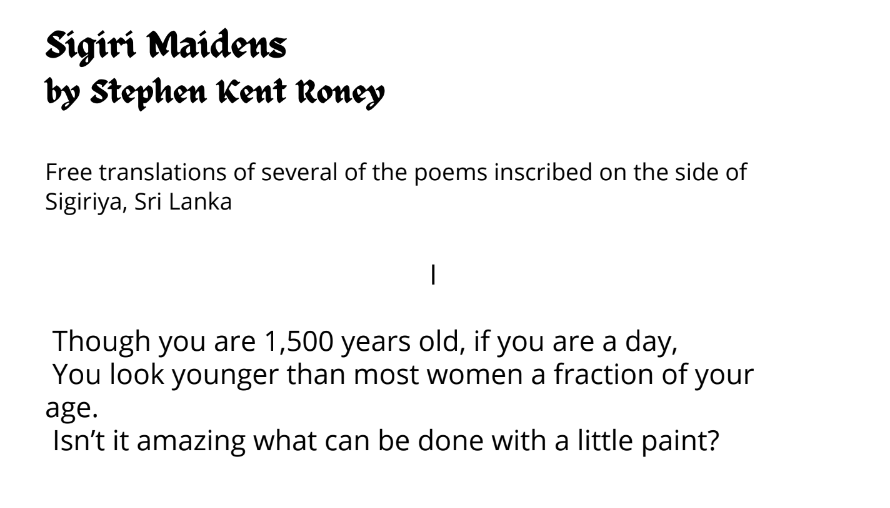
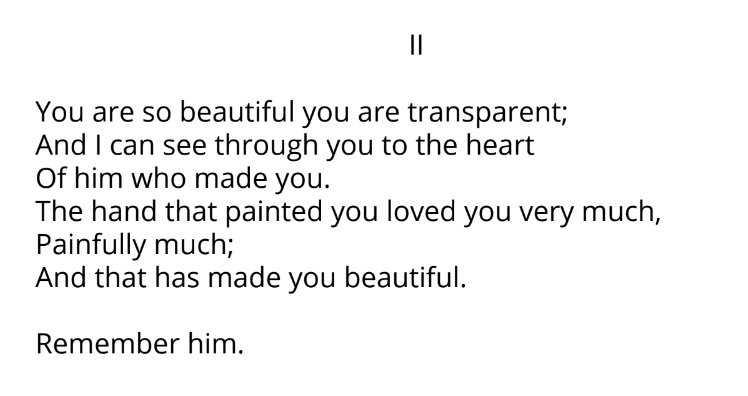
Sigiri Maidens


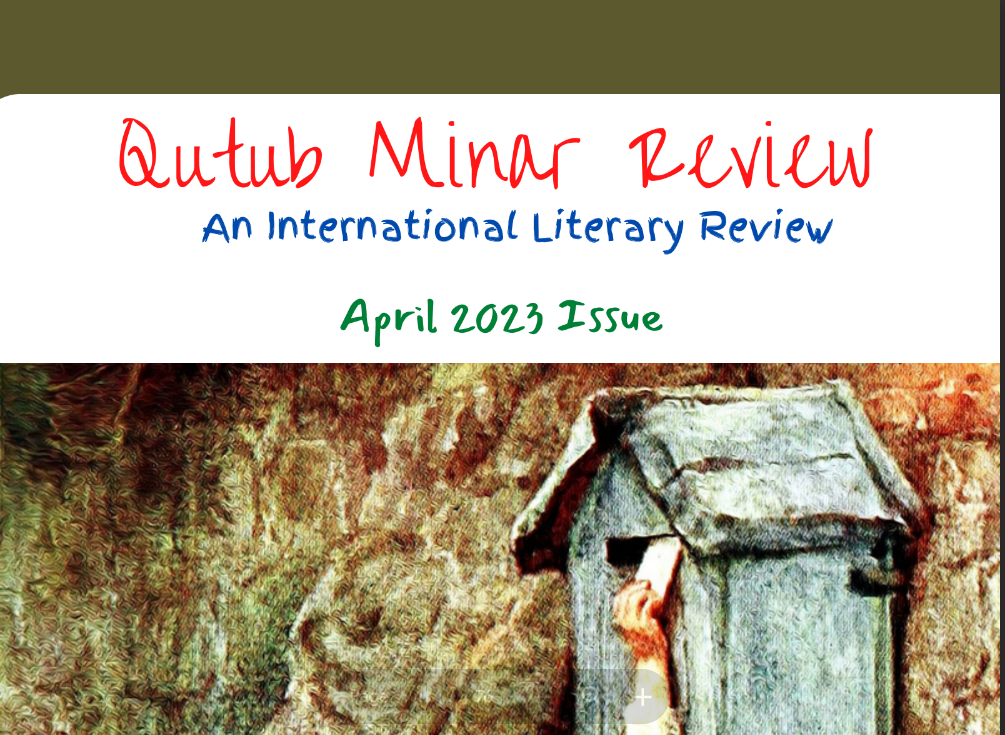
Pleased to report that my three short poems "Sigiri Maidens" have been published in the April 2023 issue of Qutub Minar Review, an international poetry journal out of India. Some of the other congtributors are quite impressive. 

Paperback edition: https://www.lulu.com/shop/som/qutub-minar-review-april-2023-issue/paperback/product-vvdkgw.html?page=1&pageSize=4

(To avail 15% discount on paperback use discount code:  WELCOME15  . Discount code is available for all those who wish to support this project.)

E-edition link: https://qutubminarreview.wordpress.com/qutub-minar-review-april-2023-issue/


Tuesday, July 19, 2022

All Things Visible and Invisible


It has been brought to my attention recently that a large number of people, possibly a majority, actually believe that the physical world is the real world. Not just that the physical world is real—which is debatable—but that there is nothing beyond the physical world—which is stark insanity.

What brings me most immediately to this thought is some poems appearing in my email box from the League of Canadian Poets, under their “Poetry Pause” programme (you can sign up free here). One was just the poet describing her body:

Most loyal beautiful body

--Who aches only for your love.

 Another was the poet describing her desk.

A surplus teacher’s desk, 

solid oak, three heavy drawers

on each side of a skirted knee-hole.

There is no poem to such poems. Poetry speaks of the transcendent. We do not need it to talk about what is before our eyes.

Another example of materialism, in the textbook from which I taught this morning: it took pains to distinguish between “fact” and “opinion,” but never noticed or noted that there is a more important third category, truth that is not fact. Here’s an obvious example:

We hold these truths to be self-evident, that all men are created equal, and are endowed by their creator with certain unalienable rights, that among these are the right to life, liberty, and the pursuit of happiness.

Not a trivial point.

In the wider world of truths, facts are trivial; yet only facts are acknowledged by the standard textbooks.

Another example: most people are quick to deride “materialism,” but then they think that materialism simply means wanting or having wealth. A purely materialistic concept of materialism, a cartoon. They are not out of the box. They just resent people who have more material than they do.

I read a poem at a recent meeting of a poetry society, which asserted, in rhyme, that the delusions of the mentally ill had truth in them beyond the ken of psychiatrists. “There are more things in heaven and earth, Horatio, than are dreamed of in our philosophy.”

And if he asks in riddle who you are

You must lie as dead as paper-thin straight line

Assume a name--say, one you took at birth

And pretend you only know of space and time.

Surely a group of poets would get it.

The first reaction from an audience member: it reminded them of Ogden Nash, or Alexander Pope.

What? Either meaningless nonsense, then, or mere clever wordplay. Pope is conspicuous for never speaking of the transcendent. For this Blake mocked him.

I can’t decide whether that respondent was trying to deny the existence of anything beyond the senses, or whether he was really so lobotomized in his view of existence.

Another listener chimed in that she liked the poem, and had often written herself about social justice.

Another common modern tack. Poets now all always either talk about “nature,” meaning the purely material world, or politics, the quest for power over others. Neither is worth an honest poem. 

It seems to me necessarily true that anyone who is not fully aware of the world beyond the visible is lacking a soul. More or less by definition. They are only robots.

Yet realizing that many are at this spiritual level explains the common conflation of just about everything with sex and power.


Wednesday, March 30, 2022

Urge for Going


I just had the immense pleasure of going through Joni Mitchell's lyrics for "Urge for Going" with a student.

Mitchell is an excruciatingly good poet. I think it is possible "Urge for Going" is actually the best poem ever written in Canada. And the most Canadian.

I awoke today and found the frost perched on the town

It hovered in a frozen sky, then it gobbled summer down

When the sun turns traitor cold

And all the trees are shivering in a naked row

I get the urge for going but I never seem to go

I get the urge for going

When the meadow grass is turning brown

Summertime is falling down and winter is closing in

I had me a man in summertime

He had summer-colored skin

And not another girl in town

My darling's heart could win

But when the leaves fell on the ground

And bully winds came around pushed them face down in the snow

He got the urge for going and I had to let him go

He got the urge for going

When the meadow grass was turning brown

And summertime was falling down and winter was closing in

Now the warriors of winter they gave a cold triumphant shout

And all that stays is dying and all that lives is getting out

See the geese in chevron flight flapping and racing on before the snow

They've got the urge for going and they've got the wings so they can go

They get the urge for going

When the meadow grass is turning brown

Summertime is falling down and winter is closing in

I'll ply the fire with kindling and pull the blankets to my chin

I'll lock the vagrant winter out and I'll bolt my wandering in

I'd like to call back summertime and have her stay for just another month or so

But she's got the urge for going so I guess she'll have to go

She gets the urge for going when the meadow grass is turning brown

And all her empires are falling down

And winter's closing in

And I get the urge for going when the meadow grass is turning brown

And summertime is falling down

And winter closing in.


Sunday, November 07, 2021

A Near-Death Experience


As I rode down through old York town

I saw a maid with ravishing raven hair

All dressed in Spanish.

I felt the pistol at my hip,

Still warm from the other guy.

But then a vagrant putto dodged out from some blind alley

Between two graffitied buildings

And took dead aim.

I awoke days later at Toronto Western.

The doctors told me I’d been lucky

The arrow was deflected by the poem in my pocket

Next to my heart.


-- Stephen Kent Roney 


Sunday, September 26, 2021

Mensa Poetry Prize


Delighted to announce that my poem "On the Night We Held the Moon for Ransom" has been unanimously selected as the winner of this year's Mensa International Poetry Competition.


Friday, August 13, 2021

Limerick


Bacon and Newton and Locke

Went to fish from the Bay Street dock;

Instead of a worm,

Used a variable term,

And could not digest what they caught.


-- Stephen K. Roney

Clerihew Too


Amelia Earhart

Couldn't fill her dance card;

So she thought it would be terrific

To transit the Pacific.

-- Stephen K. Roney

Clerihew


Thomas Alva Edison

Wouldn't take his medicine.

He gave light to the earth

For whatever that's worth.


--Stephen K. Roney


Monday, January 11, 2021

The World in Winter


Art thrives when the world has fallen apart. Art is the attempt to put it back together.

The US seems now gone fascist, following China.

It is time for poetry.


Four walls a door a window

Without, the face-full sea.

Was life ever more than this?

I hear the sirens in the night

I see the weary parade of morning

Rare times the lark sings mad above the snow

Again in the calliope dawn

With a timpani bang and a tin whistle

The shuffling symphony that becomes the carnival day begins.


-- Stephen K. Roney

Saturday, December 05, 2020

A Poetry Slam


A recent example of the growing racism in Canada: I recently received a Facebook announcement for a Poetry Slam. Poets were invited to sign up, to be chosen by lottery. However, just below this was the note, in large print, “60% of slam spots reserved for Black and Indigenous poets.”

Couldn’t be more blatant than that. 

The invitation was illustrated by a photo of a woman wearing a black t-shirt reading “NOT TODAY COLONIZER.”


Segregation, racial quotas, and hate speech, too. Lynchings next. I would be concerned about attending such an event while white, Jewish, or Asian. Poetry slams can get emotional.

The event is free for blacks and indigenous; $14 for all others, explicitly as a form of “redistribution/reparations.” (Although they say nobody will be turned away for lack of funds.)

Interesting that this is one post Facebook neither flags nor bans. Just to see what would happen, I reported it, and they quickly assured me that it violated none of their "community standards."

Welcome to the Weimar Republic.


Sunday, November 01, 2020

Of Poetry, Written in Times of Peril


Does poetry mean anything? My friend Antiochus says no. The meaning is just what each reader takes from it. This is the postmodern view.

He writes “what about when one person reads the poem one way and is absolutist in his view about what it means, and another person reads the poem a second way and is absolutist in his view about what it means?”

That is when discussion, and learning, can begin. They each present their evidence and their arguments to arrive at the truth. One is right, and the other is wrong; or perhaps, they are both wrong, and the discussion will reveal this.

If, on the other hand, everyone is simply entitled to their own interpretation, there can be no discussion, no learning, no movement towards truth, and no agreement. No contact of souls. At worst, they struggle to the death for dominance; or they try to shout one another into silence. As with our current politics. Or else, more happily, they must simply ignore each other. You say the poem looks like a camel; I say it looks like a lobster. It cannot matter what you think. We have made no meaningful contact, we have learned nothing, and neither of us is closer to truth.

Let me back up and explain my absolute commitment to absolutism. I believe, agreeing with philosophers stretching back at least to Plato, and not only in the West, that the purpose and meaning of human life is to seek the Good, the True, and the Beautiful—the three great absolutes. This must be so, because we perceive these three things as of self-evident value.

Anything we do that is not directed towards achieving one of these three goals is wasted time and effort. So if poetry does not itself strive to express some truth, it is to that extent without value. If we, in turn, do not strive to find the truth of the poem, we are just rolling stones up a hill.

You might argue, I imagine, that poetry is just about Beauty, not Truth or Goodness. If so, it is of relatively less value than something that combines Beauty and Truth. But I agree with Keats: “Truth is Beauty, Beauty Truth; that is all ye know, and all ye need to know.” Transcendental values cannot really be separated. Nothing is truly beautiful that is not also both true and good; nothing can be good that is not also true; and so forth. The beauty we perceive in a poem is an intuitive initial perception of truth and goodness.

Antiochus writes that, if someone misinterprets a poem, “that's on the poet's shoulders because the clarity wasn't there.” I disagree. Being easy to understand is not traditionally the task of the poet, or of poetry. TS Eliot actually criticizes Rudyard Kipling for being too easy to understand: “We expect to have to defend a poet against the charge of obscurity; we have to defend Kipling against the charge of excessive lucidity.”

No doubt a poet should strive to be no more obscure than necessary—Eliot is saying that, implicitly, too. Poets must be defended against that charge. But a good poem should be, will be, difficult to understand. Because it is speaking of some deep truth, and deep truths are intrinsically hard to grasp.  

Heraclitus: “One would never discover the limits of psyche, should one traverse every road―so deep is its logos."

Show me an easy poem, and I’ll show you doggerel.

Antiochus argues that anyone’s “honest evaluation, with no underlying agenda, of what [a poem] means is legitimate.”

Does this mean that it is impossible to be honest, yet wrong? People once honestly believed the sun orbits the earth; I once honestly believed Santa put those presents in the stockings. Or does “legitimate” mean something other than true here? Is it possible for an opinion to be wrong, yet “legitimate”? If it only means “sincere,” Antiochus has said only that honest opinions are honest opinions.

A bit off topic, but Antiochus also wants to insist that you can say all the same things in prose that you can in poetry. Let me explain why I believe that is not so. Prose is the written word: it lives on the page. Poetry is often called the spoken word; but that is wrong. Poetry is the remembered word; it lives in memory, as a new bit of mental furniture, our programming. Accordingly, it can accomplish things that prose cannot. On an analogy with medicine, poetry does mental surgery, and permanently alters a soul. Prose too may heal, but like a pill, its direct effects do not last.

This is of course a generalization. Plots, characters, even verbatim passages of prose can linger in the mind. But poetry, properly assimilated, is remembered word for word.

Antiochus improperly then uses the example of bad poets to argue that poetry is not in fact a difficult form:

“I have known a lot of bad poets, beginning with the plethora of teenaged girls in high school and continuing through to creative writing classes and continuing further to published writers of whose work I could make neither head nor tail, and I could never see that the poet's intent was to write something he or she couldn't say in prose.”

This is like using the example of your kid sister’s caterwauling violin practice to show that it is easy to play the violin. It proves the opposite. There are far more good prose writers than poets, and there is far more good prose in the world than good poetry. It is easier to prescribe a pill than to do brain surgery.

Leonard Cohen refused on at least one occasion to call himself a poet, saying that poetry is a judgement, and nobody has the right to pass that judgement on themselves. Recall Coleridge’s definition of poetry, “the best words in the best order.” That is a high bar to clear. Most contemporary so-called “poetry” is nothing but self-absorbed prose without grammar or punctuation. It could easily be computer-generated—and has been.


Wednesday, October 07, 2020

Political Poetry in Fredericton


Jenna Lyn Albert


There is a controversy in Fredericton over the city’s poet laureate, Jenna Lyn Albert. She recited to city council a poem describing an abortion. Some councillors found it too political.

The poet laureate herself admits it was political in intent:

“With the impending closure of Clinic 554 … I felt it was really important to share a poem about the importance of abortion access."

She is also quoted as saying “Poetry is inherently political. It would be lacklustre if you were to take that aspect out of creativity and of the art form away from it."

She is wrong to say that poetry is inherently political. Take the example of Leonard Cohen, Canada’s preeminent poet. Does anyone really know his politics? Or take Shakespeare. Perhaps in his superheated environment, he did not find it safe to reveal his political opinions. Regardless, he managed to produce a respectable body of work.

What are the politics of Al Purdy’s “The Country North of Belleville”?

Can you cite a famous poem that is overtly political? Perhaps Yeats’ “Easter 1916”; but only in the sense that it refers to a political event. In the poem, Yeats’s own opinion on the event is ambiguous.

Poetry surely has the right to express political opinions. It is just not a good idea. Poetry is an attempt to speak of truth and the eternal. Political issues are transitory and about power. They are more or less incompatible. Write a political poem, and it is probably not going to be that successful; and not likely to endure.

We have, moreover, an endemic problem in Canada currently, that poetry and the arts in general have been coopted for political purposes by one side of the political debate, the left. It is difficult to imagine a strongly anti-abortion poem being read in Fredericton City Hall; or published in any major poetry journal. This one-sidedness is poisonous to our political discourse, and poisonous to art. It is probably largely why the general public has lost in poetry. It is no longer very good. It has not just that poets rise within the craft not for ability, but for espousing the right opinions. It is also that the poems they produce become predictable, repetitious, and without new insight. As Orwell has aptly explained in “Politics and the English Language,” political sloganeering is the opposite of insight.

Moreover, it seems obvious that a poet laureate does not have the right to express partisan political positions in that official capacity. Even if poorly paid, the poet laureate is on the public purse: he or she is an unelected public official. It is therefore improper for him or her to express opinions on political issues of the day just as it would be for the Governor-General, a Lieutenant-Governor, or for any other public servant.

The poem was pretty weak, too.


Wednesday, July 15, 2020

Monday, June 29, 2020

Ozymandias


Here's my friend Jack Rigg reading the classic Shelley poem.

Your mileage may vary, as they say, but to my mind, nobody does a better job at a dramatic reading than Jack.  It's a tricky thing to do: the dramatics makes you want to do one thing, and the rhythms of the poem make you want to do another. It's tough to strike the right balance.

Jack could do a master class.


Saturday, April 18, 2020

Remembering Poetry


Nobody any longer understands poetry. Including most people who consider themselves poets.

This has to be considered odd, since until recently—perhaps 150 years ago—poetry was the most popular literary form.

Since this is National Poetry Month, my friend Xerxes did a column celebrating the poem as a form.

But he seemed to struggle to define it.

He suggested, first, that poetry is about metaphor.

Much poetry uses metaphor, it is true. But so does good prose; the genre that depends most fully on metaphor is myth or legend. And some poetry does not. It is considered bad form to use an obvious metaphor in, for example, a haiku. Or in some modern forms: as aggressively asserted in Gertrude Stein’s famous line, “A rose is a rose is a rose.”

He next suggests that poetry is about the expression of emotion; quoting Wordsworth’s line that it is “emotion recollected in tranquillity.” The full quote is:

“Poetry is the spontaneous overflow of powerful feelings: it takes its origin from emotion recollected in tranquillity.” 

But that defines, not poetry, but Romantic writing. It would be equally true of Goethe’s The Sorrows of Young Werther. It is clearly untrue, on the other hand, of most poetry: of the great epics, the Iliad, the Odyssey, the Mahabharata, The Divine Comedy, The Canterbury Tales. Take only them, and emotional expression is a minority genre in terms of lines written. And this is not to mention Alexander Pope, or Robert W. Service, or Milton, or Rudyard Kipling, probably the four most popular and best-selling poets in the English language--or even the later Wordsworth.

Xerxes then posits—and this is his strongest point—that poetry seeks to say things “with an absolute minimum of words.” I have seen this said before; however, this defines not poetry, but modernist style. In modernist writing, it is equally true of prose: this is Strunk’s famous dictum, “omit needless words!”

None of these things are definitive of poetry: not economy of words, not metaphor, not vomiting up emotions on a page. What makes poetry a distinct form is its medium. And that medium is not the page.

Prose is the written word, preserved on a page.

Drama is the spoken word, seen live on a stage.

Poetry is the remembered word, kept always in the mind.

Poems really only work once memorized. This is exactly how and why a good poem will, in Xerxes’s own words, “dance a polka in your head.” It is experienced as uniquely alive.

This is the reason for rhythm and rhyme: they are mnemonic devices. They give you associations to help you memorize the poem. Contemporary poetry has been gravely crippled by their absence.

This is also the reason for much of poetic imagery; it is often useful as metaphor to convey some meaning, but whether or not it is metaphor, it creates visual associations, another mnemonic. Yeats sometimes made a point of writing poems connected only by images instead of rhyme. Lesser poets saw this, without seeing the art, and understood from this only that poems need not rhyme.

The current unpopularity of poetry, and the general inability to understand poetry, is directly due, I think, to a more general modern hostility to memorization.

Big mistake, for many reasons. That it killed poetry, the highest form of literature, is perhaps the least of it. We are all wandering aimlessly about with the bulk of our brains anesthetized.