Playing the Indian Card

Showing posts with label poverty. Show all posts

Wednesday, December 18, 2024

Giving to the Poor


I keep seeing stupid posts saying things like this: “Elon Musk is worth $442 billion. Such greed! There are only 8 billion people on Earth. If he handed all that money out, everyone on Earth would be a billionaire. No one man should have so much.”

Seriously. I see and hear this repeatedly.

Do the math: 442 divided by eight: Elon Musk could give each of us 55 dollars and 25 cents.

Musk would then have nothing, and nobody else would really be any richer.

A similar comment: “How can Musk complain about homelessness being due to addiction and mental illness? Why doesn’t he give some of his money to the poor and actually do something about it?”

This assumes that homelessness is caused by poverty; that you can fix poverty by giving poor people money; and that Musk is doing nothing useful with his money.

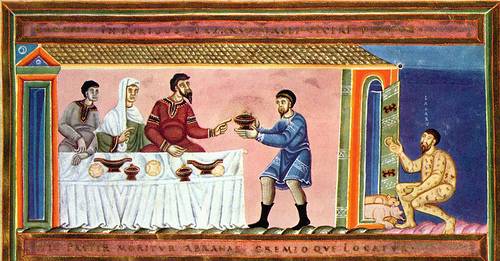
In principle, nobody should hoard possessions. See the parable of Dives and Lazarus. Luke 16: 19-31. If you have two coats, and you see someone else freezing, you owe him one of them. 

However, someone who is rich is not necessarily hoarding. Not all gains are ill-gotten. Musk or another wealthy man may be living modestly, but using his money as a tool to improve the world. Entrepreneurs commonly are. Musk clearly is. Give away all his money, and we get none of the innovations he is responsible for, which cumulatively improve everyone’s lives far more than a one-time payment of $55.

And if we do have more than we need, we must target our charity so that it actually does help others, rather than just using it to salve our conscience, or make us feel superior. We need to do what is best for them, not what is easiest for us. 

Homelessness is not caused by poverty. 

I volunteer at Romero House, giving meals to the poor. Some of the people who volunteer there have been on the streets themselves. They never got off the streets because someone gave them money. It is always because they found religion. Ask AA about that. Ask the Salvation Army.

One guy gave me some interesting information. Back in those days, he would beg on the streetcorner uptown. He claimed he cleared thousands in a week just doing this. The problem was, in the afternoon, he spent it all on drugs or alcohol.

So it does no good to simply give a truly destitute person money. It probably does them harm. 

The local own council sought last year to end homelessness by setting up a village of containers converted into mini homes, in a downtown parking lot where the homeless already gathered.

Yesterday, I saw the containers have all been shut down and moved into a pile. At the onset of another winter. Clearly the experiment did not work. 

The problem is meaninglessness. These people are in real need; they are dying by the day. But we have to give them meaning and hope, not money for another fix. Or, worse, a free fix. 

We need to get out and talk to them, about Jesus, the Gospel, God. As the religious charities are or ought to be doing. If you want to help, volunteer with them.


Tuesday, October 24, 2023

The People Shortage


I got a quick lesson in economics the other day. Someone was wondering why clay for crafting was so expensive, and why it was shipped in from Ontario. After all, there are rich clay deposits here in New Brunswick. And had it explained to them.

It’s all due to underpopulation. 

You can mine clay here, but it must be processed. By the time you get it to Ontario, it cannot compete there with the cost of Ontario-mined clay. But the local market is not large enough to support the cost of a processing plant.

And so, historically, industry after industry has pulled up stakes and moved to Central Canada.

The Canadian Atlantic Provinces are generally underdeveloped, because they are too far from markets. Granted, they are closer to Europe; but transportation by water is cheaper than by land. It still makes most sense to ship to and from the big markets of Central Canada through the St. Lawrence Seaway. 
I saw the same thing in the BC interior; vast stretches of what could be fertile land, unused or left in forest because too far from any large market.

I have heard the same problem has kept Latin America historically poor.

The obvious solution is to get more people living in Atlantic Canada: then the economies of scale would make it worthwhile to mine that clay, to grow those vegetables, to be used or consumed locally.

We have been fed the lie for many years that “overpopulation” leads to poverty. Since each individual human, on average, produces more than they consume, the reverse is true. Cities are generally more prosperous than the countryside, and young people do not pull up roots and head to a small town to make their fortune. Some of the most densely populated countries are also the richest: Singapore, Bahrain, Korea, Netherlands, Japan. Some of the least densely populated are the poorest: Mongolia, Western Sahara, Namibia.

Sunday, June 25, 2023

The Preferential Option for the Poor


Catholic social doctrine is, to my mind, close to being self-evidently true: solidarity, subsidiarity, human dignity, the dignity of labour. If only we could all agree on getting it done.

Except for one issue: the preferential option for the poor. Of course this is right; but how to go about it as a practical matter? How reduce inequalities of wealth in society?

We cannot simply take from the rich and give to the poor. This, as Catholic social doctrine makes clear, is unjust. Each man has a right to the products of his labour. This is what social justice actually means: to each according to his merits. That means he has a right to his property.

On the other hand, the dignity of man, and human solidarity, means we must together ensure that no one is left without means sufficient for life. We are each our brother’s keeper. In the classic case, if a man is starving, he has a right to take a loaf of bread. It is not theft, in a moral sense. We must organize society so that no one is sleeping in a tent in a Canadian winter.

But how?

Unions? Collective bargaining? Does not work. If one shop is organized to achieve higher wages, this means they must price their products higher. Customers go elsewhere, the firm goes out of business, and everyone starves. 

Organize across an entire industry, and the work simply moves abroad. 

The union movement has therefore collapsed in any industry which cannot establish a monopoly. It is limited to the building trades and government workers. 

People in the building trades and the civil service make more than the average income. 

So unions make the rich richer, by forcing the poor to pay more for certain goods and services.

A minimum wage? This has all the same problems. Jobs are eliminated in favour of self-serve and automation. As has been said, the real minimum wage is zero.

Welfare? A Universal Basic Income? Daniel Patrick Moynihan demonstrated its effects. By replacing the father in the family, it encourages family breakdown. Children do not well in a single-parent family, and the next generation is doomed to poverty and helplessness. It violates the dignity of work.

The first thing that might be done is to discourage single-parent families. End no-fault divorce.

The one thing that seems most obvious is that education should be free at all levels; as it is in some European countries. The only criterion for advancement should be merit. This is social justice; it gives everyone an equal shake. This is the same principle on which we have public libraries. It benefits not only the poor, but society as a whole: it means we get the best at each position, improving overall efficiency. If anything done by government ever were an investment, this is one.

The next thing would be monasteries—or some equivalent. A place where the poor and oppressed and those abandoned or abused by their families could be taken in, but with dignity and purpose. A place abused children could safely run away to. Sadly, the monasteries were broken up all over Europe in about the Enlightenment, not because the system did not work, but because it worked too well: the monasteries grew rich, and the civil power wanted the assets. 

For some generations, the alternative for poor kids who were abused was to run off with the circus, or to become gas jockeys somewhere. That escape was killed by child labour laws and minimum wage. Leaving what? Only drug dealing or prostitution.

There was an attempt in the Seventies and Eighties to revive something like the monastery system: the “cults.” The Hare Krishnas, the Moonies, Scientology, the Falun Gong in China. And the authorities went after them hammer and tongs wherever they appeared. Remember Waco. 

Even the Indian residential schools were too well calculated to help the Indian poor, and so have been declared anathema. Residential schools should probably instead be expanded: any child born into a single-parent family should attend a residential school. Ideally not run by government, but by some religious organization.

The reality is that much of society is constructed to keep the poor down.


Sunday, October 23, 2022

The Little Match Girl


Most literary criticism is awful. Don’t get me started on Hamlet’s supposed “indecision.” 

Most of it is based on the current fashionable academic theory, Marxism or Freudianism or Jungianism or intersectionality, and not at all on real world concerns like religion and family.

Interpretations of Hans Christian Andersen’s “The Little Match Girl” relentlessly seem to see her problem as poverty. Anderson is supposedly protesting social inequality.

No. It is about child abuse and loveless families. Although we talk about “child abuse” these days, the reality of true child abuse, the loveless family, seems to be the greatest of social taboos. We seem to consistently refuse to see it when it is right before our eyes.

Hamlet being another example…

The little match girl stays out all night and freezes to death not because she is poor. It is not because she cannot afford to go inside and warm herself. She has a home. Granted, “at home it was cold too, for above her she had only the roof, through which the wind whistled, even though the largest cracks were stopped up with straw and rags.” But that is better than the street, and there is no reason to suppose there would be no wood or straw there to make a fire. Certainly, had she gone home, she would not have died of hypothermia.

She cannot go home because “from her father she would certainly get blows” for not selling any matches.

Note too that, when she does not come home, her father or mother do not come out and look for her. And she can assume they will not. The point is not even the blows—it is rejection.

There is no indication that her grandmother had more money than her parents, and this is not mentioned as a consideration. Had she, wouldn’t her parents have inherited it? The significance of her grandmother is not that she will feed and warm the little girl, but that she was “the only person who had loved her.”

And the grandmother’s love matters to her more than the roast goose or the warm fire: “Oh, take me with you! You go away when the match burns out; you vanish like the warm stove, like the delicious roast goose, and like the magnificent Christmas tree!" She is asking for her grandmother’s company, not for the other three.

When they find her corpse, people suppose she had lit the matches to warm herself. “No one had the slightest suspicion …” In other words, physical warmth was not the issue. The cold itself was a metaphor for the emotional coldness she had experienced throughout her young life. Only a crass materialist could see otherwise.

The most telling element in the story is this: “One slipper was nowhere to be found; the other had been laid hold of by an urchin, and off he ran with it; he thought it would do capitally for a cradle when he some day or other should have children himself.”

This is a detail unnecessary to the narrative. Both slippers might as easily have been lost in the snow, as one was. It superficially makes no sense, as a slipper would be too small to use as a cradle. 

When we see an anomalous detail like this, we should take it as symbolic.

The street urchin contrasts with the match girl’s father. Although he himself has nothing, no parents, no parental love, his first thought is to provide not for himself but for an imaginary child. And we know children think like this; we are all born with the maternal or paternal instinct. 

Which speaks in condemnation of the match girl’s parents. Her father expects her to provide for him. She does not have shoes, while her mother has slippers.

The frustrating thing about creative writing is that, while it seems to be the only way one is allowed to tell the truth, it hardly matters. Whatever you write will be misinterpreted.

Let he who has ears to hear, hear. Let she who has eyes to see, see.


Saturday, October 01, 2022

The Real Problem of Poverty


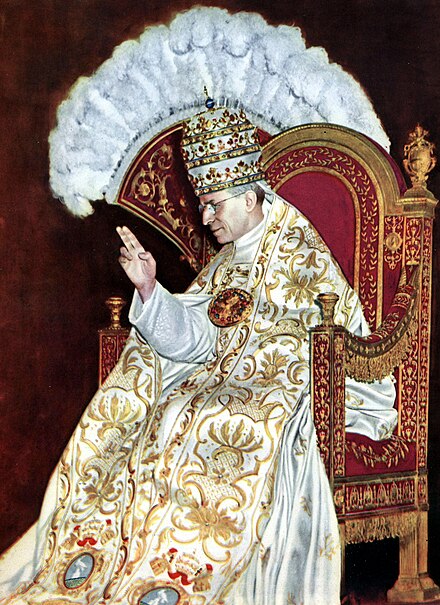
Pius XII in the sedia gestatoria

Just attended a poetry reading on the theme of poverty. Unfortunately, after a dozen poets had read their poems, the meeting devolved into a political meeting, with the hosts insisting that the problem was systemic, that it was about intersectionality and some having special privilege, and—revealing quote—“the real problem is not poverty, but abundance.”

It is not that the left wants to help the poor; it envies the rich.

Perhaps a dozen poets read. Only four were “white.” Only two spoke of personal experiences of poverty. Both were white. 

Despite this, as if deaf, the hosts asserted afterwards in their political speech that poverty exists because white people, along with straights, and men, have a systemic advantage.

In fact, the Canadian immigration system favours the wealthy and well-educated among immigrant groups. We are importing the upper classes. And being rich in a poor country means far more privilege than being rich in Canada. Once they arrive, these non-white immigrants are systematically given privileges over those, primarily “white” who have been here for generations; in the name of “affirmative action” and “equity,” they are systematically favoured in hiring and promotion.

I once challenged a Pakistani immigrant of my acquaintance, a grad student at U of T. 

“Why do you say you are discriminated against?”

“Because I’m not yet a member of the Granite Club.”

Another claimed oppression becuase he was not yet a full partner at his accounting firm.

So it is no surprise that it is the “whites” in any random group of Canadians who have known poverty. The usual claims we hear about “intersectionality” are the opposite of the truth. 

In the same way, gays are privileged over “straights,” not just now, but throughout our history. A gay man has no wife and kids to support. A gay couple generates double incomes with no children. In the traditional sex-segregated workplace of days gone by, a gay man or woman could trade sexual favours for advancement.

Women are traditionally privileged over men, and always were. In a conventional family, they got to spend 80% of the family’s shared wealth. They had a legal right to support if they chose not to work. They had more free time--demonstrated by their much higher purchase of magazines and books, and that the vast majority of TV programming was aimed at them. Men have always been the working class; and expendable in war or in dangerous jobs.

In other words, the modern social hierarchy called “intersectionality” systematically asserts the opposite of the  truth.

One of the participants at the poetry reading, citing the recent royal funeral, went on about how wrong it was for the British royal family to possess so much wealth. Why couldn’t it be distributed to the poor?

But distributing it to the poor is not the point. Were it distributed to the poor, it would help a bit perhaps, a few pounds more for a month or a year, and then be gone forever. It would be very little per capita. On the other hand, the crown jewels, for example, are not of any great personal benefit to the Queen. She gets to wear them once, at her coronation, and then they are stored behind glass at the Tower of London for tourists to look at.

The pomp of a royal funeral, or the crown jewels, are major tourist attractions. They generate wealth. Including more wealth for the poor than a one-time distribution of state wealth would.

So the problem is not that some people are poor. The problem is that the royals are rich. The problem is envy. The relatively rich always envy the richer. The poor have no such ambitions. They only want enough. The poor delight in the chance for a celebration now and then, to pull them out of their sordid daily lives; just as it is the poor who will invest in a lottery. To them, it is worth the penny for the fantasy.

One participant in the political discussion was similarly shocked by a scene she said she saw in the Vatican. Women were tearing off their jewellery and throwing it at the pope in his chair.

I have some doubts she actually saw this. The pope has not promenaded in a chair since John XXIII. But if she did see it, what was she seeing? Not the accumulation of wealth, but relatively wealthy people—wealthy enough to own valuable jewellery—surrendering their wealth. The pope was not going to wear that jewellery, was he? The pope does not get to live a particularly luxurious life. The jewellery, if it was collected, was more likely to go to the poor, through Catholic charities. And if not to the poor, to the church rather to any individual. To churches, open for anyone to enjoy.

People who are up to no good will always assert the opposite of the truth. And, if anyone corrects them, will set up an ungodly howl.

Accordingly, I bit my tongue. Such is the price of life in society. The most I dared do was post in the comments section "the real underlying problem is poverty of meaning."

Instead, I go home and post on my blog.


Saturday, September 10, 2022

Postcolonial Poverty


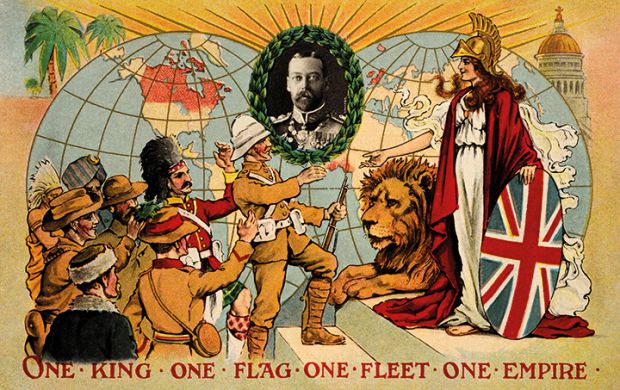
With the death of Queen Elizabeth, much is inevitably being said of the evils of the British Empire.

It is an interesting fact that Columbus discovered the New World the same year that the Spanish finally expelled the Moors. In other words, Spain began its greatest, most glorious era the very year it slipped the yoke of colonization itself.

The Dutch repeated the trick: they built an overseas empire just as they were casting off the Spanish yoke in turn.

The Jews, we know, are notably successful. Within living memory, they were hunted and killed throughout Europe.

In 1930, under the British Empire, India was responsible for 6.42% of world GDP. Five years after independence, it was down to 3.8%. In 2010, it was at 4.2%; it has risen in the last few years to 7.19%.

In other words, places like Africa and South Asia cannot blame their present poverty on having been oppressed three generations ago. Modern American blacks cannot blame their present poverty on slavery a century and a half ago. It does not work like that.


Saturday, January 01, 2022

The Pardoned Ox


Ebenezer Scrooge: "Are there not workhouses/"

I fear my last post may have been too harsh o friend Xerxes, and may leave the impression that we are obliged to give all we have to the poor. Indeed, doesn’t Jesus even say that in the Bible?

Not so. We are not so obliged. There is a difference between what we have earned honestly or by devious means. What we have earned honestly, by providing a useful good or service, we have a right to. The Bible does say “the workman deserves his wages.” 

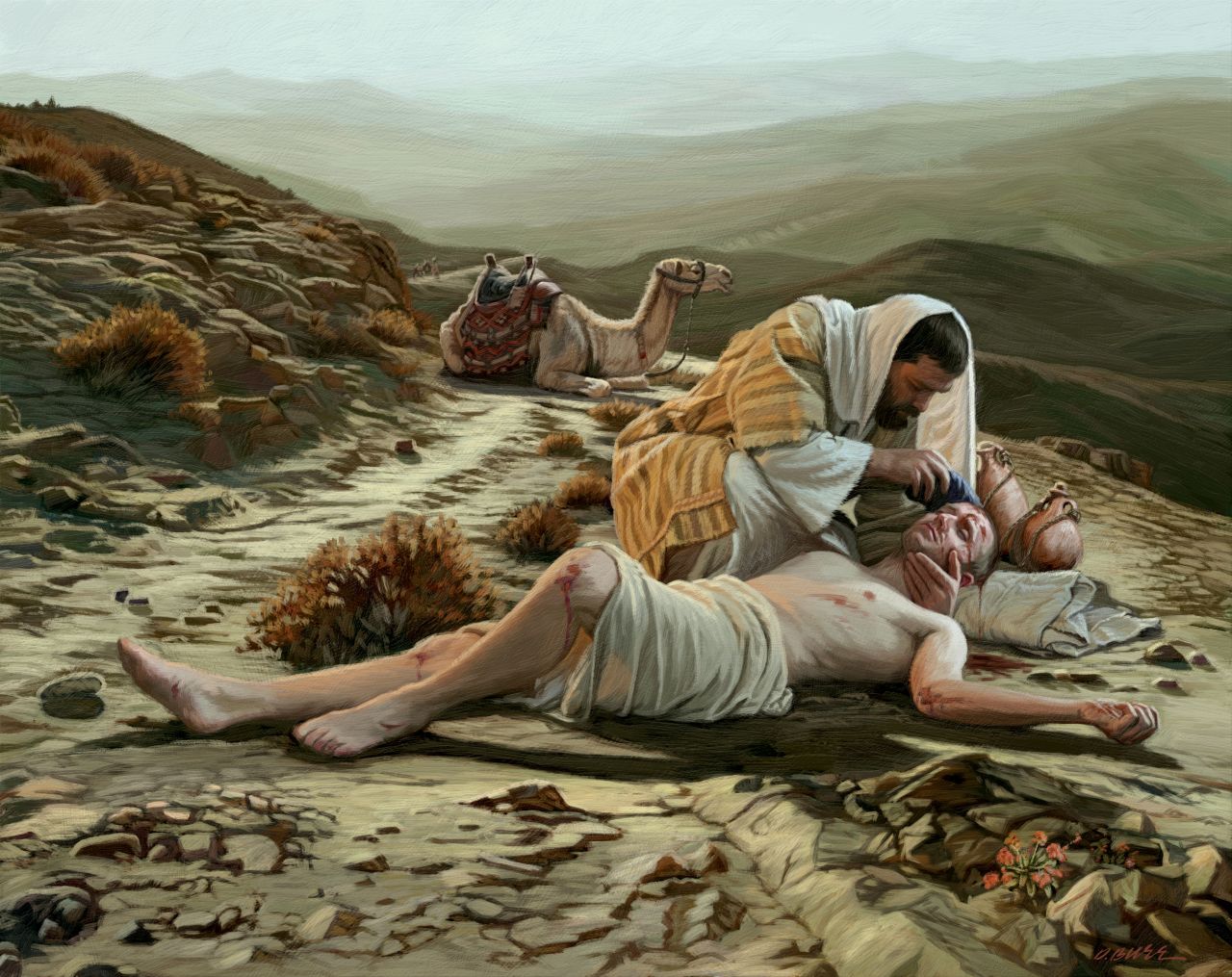
One would hope that we would give what we can to help others, our neighbours, in dire need. As in the parable of the Good Samaritan. The church teaches that, if a man needs a loaf of bread to save his life, he has the right to that loaf of bread, whoever legally owns it. Michael Knowles gives the example of a beggar who shows up to your door, on the point of death. Don’t you have a duty to give whatever you reasonably can to save his life? 

But then extend the principle to all the people starving in the world today. Don’t we then have the obligation to give what we have, until we ourselves are barely above starvation, if necessary, to help them?

There is a Confucian story of a king who heard the sacrificial ox loudly lament when it was on the way to being slaughtered. Moved by pity, the king ordered that ox returned, and another taken.

When I read this, I thought the distinction was purely sentimental, self-indulgent. An ox would be killed. How did it matter morally which one?

Perhaps I was wrong. It is ever wise to scoff at Confucian wisdom.

The rich man and Lazarus

Given that, as Jesus says, “the poor will be always with you,” you cannot extend the principle of benevolence to all oxen, all beggars. Then it becomes an insoluble problem, and Xerxes is left obliged to spend all his time, money, and energy on some poor person somewhere. Some choose to do something like this—the Franciscans. But if we all did, society and civilization would end, as no one any longer would have children, or write novels, or compose songs, or teach, or build bridges.

It has to be that one beggar at your door; that one ox. It has to be the need you see around you. In the case of the Good Samaritan, the stranger he encounters in a ditch. For it is not that God is calling you to solve the problem of suffering in the world. That would even be presumptuous. That is God’s job, and God has his reasons for permitting poverty to endure. But if a beggar comes to your door in obvious need, that is Christ putting you to the test. Do you see him as a neighbour, or just another statistic? “I gave at the office.” “I pay taxes.” “Are there not workhouses?”

Perhaps this is why, in the Biblical tale of the rich man and Lazarus, Lazarus has a name. It otherwise looks like a parable--but in a parable, formulaically, no one has a name. They are, after all, only hypothetical people in a thought experiment. It may be important, for the story, that the rich man knows Lazarus as another human individual, not just a hypothetical, yet does not help. And so goes straight to hell.

Which rather justifies Xerxes with his hummingbird. He does not personally see the homeless in East Van. They did not quite appear to him. They may still be hypothetical.

The problem is with implicitly claiming virtue because of his tinkering with a hummingbird feeder. As though that justified him in the face of human poverty nearby. This is the context in which Jesus says, in the gospels, “give all you have to the poor.” It was in answer to a rich young man who wanted to be able to consider himself virtuous. Not that you must do this, but that you must do this if you want to claim virtue. Otherwise, be humble, and do what God presents to you--the people he seems to entrust to your care.

The Good Samaritan

This is also no doubt the origin of that saying, “charity begins at home.” Perhaps, after all, even with a hummingbird, so long as there is not someone starving at your door.


Monday, May 17, 2021

The Growing Threat of Affordable Housing


Poor people: not as spiritually uplifting to look at as wildflowers.

Friend Xerxes laments that a local hiking trail he has been accustomed to use to view wildflowers has now been fenced off to allow the construction of a new subdivision. “In our social structure,” he observes, “private property is close to sacred.”


He gets that just about backwards.

The basic premise on which our common law is founded is that nobody can really own land.

Land is God’s creation, and is therefore meant by him for the use of all mankind—just as we assume with air or water.

One does not actually own the land, but the labour one has put into it. If this is inseparable from the land itself, that establishes ownership.

This is why we have “squatter’s rights.” If land is lying unused, anyone who builds on it or tills it or seeds it establishes ownership. This supersedes any paper deed.

This means that any government is acting illegitimately if it prohibits productive use of land; if it leaves land as wilderness. So long as anyone genuinely needs that land in order to grow food, it is immoral to refuse this. So long as someone genuinely needs that land to build shelter, it is immoral to refuse this.

To justify preserving a local hiking trail, you need to argue that this use of that land is most beneficial even to the poorest of citizens. Ultimately, not just the citizens of the local area, but all mankind.

Unfortunately, we have lost sight of this. The poor are suffering everywhere as a result.


Monday, June 08, 2020

The Poison of Credentialism


Our current society is afflicted with the disease of credentialism and professionalism. More and more specialized education is being demanded generation by generation for almost any job.

I have long thought this was mostly due to the GI Bill and its equivalents in the years after the Second World War. At about that point, going to college developed a huge new cachet.

But it occurs to me, in the recent controversy about private care homes in Canada, that there is a second factor, at least as important. The influence of the GI bill, after all, should have subsided in a generation or two. But credentialism and higher ed has only grown and grown.

I think a second factor, perhaps a more important factor, is the growth of government. And not just government growth, but the growing attractiveness of government work. This seems to me to have kicked off, in Canada, in the Sixties, when the Pearson government allowed government workers to unionize and to strike, and started giving them big pay raises at regular intervals. Similar things seemed to happen at about the same time in the US and UK.

This violated an ancient principle of democratic government. The traditional understanding was that, if you joined the government service, you were sacrificing the chance of high pay in return for job security. A fair enough trade.

As of Confederation, civil servants were actually not permitted to vote. To allow this was seen as self-dealing. Now they were not just allowed to vote, but allowed to set their own pay levels. For both sides at any negotiating table within the civil service are civil servants, and both benefit from a pay raise. In private industry, the employers will resist because they may lose profits, or market share. In government, there is no such annoying friction.

As a result, it has over the years since become significantly more profitable to work for the civil service than in the private sector. The civil service has become, in effect, the ruling class.

Traditionally, government jobs, not depending on meeting any customer’s or client’s needs, as private operations must, tend instead to hire based on “qualifications.” This is seemingly inevitable, and honourable: in ancient China, it produced the Confucian examination system. It is the way to hire on merit.

But it has produced its own problems, now that government work is so attractive. Since the pay is much higher, everyone wants to work for government, and so qualifications, and higher and higher qualifications, become greatly valued, even in the private sector. Because in any sector, people will still hold out hope for that possible government job.

As a result, for many jobs, perhaps virtually all, the required qualifications far exceed what is actually needed to competently do the job.

What happens in the case of a job, like caregiver in a rest home, for which any training of real practical value would take perhaps four weeks, yet the competition for the best jobs, those working in government-run homes, prompts the requirement for a two-year diploma or a four-year degree or more?

Several things. First, in the colleges and universities offering such formal qualifications, you must stretch four weeks of content over two years. You are therefore consistently pitching the job to the least naturally talented in the field. You are weeding out the more competent.

Second, and often as an alternative, you find the need to pad out the curriculum with irrelevancies. But what irrelevancies? Politics is the natural remedy. The politics of the field. Since those designing the curriculum will be those already in the field, this is what will seem most useful to them. Most of the trainee’s time in class may therefore be spent on an ideological indoctrination, into positions that favour the interests of that occupational group. Into class consciousness, and an awareness of class interests.

This is what is known elsewhere as a cartel, a conspiracy against the interests of the general public. Just putting two tradesmen together in a room, Adam Smith observes, is going to produce such schemes. Imagine putting hundreds together in a classroom for several years.

Third, the cost of getting an unnecessary education tends to exclude the poor from the given field. Not only do the poor therefore get poorer, while the rich get richer; this also means that the field is selecting not on competence, but on inherited privilege. The public suffers poorer service.

This is surely a problem in any profession. It is an especially serious problem in professions that in reality require special talents rather than significant formal training: in the vocations. For example, professionalizing has been visibly devastating for journalism. In the old days, kids became journalists out of high school, because they were independent-minded and could write. And they were worth reading. Now these bright poor kids have nowhere to go, and the rest of us have nothing to read worth reading.

Professionalism has been equally devastating to teaching. The ability to teach, like the ability to write, is not something that can be taught. It is a gift of the spirit.

I expect the same is happening with nursing and caregiving. Compassion cannot be learned in a classroom.

Medical doctors no doubt need their specialized knowledge; but perhaps nowhere is creeping professionalism more damaging than among the social sciences. Among social workers, psychologists, psychiatrists, and the like.

Happily, there are definite signs that the high-tech revolution is breaking this pervasive form of priestcraft. At the same time, it seems necessary to end the right to strike within the civil service, and have civil service pay rates set by an independent panel to be a fixed percentage of private sector salaries for the same job description.


Saturday, February 01, 2020

The First Beatitude


Nirvana

Blessed are the poor in spirit, for theirs is the Kingdom of Heaven.

This is the first of Jesus’s Beatitudes, in which he identifies those to whom his good news is addressed.

Who are the poor in spirit?

The word “nirvana” the goal of all Buddhists, literally means the snuffing out of a candle. The flame of the candle represents desires. The whole program of Buddhism is to overcome your desires. Your coveting, your lusts.

The Buddhist “Four Noble Truths” are equivalent to the Christian Beatitudes. The proper title is “The Four Truths of the Noble Ones.”

1. Existence is full of suffering.

2. This is caused by desire.

3. Eliminating desire eliminates suffering.

4. There is a path to eliminate desire.

St. Paul uses the same fire image when he says “It is better to marry than to burn.” Fire here = lust, desire.

A bad person is perhaps, at base, someone who cannot control their desires, but must always indulge them. Both we and the Buddhists refer to this as “selfishness”; the “self” is the thing that desires. Self=desires. We use the pseudo-scientific term “narcissism” to express the same thing.

And this, a general inability to control desires, may condemn the narcissist therefore to “the eternal flames.”

It may be an image similar to the classical one of Tantalus, who always sees a banquet just beyond his reach.

The Buddha uses the image of a house on fire.

It is the curse of the bad man, the narcissist, to always have unsatisfied desires, for in the end, the world cannot be enough. And so he surrenders himself to the flames.

Luke’s begin more plainly, “Blessed are the poor.” In speaking of the “poor in spirit,” we cannot therefore drift too far from the image of literal poverty. It cannot simply mean, for example, the humble. That is covered elsewhere—“blessed are the meek.” It cannot mean the sad; that is covered by “blessed are those who mourn.”

Surely it means, to live as though you were poor, regardless of your actual wealth. Which is to say, to restrain and control your desires, as the literally poor are obliged to do.

The literal poor are blessed, perhaps, because they are forced to learn how to do this.


Saturday, January 25, 2020

The Growing Threat of Dollar Stores


Parkdale Dollarama, Toronto

There is a movement underway, I read, to ban or limit the number of Dollar Stores. CNN gives the case against them, briefly, as “discount chains stifle local competition and limit poor communities' access to healthy food.” 

“Advocates of tighter controls on dollar stores say the big chains intentionally cluster multiple stores in low-income areas. That strategy discourages supermarkets from opening and it threatens existing mom-and-pop grocers, critics say.”

There is, it seems to me, a problem with that logic. The Dollar Stores are not limiting or stifling competition; they are competing successfully. It would be measures discriminating against them that limit or stifle competition.

This is surely no different in principle from a town with two grocery stores deciding that Joe’s store must close in favour of Lee’s store. And on the grounds that Joe’s prices are too low?

To say the Dollar Stores are intentionally clustering multiple stores in low-income areas to discourage supermarkets from opening makes no sense either, on the obvious grounds that Dollar Stores must make a profit. If they are concentrating in a certain area, the traffic must be sustaining this; moreover, it must be more profitable to locate a second store here than in some upmarket area.

Which is hardly a surprise for a bargain store.

As to their limiting poor communities’ access to healthy food, this is arguing that giving people more choices gives them fewer choices. If there is a market for healthier food at higher prices, then it is still there for some other merchant to fill.

In fact, here in Toronto: I see a standard pattern. A Dollar Store always opens next to a discount supermarket. Often they share the same building. The two are obviously complementary. You cannot buy everything you need at the Dollar Store. I cannot believe anyone does, or could, do the bulk of their grocery shopping at one. Their business model limits the Dollar Stores, generally, to non-perishables with a longer shelf life.

You go there for the bargains, then fill out your weekly needs next door at the supermarket.

The supermarkets, interestingly, still stock the same items as the Dollar Stores. You would think, if the Dollar Stores really were so lethal to competition, these supermarkets next door would concentrate on stocking only what the Dollar Stores do not. Instead, they still find it profitable to provide full service.

So what is behind this drive against the Dollar Stores?

I think it must be simply hatred of the poor. They are unsightly. Being made aware of their existence, seeing them in your neighbourhood, makes you feel guilty.

But the sickest thing is how this is all presented as a desire to “help” the poor. CNN headlines the issue: “Dollar stores are everywhere: That’s a problem for poor Americans.”

Another telling example of the general principle that, if you are planning to do something truly nefarious, you always represent it as the exact opposite.


Monday, December 30, 2019

Pete Buttigieg's Christmas


The Flight into Egypt

Pete Buttigieg has gotten a lot of criticism for his Christmas tweet:

“Today I join millions around the world in celebrating the arrival of divinity on earth, who came into this world not in riches but in poverty, not as a citizen but as a refugee. No matter where or how we celebrate, merry Christmas.”

Others quickly pointed out that there is no indication in the Gospel that Jesus’s birth family was either rich or poor. And Mary and Joseph were in Bethlehem not as refugees, but to register for a census.

And why can’t he use the name “Jesus”?

It seemed to me initially obvious that Buttigieg was way off; I am surprised to see that some have also defended his tweet.

Peter Wever at The Week, for example, responds “it's hard to see how a carpenter from an otherwise insignificant village in Galilee would be well-off.”

I suppose that depends on what counts for you as “well-off.” A carpenter from a small town in America today can do well enough. He’s just not going to make the Fortune 500.

But it seems to me the bottom line is that, if it were somehow significant to the narrative that Jesus was either rich or poor, that fact would have been noted in the Gospels.

Jack Jenkins responds that Jesus, Mary and Joseph were indeed refugees at a later point, the flight into Egypt.

JMJ do seem to fit the meaning of “refugee” in informal usage during the flight into Egypt; but not the legal definition. Because they did not leave their home country—Judea, Galilee, and Egypt were all provinces of the Roman Empire. It would be like fleeing from Georgia to Ohio. As many blacks did during “Jim Crow” days.

This does not look to me like a plausible interpretation of what Buttigieg wrote, however. He was speaking of how Jesus came into this world, not of subsequent events.

So it seems to me there are two possibilities here: either Buttigieg does not have a very clear idea of the New Testament; or he is distorting it to suit a political agenda.

Either way, it does not mark him as a serious Christian.

This would not matter, except that he has made his Christianity a central feature of his campaign, arguing that he can win Christian votes away from the right.

A tweet like this seems to make this less likely, by showing how superficial his avowed Christianity actually is.

There may be a constituency, on the other hand, of those who are not themselves serious Christians, but who would still like to be reassured that their political beliefs do not run counter to it. This, after all, is presumably why we hear ahistorical assertions that, say, Jesus was black, or a communist, or a political revolutionary.


Sunday, January 28, 2018

"Make the Rich Pay" -- The Rich


The rich tend to be on the political left.

Have you noticed?

Sure, you have heard about “the Koch brothers.” Or Conrad Black. But they are the exception. Conrad Black was one big newspaper proprietor who was on the right. He made news because of this. How many newspapers are on the right? Apparently, the owners of all the others are on the left. Rupert Murdoch makes news for running a TV network on the right. But this was also a huge profit opportunity, precisely because most media are strongly on the left, and a customer base was not being served. Other proprietors were so strongly on the left that they were prepared to let their businesses suffer for the sake of their politics.

Pick a posh neighbourhood in the US or Canada. Odds are, it votes left. Westmount—Liberal. Outremont—NDP. Rosedale—Liberal. Vancouver Quadra—Liberal.

The left claims to be “for the poor.” It is really for the rich. The poor in the last US election seem to have mostly voted for Trump. Not that the right is necessarily for the poor—but they do not make this their banner slogan, either.

This is how that works.

Everyone who has more money than they really need sees poorer people and, even if they do not feel a tad guilty about this, they at least fear envy. So there is always a market for some scheme that will “help the poor.” This allows the rich to point for vindication of their own wealth to the fact that they have publicly supported such schemes. They are “progressives.” It’s a less painful alternative to the alternative of either actually, personally, giving money to the poor, or admitting they are a little selfish for not doing so.

Not, let us note, that there is any positive moral obligation to give money to the poor. But that is a separate and more complicated argument. People do feel guilty, and do experience envy.

The standard and most popular tactic among politicians, to meet this client need, is to conjure up an imaginary class of “rich capitalists” whose responsibility it is to divest their wealth for the sake of the poor, and not us, we poor people in Rosedale or Outremont. After all, they have more money than we do.

No matter how rich you actually are, this is necessarily always true. You can always pass the buck up the chain to someone who has more and is not doing their share. Everyone can use the same logic, and make the same claim, all the way up to the one last person who actually is the richest soul in the land, or the world. “Why should I be giving up what I have? After all, Warren Buffet has more. Take his money first.”

But even at the very top, a lot of the madly rich, like the magnates in Silicon Valley, are also on the left. You can find all kinds of them calling for higher taxes—obviously on themselves.

“Heck, I’m for helping the poor. I’m not greedy. I think we should all pay more taxes.”

This works for the really rich, too, who cannot fool themselves into believing they will not bear the higher taxes. They are passing the buck back down the line, in effect. You think he should pay instead of you. He says he’ll pay if you pay too. The positions are actually contradictory, but both on the left. They both come out as “the rich should pay more taxes.”

There are other considerations. It is naive, in the end, to imagine that money going to government goes to the poor. Most of it, of course, goes into the pockets of bureaucrats, and bureaucrats can be among the very rich. Indeed, just about all of the richest neighbourhoods in the US are in the suburbs of Washington D.C.. Guess who lives there (and guess how they vote). Even money specifically earmarked in budgets for the poor goes, apparently, 70% on administration costs—to bureaucrats—and only 30% to the poor. The figures are reversed, on average, for private charities.

At the same time, big government is to the advantage of those who are now rich. More regulation restricts competition. More corporate welfare is available, more fat contracts are put out to tender for established businesses. There is no reason for a big business to prefer a free market.


Sunday, November 06, 2016

Lives Lived


Posh neighbourhood in the Philippines?


The Lower East Side Tenement Museum in New York City has a great virtual tour available online:

http://tenement.org/immigrate/

Visited it with my family some years ago. A great museum; but my Filipina wife was not impressed with the supposed tough conditions our immigrant ancestors faced. The apartments actually look rather spacious, and certainly held fewer people per square meter than a typical home in the Philippines today.


Tuesday, October 04, 2016

St. Mike's


St. Michael's Cathedral in Toronto has just reopened after five years of renovations. It looks great. Much lighter and airier than when I attended back in the 1980s.

Inevitably, the story in the National Post has drawn comments about spending money on the church building instead of on "food daycare the disadvantaged." "Ever heard of Francis of Assisi?" asks one critic, presumably referring to the Franciscan vow of poverty. "Sure is good they were able to renege on their obligation to residential school survivors so that they could use the money for this instead."

Beauty is worth paying for. Life is a quest, as Plato said, for "the Good, the True, the Beautiful."  Those who do not value beauty might as well also not value truth or the moral good. To a Catholic, either is worth dying for; and so worth spending money on instead of daycare. But as I understand it, most of the money spent here was needed because the church, a very old building, erected in 1848, was no longer structurally sound. So the ultimate question is, should you have a church or not? Is religion as important as food or daycare?

Adding "the disadvantaged" here, as our commentator does, is not legitimate. Money spent on a church is money spent on the disadvantaged. If a church has value, it has value for the disadvantaged.

Is religion as important as food or daycare? Jesus himself gave the answer: "man does not live by bread alone." Religion, meaning, beauty, truth, the moral good, and a sense of purpose, is every bit as important, or more so.

Saint Francis would agree. With all his concern for the poor, his priorities, in life, included restoring the chapel of San Damiano,which had fallen into ruin. God himself had told him, "Francis, Francis, go and repair My house which, as you can see, is falling into ruins." God and Francis knew well what the poor really needed most.

This is especially true in the neighbourhood of St. Michael's. Is there a crying need in downtown Toronto for more charity daycare? I think not. If not needed, daycare ought not to be encouraged; it is not good for children. And who really needs it? Someone who is going off to work, and for a second income. A family pulling in two incomes in Canada is not poor. And is quite possibly sacrificing the welfare of their children for greater material wealth. Ought the rest of us to subsidize this?

So too for any money paid to those who attended residential schools. This is throwing good money after bad. First, the faithful paid for their education, in large part. Now they are to pay for paying for their education. Great sums have been shoveled onto the reserves for generations. It ought to be obvious that money is not going to change anything there.

As to food for the neighbouring poor--there are really only two reason why anyone in Toronto, or in Canada, is without food or homeless. Neither is a lack of money. It is either because they are mentally ill, and so cannot take care of themselves, or because they are addicted to something, and spend their money on it instead of food and shelter. Otherwise, given our social safety net, let alone our prosperous economy, in world or in historic terms, everyone in principle has what they need. Local governments in England have recently started putting up signs warning good-hearted citizens not to give spare change to local beggars. It is more or less certain that it will go on drugs or alcohol, making their real problems worse.

Giving the local poor more money, then, is a bad idea. The better to kill them with, my dear. Giving them food, as Catholic charities regularly do, is a better idea, but in the end, not a solution, It keeps them alive for another day, but does not solve the basic problem. It does not give them what they really need..

The same might be said of many of the "survivors"of the residential schools; of the Indians on reserves. Money is more the problem than the solution. More money is likely to go on more alcohol.

The underlying problem, that manifests iteslf as either addiction or mental illness, is a lack of meaning, a lack of any sense of direction, of values, of reliable truth, in life.

What is the cure for that? What does the Church Street neighbourhood then most need?

A church. A magnificent church. One too grand to be ignored. One open to all.


Saturday, October 27, 2012

This Statistic Shows the Wisdom of McGovern's Mincome

If the money spent on poverty programmes in the US were simply handed as cash to families below the poverty line, all of them would have incomes above the mean--about $61,000 on top of whatever they currently earn.

Obviously, over two thirds of what we are currently spending to "help the poor" is really going in bureaucrats' salaries.

Wednesday, December 26, 2007

The Evil Legacy of European Colonialism

Dear Abbot:

The Third World is poor today because of the legacy of colonialism. While the charges of corruption and incompetence are, in many cases, true, let us not forget what created the conditions which gave rise to such regimes: subjugation and colonization by European governments.

Guilty White Liberal


Dear Guilty:

Certainly not because of a legacy of colonialism. Let’s look at that.

Suppose that European colonialism was purely exploitative, and not, as it was generally thought at the time, a type of foreign aid. Even so—when did it end? India gained independence in 1947. Qatar and the Gulf States gained independence in 1972. Let’s split the difference; say that the average former colony of Western Europe in the Third World achieved independence about 47 years ago, circa 1960.

Now, that does seem like a fair length of time to make good any lingering unwanted colonial legacy. That’s two generations of leadership.

Compare the postwar experience of Germany and Japan. They lost a total war, unconditionally. They were more or less reduced to rubble. Surely no colonial oppression, however severe, could have been more devastating.

Now count 47 years forward from this point: that’s 1992. Both were in fairly good shape by then, weren’t they? So is it reasonable to blame a claimed exploitation two generations ago in other cases?

Nor does the German and Japanese case seem to be an artifact of a particularly generous peace settlement. The same had been done before. Japan’s colonization of Korea was, by most accounts, one of the harshest of colonial regimes. It included an attempt to wipe out the Korean language, for example, and live medical experiments on Koreans. Nevertheless, wasn’t South Korea doing fairly well by 1992? France lost the Franco-Prussian War badly in 1871. Paris was starving, and France was charged a deliberately exploitative indemnity. Nevertheless, France pulled itself sufficiently together to stage two world expositions, erect the Eiffel Tower as the world’s tallest building, become the acknowledged center of world culture, and come back and defeat Germany, by 1918—47 years later. Germany, similarly crippled and stripped of its resources as a result of that war, in a notoriously rapacious peace settlement, came back to conquer France by 1940, and indeed made a serious bid to take over the world—21 years later.

Odd that these other tragically oppressed countries cannot manage the same. Note too, neither Germany, nor France, nor Japan, nor South Korea, are particularly rich in natural resources. Not nearly as rich as, say, the Philippines, Nigeria, Iran, or Zambia.

Now let’s compare culturally similar areas with different experiences of colonialism. Is Ethiopia, not colonized but for a brief period by Italy, doing so much better than the rest of sub-Saharan Africa? No: of the 195 nations tracked by NationMaster for GDP per capita, Ethiopia ranks 192nd. Most African countries, obviously, do better. Similarly, compare the experience of Hong Kong, Taiwan, or Singapore, all former colonies, all ethnically and culturally Chinese, with that of Mainland China, which mostly avoided direct colonization. Singapore: nominal GDP per capita: $26,892. Hong Kong: $25,592. PR China: $1,712. Or, indeed, compare Canada, fully independent only in 1933 by the Statue of Westminster, with any given Latin American country—most having achieved full independence in the early 19th century. Is Canada really doing so much worse than Argentina? Or compare Saudi Arabia with the smaller Gulf States—Saudi achieved independence from Turkey in 1918; the others were held by Britain until the 1970s. Is Saudi in better shape? No; in terms of GDP per capita, it is doing worse, despite having far more oil. Saudi: $13,399 per capita; Qatar: $52,299; UAE, $28,611; Bahrain, $17,773; Kuwait, $31,860.

Frankly, while there were some cases of genuine exploitation, it looks as though most nations colonized by Western European powers last century actually have an advantage over those who were not. Nor should this be surprising. This is just what the European powers thought they were doing, and intended to do, for the most part: to bring peace, order, and good government, to mentor and educate, to facilitate trade, and to build infrastructure. All of this should have been to the benefit of the local population. Empires were commonly thought of not as moneymaking ventures, but as a drain upon the resources of the home country.

Yes, the colonial masters hoped at best to make a profit, but from expanding trade: a large empire was a large free trade area. Free trade is to the benefit of both parties. If it is exploitation, it is an exploitation the rich world has since embraced for themselves, in such new empires as the EU and NAFTA.

Reality check: if the European powers were really in the business of ruthless exploitation, why would Britain pull out of the Persian Gulf in the 1970s, precisely when their tiny charges, Kuwait, Bahrain, Qatar, and the UAE, previously economic basket cases, became fantastically profitable? These are even today small, militarily puny countries. In purely military terms, Britain had it chosen so could still be sitting on the oil and gas reserves of Kuwait, Qatar, Oman, and the UAE. It would probably have been easier than clinging to the Falklands.

Finally, there was nothing new to most of the nations the Europeans colonized about the experience of colonialism. It is the norm of world history—the nation state is mostly a modern European creation, and itself part of Europe’s legacy to the Third World. Before Europe came, what Third World nations were unified, free and self-governing? Only a handful. China was held by the Manchus—the Manchurians. Hindu India was held by the Muslim Moghuls—the Mongols. The Arab Middle East was held by Turkey. Africa was primarily tribal, but with more powerful tribes often enslaving their neighbours. Consider the history of Israel in the Bible, and realize that it was typical of pre-modern nations generally. The only thing special about their experience of European colonialism is that it, uniquely, ended amicably with their complete freedom.

No—this continuing claim of harmful colonial legacy is a con perpetuated by corrupt ruling classes. It is a scapegoating of foreigners, no more plausible than, no more noble than, and more or less of a piece with Hitler’s scapegoating of the Jews. It is the traditional technique of a bad, oppressive government.

Abbot

Thursday, December 13, 2007

The $25,000 Dessert. Cockroaches Extra.

Some kind soul has anonymously stuffed printouts of several opinion pieces in my mailbox. My guess is this is in response to my blog. The pieces are left-wingy in tome—one is by Paul Krugman. I’m not sure if this is someone who agrees with my Clear Grit politics, and wants to hear my take on these, or someone who agrees with Paul Krugman, and wants to win me over. Either way, the material is appreciated. We read your mail. I’ll try to deal with each in turn over the next few days.

The first piece is on New York restaurant Serendipity 3, which was awarded an entry in the Guinness Book of Records for “world’s most expensive dessert”—a $25,000 US chocolate dish featuring 5 grams of edible gold. One week later, they were shut down by the NY Health Department, for a kitchen containing “a live mouse, mouse droppings… fruit flies, house flies, and more than 100 live cockroaches.”

The moral the article takes from this is that “the public sector is in bad decay,” because of those who have “lobbied against higher taxes and regulations on business.”

This seems an odd conclusion—after all, the Health Department closed the place down. How does this show it as powerless or lacking the necessary resources?

But what about the larger case—the case for government regulating business? The article suggests that this would somehow help the poor. It does not say how.

For good reason. Government regulation hurts the poor, and helps the rich.

First, it raises barriers to new players entering the market, and so protects those currently there—at the expense of consumers generally. Prices and profits are higher as a result. This is doubly true because new players entering a market, without an established reputation, usually compete on price.

Second, it provides from everyone’s taxes services that benefit established businesses, giving them for free what they would otherwise have to pay for. In the present case, if the government did not automatically certify the quality of restaurants, would there be no quality checks of any sort? No chance; restaurants competing on quality would necessarily want some evidence to present to consumers. Someone would provide a certification service privately; or an industry association would. Either way, this would be borne fully by the regulated businesses, and their relatively wealthy customers, instead of by all of us.

Meanwhile, the genuinely poor need food to be as cheap as possible; for them, quality is a secondary consideration. But, with government enforcing the same quality standards on everyone, they have no choice—they must pay higher prices plus higher taxes for something they don’t want or benefit from, for the sake of the rich.

The current writer, for from really caring about the poor, is apparently troubled by the quality of the goods at the “high-end food markets” near his home, which he planned to patronize to the exclusion of ever cooking for himself. The poor, of course, cannot contemplate such options.

But this, in itself, is fair enough. It is a legitimate task of a food reviewer, and the wealthy can pay for this information, by buying a newspaper or magazine, and choose service providers accordingly.

But I do mind the dishonesty and callousness of pretending it is all for the sake of the poor, who will be harmed by it; and of demanding that the poor should pay for the pleasures of the rich.

Next… child labour.