Playing the Indian Card

Showing posts with label equity. Show all posts

Sunday, August 03, 2025

Jesus Was No Socialist

Why are haunted houses never small or modest?


First Reading: Ecclesiastes 1: 2; 2: 21-23

Vanity of vanities, says Qoheleth, vanity of vanities!  All things are vanity!Here is one who has labored with wisdom and knowledge and skill, and yet to another who has not labored over it, he must leave property. This also is vanity and a great evil.

For what profit comes to man from all the toil and anxiety of heart with which he has labored under the sun?

All his days sorrow and grief are his occupation; even at night his mind is not at rest.

This also is vanity.

Second Reading: Colossians 3: 1-5, 9-11

1 Therefore, if you be risen with Christ, seek the things that are above; where Christ is sitting at the right hand of God:

2 Mind the things that are above, not the things that are upon the earth.

3 For you are dead; and your life is hid with Christ in God.

4 When Christ shall appear, who is your life, then you also shall appear with him in glory.

5 Mortify therefore your members which are upon the earth; fornication, uncleanness, lust, evil concupiscence, and covetousness, which is the service of idols.

9 Lie not one to another: stripping yourselves of the old man with his deeds,

10 And putting on the new, him who is renewed unto knowledge, according to the image of him that created him.

11 Where there is neither Gentile nor Jew, circumcision nor uncircumcision, Barbarian nor Scythian, bond nor free. But Christ is all, and in all.

Gospel: Luke 12: 13-21

13 And one of the multitude said to him: Master, speak to my brother that he divide the inheritance with me.

14 But he said to him: Man, who hath appointed me judge, or divider, over you?

15 And he said to them: Take heed and beware of all covetousness; for a man’s life doth not consist in the abundance of things which he possesseth.

16 And he spoke a similitude to them, saying: The land of a certain rich man brought forth plenty of fruits.

17 And he thought within himself, saying: What shall I do, because I have no room where to bestow my fruits?

18 And he said: This will I do: I will pull down my barns, and will build greater; and into them will I gather all things that are grown to me, and my goods.

19 And I will say to my soul: Soul, thou hast much goods laid up for many years take thy rest; eat, drink, make good cheer.

20 But God said to him: Thou fool, this night do they require thy soul of thee: and whose shall those things be which thou hast provided?

21 So is he that layeth up treasure for himself, and is not rich towards God.


These mass readings for this Sunday amount to a clear rejection of the left-wing idea of “equity.” Justice, Ecclesiastes asserts, requires that a man keep what he has earned from his labour. Not just his physical labour, but also what he has earned from his wisdom, and knowledge, and care. No doubt it is legitimate for government to take some in return for services rendered. No doubt it makes sense to provide a “social safety net” as group insurance. But for a government to get into the business of wealth redistribution is, in the words of Ecclesiastes, “a great evil.” That should settle the matter.

If not, the Gospel conveys the same message. Someone comes to Jesus demanding that his brother divide their inheritance equally. And Jesus refuses.  So much for Marxist equity.

Jesus says “who hath appointed me judge over you?” This is odd, and commands our attention, because Jesus is the rightful judge of the deeds of all. No one has to appoint him. How is it he has no authority in this case?

Because there is no moral issue involved. In an inheritance, neither party has earned the money. Neither has a moral right to it. So it is an administrative issue, a matter for king or Caesar: what does the law say? 

Jesus then goes on to address the moral issue: demanding equity is the sin of covetousness. 

This is not to let the rich off the hook. This is not to praise the rich. As the second, epistolatory reading tells us, their pursuit of riches is idolatry.

I worked for some years in Toronto with and among the “mentally ill.” Some of the names of these street people might surprise you. You might recognize some of the family names. A striking proportion of the severely mentally ill come from prominent families. Few seem to emerge from wealthy families with psyches fully healthy and intact. Most large old houses are haunted, and have closets full of skeletons. We know this, as a folk truth.

Thoe who are rich are likely to be covetous; for those who are covetous are likely to grow rich. This is obvious on the simple and self-evident principle that when we try to get something, we are more likely to get it. The same will be true for those who strive for social prominence. They are almost inevitably idolators.

Mental illness is spiritual illness. Mental illness naturally comes of growing up in a family with values askew. And the sins of the fathers are visited upon the sons, unto the third and fourth generation.

The rich are not to be praised or admired; at the same time, it is folly to envy the rich. 


Saturday, June 01, 2024

How Electoral Democracy Really Works


Three-term London mayor Sadiq Khan

Conventional wisdom is that in a democracy, being a minority means being oppressed. What could be more obvious? Democracy means majority rule. And so we institute all manner of preferences and handouts for minorities. In the name of “equity.”

But this is not how an electoral democracy actually works. In order to achieve public office at any level, you need an army of committed volunteers; you have to belong to a committed, close-knit, well-organized group with a shared agenda. For generations, every mayor of Toronto was a member of the Orange Order. A Greek alderman explained how it worked to a political newbie: you need to belong to some minority to get volunteers.

Of course, this describes a political party. But it also describes a minority ethnicity. And within the political parties, the way to get the local nomination is with your army of ethnic volunteers and people who will bus in to vote for one of their own. Even if there is no nomination contest, the political party will want a candidate with some strong local ethnic ties, because they want these volunteers in the election proper.

Accordingly, members of minority ethnicities have a built-in advantage. They automatically have an army of volunteers who will support and work for them on the basis of their religion, skin colour, or cultural affiliations. The average majority Canadian does not have that. They must build it from scratch, if they can. And this is still without considering the benefits of an ethnic block vote—as Quebec, for example, has used effectively in Canadian federal politics.

In power, these special interest groups are then able to vote themselves special privileges. So we have the edifice of multiculturalism, affirmative action, special handouts based on race, and the like.

To be fair, there is as well a second factor: if some group of people has extra time on their hands, they have the time to organize and agitate for their special interests. This is why retirees have always had an outsize voice in our political life. They have the time to engage in politics.

This is also the key advantage of farmers and teachers, who also always get priority for their interests in our political life. They will insist that they work hard, and they do, but their work is seasonal. They have an off-season for organizing and agitating. 

The free time available to suburban women has always been behind feminism’s success. They will insist that women have been traditionally oppressed and overworked; the opposite is the truth. Publishers of books and magazines, TV networks and film distributors, have known for generations that the vast majority of their audience is female—only women have enough leisure time. Freidan’s essential complaint, that launched the feminist revolution, was boredom. Women have time to organize to get what they want.

And it is why homosexuals have an outsize influence. Because they do not have kids and families, gays have fewer responsibilities; and so more time to devote to political action. 

We may not be able to fix this problem of minority rule. It may not even, overall, be a bad thing; at best, it can counterbalance possible discrimination against a minority. Multiculturalism, on the other hand, certainly makes it worse.

But at the very least, we should be aware of what is going on.  The special interest groups are not being given preferential treatment because they are or were oppressed, but because they hold power. They can take what they want, and so they do.


Saturday, October 08, 2022

White Privilege: A History


A friend posted on Facebook his regrets for his “white privilege.” “Know your history,” he prodded. And a lot of others chimed in with their woke assent. Virtue was roundly signaled.

I wish he did know his history. The myth of “white privilege” has emerged and is possible only because the left first went through our schools and suppressed the teaching of history. As with most things, the official line is the opposite of the truth. There is non-white privilege. There is no white privilege.

At the present day, demonstrably, in Canada, “non-whites” are systemically privileged over whites. Special aboriginal rights are enshrined in the Canadian Charter of Rights and Freedoms. Without this special exemption, the preferences given to aboriginals would be in violation of the equality rights given in the charter.

The complex of “affirmative action” preferences in government programs, education, and corporations are a blatant violation of equality rights. They ought to have been challenged long ago. Nobody has. Such is the overriding power of non-white privilege.

One might argue that such special benefits are needed to counterbalance discrimination in the wider society—some hypothetical society beyond government, the media, the corporations, and the education system. Perhaps the alleyways? Perhaps the schoolyard at recess?

Yet even at a social gathering, it is socially acceptable to mock “rednecks,” but not aboriginals or blacks. It is socially acceptable to mock Christians, or “bible thumpers,” or evangelicals, but not Muslims. It is socially acceptable to complain about Americans, or the English, or Europeans, or whites, but not Blacks or Indians or South Asians.

Even in the past, when it was okay to mock Indians or Chinese or blacks, it was at least as socially acceptable and as common to mock the Irish, the Scottish, the Polish, the Ukrainians, the Italians, or the Jews. All white, or considered “white” today.

The proponents of the premise of “white privilege” will no doubt counter that all such current forms of discrimination and non-white privilege are merely “equity,” a leg up for past discrimination against non-whites. Even if this discrimination was against individuals now long dead, it supposedly leaves marks and social inequities that persist today. 

The idea, then, that Canadian history has discriminated against non-whites. 

I challenge that, firstly on the basis that “white” and “non-white” are terms that would have meant nothing to our ancestors. This particular racial division emerged in the US and in South Africa, particularly in reference to the Civil Rights movement and apartheid, about the middle of the twentieth century. These were never meaningful categories in Canadian society, if only because few Canadians had come in much contact with anyone not of European ancestry. There was little chance to discriminate against people not present, and “white” or “non-white” was not top of anyone’s concerns.

Rather, popular discrimination in Canada was on the grounds of religion, language, and ethnicity. No Irish need apply, for example.

You might argue that, if Canada lacked Africans, they had the “First Nations.” But the treaties and the Indian Act always systemically favoured the First Nations. A survey of Canadian literature and popular culture demonstrates that, far from denigrating Indians, Canadian culture has always elevated them as romantic and heroic, and identified with them.

Canada has also had East Asians in significant numbers, for at least as long as Canada has been in legal existence. Probably every small town across English Canada has long had one or two or more Chinese families. And they have certainly faced discrimination: head taxes. The Japanese were interned during the Second World War.

But about that internment. It was not a case of racism; perhaps of ethnicity. For Ukrainians were similarly interned during the First World War, and even during the second, the majority of internees were not Japanese. Germans and Italians were also interred. The fact that the Japanese internment is remembered as something special is arguably an example of modern race preference, not past racial discrimination.

And, counter to theory, despite discrimination in the recent past, Asian-Canadians are doing better in Canada today than most demographic groups. And many current “equity” programs discriminate against them, just as they discriminate against “whites.”

And as to past white privilege, by all means, read your history. Read about how most of the ancestors of the “white settlers” came. Read about indentured servitude, read about the Great Hunger, read about the Highland Clearances. Read about the expulsion of the Acadians, read about the Home Children, read about the Holodomir, read about the Holocaust. Then tell me that white Canadians benefit from historic privilege due to the colour of their skin. 

For these are the backgrounds from which the great majority of European Canadians descend. They were not members of a wealthy upper class, as more recent immigrants tend to be.


Those who might be doing well today have worked their way up from ancestral backgrounds as dark as those of any non-Europeans. Most arrived in Canada destitute, many in bondage.

Apart from the history, if only we taught literature in our schools, we would know better than to believe in “white privilege.”

Let’s look only at the issue of indentured servitude. Up to the American Revolution, two thirds of all European immigrants to the British possessions in the New World came as indentured servants.

I quote from the first paragraph of Swift’s “A Modest Proposal,” describijng life in 18th century Dublin. The piece is satire, but for the satire to land, it has to be accurate in its description of actual life in Ireland.

“These mothers, instead of being able to work for their honest livelihood, are forced to employ all their time in strolling to beg sustenance for their helpless infants who, as they grow up, either turn thieves for want of work, or leave their dear native country, to fight for the Pretender in Spain, or sell themselves to the Barbadoes.”

What is that about? Sell yourself to the Barbadoes?

And all this well before the Great Famine.

And again:

“I am assured by our merchants, that a boy or a girl, before twelve years old, is no saleable commodity, and even when they come to this age, they will not yield above three pounds, or three pounds and half a crown at most, on the exchange.”

What? Children and teenagers were bought and sold? And so cheap?

They were then shipped out to the so-called “settler colonies” as indentured servants. On Christian principles, they were only selling their labour, not themselves. But in practice, they lived the same lives in the same conditions as the African slaves for the fourteen years of their servitude.

Indeed, quite likely worse lives. An African slave was yours for life; it made sense to preserve his health. But if you have him for only another few years, it makes financial sense to work him to death.

Have you ever noticed how many “African-Americans” have Irish-sounding surnames? Shaquille O’Neill. Bill Cosby. John Coltrane. Countee Cullen. Marcus Garvey.

Did you ever wonder why?

The black slaves and the Irish indentures lived and worked together. They naturally intermarried.

Fourteen years of slavery might not sound so terrible. But the average lifespan for an Englishman in the 18th century was 34 years. It was surely lower in Ireland, due to poverty and malnourishment. Fourteen of those years was therefore significant. In fact, more than half of indentured servants died in servitude.

Slavery was abolished throughout the British Empire in 1834. Indentured servitude was banned in Canada only in 1917.

And who owes whom reparations for that? Should the grandchildren of slaves be paying reparations to the great-great grandchildren of slaves held in some other country?


Saturday, October 01, 2022

The Real Problem of Poverty


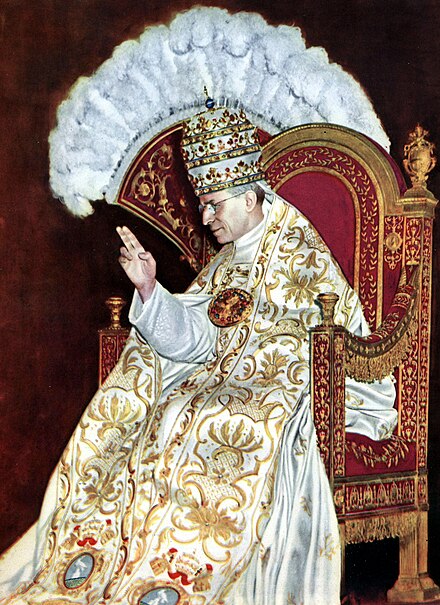
Pius XII in the sedia gestatoria

Just attended a poetry reading on the theme of poverty. Unfortunately, after a dozen poets had read their poems, the meeting devolved into a political meeting, with the hosts insisting that the problem was systemic, that it was about intersectionality and some having special privilege, and—revealing quote—“the real problem is not poverty, but abundance.”

It is not that the left wants to help the poor; it envies the rich.

Perhaps a dozen poets read. Only four were “white.” Only two spoke of personal experiences of poverty. Both were white. 

Despite this, as if deaf, the hosts asserted afterwards in their political speech that poverty exists because white people, along with straights, and men, have a systemic advantage.

In fact, the Canadian immigration system favours the wealthy and well-educated among immigrant groups. We are importing the upper classes. And being rich in a poor country means far more privilege than being rich in Canada. Once they arrive, these non-white immigrants are systematically given privileges over those, primarily “white” who have been here for generations; in the name of “affirmative action” and “equity,” they are systematically favoured in hiring and promotion.

I once challenged a Pakistani immigrant of my acquaintance, a grad student at U of T. 

“Why do you say you are discriminated against?”

“Because I’m not yet a member of the Granite Club.”

Another claimed oppression becuase he was not yet a full partner at his accounting firm.

So it is no surprise that it is the “whites” in any random group of Canadians who have known poverty. The usual claims we hear about “intersectionality” are the opposite of the truth. 

In the same way, gays are privileged over “straights,” not just now, but throughout our history. A gay man has no wife and kids to support. A gay couple generates double incomes with no children. In the traditional sex-segregated workplace of days gone by, a gay man or woman could trade sexual favours for advancement.

Women are traditionally privileged over men, and always were. In a conventional family, they got to spend 80% of the family’s shared wealth. They had a legal right to support if they chose not to work. They had more free time--demonstrated by their much higher purchase of magazines and books, and that the vast majority of TV programming was aimed at them. Men have always been the working class; and expendable in war or in dangerous jobs.

In other words, the modern social hierarchy called “intersectionality” systematically asserts the opposite of the  truth.

One of the participants at the poetry reading, citing the recent royal funeral, went on about how wrong it was for the British royal family to possess so much wealth. Why couldn’t it be distributed to the poor?

But distributing it to the poor is not the point. Were it distributed to the poor, it would help a bit perhaps, a few pounds more for a month or a year, and then be gone forever. It would be very little per capita. On the other hand, the crown jewels, for example, are not of any great personal benefit to the Queen. She gets to wear them once, at her coronation, and then they are stored behind glass at the Tower of London for tourists to look at.

The pomp of a royal funeral, or the crown jewels, are major tourist attractions. They generate wealth. Including more wealth for the poor than a one-time distribution of state wealth would.

So the problem is not that some people are poor. The problem is that the royals are rich. The problem is envy. The relatively rich always envy the richer. The poor have no such ambitions. They only want enough. The poor delight in the chance for a celebration now and then, to pull them out of their sordid daily lives; just as it is the poor who will invest in a lottery. To them, it is worth the penny for the fantasy.

One participant in the political discussion was similarly shocked by a scene she said she saw in the Vatican. Women were tearing off their jewellery and throwing it at the pope in his chair.

I have some doubts she actually saw this. The pope has not promenaded in a chair since John XXIII. But if she did see it, what was she seeing? Not the accumulation of wealth, but relatively wealthy people—wealthy enough to own valuable jewellery—surrendering their wealth. The pope was not going to wear that jewellery, was he? The pope does not get to live a particularly luxurious life. The jewellery, if it was collected, was more likely to go to the poor, through Catholic charities. And if not to the poor, to the church rather to any individual. To churches, open for anyone to enjoy.

People who are up to no good will always assert the opposite of the truth. And, if anyone corrects them, will set up an ungodly howl.

Accordingly, I bit my tongue. Such is the price of life in society. The most I dared do was post in the comments section "the real underlying problem is poverty of meaning."

Instead, I go home and post on my blog.


Monday, May 24, 2021

The Real World of Discrimination


The much-despised Tree of Life, in Kabbalistic symbolism: a representation of the attributes of God.

Caitlin Press in Tofino is calling for poems for an anthology about trees: ideally poems that “dispel the myth of hazardous and inconvenient trees.”

This is striking, because there are no such myths. In every known culture, trees are venerated. Which is why there is a market for an anthology of poems about trees. People love trees.


The much-despised Christian Tree of Life

This points to a common phenomenon. There is a persistent tendency to declare things or groups that are especially favoured to be or to have been discriminated against. Conversely, things or groups that have genuinely experienced discrimination get no love. In fact, this almost goes without saying: you are automatically not discriminating against any group you lament as being discriminated against.

For example, we are told endlessly that women have faced discrimination throughout history. Yet demonstrably, current laws discriminate in their favour in myriad ways. This is also true historically: women have always been put on pedestals. In many cultures, women were exempt from prosecution for any crimes; they were protected in times of war, rather than being sent to the front; and on and on. The exalted status of women has always been, in a phrase, a “motherhood issue.” And this is biologically hard-wired. Men are expendable, but women are not: they are needed to ensure the survival of the tribe.

We in Canada are told incessantly, and have always been told, that Indians have been discriminated against. Yet they are demonstrably given more rights than other Canadians: special treaty rights, a wide range of benefits not available to other Canadians. Any history of the Indian in literature reveals an unrealistic reverence for the “noble savage.” Everyone has always wanted to be an Indian, in Canada and in the US. And no, their land was never taken or stolen from them—a subject that might take us, for the moment, too far afield.

What about African Americans? Everybody agrees they have been discriminated against; and surely they have a legitimate grievance? After all, they were enslaved. But compare the Irish; the Irish too were enslaved in the New World, if not perhaps to a comparable extent. Indentured servitude. Moreover, the Irish, unlike the blacks, have been systematically oppressed wherever they lived for about five hundred years, including a mass starvation in the middle of the last century. About the same time slavery was abolished—after it was abolished throughout the British Empire. On balance, then, the Irish have arguably had a tougher time of it for longer. Yet there is little or no sympathy for the Irish. Current laws discriminate in favour of African Americans; and against Irish Americans.

It may be disturbing to accept it, but chattel slavery was thought throughout its existence to be of benefit to the African American slaves. They were understood to be unable to look after themselves properly, whether due to genetic incapacity or lack of civilization, and, like children, were to be taken care of. They were not hated or despised, any more than children are.

The Irish, by contrast, were hated and despised.

Who has authentically been persecuted and discriminated against, in recent times? The Jews. Within living memory, there has been a systematic and international attempt to exterminate the Jews. Compare African American slavery—never meant to harm, and abolished a hundred and fifty years ago. Anti-Semitic attacks are still the most common hate crime in Canada, and are on a rapid upswing across North America and Europe. Yet there is little public attention to it; if anything, it seems to be encouraged by some public figures.

The Poles. As many Poles as Jews were executed by Hitler in his camps; their country was carved up and enslaved in turn by Germany, Austria, Russia, and the Soviets. Yet Poles remain one ethnic group it is still acceptable to lampoon. Polish jokes are more or less okay in polite company.

There was something like an attempt to wipe out the Ukrainians within living memory. Yet Ukrainians remain another ethnic group it is still acceptable to lampoon. 

There was a concerted attempt to wipe out the Armenians barely a hundred years ago. It may not be fashionable to mock Armenians, but there is also no sympathy for them.

Who else has known great suffering in recent decades? The Koreans suffered a brutal occupation and something like a genocide under the Japanese, from 1911 to 1945, after which they lived through a devastating war. The Filipinos suffered more under Japanese occupation, reputedly, than any other occupied nation during the Second World War. It was not a matter of discrimination, but the Chinese and the Cambodians suffered holocausts of historic proportions within the lifetimes of many, and the Vietnamese lived through perhaps thirty years of scorched-earth war. Yet these groups are given no consideration in North America; instead, they are systematically discriminated against.

To be fair, African Americans, Indians, and perhaps women have a legitimate grievance, that they have not thriven despite the special help they have been given throughout recent history. Conversely, the Irish, the Jews, the Armenians, the Poles, the Ukrainians, have been successful, even notably successful, despite persecution.

But that is neither here nor there. Being coddled is not necessarily to one’s long-term benefit, because it strips you of self-reliance. It gives you unrealistic expectations, and, when they are not met, leaves you capable of doing little but complaining loudly.

These two unlucky fates, being genuinely discriminated against and being coddled, correspond to two common fates within a dysfunctional family. One child will be spoiled into arrested development, and will grow up to be a narcissist. The next child will be tormented, but, if they survive and survive without being permanently crippled, may even be stronger for the experience. They may grow up to be a hero.