Playing the Indian Card

Showing posts with label slavery. Show all posts

Thursday, September 03, 2026

Canadian Guilt


Correct me if I’m wrong, but it seems to me that Canadians are misguided in feeling any guilt over slavery or the Indian residential schools.

Slavery was never recognized in Canada. In the lower 13 colonies, laws had to be passed permitting the institution. Common law does not recognize the right to own another person. In Canada, as in the UK, there were no such laws. This means slavery was, by default, always illegal. There was no reason or need to pass any specific law prohibiting it. Although Upper Canada, aka Ontario, did so in 1793.

All a supposed slave needed to do in Canada, was to run away. The government and the authorities would not support the slaveowner in any attempt to recover his property. If he went to court, the court would declare the enslaved man free. 

There was slavery, granted, everywhere else in the world. But not here, except among the “First Nations” beyond the reach of the law.

I also believe Canadians have nothing to apologize for regarding the Indian residential schools. There has even been an attempt to make that statement illegal and punishable by up to two years in prison. There would be no need were it not a true statement. I have read the Truth and Reconciliation Report. Despite it being their mandate to dig up all the possible dirt on the residential schools, they found nothing. And there were no mass graves.

No doubt there were some predatory individuals in the schools, as there are in any school. But the structure of the residential schools was designed to reduce this risk to a minimum. No doubt some children died in their care. Children often died young a century ago. No doubt some schools were short of funds, and cut corners. As happens with bureaucracies everywhere. The bottom line remains: the intention to educate was a noble and a charitable intention, and one called for by treaty and by the First Nation themselves. If getting educated is an attack on one’s culture, what does that say about your culture?

You may argue that the schools suppressed the native languages. After all, they forced everyone to speak English or French.

Just like any language school today. Immersion is the best way to learn a language.

What is the purpose of language? To communicate. On average, an aboriginal language in Canada has about one thousand speakers—and, having no written form, no literature. One thousand people with whom you can communicate. Compared to English the practical value of knowing that language is infinitesimal. Why spend class time on it, especially since, arriving at the age of six or above, the student is already fluent in it, more fluent than the teacher.

These schools took in students from a variety of tribes or “nations.” The students themselves could not communicate to one another in any language other than English or French.

Were the schools designed to suppress Indian culture and force assimilation to the mainstream? Perhaps they should have been, but they were not. Just the opposite. Were assimilation the intent, there would have been no Indian schools—the children would have been sent to the regular provincial schools with everyone else. Residential schools preserved some sort of Indian separateness, cultural distinctness. They trained for skills thought useful for a life on the reserve, not for success in the broader society.

Canadians will need to look harder for something to feel bad about. Might I suggest in this regard, for more suitable contemplation, our chronic anti-Americanism? Our turning away from religion? Our unrestricted abortion, and now euthanasia? Our arrogance on the world stage?


Sunday, February 23, 2025

Robbing Peter to Pay Paul Reparations


Sunny Hostin: Black Like Me?


Sunny Hostin, who has loudly called for reparations for slavery, discovered on air that her ancestors were Spanish slaveowners. 

So were those of Kamala Harris in Jamaica.

This illustrates the illogic of reparations. The likelihood is that most “African-Americans” are ethnically mixed, and descended from slaveowners as well as from slaves. It is not likely, after all, given human nature, that slaveowners back then denied themselves sex with female slaves. 

By contrast, few living “white” Americans will have descended from slaveowners. Most probably trace their ancestry through Ellis Island in more recent years. Even most who don’t will have ancestors who lived in the non-slave North, with four times the population at the time. Their ancestors fought to end slavery. And even those whose ancestors came to the US South, will probably bear no blood guilt. Only 1.4 percent of the white American population owned slaves.

All those Scots-Irish rednecks and hillbillies, the stereotypical white Southerner? Their own ancestors were probably slaves, at least temporary slaves, brought over, often against their will, as indentured servants. That was the common fate for Irish, Scottish, or Acadians (Cajuns).

So “African-Americans” are more likely to be descended from slaveholders than “white” Americans.

Who should pay reparations to whom?

The concept is nonsensical, obviously unjust, and patently ahistorical.


Sunday, February 11, 2024

... And It Brought Us Justin Trudeau


Sunny Hostin, a “black” host on The View, recently learned on-air that her ancestors included slaveowners. Which puts her in an ambiguous situation, since she has been calling for reparations for American blacks over slavery. Kamala Harris is also descended from slaveholders, in Jamaica.

Problem: under slavery, slavers owned their slaves. They could do what they wanted with them. Can anyone doubt they used black slaves for sex?

Probably no Americans tracing descent from the institution of slavery are purely African by genetics. They are probably also descendants of the slaveowners. Even on the African side, they are probably as much descendants of slavers as of slaves; the practice of slavery has been endemic in Africa from ancient times.

So, if any Americans are owed reparations for slavery, they are owed it by themselves. Not by the innocent descendants of European immigrants arriving in America after slavery was abolished, from a continent where the practice was almost unknown, but for the danger of being carried off by Arab slavers from Africa. Not from those whose ancestors laboured alongside the blacks as indentured servants. Only one percent of Americans ever owned slaves.

But of course the whole concept of reparations for those who never experienced slavery is nonsense to begin with. It makes sense only for living survivors of an injustice. We are individuals, responsible for our acts, not for the acts of others. None of us can justly be rewarded or punished for the deeds of our ancestors. The more so since the child of a bad person is most likely already their worst victim. 

The idea of inherited guilt or credit is the essence of human inequality. It is what the American Revolution was meant to end forever. It is the notion of inherited privilege; and it is blood libel.

All the same arguments hold for the idea of special “aboriginal rights” in Canada. There are few if any “pure blood” Indians in Canada. We are all Americans, we are all Canadians, we are all brothers and sisters.


Thursday, September 07, 2023

Saturday, October 08, 2022

White Privilege: A History


A friend posted on Facebook his regrets for his “white privilege.” “Know your history,” he prodded. And a lot of others chimed in with their woke assent. Virtue was roundly signaled.

I wish he did know his history. The myth of “white privilege” has emerged and is possible only because the left first went through our schools and suppressed the teaching of history. As with most things, the official line is the opposite of the truth. There is non-white privilege. There is no white privilege.

At the present day, demonstrably, in Canada, “non-whites” are systemically privileged over whites. Special aboriginal rights are enshrined in the Canadian Charter of Rights and Freedoms. Without this special exemption, the preferences given to aboriginals would be in violation of the equality rights given in the charter.

The complex of “affirmative action” preferences in government programs, education, and corporations are a blatant violation of equality rights. They ought to have been challenged long ago. Nobody has. Such is the overriding power of non-white privilege.

One might argue that such special benefits are needed to counterbalance discrimination in the wider society—some hypothetical society beyond government, the media, the corporations, and the education system. Perhaps the alleyways? Perhaps the schoolyard at recess?

Yet even at a social gathering, it is socially acceptable to mock “rednecks,” but not aboriginals or blacks. It is socially acceptable to mock Christians, or “bible thumpers,” or evangelicals, but not Muslims. It is socially acceptable to complain about Americans, or the English, or Europeans, or whites, but not Blacks or Indians or South Asians.

Even in the past, when it was okay to mock Indians or Chinese or blacks, it was at least as socially acceptable and as common to mock the Irish, the Scottish, the Polish, the Ukrainians, the Italians, or the Jews. All white, or considered “white” today.

The proponents of the premise of “white privilege” will no doubt counter that all such current forms of discrimination and non-white privilege are merely “equity,” a leg up for past discrimination against non-whites. Even if this discrimination was against individuals now long dead, it supposedly leaves marks and social inequities that persist today. 

The idea, then, that Canadian history has discriminated against non-whites. 

I challenge that, firstly on the basis that “white” and “non-white” are terms that would have meant nothing to our ancestors. This particular racial division emerged in the US and in South Africa, particularly in reference to the Civil Rights movement and apartheid, about the middle of the twentieth century. These were never meaningful categories in Canadian society, if only because few Canadians had come in much contact with anyone not of European ancestry. There was little chance to discriminate against people not present, and “white” or “non-white” was not top of anyone’s concerns.

Rather, popular discrimination in Canada was on the grounds of religion, language, and ethnicity. No Irish need apply, for example.

You might argue that, if Canada lacked Africans, they had the “First Nations.” But the treaties and the Indian Act always systemically favoured the First Nations. A survey of Canadian literature and popular culture demonstrates that, far from denigrating Indians, Canadian culture has always elevated them as romantic and heroic, and identified with them.

Canada has also had East Asians in significant numbers, for at least as long as Canada has been in legal existence. Probably every small town across English Canada has long had one or two or more Chinese families. And they have certainly faced discrimination: head taxes. The Japanese were interned during the Second World War.

But about that internment. It was not a case of racism; perhaps of ethnicity. For Ukrainians were similarly interned during the First World War, and even during the second, the majority of internees were not Japanese. Germans and Italians were also interred. The fact that the Japanese internment is remembered as something special is arguably an example of modern race preference, not past racial discrimination.

And, counter to theory, despite discrimination in the recent past, Asian-Canadians are doing better in Canada today than most demographic groups. And many current “equity” programs discriminate against them, just as they discriminate against “whites.”

And as to past white privilege, by all means, read your history. Read about how most of the ancestors of the “white settlers” came. Read about indentured servitude, read about the Great Hunger, read about the Highland Clearances. Read about the expulsion of the Acadians, read about the Home Children, read about the Holodomir, read about the Holocaust. Then tell me that white Canadians benefit from historic privilege due to the colour of their skin. 

For these are the backgrounds from which the great majority of European Canadians descend. They were not members of a wealthy upper class, as more recent immigrants tend to be.


Those who might be doing well today have worked their way up from ancestral backgrounds as dark as those of any non-Europeans. Most arrived in Canada destitute, many in bondage.

Apart from the history, if only we taught literature in our schools, we would know better than to believe in “white privilege.”

Let’s look only at the issue of indentured servitude. Up to the American Revolution, two thirds of all European immigrants to the British possessions in the New World came as indentured servants.

I quote from the first paragraph of Swift’s “A Modest Proposal,” describijng life in 18th century Dublin. The piece is satire, but for the satire to land, it has to be accurate in its description of actual life in Ireland.

“These mothers, instead of being able to work for their honest livelihood, are forced to employ all their time in strolling to beg sustenance for their helpless infants who, as they grow up, either turn thieves for want of work, or leave their dear native country, to fight for the Pretender in Spain, or sell themselves to the Barbadoes.”

What is that about? Sell yourself to the Barbadoes?

And all this well before the Great Famine.

And again:

“I am assured by our merchants, that a boy or a girl, before twelve years old, is no saleable commodity, and even when they come to this age, they will not yield above three pounds, or three pounds and half a crown at most, on the exchange.”

What? Children and teenagers were bought and sold? And so cheap?

They were then shipped out to the so-called “settler colonies” as indentured servants. On Christian principles, they were only selling their labour, not themselves. But in practice, they lived the same lives in the same conditions as the African slaves for the fourteen years of their servitude.

Indeed, quite likely worse lives. An African slave was yours for life; it made sense to preserve his health. But if you have him for only another few years, it makes financial sense to work him to death.

Have you ever noticed how many “African-Americans” have Irish-sounding surnames? Shaquille O’Neill. Bill Cosby. John Coltrane. Countee Cullen. Marcus Garvey.

Did you ever wonder why?

The black slaves and the Irish indentures lived and worked together. They naturally intermarried.

Fourteen years of slavery might not sound so terrible. But the average lifespan for an Englishman in the 18th century was 34 years. It was surely lower in Ireland, due to poverty and malnourishment. Fourteen of those years was therefore significant. In fact, more than half of indentured servants died in servitude.

Slavery was abolished throughout the British Empire in 1834. Indentured servitude was banned in Canada only in 1917.

And who owes whom reparations for that? Should the grandchildren of slaves be paying reparations to the great-great grandchildren of slaves held in some other country?


Saturday, September 24, 2022

Why the Jews?


The CBC of course uses the death of Queen Elizabeth as an opportunity to slam the British and the monarchy. Just as Easter is always an occasion to question the divinity of Christ.

Both speakers simply assert without argument that empire was a matter of “looting and plundering” the colonies. ”Forty-five trillion dollars of wealth stolen just from the Asian subcontinent.” Even defenders of the monarchy and the British are inclined to argue only that the indecencies of the Empire were long ago.

Yet this is a point that needs to be established. Was government by the British more costly to the colonials than local government? There is no reason to assume so. In fact, historians often suggest that the reason the British, and other European, empires broke up after the Second World War was that the European countries could no longer afford them. They were being subsidized, then.

Were local industries suppressed? India commanded a larger portion of world GDP under the Raj than it did for many decades after independence. That does not sound like a suppression of local industry.

Of course, the issue of slavery is raised. Yet, as Don Lemon learned in a recent interview, if slavery is the premise, it is probably the British who deserve reparations. Slavery was universal. Britain was among the first nations to abolish it, they ended it in all their possessions, and they spent a great deal to end the practice everywhere.

The CBC interviewee actually blames Britain for ending the slave trade, on the grounds that they paid for the slaves’ freedom, instead of paying the slaves.

We have probably all had ancestors who were slaves, and ancestors who were slavers. Who pays whom? The one group who seem more deserving than the rest of us are the British, who ended slavery, fought the slave trade worldwide, and were still paying to end slavery as recently as 2015. That means most Britons still living today.

Surely it is they who deserve reparations. 

The interviewer suggests the Koh-I-Noor diamond should be returned “either to India or to South Africa.” But a half-dozen countries in total claim the diamond. They all say it was stolen from them by one of the others. So whom to “give it back” to? England obtained it by a peace treaty, in return for other concessions. If it is returned to India, other elements of that treaty must properly also be renegotiated. In effect, then, it must be bought back. And what if some other country wants to offer Britain more for it?

The interviewee even blames the British Empire for the Caribbean’s sovereign debts, and for climate change.

I doubt any of that sovereign debt was racked up by the colonial authorities. I doubt the British Empire had much effect on greenhouse gases today.

It all reminds me of an old Yiddish joke. A couple of Nazis stop a Jew in the street, and challenge him.

“Who is responsible for Germany’s problems?”

The Jew knows they want an excuse for a beating.

“The Jews,” he answers. “And the bicycle riders.”

“Why the bicycle riders?”

“Why the Jews?”

The answer is simple: because, like the British, they are envied.

Saturday, July 11, 2020

Reparations for Slavery


One aspect of the current uproar around race is a demand in the US that the government pay reparations for slavery.

The notion is nonsensical.

To whom? There are no former slaves in the USA. To pay reparations to the descendants of slaves becomes a matter of inherited privilege. The Declaration of Independence weighed in against such things in stern terms when it declared that all men are created equal.

And how do you track descendants? As any DNA analysis will demonstrate, essentially no “African-Americans” alive today are of purely African origin. In other words, part of them is slave, and part of them is not—is, possibly, slave owner. Presumably, then, they should pay reparations to themselves, one pocket to the other. 

By contrast, given the demographics, it is exceptionally unlikely that the average non-black American living and paying taxes today had an ancestor who owned African slaves. Most have come more cecently from Europe, and even among those whose ancestors were in North America before 1860, the rate of slaveholding was something like 1%. If they came from Europe, slavery had not been a thing in Europe for the past few thousand years. By contrast, among African-Americans, even their African ancestors were likely to have had African slaves, since slavery was an endemic practice in Africa until recent times. Why then are the descendants of those who did not hold slaves paying reparations to the descendants of slaveholders?

It is true that corporations are considered people; accordingly, the US government can be held liable now for injustices perpetrated by the US government in even the distant past.

But here we have another problem. The US government spent a good deal of money, and lost a lot of soldiers’ lives, to end slavery. The governmental organization liable for slavery would be the Confederate States of America. I hear they filed for bankruptcy some time ago.

Perhaps then government responsibility devolves to the individual states. But good luck figuring out whether, and how many of, a given individual’s ancestors were held as slaves in the sovereign state of Mississippi.

And then, what about others whose ancestors were enslaved? What about the Irish, my own forebears, who were commonly held in indentured servitude, slavery by the UN’s current definition, throughout North America and the Caribbean, and who were dying in multitudes by a largely government-induced famine in the same years immediately before the African slaves were freed in the US? Why reparations for the one group, and not the other?

The natural reaction is to point out that modern Irish-Americans do not need the money. By and large, despite coming from such a dark place so recently, they are doing well. The same might be said of the Jews, who were being dispossessed and systematically exterminated in Europe up to 1945, almost a century after the last slave in the US was freed. Yet nobody thinks the Jews need public money. Or the Armenians, or the Lebanese, or the Ukrainians, or the Cambodians, all victims of more recent holocausts.

Reparations are not called for, would not be just, and, on this evidence, would do no good. It is not the legacy of slavery that is holding African-Americans back.


Wednesday, April 13, 2016

Want Slaves?


Arab slave merchants with Zanzibar slaves.

It is no particular knock against Indian culture to note that they practiced slavery. After all, until recently, everyone did. A few years ago I lived in Al Ain, an oasis in the Arabian desert. It has a large livestock market, probably serving most of the United Arab Emirates and the southern part of Saudi Arabia. This is the last water source inland from the Indian Ocean coast before the barren desert begins. At that coast, dhows used to arrive from Oman's African possessions, once stretching south to Zanzibar.

Up into the 1950s, this livestock market was also the slave market. Slavery was officially outlawed in Saudi Arabia only in 1962 (Guy Nixon, Slavery in the West, Bloomington, IN: Xlibris, 2011, p. 13).

Slave market, Khartoum
Slavery has been routine in China, India, Africa, and the Muslim world throughout recorded history. It is enshrined in the Code of Hammurabi, the world's first recorded set of laws. It is now considered an unspeakable evil, but almost all past societies have found it not just useful, but necessary. After all, before our current bankruptcy laws, what were you going to do if someone got himself into more debt than he could possibly repay? What were you going to do if you took prisoners of war, in a time when social organization was too weak to sustain prisons? Indeed, what were you going to do with ordinary criminals? You could cut off their heads. You could cut off their hands. Or you could take it out in labour.

However, it is worth mentioning that slavery was the common practice among Canadian Indians too, because enslavement is too often represented as a peculiarly European, and even English, vice, replacing in Canada a native society that was all unicorns and rainbows. This is squishy-headed romanticism, “noble savage” stuff. Of course Indians kept slaves; like everyone else. Captain John Smith, of Pocahontas fame, speaking of Powhatan's tribe, observes that they made war, "not for lands and goods, but for women and children, whom they put not to death, but kept as captives, in which captivity they were made to do service" (Samuel Purchas, Purchas His Pilgrimes, 1625, edition of 1908, Volume 4, pp. 1699-1700). 

Captain John Smith and Pocahontas

The group we obediently politically correct sorts recently started calling “Dene” were formerly called, from the Cree, the Slaves or Slavey. That was their chief significance, to the Cree, who regularly raided and enslaved them. The Jesuit Relations have many stories of the Eastern Woodlands Indians holding slaves. Among others, Father, now Saint, Isaac Jogues was captured by the Iroquois, and enslaved for about a year, until he was ransomed by the Dutch (Jesuit Relations 31, p. 91). The system among the Iroquois was to give a captive to any family who had lost a relative in war. The family—generally the wife or mother--could choose to have the captive tortured to death, or make use of the slave's labour for as long as they saw fit. Father Joseph Poncet writes, of his own captivity: “I was given to a good old woman in place of a brother of hers, who had been captured or killed by those on our side. Nevertheless, my life was not yet safe; for that woman could have made me die in all the torments that could have been suggested by revenge” (Jesuit Relations 40, p. 135). The Jesuit records explain, of the Iroquois, "When a barbarian has split the head of his slave with a hatchet, he says, 'It is a dead dog—there is nothing to be done but to cast it upon the dung hill'" (43, p. 295). Iroquois slaving raids could produce three or four hundred captives at a time (Almon Lauber, "Indian Slavery in Colonial Times," Columbia University Ph.D. Thesis, 1913, p. 29). Jesuit Father Fremin mentions an Iroquois woman who owned twenty slaves (Jesuit Relations 54, p. 93). French sources attest that the Huron and Ottawa also kept slaves; Ojibwe slaves came from as far away as Eskimo country (Jesuit Relations 30, p.133).

You can certainly find sources which will deny that tribes did not practice slavery, or claim that slavery was rare outside the Pacific Northwest. This is sheer political correctness. As the Jesuit records show, slavery and some sort of slave trade was widespread and followed a familiar pattern: it was an established cultural practice, with set laws to govern it. The slavery deniers rely on making a slippery distinction between “captive” and “slave.” But even this does not hold up. The early French sources make it clear that being captured in war was not the only way one could become a slave. There were deliberate slaving raids. Beyond that, debt was another route to enslavement (Jesuit Relations 16, p. 199). Just as with slavery elsewhere.

Treaty requiring return of escaped slaves, 1480 BC.


UNESCO defines slavery as “an element of ownership or control over another's life, coercion and the restriction of movement and by the fact that someone is not free to leave or to change an employer." (http://www.unesco.org/new/en/social-and-human-sciences/themes/international-migration/glossary/slavery/). By that definition, there can be no question: slavery among North American tribes was practically universal. It is also the common condition of expat employees everywhere; but never mind. Like any bureaucracy, UNESCO needs to artificially create problems as an excuse for more funding. If you want a problem never to be solved, set up a government bureaucracy to solve it. 

Let's stick with the dictionary. Oxford defines slavery as “A condition of having to work very hard without proper remuneration or appreciation.” That proves conclusively, among other things, that I am currently a slave. Merriam-Webster defines slavery as “the state of a person who is a chattel of another.” By that definition, the American Indian practice was surely slavery—besides being able to buy or sell a slave, an owner could kill without penalty. What else could more clearly define ownership?

The Indians of the Canadian Northwest were especially energetic slavers. An estimated one quarter of the resident population among Pacific Northwest tribes were slaves; a proportion similar to the US South before the Civil War. When being taken over by the U.S. After the Alaska purchase meant freedom for their slaves, the Tlingit of Alaska crafted a totem pole with the figure of Abraham Lincoln at the top, to shame the government and demand compensation.

Abtraham Lincoln figure from original Tlingit totem pole.

Among the Tlingit, the practice was to pull out one eye to identify a slave as property. The Indians of the US Southwest would instead cut the tendons of the ankle, or cut off part of a foot. This made escape difficult. Slaves might be ritually killed at a potlatch, usually by being brained before the guests with an axe, or at the death of their master, to provide services in the next life. Or, of course, if they grew old or got sick. A prominent Tlingit or Haida citizen might own as many as fifty slaves.

Slavery among Alaskan Indians was only outlawed by court decision in 1886, two decades after the Thirteenth Amendment to the US Constitution prohibited it for whites. Instances of enslavement are still reported as late as 1903. The Queen Charlotte Islands, now renamed, with proper respect to the local Indian culture, Haida Gwaii (“Islands of the Haida People”), have been described as “the great slave mart of the northwest coast” (Bancroft, History of the Northwest Coast, ii, pp. 647-649).

Until 1850, the Thompson Indians of British Columbia kept slaves (Teit, "The Thompson Indians of British Columbia," in Memoirs of the American Museum of Natural History, pp. 269, 290). In 1836, the Chinook Indians of the BC interior still kept slaves (Thomas, Indians of North America in Historic Times, p. 369). Lauber concludes, “among the North American tribes, the custom of slave-holding was practically universal” (Indian Slavery in Colonial Times, p. 45).

Oddly enough, as is so often the case, what is commonly believed about slavery is the exact opposite of the truth. Those who profit from deceit usually, instinctively, feel safest as far away from truth as possible. The peculiar institution was hardly a uniquely European or even English vice. In fact, in all the world, in pre-modern times, there was only one notable, though only partial, exception to the general practice of slavery: Christian Europe. Moreover, it was primarily Christian reformers who had the institution ended, world-wide, over the last two or three centuries.

The ancient Romans had slaves. The ancient Greeks had slaves before them, and the ancient Egyptians and Mesopotamians. But almost as soon as Christianity became the established church of the Roman Empire, the practice fell into radical disuse. While usually not prohibited outright, it did not fit with the Christian belief in the equality of man. Usury was by Christianity banned, preventing people from falling into insurmountable debt. Prisoners of war came to commonly be ransomed, or simply “paroled,” released on giving their word that they would not again take up arms. Where the practice persisted, Christianity assigned the enslaved person significant rights. According to the church, no person, on principle, could ever be owned by another person; the master could, at most, have rights to their labour. In other words, the Christian practice was servitude, but not slavery, according to Merriam-Webster's strict definition. John Chrysostom, church father, described slavery as “the fruit of covetousness, of degradation, of savagery ... the fruit of sin, [and] of [human] rebellion against ... our true Father.”

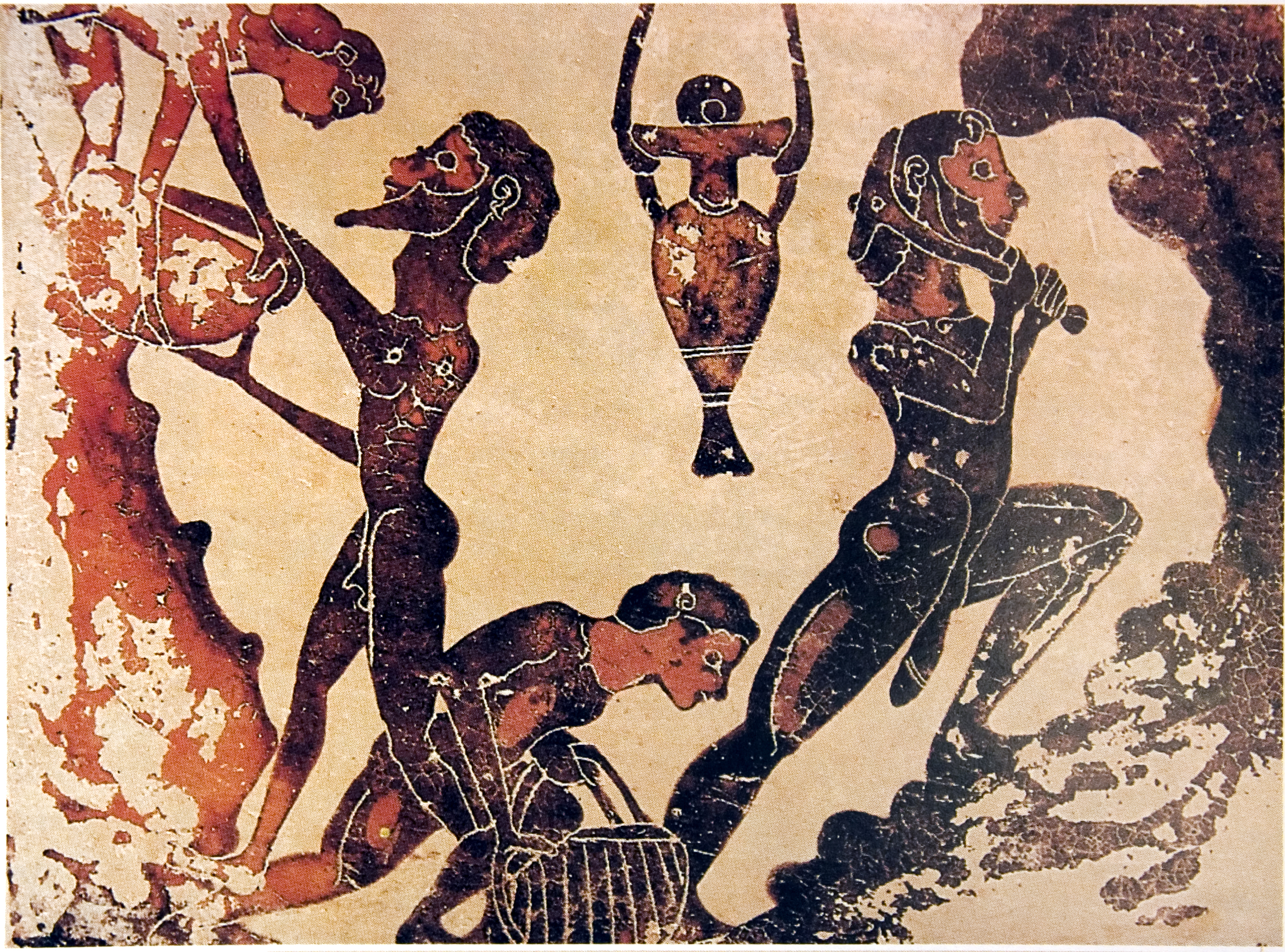
Ancient Greek slaves working in a mine.

So why did slavery, and extreme chattel slavery, revive among Europeans in the New World? Two clues: note that it reappeared very soon after Columbus landed, and it appeared only in the Americas. It was not generally accepted, even then, in Europe. Ownership of people had to be expressly permitted by statute in the English American colonies; it had no status in English law. It was legalized in Massachusetts in 1641, in Connecticut in 1650, in Virginia in 1661. It was, to our everlasting credit, banned in Ontario (then Upper Canada) in 1793. Upper Canada was the first British colony to abolish slavery. It was not a major local issue at the time, but Governor Simcoe wanted to prevent United Empire Loyalists from bringing in slaves as they immigrated from the new US. Simcoe considered slavery “an offense against Christianity.”

Massachusetts governor's warrant allowing the sale of native Indians as slaves.


The obvious conclusion is that Europeans were re-exposed to the idea by their travels, by contact with the Muslim world, with Africa, and with the American aborigines, among all of whom it was established and common practice. “The finding of the same custom among the Indians themselves, make their carrying on of the practice quite natural” (Lauber, p. 46). Columbus encountered slaving almost immediately on landing: the local Indians of San Salvador made him understand that “people from other adjacent islands came with the intention of seizing them, and ... they defended themselves” (Columbus, Journal of the First Voyage, 12th of October).

The first slaves held by Europeans in America were certainly native Indians. One can imagine how it came about. Indians, wishing to make a bargain, would have presented slaves as trade goods as a matter of course. When in Rome... Later, they discovered a European interest in furs, but at first, the native interest in European goods far exceeded their capacity, in their extreme poverty, to trade anything of comparable value in return. Columbus attests to an extreme thirst to trade in the Indians he first encounters: “for the longing to possess our things, and not having anything to give in return, they take what they can get” (Journal of the First Voyage, 13th of October). On his Western travels, De Boucherville was offered many slaves as a means of establishing good will (Lauber, p. 32). “In 1684, the Indians offered Du Luth slaves to take the place of some assassinated Frenchmen. In 1724, the Indians at Detroit offered the French commander, by way of truce, two slaves for the same purpose.” (Lauber, p. 38). At the same time, Europeans were certainly taken by Indians in slavery, from very early colonial days; turnabout probably seemed fair play. “Strachey, in The Historie of Travaile into Virginia, speaks of a story that he had heard from the Indians, concerning an Indian chief, Eyanoco by name, liv'ng somewhere to the south of Virginia, who had seven white slaves who had escaped from the massacre at Roanoke. These slaves the Indians employed in beating copper.” (Lauber, p. 46, note; Hakluyt Society Publications, 6, p. 26). “Captain Hendrickson, in 1616, found three persons belonging to the Dutch West India Company, who were slaves of the Mohawk and Minquae, and who were traded to him for merchandise” (Hazard, Annals of Pennsylvania, p. 7). Lauber cites more cases from early records. The taste acquired, the number of available natives become too few, the Irish, conquered and sold into service by the English, often took their place. Then Africans were imported. Offered, in turn, by Africans eager to trade for European manufactures.

African slaves
The Portuguese had explored the coast of Africa down to the Cape of Good Hope by the time Columbus reached Hispaniola. The local inhabitants of their colonies along the African coast, which they had established for ship resupply, all offered slaves. But at first the Portuguese had no use for them. Then Spanish and Portuguese Catholic missionaries began advocating accepting them, as the alternative was generally to see them put to death by the tribes who had captured them as spoils of war (Nixon, p. 11). The same may often have been true of Indian slaves. If the Iroquois had no use for a captive as a slave, they were slowly tortured to death.

In sum, slavery was nearly universal outside of traditional Christian lands. Indian slavery is no special knock against Indian culture. Still, we do not want slavery, do we? We do now believe in the equality of mankind? We don't think only Haida are human? So recall, when you hear demands for a return to traditional Indian culture, and the claim that it was corrupted by European influence, that some of those rainbow unicorns were not there of their own free will. Traditional Indian culture often involved, and economically relied upon, slavery. It is hard to see the good in reviving that culture in too much detail.

Want slaves? Ask an Indian.


Monday, February 17, 2014

Reparations for Slavery

Does someone deserve reparations for living here?

A coalition of 14 Caribbean states, including Jamaica, is now asking for reparations for slavery from Britain, France, and Holland.

I suppose I should support the campaign. For, after all, if these folks deserve money from modern Britons now for a policy that ended in 1833, I should surely score something nice for the longstanding occupation and mass starvation of my ancestors in Ireland, right up to the 1920s. And then there is the matter of the Irish slave trade.

If only it weren’t for the obvious injustice of the claims.

After all, not a single Briton living today has owned a slave, and not a single Jamaican can claim to have been enslaved. So why should either accuse the other of guilt or responsibility? If this is just, should modern Jews then bear responsibility for the crucifixion of Jesus Christ?

The advocates of reparations say, ““You can’t have it both ways,” … “Your [British] society was developed. You are enjoying a lifestyle because of the blood, sweat and tears of people in the past.”

Yet this was a past that ended almost two hundred years ago. If it is really responsible for Britain’s current relative wealth, and Jamaica’s poverty, then how to explain the current wealth of Germany, for example, who was never involved in the slave trade, and has risen from utter desolation as recently as 1945? The same could be said for most of Europe, and Japan; or for any number of immigrant families who arrived destitute on America’s or Canada’s shores, and in two or three generations were quite well-off.

The demand overlooks the fact that, in world terms, Britain, France and Holland were actually among the first countries to abolish slavery. It persisted much longer in Africa: in Niger and Mauretania, into the 21st century. Had their ancestors not been transported to the new world, it would probably have taken several generations longer for African-Caribbeaners to have achieved freedom from the practice.

The demand for reparations also overlooks the fact that Britain left the ex-slaves and their modern descendants in possession of several new democratic nations. And that the citizens of these countries, on the whole, are better off financially as well as in terms of personal freedom than African-Caribbeaners would be if they were now living in Africa. Jamaica’s GDP per capita is higher than almost all black African countries, and a full ten times greater than the ethnically comparable nation of Liberia. And Jamaica is one of the poorest of the former British possessions in the Caribbean. The GDP per capita of the Bahamas, for example, is three to four times larger again.

Obviously, such variations in the economic welfare of otherwise similar states have nothing to do with slavery two or three hundred years ago. They have to do with good and bad governments today.

Unfortunately, it is entirely in the interests of bad governments and corrupt elites to demand reparations for slavery. Not just for the free cash, but to distract attention from the real problem, and their own culpability.

Wednesday, November 06, 2013

Slavery and the Bible


Joseph being sold into bondage.

A friend who claims she is an atheist has linked on Facebook to a poster with the caption: “If the bible got the easiest moral question humanity has ever faced wrong, and that was slavery, then what are the odds that it is wrong on something as complex as human sexuality?” – Dan Savage.

Let’s respond: both major premise and minor premise are wrong. Therefore, the conclusion does not follow.

First, slavery is not the easiest moral question humanity has ever faced. It is a complex issue. Second, it is not clear what the Bible’s position is on slavery (whereas its positions on human sexuality are generally straightforward).

What is “the easiest moral question humanity has ever faced”? Surely murder, not slavery; is enslaving someone worse than murdering them? Is life less important than liberty?

So, murder is the easiest moral question. But to be clear, there are degrees of murder. Surely mass murder is worse than individual murder: killing a million people is worse than killing one. So, mass murder is the easiest moral question. In addition, surely killing someone who is absolutely blameless is worse than killing someone whose own deeds are dark—there are various shades of gray on the path to what becomes justifiable homicide. Moreover, surely killing someone who is about to die the next day of natural causes is not as bad as killing a young person with their whole life before them. The net natural lifespan remaining enters into the equation.

Therefore, being precise, the easiest moral question mankind has ever faced is, in fact, not slavery, but abortion on demand: the mass murder of innocents at the very beginning of life.

I think you will find that the Bible is against this. The evil of killing children is a central theme throughout the book.

Slavery, by contrast? While an evil in itself, it may easily be preferable to the alternatives available.

First, let’s define our terms. Merriam-Webster defines slavery as “the state of a person who is a chattel of another.” This I find unsatisfying, because what a “chattel” means can vary greatly; what ownership entails may vary greatly depending on the laws in force. Moreover, being owned is not necessarily an unpleasant thing: when my kids refer to me as “my Dad,” or my wife as “my husband,” I tend to feel proud, not oppressed. Yet this is, literally an assertion of ownership.


William Wilberforce, Evangelical Christian, the man who ended slavery throughout the British Empire.

Wikipedia says slavery is when “one human being is legally the property of another, can be bought or sold, is not allowed to escape and must work for the owner without any choice involved.” Again, let’s skip that “legally the property of another” as too vague. Let’s say a slave “can be bought or sold, is not allowed to escape, and must work for the owner without any choice involved.”

Notice that that comes close to a definition of what happens when you are sent to prison. It is also pretty close to what happens when a divorced father is ordered to pay child support. The only thing missing is the “bought or sold” bit. Which does not really seem to be the most oppressive part, does it? Athletes have long been “bought and sold” by their teams, but we don’t think of them as suffering too much because of it.

So, are you willing to insist that these arrangements, prison for crime and mandatory child support, are obviously immoral? Not even the “easiest moral question humanity has ever faced,” but just obviously immoral? What’s your alternative?

Think carefully, because the obvious and historical answer is, in fact, “slavery.” Until fairly recently, societies were not strong or rich enough to support police forces and prison systems, to track down debtors, or to tend abandoned children. These necessarily had to be farmed out to individuals, and that means slavery. Recall that there were not even any organized police forces in Europe until the early 19th century—Robert Peel and his “Bobbies” being a famous early example.

Not coincidentally, this is the same time slavery started to fade out. At the beginning of the 19th century, three-quarters of the world’s population was still held in slavery of some sort. By the end, slavery in all forms was banned throughout Europe, America, and most of the rest of the world.

From the beginning of recorded history, slavery has been used to address four problems: 1. Punishment for crime; 2. Inability to repay debts; 3. Poverty, and 4. Conquered people.

Punishment for crime seems obvious: if you do not have a prison system, what do you do? Either you execute for every crime, or you torture, or you exact fines for everything, or … you enslave them. None of these sound good, but you must have some punishment for crime. Especially in the case of theft, but also assault and any other form of personal harm, enslaving them seems an obvious solution: the criminal’s labour can actually pay the victim back. Is our present system, in which the victim usually gets nothing, obviously better?

By extension, slavery also works as a way to pay back debts. Is our present system, of declaring bankruptcy and walking away, obviously more just? Although it brings economic benefits, it is surely not as fair to the creditors.

Poverty explains the bit in the Bible about selling your daughter. When there is no welfare system, what do you do? Is selling yourself or your child into slavery worse than leaving them and you to die slowly of starvation in the street? Is it even fairer than forcing others to pay for your upkeep without recompense, as we do at present?

Enslaving conquered people seems less fair than these other forms of slavery. But here, too, there was a practical necessity. Prisoners of war require a prison system. Without one, what do you do with a defeated enemy to prevent him from just running home, re-arming, and coming at you again tomorrow? Okay, you could kill him and eat him. It’s been done. Slavery seems a bit better. It takes a very high level of trust for both sides to sign a paper promising not to take up arms again right away, and let that suffice.

The Bible does not clearly take a stand either for or against slavery; it accepts it as a fact of life. Joseph being sold into slavery by his brothers, or the Hebrews being in bondage in Egypt, are hardly presented as good things. And that, given the alternatives, seems to be the morally proper position. A comparable case is that of usury. In the Bible, charging any interest on a loan is considered a sin. This is no longer held to be so, by most Christians and Jews, because the danger of usury has been eliminated by the bankruptcy laws. Now it is only excessive interest that is condemned. Another is capital punishment. This is obviously permitted in the Bible; that does not mean it is presented as something good. It was a practical necessity. Now, on the other hand, when almost all nations have dependable prison systems, the Catholic Church holds that the underlying principles of the Bible make it immoral.

It seems likely, too, that the Bible would have been opposed to the particular form of slavery practiced in the US South up until the middle of the 19th century, which is probably what most of us think of when we hear the word “slavery.” In fact, it was Christianity that ended it.


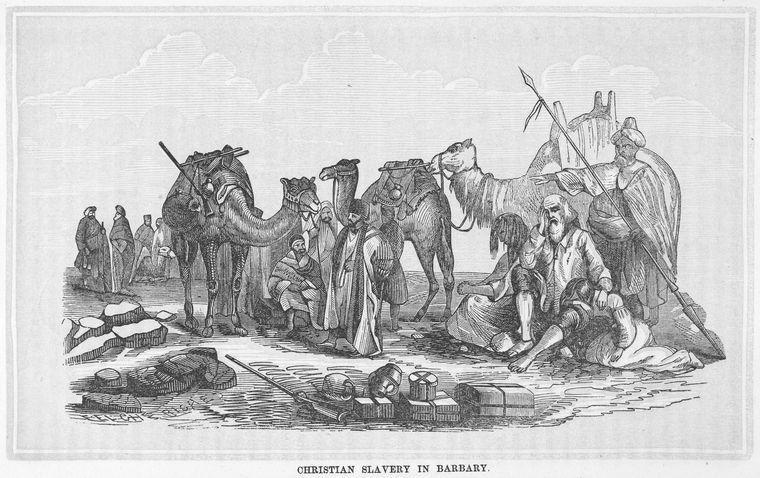
European Christians enslaved in Barbary.

The biggest problem with US slavery was that it assumed human inequality: it saw Africans as an inferior race who were better off as slaves. The Bible insists on the moral equality of all human beings, as children of God. Locke took this religious assertion, and from it developed his political ideas, later enshrined in the US Declaration of Independence: that all men are created equal, and that they are endowed by their Creator with certain inalienable rights, among which are a right to liberty.

This “right to liberty” was the doctrine that eventually ended slavery, and it came, says Locke, from the equality of man as asserted in the Bible.