Playing the Indian Card

Showing posts with label native people. Show all posts

Tuesday, September 22, 2026

Turtles All the Way Down

A Hindu traditional image of the cosmos


I was upset, unreasonably, by a recent bit by the National Post on “Turtle Island.”  Because they were saying what I’d been saying for years. And no one has been listening. I want credit!

It was about “Turtle Island” supposedly being the traditional name for North America among the native peoples, the “First Nations.” There are problems with that idea.

First, the native people would have had no idea what a continent was, let alone having a name for the one they were supposedly on. Micmac living in Nova Scotia, say, would have had no idea there was a vast ocean five thousand kilometers to their West, nor one as distant to their North, or to their South. Nor would they have imagined this was of any significance. Continents are a fairly arbitrary Western idea, a cultural construct. Why, for example, are North and South America separate continents? More or less because Teddy Roosevelt dug the Panama Canal. In much of Europe, the Americas are still not considered two continents, but one. And what is the sense of seeing Europe and Asia as two continents instead of one? Why do the Urals split continents, but not the Himalayas or the Andes? 

When some ancient culture refers to living on a large island –as they all do -- they are conceiving of all creation, the ordered cosmos, as an island, not this or that body of land. And surrounded not by physical seawater but by the “sea” of chaos. Ancient Greece conceived it so, Ancient Mesopotamia conceived it so, and so did the Old Testament’s seven days of creation. “Turtle Island” is not North America, or even planet Earth, but the cosmos, the material world.

And according to the native people, there ain’t necessarily no turtle, either. There were thousands of different ethnicities wandering about Canada, each with their different creation myths. Perhaps one or two involved a turtle; perhaps none.

The “Turtle Island” concept as supposed native name for North America comes from Gary Snyder, West Coast Beat poet and environmental activist, who used it as the title of a poetry collection in 1974. He claimed without evidence that it was from Native American culture. He really got it from India, and from the Western philosophical tradition. It is an old Hindu idea that the world is supported on the backs of elephants who stand on a turtle. This image, misunderstood to be literal, has been preserved since the 19th century by European/American philosophers to be mocked as an example of primitive thinking and of infinite regression: “it’s turtles all the way down.”

Probably most people today claiming to be “First Nations” genuinely believe this was their own ancestral belief. How would they know? They got that idea from the TV, like the rest of us. They grew up in the same culture as the rest of us. “Native wisdom” is all a childish fantasy from the hippie movement of the 60s.


Sunday, August 17, 2025

The Myth of the Dying Indian


Hills and Angry Waters-- an old poem about Saint John, New Brunswick

Where bold the hills outjutting to the reef rough swept with spray,
And Whygoody's swirling water meets the tides of Fundy Bay,
An Indian Chieftain with his tribe had camped upon a day
By the coves and purling brooks of Managuashe.

Straight stood the chief outgazing o'er the billows flecked with foam,
Where the broken sunbeams wander and the shapeless shadows roam.
The south wind brought its message of the salmon speeding home,
To their river haunts beyond bold Managuashe.
 
Then blazed the bonfires brightly on the hills from bay to bay,
And the Indian braves and maidens danced and sang in wild array.
The Indian Chieftain and his tribe feasted 'till dawn of day,
On the old and loyal resorts of Managuashe.

Again gazed Panamseguis o'er the deep on rushing tide;
Now, his eyes were strained in wonder, low he bowed his head and sighed,
And to his people thus he spoke, humbled his voice and pride.
On the forest camping ground of Managuashe.
 
My brothers, braves and children of the noble Malicete,
Your hearts will burn with anger at the sight your eyes shall meet.
Behold! Upon you swelling flood the vanguard of a fleet
Which shall take from us our rugged Managuashe.
 
Many moons ago a vision by the great Manitou sent,
Appalled mine eyes and spirit, and I heard my tribe's lament.
I saw a wondrous great canoe with glistening wings intent,
On harbour making here at Managuashe.
 
Braves of some mighty nation strange, and of a feature white,
With thunderous magic weapons which blazed upon the night;
My people, like the falling leaves, sadly in hopeless plight,
Were scattered from the glens of Managuashe.
 
The vision changed and clearly I saw with wondering eyes,
Habitations, huge and strange, of a mighty race arise,
People of marvellous ways, and deft of hand, and wise,
Swarming great trails o'er Managuashe.
 
Then came to on the spirit of the "Hills and Angry Waves,"
His footfall like the trampling of swift and countless braves,
His voice like surging breakers in the deep and rocky caves.
Along the shore of lofty Managuashe.
 
His features stern, yet kindly, were wreathed in vapor cold,
His garment as pine needles, woven with ferns of gold,
He took my hand and sadly, and now our fate is told,
He led me from beloved Managuashe.
 
LH.W.


This poem is a nearly perfect expression of the myth of the Dying Indian. You’ve seen it many times in movies. Everyone thinks it is true. Indians are always dead or dying. It is like the similar myth of the Magic Negro.

The Indians are not dead and not gone. They are living in Saint John. I see them on the public transit and in the mall. And I, and many of the other riders or shoppers, probably have Indian blood, even if they do not know this, or look Indian or identify as Indian. There are many more Indians in Canada now than there were when the first modern Europeans were sighted.

They have not moved anywhere. The truth is more the reverse. Before the Europeans came, they were always moving. Now they generally stay in one place. Maliseet (Wolastoqay) Indians moved their village about every two years; the Cree every two weeks.

Their lands were never taken from them. Eighty percent of New Brunswick, and ninety percent of Canada, is still wild, unsettled, and available for hunting and foraging. The rest was sold by treaty. There are simply better ways for modern Indians to make a living, less vulnerable to famine and starvation in a bad season.

Their eyes did not burn with anger at the coming of the Europeans. The local Indians, here as in most other places, welcomed the Europeans and urged them to stay for the opportunity to trade, for access to their better technology and system of government, and for protection against their enemies. There were no “Indian wars” here—wars in which one side was Indian, and the other European. There were wars between European powers, and between Indian groups, and they might have intersected, but not Indian versus European wars. The political divide was not Indian versus European.

And there was no vanguard of a fleet here in Acadia or the Maritimes. Starting at or before Estevan Gomes in 1535, there were occasional visits by one or two ships at a time, fishermen or explorers, for a couple of centuries. Gradually there were trading posts, and a few French families came to farm the marshes. The French were not here for land; they were here for trade and to spread the gospel. Only at the end of the eighteenth century did you get the first fleet of Europeans seeking to settle—the Loyalist refugees (some of them Indians) driven out of the US.

Why are we determined to believe the Indians are gone?

Because Indians represent to us the innocence of our own childhood. We see a trace of this in the poem: as the Europeans appear, the Indians are dancing and singing—just having fun. And then the annoying adults show up, and tell them it is bedtime.

Since our childhood is irretrievably gone, we must also understand the happy carefree innocent Indians to be gone. Since we miss our childhood, we also lament the supposed disappearance of the Indians. It is ourselves we are feeling sorry for.

The pre-Columbian life of the native peoples was of course not at all the idyll we imagine.

And neither was our childhood.

We all need to grow up.

Friday, July 18, 2025

An Honest Land Acknowlegement

Spanish and Portuguese possessions according to the Treaty of Tordesillas


In May of this year, Catherine Kronas, an elected member of the school council at Ancaster Secondary School in the Hamilton-Wentworth District School Board (HWDSB), was suspended from her position by the school board because she lodged a formal objection, following proper parliamentary procedure, to the board’s requirement to make a “land acknowledgement” at every council meeting. Her concern was that this was a political statement, and compelled speech.

This was equivalent to a coup by the bureaucracy overthrowing the elected government. The school board is supposed to be subject to the elected parents’ councils, not the other way around. It is also an extreme violation of human rights: of freedom of speech, of the right to petition the government, of parental rights over their children’s education.

Why would the school board act in such a dictatorial fashion over this particular issue?

In part, this is a sign of desperation. The various bureaucracies are aware they are losing control. The natural reaction is to lash out in narcissistic rage; just as Islamic terrorism is a symptom of the collapse of Muslim confidence. We have seen blatant attempts by the “deep state” to subvert democracy in the US, in France, in the UK, in Germany, recently. Canada is probably no worse.

The reason the school board is enforcing this “land acknowledgement” in the first place is, of course, that it is a lie. Forcing people to repeat a lie is an exercise in control for its own sake.

Nobody feels the need to enforce a truth. Truth can look after itself.

The various “land acknowledgements” are also violations of the principle of human equality; they imply that some citizens have, by birth, some claim to the land above that of other citizens. 

One might counter that they are meant merely as a matter of historical interest. However, if so, they are still discriminatory in mentioning only approved “First Nations” groups who fought over this land, and not also historic claims to the land by the French, the British, and, by Treaty of Tordesillas, the  Spanish.

Especially obnoxious is the common claims that some part of Canada is “the unceded territory” of this or that tribe. This is a plain lie. Sovereignty was expressly ceded by treaty across the Prairies and the north, throughout Ontario, and in the Peace and Friendship treaties in the Atlantic Provinces. Note, for example, this text from the “Articles of Submission,” 1725: “We, the … delegates from the … tribes inhabiting within His Majesty's said territories of Nova Scotia or Acadia and New England, do, in the name and behalf of the said tribes we represent, acknowledge His said Majesty King George's jurisdiction and dominion over the territories of the said Province of Nova Scotia or Acadia, and make our submission to His said Majesty in as ample a manner as we have formerly done to the Most Christian King.” 

This is a clear surrender of sovereignty. Their land was ceded, in the same sense the French Acadian lands were ceded to Britain in 1713, or the North-West Territories were ceded to Canada by the Hudson’s Bay Company in 1870. This does not, of course, directly address the matter of individual ownership of given plots of land. That would be subject to the laws of England: “We Submitting ourselves to be ruled and governed by His Majesty's Laws and desiring to have the benefit of the same.”

Interestingly, by contrast, Spain actually never has formally ceded sovereignty over North America. So that “land acknowledgement” is the only one that might be vaguely legitimate. For what it might be worth.


Saturday, May 24, 2025

History Should Not Be a Mystery


In 1984, George Orwell wrote, “Who controls the past controls the future. Who controls the present controls the past.” 

As so often, he was prophetic. There has been a systematic movement, in our schools and in the media, to suppress history. Things disappear down the memory hole. This allows those currently in power to control the future.

A clear and present example is the public opposition by some First Nations officials to Alberta’s talk of an independence referendum. They claim that Alberta cannot separate because they are sovereign over the land. Such things are purely their decision. If Danielle Smith doesn’t like it, she should just move off their land.

Grand Chief Greg Desjarlais of the Confederacy of Treaty Six First Nations stated that treaties, which encompass most of central Alberta, cannot be dismissed by separatist ambitions, declaring, “Our nations do not and will never consent to the separation of our treaty territories. These lands were never ceded, nor surrendered.” Chief Sheldon Sunshine of Sturgeon Lake Cree Nation and Chief Billy-Joe Tuccaro of Mikisew Cree Nation accused Premier Danielle Smith of breaching Treaties No. 6, 7, and 8, asserting that Alberta lacks authority to interfere with these agreements. They demanded she cease separatist rhetoric, stating, “The province has no authority to supersede or interfere with our Treaties, even indirectly by passing the buck to a ‘citizen’ referendum.” Chief Troy Knowlton of Piikani Nation emphasized that separation requires First Nations' consent, saying, “Alberta lacks the authority to interfere with or negate those Treaties. Proceeding down a path toward separation cannot be undertaken without the consent of Alberta’s First Nations.” Chief Roy Whitney of Tsuut’ina Nation warned, “The province has no authority to try and separate.”

This is false. In the plain language of the treaties, the Indians (the legal term) surrendered all sovereignty and property rights to the Crown, its heirs and assigns, in perpetuity. Should Alberta separate, the treaties are simply transferred to the government of Alberta as the king’s assign, just as earlier treaties with Britain were transferred to Canada when Canada separated.

According to the treaties, Indians/First Nations have no more say regarding the future of Alberta than any other citizens. As, of course, human equality and equal rights demands. Unfortunately, it is useful to the powers that be to perpetuate the myth that the First Nations, and aboriginal people generally, have some important residual right to control the land. This means those in power can pay off a small group to block the will of the people and leave them to do as they wish. In this case, of course, they do not want to lose control of Alberta’s mineral resources.

Other than their leaders being paid off, there is really no plausible reason for First Nations to object to Alberta separation. It does not affect them any more than any other citizen.

Those in power would not be able to get away with this if history was properly taught in high school. But when it comes to aboriginal matters, the real history has been systematically, almost hysterically suppressed. One must not bring up the fact, for example, that no mass graves of missing Indian students have actually been found on the grounds of the old residential schools—a claim that was outlandish on its face. It has come to the point at which one NDP Member of Parliament introduced a bill making any claim that the residential schools were not genocidal punishable by a prison term.

Examples of the memory hols and its consequences could readily be multiplied. We need to teach and study history.


Monday, May 19, 2025

Loyalist Day


Loyalist Day used to be an important annual celebration here in Saint John, New Brunswick. The city traces its founding to the summer of 1783 when 17 ships arrived from New York and Boston harbour, unloading the losers in the American Revolution. They found themselves on a small rocky peninsula, an island at high tide. There was nothing here but rocks and trees, and the winters were severe. That first winter, most built tents insulated by spruce boughs. Someone had to stay awake at all hours to keep the fire going. There was an average of one death each day among them.

Only two years later, they had a royal charter for the first official city in British North America. Saint John, as we know it, had begun.

But in recent years, the city has refused to fund any special activities to commemorate Loyalist Day, the day the first ships landed. The memorial plaque and stone marking where the Loyalists came ashore, was pulled up and abandoned in a quarry on the west side.

When local historians complained, they were told by city council, “We don’t care about those English people.” And someone remarked “I wonder what the native people thought, when they came to steal their land?”

I find this callous, racist, and willfully ignorant. The whole reason Canada exists apart from the United States, is loyalty to the crown and the British connection. If we reject that, if we reject the Loyalists, we reject Canada. And there is no good response to Trump’s proposal for assimilation.

The people who waded ashore that summer were not, of course, English. They were American. Even then, America was something of a melting pot. Among them were 500 freed blacks who had made it to the British lines, for Britain refused to recognize slavery. Although not among the group that landed at Saint John, a significant number were native people, notably the Iroquois of upstate New York. There were Dutch from New York, which had been New Amsterdam. There were many Germans, including discharged Hessian soldiers. There were Jews among the group that landed in Saint John; and of course Scots, Welsh, and Irish. Don’t ever tall a Scot or an Irishman he is English.

But ethnicity should not matter. People are people. Suffering people deserve our sympathy regardless of their skin colour or language or race, and brave people deserve our admiration regardless of where they were born.

Especially when we are their inheritors. This is a question of filial piety: honour thy father and thy mother. We owe them a lot. They laid out the streets, established our forms of government, our first social institutions, many of our sports and pastimes, our cuisine, our arts, our folkways; although of course other groups have contributed since. And the city and nation they bequeathed us is, most certainly, one of the finest we could hope for in this fallen world. Travel a bit and you will see. People want to move here from most other places.

As for the local native populations, the matter is complex. Groups and individuals fought on both sides during the American Revolution; as they had in the French and Indian Wars. They were not passive victims, but participants, in these conflicts. Some lost, just as some Europeans lost. 

Broadly speaking, however, European settlers did not steal their land, at least in Canada. Everything was done by treaty, in principle by mutual agreement and with compensation. And the end result: Canada is still 89% unsettled Crown Land—over which, by treaty, today’s native people are free to roam, hunt, and forage as they always did. Only eleven percent of their prior lands have been given over to settlement—and of course, native people have been as free as any other citizens to take up these lands too. They own that eleven percent still in the same sense all other Canadians do.

Back in the day, in 1783, the presence of the European settlers was generally welcomed. It granted the native people security in possession and use of their lands—before this, before treaties and redcoats, warfare was more or less constant. If you encountered a member of a different tribe in the forest, you feared violence. You feared violence at home in your sleep. The presence of Europeans, especially in a place like Saint John, at the mouth of a long river, offered opportunities for trade that made native groups located near a European settlement rich. It gave them military advantages over distant rivals: not just through alliance with the Europeans, but by trading for iron knives and hatchets, guns, horses. And perhaps most importantly, having Europeans nearby protected native people from the ever-present danger of famine: crops, crop storage, and ships arriving with cargo from overseas were far more reliable food sources than the rivers or forest.

Not such a bad deal.

I have not a drop of English blood, so far as I know. I do not believe any of my ancestors were UE Loyalists, But happy Loyalist Day.


Sunday, September 11, 2022

More on Residential Schools


Tom Flanagan points out that nobody has ever actually done research to determine whether the Indian Residential Schools did any harm. Nobody has compared the life outcomes of those who attended with those native children who never attended. Why not?

As with the “mass graves,” the powers that be simply want a particular narrative, and will ignore or suppress any evidence that does not support it.


Wednesday, July 27, 2022

Apologizing to the Waves


As predictably as the spring rains, Pope Francis’s apology for the residential schools, delivered in Edmonton only two days ago, has already been rejected by many native leaders, notably Senator Murray Sinclair. And the media refer to it as, at best, a “first step.” All the previous apologies have been rejected—there have now supposedly been no steps before this. No surprise that this one too is rejected. By obvious implication, there will never be a last step. Every step taken will ever remain a “first step.”

It never mattered what the Pope said, or whether he came or not. Someone is not acting in good faith. The last thing the aboriginal leaders or the left ever want is reconciliation, and they will always refuse to be reconciled. The moment reconciliation is achieved, they lose their funding. And they lose their scapegoat.

Is the pope such a fool that he could not see this? I, for one, think he slandered the Church, and the residential schools, with his apology. Is this helpful? The media quote some attendees triumphant at the supposed fact that the pope has now “admitted” that “native spirituality” was right all along, and the Catholic Church was wrong. This puts native people in peril of their souls.

The media have been aggressively complicit, as usual, in this con game. For example, the CBC asserts that Lac Ste. Anne was an ancient sacred site to the Indians, “God’s Lake,” long before the first missionaries arrived. By implication, Christianity and the Ste. Anne pilgrimage are an imposition on the authentic “native spirituality.”

No, it was not called “God’s Lake.” It was called “Devil’s Lake.” That is how the HBC factors translated the Indian name, and this translation is more accurate. The place was feared and avoided, because there was believed to be a great monster in the lake that devoured people. The lake became sacred when the first Catholic missionaries consecrated the waters to St. Anne and drove away the monster.

The confusion, or deliberate misrepresentation, comes because the native groups had only the one word, “manitou,” for any spiritual being. God is of course a spiritual being; so he would in theory be a “manitou.” As were the pagan gods of Greece and Rome. However, the only spiritual beings the First Nations were aware of in their environment before the coming of Christianity were hostile toward man. “Manitou” to them was something to be feared, not to be worshipped. “Devil” or “demon” is the English equivalent.

I hope, probably in vain, that the Pope’s visit, and the immediate refusal to accept his apology, may end up calling the bluff of the swindle. It may open eyes to the fact that the left is not honest. The optics of immediately refusing to accept the apology of an aged and infirm pope may be damning. The left’s arrogance may at last be its undoing.

-- Written by a day school survivor.


Friday, August 06, 2021

Pallister's Partial Apostasy


Brian Pallister; Globe & Mail

There are continuing calls for Manitoba Premier Brian Pallister to resign for saying, on Canada Day, “The people who came here to this country before it was a country, and since, didn't come here to destroy anything. They came here to build.”

“Those remarks,” the CBC explains, “were quickly characterized by scholars as ahistorical and insensitive.”

Pallister has since apologized. His indigenous affairs minister has resigned, saying “Inappropriate words and actions can be very damaging.” The chosen replacement, himself Metis, almost immediately had to apologize for saying the Indian residential schools were started with good intentions.

Pallister’s comments were not just inoffensive, but conciliatory. He was spreading oil on troubled waters, after a destructive riot on Canada Day, as a leader should. They were also obviously true. Why, after all, would anyone cross an ocean, or cross a country, just to destroy something?

Why the dramatic attack? The modern elite demands extreme ideological conformity, and conformity to statements and concepts that are obviously untrue, precisely because they feel endangered. They have to be sure they can trust anyone in a position of power to protect their joint position. They need this sort of public oath of loyalty.

They are unlikely, over time, to keep getting it; they keep raising the ante. At this point, if people start talking openly about the matter of the residential schools and Canada’s history of indigenous relations, their prior claims of genocide will fall apart. If people start talking openly about human sexuality, their claims about gender will fall apart. At that point, the entire elite gets discredited, and falls.

If they have not by this point, they are inevitably going to overplay their hand. They are in too deep. There is a house of cards here, and the remarkable thing is that it has not collapsed already. 

Perhaps we are seeing the beginning of the end in the school board meetings in the US, in which many parents are challenging critical race theory in the schools. 

I guess this can go a few different ways: a forward march into totalitarianism to preserve the privilege of the elites; a revolution, in which they are swept out for a more democratic society in the tradition of the French or American revolutions; or first the one, some dreadful holocaust, and then the other.


Thursday, July 08, 2021

The Canadian Genocide


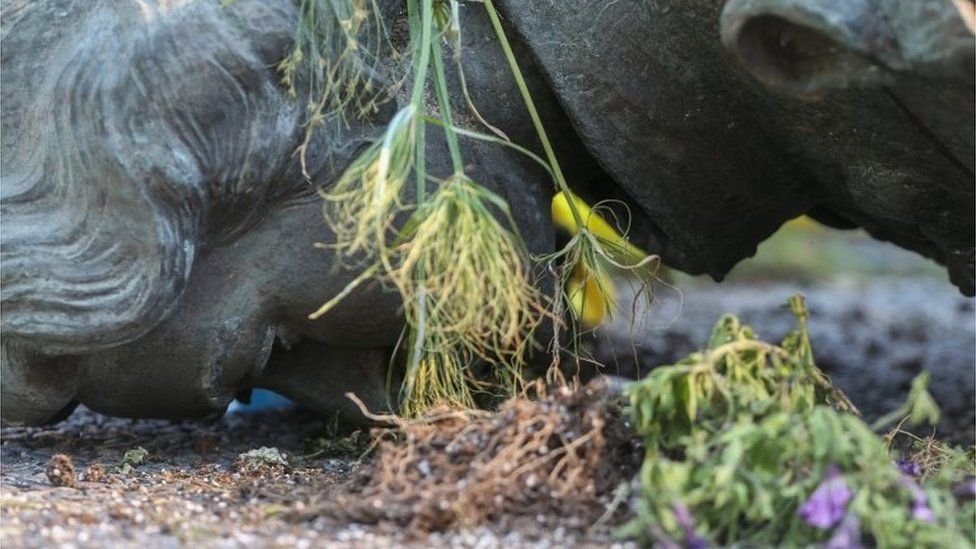
Manitoba Premier Brian Pallister is taking flak from native leaders for planning to repair and reinstall the statues of Queen Victoria and Queen Elizabeth II that were pulled down by a mob on Canada Day. Victoria’s head was recovered from the Assiniboine River. 

The Assembly of Manitoba Chiefs released this statement:

“To minimize, romanticize and celebrate the settler colonialism that displaced First Nations from their ancient and sacred lands in the most brutal and heinous ways, the way he did in his comments, is unconscionable and a desecration to the graves of the ancestors on which the legislature is built and on which the City of Winnipeg now lies.”

NDP member Nahanni Fontaine, an Indian, added:

“Canada was forged in the blood of our Peoples, on the bodies of our women and children, and in the theft of our lands.”

It is time to look at the actual history.

Not that I can blame the native people too much for not knowing it. Unless they have done a special study, they know no more about the history than the rest of us. They have been fed all the same pop culture. Their genes do not tell them anything. That said, the Indian leaders show a shocking disregard if not contempt here for their fellow Canadians, and a shocking irresponsibility in not taking the trouble to do the research. We all deserve better of them.

The First Nations of Canada have not been displaced from their lands by European settlement. Eighty-nine percent of Canada is Crown Land. Indians retain by treaty the right to hunt and fish on Crown Lands at will. In other words, for the most part, any indigenous person is able to go on using the land just as his ancestors did before Europeans arrived.

On top of the benefits they are getting from the “settler” government—welfare, free medical care, greater economic opportunities and career options of all kinds, and so forth.

Nor were indigenous groups required by the Canadian government to move. That happened in the US, not in Canada. In the treaty negotiations, they chose the location of their reserves. 

If they had any ancient land, they get to keep it. But probably no Indian group in Canada is currently on “ancient” land. They were nomadic, and Plains Cree, for example, relocated about every two weeks, fighting with other unrelated groups for hunting and foraging territory as they did. Before the coming of the Canadian government, they could count on being displaced. Only now can they expect to retain any lands indefinitely. 

They might have considered some landscape features “sacred,” but would not have owned them, been able to control their use, or happened by them except on rare occasions.

Nor is the Manitoba Legislature or the city of Winnipeg likely to be built on the graves of Indian ancestors. The Plains Indians did not bury their dead in graves, but left the bodies in trees. And moved on, quite possibly never visiting that place again. 

Nor was Canada forged in the blood of native people. There were no Indian Wars, nothing justly worthy of that name. There was no theft of lands. In most of Canada, including Manitoba, the local indigenous people negotiated to quit their land claims in return for compensation—not to mention still being able to use the land. And, in effect, having sold it to themselves, as they became Canadian citizens with the same vote as everyone else, and the same right to own land.

It is profoundly wrong to interfere with the right of all Canadians to recognize and commemorate our shared heritage, and to honour our current monarch, the symbol of our nation. Canada has too little history as it is.

But that is not the worst consequence of this strange historical slander. It actually aids and abets genocide going on today, in places like Xinjiang. 


Tuesday, July 06, 2021

Mary Simon, Our New Viceroy


Canada has a new Governor-General, Mary Simon. On the whole, she seems a good choice. It is awkward that she does not speak French. To my ear, despite a background in broadcasting, she has shown herself in her acceptance speech to be a poor speaker in English as well. It is also unfortunate that she got her start in journalism. Canada is too prone to appoint journalists to posh government sinecures. This undermines journalistic neutrality. But Simon, unlike Michelle Jean, Pamela Wallin, Mike Duffy, or Adrienne Clarkson, also had a career in elected office. 

Simon was appointed, as everybody understands, because she is half-Inuit. Everyone seems to think it was time for a GG who is from one of the native peoples.

Most often, appointing someone by race is offensive; it is a violation of the fundamental principle of human equality. But perhaps this is a worthwhile exception. It should be harder for native people to feel alienated or say they are not Canadian, when the Queen’s representative herself is native. 

Relations between native people and the rest of the population are currently strained, and getting worse year by year—in no small part thanks to the mislabeled “Peace and Reconciliation” process. Simon’s appointment, and her tenure, if she uses it well, may be oil on those troubled waters.


Friday, July 02, 2021

Some Questions on Residential Schools


Studying on the quad at Assiniboia Indian Residential School

It is surprisingly hard to get reliable contemporary information on the Indian residential schools. A lot of people are playing politics. To get the facts, one has to go back to original documents.

One assertion often made is that Indian families were obliged to send their children to a particular residential school. It was all done against the Indians’ will.

I suspect this may be no more than a reference to the general Canadian law that parents must send their children to school; the law against truancy. 

For I find references in the Truth And Reconciliation Commission final report to concern about Indian parents pulling their children out of the schools.

“Student complaints about food hurt recruitment. Kuper Island school principal J. N. Lemmens pointed out in 1891 that it was very important to provide the students with good food and clothing at his school on the British Columbia coast. He said that, unlike First Nations in other parts of the country, coastal First Nations ‘did not suffer for want of food.’ Their children were ‘used to being well fed at home.’ If the quality of food provided at the school was poor, the school might fall into disrepute” (TRC Final Report, Volume 1, pp. 488-9)

The same concern is expressed in a government report in 1907: that student attendance at the residential schools has been falling off, as parents did not want to send their children so far from home. (P.H. Bryce, Report on the Indian Schools of Manitoba and the North-West Territories, Department of Indian Affairs, p. 16).

For this to have been a concern, attendance at any particular school must have been voluntary.

Indeed, how could it not have been? The schools were generally denominationally run. Wouldn’t it have been obvious and necessary to send Catholic children to a Catholic school, regardless of their home address, and Anglican children to an Anglican school, and so forth? Meaning parents would have a choice of which residential school to have their children attend, by declaring their denominational preference. Even if students had to attend some residential school, the schools would be in competition for students. Meaning they would have a need to keep the students, and their parents, satisfied.

And it is not logically possible that Indian students were even required to attend a residential school. Because only about one third of Indian school-aged children ever did, even at the height of the residential schools.

It is also obvious that the government itself would prefer they not attend: at a residential school, the government had to pay for the student’s food and lodging. If they attended regular day schools, or just stayed at home, the government spared considerable expense.

The simple fact that parents could withdraw their children seems, at a stroke, to discredit most accusations of abuse, starvation, or cultural genocide.

Now as to those unmarked graves so much in the news recently.

We have always known there was a high mortality rate in the residential schools. For whatever reason—and science cannot agree on the reason—Canada’s First Nations have always been highly vulnerable to tuberculosis, among other diseases.  A 1907 survey of schools across the Prairies reports: “of 1,537 pupils returned from 15 schools which have been in operation on an average of eleven years, 7 percent are sick or in poor health and 24 percent are reported dead.” All of these deaths were believed to be from tuberculosis. (P.H. Bryce, Report on the Indian Schools of Manitoba and the North-West Territories, Department of Indian Affairs, p. 18).


Can the schools fairly be blamed? There was no cure for tuberculosis until 1946. Granted, bringing students together to educate them might cause the infection to spread to previously uninfected students; but what was the government to do? Not educate the children? They could and did turn away any students showing active symptoms; but TB can remain latent for a lifetime. The rate of tuberculosis in the schools ended up being only half that on the reserves, so the average student was still safer there than at home.

What about the charge that the schools tried to destroy Indian culture by requiring students to speak English or French?

There are several reasons for this requirement that have nothing to do with “cultural genocide.” First, given that the schools were in the business of teaching English or French, the best method is by immersion. Anyone who has studied in a language school will be familiar with this “English only” policy. Second, in almost no cases would the students at a school all be from the same language group. Speaking their first language instead of French or English would freeze out any minorities. Third, why would learning a new language cause you to unlearn a language you already knew? Does learning geometry make you forget your arithmetic? Granted that it is possible, through lack of practice, we have never considered this an important argument against further education. 

Finally, the evidence is ambiguous that this prohibition on using one’s first language was either widespread or, when imposed, was strictly enforced.

Many Indian children, no doubt, hated school. Me too. Perhaps we all deserve compensation.


Thursday, February 01, 2018

Cornwallis the War Criminal


The statue in Cornwallis Park

The city of Halifax is now pulling down the statue of Edward Cornwallis that has stood for over 75 years in Cornwallis Park; having originally been a charitable donation by CN hotels. Cornwallis has been traditionally felt worthy of the honour as the founder of the city. He has, however, fallen afoul of modern politics because he put a bounty on the scalps of local Micmacs.

I fear this is a manufactured controversy, and mostly a case of little brother Canada feeling the need to emulate big brother America, in his recent flurry of iconoclasm involving Civil War heroes.

Edward Cornwallis can plausibly be accused of war crimes. But not so much in Nova Scotia. The better case would be his behavior in the Scottish Highlands after the Battle of Culloden, in which he burned down barns and scattered cattle to punish the population for rebellion. In his defense, he was acting on clear orders from his superior, the Duke of Cumberland. And such scorched earth policies have been followed elsewhere: by Sherman in Georgia, or by the allied bombing campaigns during World War II.

More interestingly, in a place named “Nova Scotia,” largely settled by Highland Scots, there has never until now been an outcry against his commemoration.

Instead, the outcry has come from the Indians, or their spokespeople, over the more dubious case of his actions in Nova Scotia during Father LeLoutre’s War. Yes, he put a bounty on Micmac scalps. But it seems unfair to single Cornwallis out on this basis; he was following established custom of the time. The French already had a bounty on English scalps; the British in New England already had a bounty on Indian scalps. And, of course, scalping was standard practice among the Indians during war. Given the position and the times, Cornwallis was more or less obliged to follow suit; just as, once the Germans in WWI resorted to poison gas, the Entente were more or less obliged to use it as well. Notably, Cornwallis limited his bounty to scalps of Micmac “fighters”; Indian civilians, women and children, were not supposed to be so molested. This was not the Indian practice.

Moreover, it seems that few Indians were actually affected. According to historical records, the bounty was deemed to be “ineffective.” As a result, Cornwallis raised the scalp price. With the raised bounty, precisely one scalp was ever presented for redemption during Cornwallis’s tenure. That’s some historical atrocity. Indeed, the French Father Maillard, on the other side in the conflict, recorded Cornwallis’s term as governor as free of any atrocities.

Cornwallis is being used, in a thoroughly cowardly way, as a scapegoat.


Monday, July 24, 2017

Pikangikum


Pikangikum - Google maps.


Another mental health crisis in another Canadian reserve: Pikangikum.

The proposed solution: rush in 20 full-time “mental health workers” at a cost of $1.6 million. This adds to eight already there.

Pikangikum has a population of 2,100.

Over the longer term, we are told, the proposed solution is a “fundamental rethink of the way care is delivered on reserves.”

Yeah, that ought to do it. We’ll “rethink.” We’ll have a committee.

“The health-care system … First Nations people receive is not equal,” a local physician explains, noting “Canada has grown accustomed to witnessing this injustice.”

“It is inferior …. It is not equitable.”

This is obviously not true. One mental health worker for every 75 people? The people of Pikangikum clearly have access to more mental health help than anyone in Canada who does not live on a native reserve.

“Communities know what is going to work for them,” says local MP Bob Nault. “Why can’t we help support those plans?”

“Indigenous health has been focused on measuring the number of dollars spent as opposed to health outcomes,” adds Dr. Alika Lafontaine, the past president of the Indigenous Physicians Association of Canada.

In other words, the solution proposed by politicians and the press is to send yet more money to band leaders, with less accountability.

Yeah, that’s never been tried before. That ought to work.

To make things worse, that is. Obviously, no lack of mental health workers has caused the mental health crisis on this and so many other remote reserves. Nor has mucking about or oppression by the white man: these are the very places where the white man is not. The problem has to be the reserve itself; and its leadership.

Far from sending more money to the reserve leadership, increasing their power and control over the band members, the obvious solution is to get these poor kids off the reserves.

Apartheid is not an idea with a promising past.


Monday, May 29, 2017

A Compilation of Leftist Views on "Cultural Appropriation"


Grey Owl.

Reading my friend Xerxes’s column is a valuable window on left-wing thought. He wrote recently on cultural appropriation. This week, he printed responses from readers on the topic.

I am herewith appropriating their comments in order to analyse them. This counts as fair dealing, I believe: for research purposes and for comment.

Xerxes:

I got letters of support for my views about “cultural appropriation.” [He, uncharacteristically, did not take the usual leftist line, and refused to condemn it.] But I noted that they came, mostly, from white males. Who are, of course, the dominant social group that minorities and marginalized rebel against.

Me:

If you stop and think for a moment, that is lucky for the rest of us, and selfless and generous of white males. Just suppose if they started objecting to anyone else “appropriating” anything developed by white males, like so many other groups do.

Want a list?

Fortunately, however, some of these “white males,” at least, still believe in the brotherhood of man.

Xerxes:

X, who describes herself as “Dweller on unceded Algonquin territory,” wrote, “Please add to your analysis the context of colonization on Turtle Island. This is what matters in the recent debates. Not ‘freedom of expression’ or quid pro quo. Abandon those. Forever. Please.
Me:

Excuse me. Unless she is simply being incoherent, she just called for abandoning freedom of expression, forever.

No. She is a Nazi.

You can see what the alt-right is on about.

Xerxes, again quoting X:

… “At a larger level, please give up on reconciliation. It is a proposition fueled by white liberal guilt.”
Me:

Right. She is also against reconciliation. Instead, she demands “decolonization.” She does not say what this means.

She is declaring war to the death. Just so we’re clear.

Xerxes (quoting another reader):

“Our laws protect your words or your invention based on their ‘fixed form.’ They don't protect a people's stories or cultural practices, so the non-Indigenous have appropriated them and don't see the problem: after all, it's *legal* to rewrite my story in your own words or manufacture your somewhat-modified version of my widget.
Me:

Dear Reader is confusing two things: the moral aspect of imitation of another’s work, and the idea that you own someone else’s work because of your race. The first is just morally and legally dubious; the second is an unrelated and obviously immoral claim.

The latter is the claim made by those who condemn “cultural appropriation.”

It is, among other things, extreme racism.

Xerxes (still quoting the same Dear Reader):

“… those who dismiss cultural appropriation as ‘political correctness’ show a definite lack of empathy. They don't get the point that they may be misrepresenting what they appropriate, violating a religious taboo,”

Me:

Interesting to hear someone on the left express concern about violating a religious taboo.

Currently on Facebook, for example, I see protests against the Trump entourage because, in posting a photograph of the NATO leaders’ wives, they failed to identify as such the male gay “wife” (or “husband”) of Luxembourg’s PM. This is supposedly “homophobic.”


Does it not matter that even including him in the photo "violates a religious taboo" for not just one, but most or all of the world’s major religions? Matrimony, after all, is a sacrament.

Religious rights must be allowed fully and equally to all. Not just to preferred groups.

Xerxes (quoting the same reader):

... or even -- and this is a sore point-- blocking the way for the people who can tell the story from lived experience and full awareness of its meaning.
Me:

This is a classic straw man argument. Blocking the way? Nobody ever, anywhere, has argued that aboriginal writers should not be allowed to write, or should not be published.

Actually, of recent years, we have instead heard aboriginal writers complain instead of being taught English and how to write. That’s the residential school thing, for example.

Xerxes, quoting Dear Reader:

“… the reality is that it's (still!) hard for a non-majority-culture writer to get his or her stories published.”
This is perfectly counterfactual. The reality is that everyone is fascinated by Indians, and there has always—always—been a healthy market for anyone claiming to reveal aboriginal culture. An obvious example currently is Joseph Boyden. Do you really think he assumed an Indian identity because he thought it would make it harder to get published? Did Grey Owl? Elizabeth Warren? Iron-Eyes Cody? Carlos Casteneda (“Don Juan Maquis”)? John Neihardt (Black Elk Speaks)? Ward Churchill? Jamake Highwater? Hyemeyohsts Storm? Zane Grey?

For all of North American history, claiming to be aboriginal has been a clever if dishonest way to get published.

The problem rather has been a shortage of competent aboriginal writers to meet the demand. In the end, you have to be able to write. Even today, most Canadian (status) Indians do not finish high school.

Xerxes (Dear Reader):

“The loudest voices in favour of the ‘Appropriation prize’ were certain middle-aged white males not noted for sensitive journalism.”
Me:

This is a deeply racist observation, and a profound assertion of privilege. As well, of course, as a classic ad hominem.

Some are not allowed opinions because of their sex or race? Uppity white males, shut up?

Xerxes:

Y, ..., seems to have followed the controversy closer than I did: “It was NOT the idea of people from dominant cultures writing about non-dominant cultures that was at the root of the dispute. It was the idea of an award for such writing that offended people, and rightly so, because as several people pointed out, such an award would become another way for (mostly) white, (mostly) male authors to receive kudos at the expense, or perceived expense, of people of color and/or women. The consensus was yes, please, learn and write about cultures not your own, but no thank you, no awards.”

Me:

The problem is that the awards might go to someone of the wrong sex or race?

The author apparently believes that art should be valued not for its quality, but for the race and sex of the person who created it.

This is racism of the most pernicious sort.


Wednesday, May 25, 2016

The Original Affluent Society


Death of Minnehaha: The Romantic Indian

It ought to be a no-brainer.

I don't know about you, but to my mind, this Noble Savage fellow has long outstayed his welcome. Believing him to be a real person is beginning to look positively looney. But in fact, we are not free of him yet. Not only did he practice perfect sexual equality, while at the same time paradoxically allowing feminine dominance in all things; not only did he body forth the beautiful communist ideal; not only did he live in perfect peace with his neighbour, wanting only friendship and love. And not only did he get lots of hot, steamy love on demand. He also, apparently, was far richer than we, “the original affluent society,” to use the term popular in anthropology. And, unlike us, he got his material needs with little actual labour. None of this depressing nonsense about earning your living by the sweat of your brow. Remember, after all, this was Eden.

Surely, one might think, if one is prone to such activities, the average aboriginal is a lot better off with central heating, a no-leak roof over his head, perhaps a wide-screen TV, a refrigerator, a microwave, perhaps an iPod, a car, and such mod cons, than he once was living in skin tents, using stone tools, and wandering with the buffalo.

But no—it seems we modern miscreants have impoverished him.

According to Jared Diamond, he of Guns, Germs, and Steel, settled agriculture was, to use the title of a celebrated 1987 article he wrote for Discovery magazine, “the worst mistake in the history of the human race.” That's no small claim.

“Archaeologists studying the rise of farming,” Diamond explains, “have reconstructed a crucial stage at which we made the worst mistake in human history. Forced to choose between limiting population or trying to increase food production, we chose the latter and ended up with starvation, warfare, and tyranny.” Okay—we know this script. There are too many people. Apparently, people are a bad thing. Good thing we don't know any personally.

“[R]ecent discoveries suggest that the adoption of agriculture, supposedly our most decisive step toward a better life, was in many ways a catastrophe from which we have never recovered. With agriculture came the gross social and sexual inequality, the disease and despotism, that curse our existence” (“The Worst Mistake in the History of the Human Race,” Discovery Magazine, May, 1987).

Sounds a whole lot like the same old story of Mr. Noble Savage, Marxist-feminist edition. Agriculture it seems brought sexual inequality, despotism, starvation, and warfare. Probably bad teeth too. But the new claim, and the living nub of Diamond's argument, is this: before agriculture, man was able to satisfy his wants with very little actual work. “[T]he average time devoted each week to obtaining food,” Diamond says, “is only 12 to 19 hours for one group of Bushmen, 14 hours or less for the Hadza nomads of Tanzania” (ibid). And if that were not enough, it seems the items on the modern menu, although more costly, are worse for our health: “At Dickson Mounds, located near the confluence of the Spoon and Illinois rivers, archaeologists have excavated some 800 skeletons that paint a picture of the health changes that occurred when a hunter-gatherer culture gave way to intensive maize farming around A. D. 1150. Studies by George Armelagos and his colleagues then at the University of Massachusetts show these early farmers paid a price for their new-found livelihood. Compared to the hunter-gatherers who preceded them, the farmers had a nearly 50 per cent increase in enamel defects indicative of malnutrition, a fourfold increase in iron-deficiency anemia (evidenced by a bone condition called porotic hyperostosis), a theefold rise in bone lesions reflecting infectious disease in general, and an increase in degenerative conditions of the spine, probably reflecting a lot of hard physical labor. 'Life expectancy at birth in the pre-agricultural community was about twenty-six years,' says Armelagos, 'but in the post-agricultural community it was nineteen years'” (Diamond, op. cit.).

Bruegel, The Harvesters
What a pack of fools our ancestors must have been. Imagine giving it all up for a mess of potage.

But how can nutrition be better for scavengers than for farmers? Isn't scavenging a bit iffy, like dumpster diving?

Diamond expands upon the point. “First, hunter-gatherers enjoyed a varied diet, while early farmers obtained most of their food from one or a few starchy crops. The farmers gained cheap calories at the cost of poor nutrition. ... Second, because of dependence on a limited number of crops, farmers ran the risk of starvation if one crop failed” (ibid.).

This thesis is not new with Diamond, writing in the late Eighties. Any guesses when it actually emerged?

Would “1960s” surprise you? 

That was when the original studies of the Hazda and other foraging groups were undertaken. This is when the watershed “Man the Hunter” conference was held, in 1966, just in time for the summer of love. At which, it seems, the entire field of anthropology wheeled around at once to the premise that primitive man had it better than we do.

Bushmen, Bushwomen, and Bushbabies.

The times, of course, were a'changing. Civilization in general meant to those of us there at that time eternal war and slow radiation death from the atom bomb. And even aside from a certain age of man, anthropologists in particular might be expected to be especially receptive to this Noble Savage message. They have given their life to the study of foraging societies. Why would they do this, if they did not hope or want to believe that such societies had something of value to tell us? Argue that primitive societies knew something of vital importance that we do not know, and suddenly it is a glorious thing to be an anthropologist.

And so, the Noble Savage's Affluent Society premise came to be, says David Kaplan, “widely accepted by anthropologists”; the “enlightened anthropological view” (“The Darker Side of the 'Original Affluent Society'” Journal of Anthropological Research, 56:3, Autumn, 2000, p. 301, 303). It has been ever since. Don't just ask Jared Diamond. Only last year, 2015, Yuval Harari summed it up in his best-seller Sapiens: A Brief History of Humankind. “Rather than heralding a new era of easy living,” Harari writes, “the Agricultural Revolution left farmers with lives generally more difficult and less satisfying than those of foragers. Hunter-gatherers spent their time in more stimulating and varied ways, and were less in danger of starvation and disease. . . The average farmer worked harder than the average forager, and got a worse diet in return. The Agricultural Revolution was history’s biggest fraud.”

Right. Got it. Let's look at the claims in turn.

First, as we have already heard from Engels and the Marxists, agriculture caused class divisions, and the birth of tyranny and social oppression. As Diamond puts it, “Besides malnutrition, starvation, and epidemic diseases, farming helped bring another curse upon humanity: deep class divisions. Hunter-gatherers have little or no stored food, and no concentrated food sources, like an orchard or a herd of cows: they live off the wild plants and animals they obtain each day. Therefore, there can be no kings, no class of social parasites who grow fat on food seized from others. Only in a farming population could a healthy, non-producing elite set itself above the disease-ridden masses” (ibid).

There is an immediate logical flaw apparent here. If only with agriculture was there enough excess food for anyone to devote their time to anything besides agriculture, how can it concurrently be true that people had more food, and acquired it more easily, before agriculture? Secondly, Diamond's thesis that those not producing food are “parasites” itself requires a pretty distinctly Marxist understanding of the world. Who's to say those folks too were not providing value from their work? Is food production the only thing of value to mankind? Is there nothing to be said for the existence, say, of some sort of government, to protect one's rights and goods from one's neighbour, or the tribe over the next hill? Would paying some to govern be so terrible? Not to mention underwriting the trades: milling, tailoring, pottery, storage, cartage, that sort of thing. Better off without them?

It takes a Marxist to see the mere division of labour as oppression.

Second, as we have already seen from Gage, Friedan, Steinem, and the girls, old Noble Savage was a ladies' man. In primitive society, as is only just, women got everything they wanted. Diamond notes, as a supposed contrast, that primitive New Guinea agriculturalists require their women to do all the heavy labour. “Women in agricultural societies were sometimes made beasts of burden. In New Guinea farming communities today I often see women staggering under loads of vegetables and firewood while the men walk empty-handed” (ibid.).

Yali people of New Guinea

Of course, here Diamond contradicts Engels, who saw women doing all the work as irrelevant to their supposed emancipation. But let's leave that aside. Is what he says even true of agricultural society? Diamond offers no control. Let us grant, against Engels, as seems obvious, that the lot of women in primitive New Guinea agricultural societies is worse than that of Canadian women today. But the proper comparison is with women in hunter-gatherer societies, not modern post-industrial women, and Diamond offers no examples of this.

As it happens, we have a few. We find that the observations of the early Jesuits conform exactly to Diamond's--in describing practices among Canadian Indians. Here, too, women did all the heavy labour.

The problem is, these were hunter-gatherers, not farmers.

Accordingly, quite obviously, the oppression of women was not because of agriculture. Why would it be? Women's lot improved with agriculture, even if this took a little time. Women doing hard labour was more probably due to the constant warfare and petty banditry one is going to get without effective government. The men, being stronger, always needed their arms free in case of surprise attack.

Now we get down to what is truly novel about this anthropological argument: primitive society was materially better off. At least if you think only in terms of food.

Diamond makes much of the variety of available food sources: “It's almost inconceivable that Bushmen, who eat 75 or so wild plants, could die of starvation the way hundreds of thousands of Irish farmers and their families did during the potato famine of the 1840s” (ibid.) “[B]ecause of dependence on a limited number of crops, farmers ran the risk of starvation if one crop failed” (ibid).

But wait a nanosecond. Early foragers may well have had more food sources than 19th century Hibernian pastoralists. But there does not seem to be anything making this limited variety a necessary feature of agriculture. A farmer might just as easily keep a vegetable garden, cows, and chickens for eggs. What farmer, left unregulated, doesn't? Nothing even prevents him from, in a pinch, shooting a passing wild duck. He has, in effect, the hunter's food sources, plus his own. Hard to see how the additional food sources are a minus.

An Gorta Mor (Potato Famine) Memorial, Dublin

He does not need to, and a wise farmer does not, put all his land into a single crop, or even just a few. That's not even good for the land.

In the case of the Irish, the problem was political, not practical. The native Irish were permitted to farm only tiny plots of land, too small to sustain their families with anything but potatoes. Their crops were effectively limited by government regulation; any other crops were exported.

Nor is it obvious that there is such a great diversity of food sources available in, say, a Canadian prairie winter. Here, the sedentary farmer has a definite advantage. Not needing to wander, he can store the harvest for the fallow months. A forager must follow the food sources, and cannot keep anything in reserve. If by chance there is no game today, he does not eat.

Ouside of Loblaw's, no great variety of foods is available in a Canadian winter. No fruit grows, no green shows. It's meat or nothing. Even most animals are in hibernation.

The notion that primitive societies were “affluent,” absurd on its face, is made possible by the corollary that, like good Buddhists, in a “zen” way, “they limited their wants.” So they were affluent strictly in the sense of achieving subsistence with relatively little work.

One can see the mark of the Sixties here. Out of the rat race, no nine-to-five job, no materialist hangups, living off the land, lots of free time for recreational drug use. Wish, meet fulfillment.

And it is actually true enough. Primitive tribesmen are not as busy as we aging former yuppies are. If not to the extent Diamond would have us believe. The Sixties studies show that Kalahari Bushmen had a “work week . . . of 2.4 days per adult,” (Lee, The !Kung San. Men, Women, and Work in a Foraging Society, 1979, pp. 250-280). Aborigines in Arnhem Land were clocked in at 15-20 hours per week (Kaplan, op cit., p. 303). Looking at all such studies, Sahlins (1972:34), choosing his words carefully, concluded that “Reports on hunters and gatherers of the ethnological present--specifically on those in marginal environments--suggest a mean of three to five hours per adult worker per day in food production'” (Kaplan, op. cit., p. 303).

Traditional food of Australian aborigines.

Okay; that sounds pretty good. Almost like a governmnent job. But note, what is being measured is food production alone. Going out and hunting down a plump gazelle or picking mongongo nuts might take less time than accountancy, but it might involve a bit of food preparation as well, more than you need if you seize your food at the local Loblaw's in exchange for bits of paper and tiny pieces of shiny metal. When you add in butchering, peeling, processing, cooking on outdoor fires without the aid of a microwave, plus the maintenance of hunting tools, plus the commute to the hunting grounds, “the total work week for the bushmen on the lowest of estimates,” says Kaplan, “turns out to be between 6 and 7 eight-hour days (not counting child care)” (Kaplan, op. cit.).

The scavengers may still have the better deal. It is tough to get a fair comparison, because it is actually arbitrary what one includes in “work.” The average Hottentot does not punch a time clock. Travel time? Child care? Shopping? Washing the dishes? Business lunches? Meetings with the boss, or fellow villagers? By one attempted estimate, Kaplan to the contrary, Kalahari residents spend 44.5 hours a week at their “job,” if male, 40 hours if female. But a mainstream Canadian male spends, by the same rough measure, 40 hours at paid work, and then another 40 weekly taking care of business that must be taken care of without being in his job description (Kaplan, op. cit., p. 308). Advantage, still, to the Indians and aborigines. Just not as much advantage as might appear at first.

But now let's consider another factor. Granted that primitive tribes are able to fill their large intestines with less work. But isn't there something to be said for the quality of the food this labour produces? Wouldn't many of us prefer to work a little harder to pay for the food we like, say, pesto, as opposed to mac and cheese?

Hunters and gatherers cannot have the choices we do. If it is a porcupine we find on today's hunt, it is porcupine for supper. And lunch. And breakfast.

Fortunately, they come with toothpicks.

During the survey of foraging practices among the aborigines of Arnhem Land, anthropologists came upon a bit of a problem. The locals actually had access to charity food from mission stations. They could get flour, rice and sugar. And usually did. In order not to falsify their data, the anthropologists had to go to some lengths to convince the natives to abstain from these preferred foods for the course of the experiment. By the fifth day, tired of the “traditional” diet, a significant proportion of the men wanted to drop out (Kaplan, op. cit., p. 306).

Arnhem Land, north Australia: lush, tropical and full of mission stations distributing food.

Sometimes spare time is not worth the effort.

Kaplan at least hints at the issue: “In 1980 the nut crop was a good one, but Wilmsen indicates that it was barely touched because most people [Bushmen] preferred maize meal. Hitchcock and Ebert ... also note that there are foragers in the Nata region of the Kalahari who have access to mongongos but choose not to exploit them in any quantity, presumably because they 'do not taste good'" (Kaplan, op. cit.).

Here, as it happens, we may also have an explanation of the better nutrition among hunter-gatherers than among early agriculturalists, as revealed by their skeletal remains.

Foragers may have a varied diet. Of necessity. But farmers have a choice as to what to eat. Given choices, people do not always make the best ones. Ask Adam and Eve.

People invariably prefer some foods to others. Some dislike spinach, some cannot stand olives. I can't get my fourteen-year-old boy, for example, to ever vary from macaroni for supper.

People will usually, given the choice, eat what they prefer. That will probably end up limiting their diet. Early farmers would have known little about good nutrition. They just knew what they liked.

Probable result: an overall decline in health. Not from scarcity, but from abundance.

The next issue is this, and we have already at least hinted at it: although food may have taken little time to acquire, was there always food to be had?

In fact, nothing was more obvious to early visitors to these shores than the extreme material poverty of the Indians. Father Bressani speaks of “this almost unexampled poverty” (Jesuit Relations 39, p. 246). Bressani was a seventeenth-century Italian. Keep in mind, when you read such observations, that peasant life in the Italian countryside in the seventeenth century was not itself all skittles and Chianti.
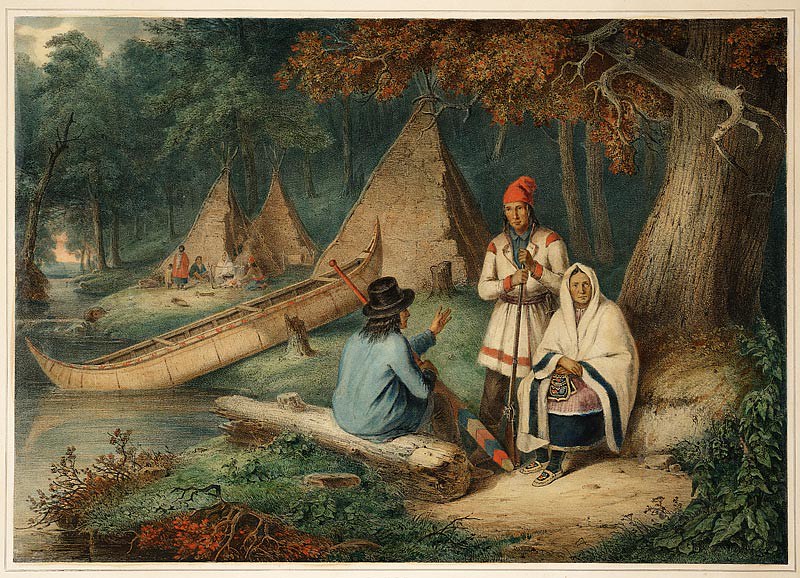
Wigwams, Quebec

Father LeJeune speaks of the state of Indian shelter. Apparently, there were no wide-screen TVs. “If you go to visit them in their cabins, ... you will find there a miniature picture of Hell, — seeing nothing, ordinarily, but fire and smoke, and on every side naked bodies, black and half roasted, mingled pell mell with the dogs, which are held as dear as the children of the house, and share the beds, plates, and food of their masters. Everything is in a cloud of dust, and, if you go within, you will not reach the end of the cabin before you are completely befouled with soot, filth, and dirt” (Jesuit Relations 17, p. 13).

Fleas were an endemic problem, commented upon by every observer. Champlain laments, of life among the Micmac, “They have a great many fleas in summer, even in the fields. One day as we went out walking, we were beset by so many of them that we were obliged to change our clothes” (Champlain, Voyages 1, Ch. 14). Lie down with dogs, and you get up with fleas.

And now we come to the food. The Hurons had it better than most. “A little Indian corn boiled in water, and for the better fare of the country a little fish, rank with internal rottenness, or some powdered dried fish as the only seasoning, — this is the usual food and drink of the country; as something extra, a little bread made of their corn, baked under the cinders, without any leaven, in which they sometimes mix some beans or wild fruits; this is one of the great dainties of the country. Fresh fish and game are articles so rare that they are not worth mentioning” (Father LeJeune, Jesuit Relations 17, p. 15).

But these were early semi-agriculturalists. It was worse for the wandering hunting tribes. “The roving Barbarians, before knowing the French, lived solely by hunting or fishing, and, through necessity, fasted more than half the year—… frequently lacking the means of preserving game or fish a long time, when these abounded, as they had no salt; while the smoke which they used in place of salt, was not adequate for preserving provisions a long time; whence they frequently died of hunger, or sometimes inflicted death out of pity” (Father Bressani, Jesuit Relations 39, p. 243).

Among these Indians, Bressani writes, hunger is a near-constant companion. And Champlain witnesses the same: “These people suffer so much from lack of food that they are sometimes obliged to live on certain shell-fish, and eat their dogs and the skins with which they clothe themselves against the cold” (Champlain, Voyages 2, Ch. 4).
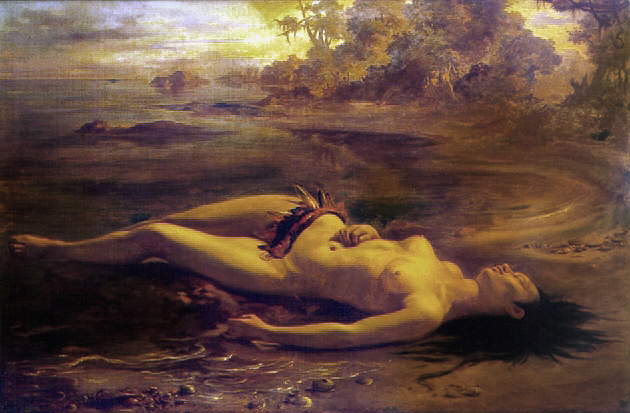
The Romantic Indian: Portuguese/Brazilian "Indianism" painting


Champlain reports an encounter with the Innu one winter, when Quebec had just been founded.

“On the 20th, some Indians appeared on the other side of the river, calling to us to go to their assistance, which was beyond our power, on account of the large amount of ice drifting in the river. Hunger pressed upon these poor wretches so severely that, not knowing what to do, they resolved, men, women, and children, to cross the river or die, hoping that I should assist them in their extreme want. Having accordingly made this resolve, the men and women took the children and embarked in their canoes,… we heard them crying out so that it excited intense pity, as before them there seemed nothing but death. ... [T]hey reached the shore with as much delight as they ever experienced, notwithstanding the great hunger from which they were suffering. They proceeded to our abode, so thin and haggard that they seemed like mere skeletons, most of them not being able to hold themselves up. I was astonished to see them, and observe the manner in which they had crossed, in view of their being so feeble and weak. I ordered some bread and beans to be given them. So great was their impatience to eat them, that they could not wait to have them cooked. I lent them also some bark, which other savages had given me, to cover their cabins. As they were making their cabin, they discovered a piece of carrion, which I had had thrown out nearly two months before to attract the foxes, .... This carrion consisted of a sow and a dog, which had sustained all the rigors of the weather, hot and cold. When the weather was mild, it stank so badly that one could not go near it. Yet they seized it and carried it off to their cabin, where they forthwith devoured it half cooked. No meat ever seemed to them to taste better. I sent two or three men to warn them not to eat it, unless they wanted to die: as they approached their cabin, they smelt such a stench from this carrion half warmed up, each one of the Indians holding a piece in his hand, that they thought they should disgorge, and accordingly scarcely stopped at all. These poor wretches finished their repast” (Voyages, vol. 2, Ch. 5).

Odd that the anthropologists seem never to have read these historical accounts. But that is the way with anthropologists. It turns out that even the early Sixties studies themselves discovered much of the same among the Kalahari bushmen they observed, but somehow entirely missed mentioning it in their published reports. Kaplan notes that during the legendary "Man the Hunter" conference, Lora Marshall commented: "The !Kung we worked with are very thin and . . . constantly expressed concern and anxiety about food." In a 1989 piece, Harpending and Wandsnider are quoted to assert that "Lee's studies of the !Kung [Bushmen] diet and caloric intake have generated a misleading belief among anthropologists and others that !Kung are well fed and under little or no nutritional stress" (Kaplan, p. 309, quoting Wilmsen, 1989). “Konner and Shostak [quoted again by Wilmsen, 1989] are quite emphatic that nutritional stress and its health consequences among the !Kung are hardly in the eye of the beholder: Deprivation of material things, including food, was a general recollection [of !Kung adults]” (Kaplan, op. cit., p. 309). “Periodic food shortages,” Kaplan continues, “have been observed among all recent hunters and gatherers” (Kaplan, op. cit., p. 321; Eaton, S.B., M. Shostak, and M. Konner, 1988, The Paleolithic Prescription. New York: Harper and Row). All of them.

There you go again: the Noble Savage archetype is powerful enough to in most cases supercede the evidence of our own eyes.

It is perhaps true that it takes only forty-four hours a week to get enough food to live on, if you are a hunter-gatherer. But it turns out that said food may oft times simply not be available.

By contrast, in many progressive municipalities, Loblaw's stores are open 24 hours.

There is, contrary to popular and fuzzy hip thought, no “balance of nature.” Nature usually follows a patternless pattern of boom and bust, one absurd extremity following upon another. A nice warm wet spring, and prey animals have a population explosion. Leading to a boom in predators, which then deplete the prey, causing a collapse in predator numbers as well as prey. Rinse and repeat. General starvation is a predictable part of the “great circle of life.” A hunter-gatherer lifestyle locks one in to these natural cycles, leading to inevitable periods of mass death.

Sadly, some have even recently died under the glamour of the Noble-Savage-Affluent-Society myth. Consider the now-famous case of Chris McCandless, only 24 years old, who sought to disappear “Into the Wild” of Alaska, and died quickly of either poisoning from eating the wrong wild plant, or simple unadulterated starvation.

Last picture of Chris McCandless alive

Because he was a modern, this was memorable enough to be worth a best-selling book. Had he been a pre-contact aboriginal, it would not have even been news.

The 1960s Noble Savagist surveys, deliberately or not, did not account for possible slow periods in the good old merry-go-round of life, or rather slaughter—slow periods that, in Canada, will come predictably and severely every winter, for perhaps the odd seven months in a row. The studies of Bushmen and aborigines were “best-case” scenarios. Anthropologists were among their subjects for only a few days or a few weeks, at the most abundant time of the year. As Kaplan notes, “Although carried out under less contrived conditions than the McCarthy-McArthur survey in Australia, [which, note, was even worse in this regard] Lee's investigation [of the Bushmen] suffers from some of the same shortcomings: for example, to buttress his argument concerning Bushmen well-being, Lee would like to extrapolate his findings from one portion of the seasonal cycle to the entire cycle, even though he is aware of the significant difference between the dry season and the wet season. Between August and October, water is limited and food scarce. Lee's survey was done from July 6 to August 1” (Kaplan, op. cit., p. 307).

There may indeed be a good reason why all studies of existing hunter-gatherer societies are done in the tropics. The tropics may be the only place where hunting and gathering is even remotely viable. As my Filipina wife maintains, it is not easy to starve in the tropics. Some kind of fruit is in season at al times of the year; the woods are thick with birdsong.

There is never the ghostly silence of a Canadian winter.

"Iracema"; Portuguese "Indianism" painting

Although there might be famine at any time, wind and weather permitting, this is when, according to the early French journal-keepers, Indian starvation inevitably appeared. For a period stretching perhaps from November to May, with nothing green other than pine needles growing, possible food is limited to ice-fishing and a few non-hibernating animals. Not easy to find at the best of times. Not easy to run down and kill, especially without rifles. Samuel de Champlain reports: “The savages who dwell here are few in number. During the winter, in the deepest snows, they hunt elks and other animals, on which they live most of the time. And, unless the snow is deep, they scarcely get rewarded for their pains, since they cannot capture anything except by a very great effort, which is the reason for their enduring and suffering much” (Champlain, Voyages, Volume 1, Ch. 6). Deep snow was the one thing that allowed them to overtake the prey, if they were equipped with snow shoes. The animals, by contrast, often got bogged down in the deep drifts.

As evidence that women in foraging societies supposedly had higher status, Diamond offers this consideration: “nomadic hunter-gatherers have to keep their children spaced at four-year intervals by infanticide and other means, since a mother must carry her toddler until it's old enough to keep up with the adults.” (Diamond, op. cit.).

A bit of a non sequitor, surely. Diamond to the contrary, this does not sound like a good thing, for either males or females. Better for women? Aren't a certain proportion of those dead children female? Or is it that, to Diamond or to other noble savages, children are not human? To me it sounds like a terribly evil thing, that we should all be glad to have put behind us. That is, if we really have.

Diamond's point is the usual feminist one that motherhood is oppressive to women. It gets awkwardly in the way of free sex, in any case.

Our point is different. The traditional Indian lifestyle, because of the severe food contraints, did not leave a lot of margin for the social safety net we have in modern Canada come to expect. Most kids, it seems, were killed as a matter of standard practice. Estimates for infanticide of female children in traditional Canadian native cultures range from 50 to 80 percent (Schrire, Carmel; William Lee Steiger, "A matter of life and death: an investigation into the practice of female infanticide in the Arctic". Man: the Journal of the Royal Anthropological Society 9: 162).

Thr Inuit killed children by throwing them into the sea. The Yukon tribes stuffed their mouths with grass and just left them to die. Dene traditions were similar. Such practices lasted into the 1930s and 40s, when contact with the mainstream culture, and welfare payments, ended them.

Eskimo mother and child.

Father Jouvency reports of the Innu, “the women, although naturally prolific, cannot, on account of their occupation in these labors [the hard physical work demanded of them], either bring forth fully-developed offspring, or properly nourish them after they have been brought forth; therefore they either suffer abortion [i.e., miscarriage], or forsake their new-born children, while engaged in carrying water, procuring wood and other tasks, so that scarcely one infant in thirty survives until youth” (Jesuit Relations 1, p. 255-7). Orphans, he reports, are killed as a matter of routine (Jesuit Relations 1, p. 259).

Orphans and prospective infanticides became, therefore, for the Jesuits, a rich harvest of souls. Father Biard, working among the Micmac, notes, “I saw this girl, eight or nine years old, all benumbed and nothing but skin and bone. I asked the parents to give her to me to baptize. They answered that if I wished to have her they would give her up to me entirely. For to them she was no better than a dead dog. They spoke like this because they are accustomed to abandon altogether those whom they have once judged incurable “ (Jesuit Relations 2, p. 13).

Indian shaman

If it is not already obvious, the same fate would similarly await the aged, as the merely ill of any age. No room for sentimentality here. “[I]t is the custom,” the Relations report of the Indians about Port Royal, “when the Aoutmoins [shamans] have pronounced the malady or wound to be mortal, for the sick man to cease eating from that time on, nor do they give him anything more. But, donning his beautiful robe, he begins chanting his own death-song; after this, if he lingers too long, a great many pails of water are thrown over him to hasten his death, and sometimes he is buried half alive” (Jesuit Relations 1, p. 167).

If you weren't dying fast enough, they were eager to help you along. Or perhaps not dying at all.

For all these sufferings, it is only too apparent, the greatest help was to live near the newly-arrived Europeans. Jesuits would take your excess babies. The French in their fort would give you, in need, provisions and birch bark. They would always trade food for furs. “[T]hose who are situated near the sea,” Bressani explains, “have, by the exchange of their Beaver skins, provisions for some part of the Year” (Jesuit Relations 39, p. 243). It does not seem to have been terribly clear to these first-contact Indians that the Europeans were viciously robbing them of their land and their happy, idyllic, affluent lifestyle. No doubt more recently the Arnhem Land aborigines have suffered the same confusion, in light of the free nourishment from the nefarious mission stations.

The Sixties studies of hunter-gatherers miss one further factor that would have been a matter of life-and-death for the earlier aboriginals. Modern hunter-gatherers have a government somewhere to keep relations with their neighbours on an even keel. Murder, theft, and cannibalism are punished. They might now, as before, have to spend only forty-four hours a week on food. But now, unlike then, they need spend no additional time on self-defense. In the real state of nature, as Hobbes points out, not to mention Darwin, and as we have already seen, self-defense would have been an all-consuming consideration. Government, oppressive as Diamond may find it, can prevent adversaries from killing you, or stealing your food, or taking you as food.

Hence, perhaps, the idle hours. That may be a new thing. It may not be because of the hunter-gatherer lifestyle. It may be because the hunter-gatherer lifestyle no longer really exists, anywhere.

So why do some societies, as Diamond points out, resist the change? Why are there still, at a minimum, Australian aboriginals, Kalahari Bushmen, and Canadian Indians?

Diamond takes the fact that some few societies seem to resist the transition to agriculturalism as itself evidence that agriculturalism is undesirable. That evidence, mind you, cuts both ways. Six thousand years ago, everyone was a hunter and a gatherer. Now, almost nobody is. The evidence here, surely, is that farming is overwhelmingly more desirable.

There are probably no true hunter-gatherer societies left, except those we can know nothing of, for they have not yet been contacted. A bit of an observer paradox here: the safe presence of white-skinned anthropologists almost necessarily means their subjects are no longer truly in the state of nature. Those who have not begun to farm may be sustained largely on the handouts from the misson stations, or government welfare.

If there is also a residual resistance on the part of a few cultures to settle down to pastoralism, the Bushmen of the Kalahari, or the Indians of Canada, might it mostly be that, for most males, hunting is fun, and farming is not? Evolution surely makes it so. We were hunters for a hundred thousand years, and farmers only in the last few thousand. Aren't we hard-wired, like any predator, to get a nice big adrenaline rush out of the hunt and the kill? Isn't it tough on most young men, naturally craving adventure, not to be able to do it any more, at least not daily, and not to have it valued? Might this feeling not also be amplified by the fact that, in hunter-gatherer societies, because of defense needs, any tilling of the land that did occur was done by the women? So farming was “women's work,” implicitly effeminate. To most red-blooded males, that is not a recommendation.

Didn't even the cowboys of the Old West feel this way about the settlers? Settling down meant an ultimate loss of freedom. Don't most young boys—or even aging accountants, according to Monty Python-- imagine themselves either running away to sea and being marooned on a South Sea Island, or as cowboys riding the lonely range?

Guiding a plough and reaping what you sow just isn't as exciting.

But be that as it may; there is something to be said for living past nineteen. There is something to be said about not living in constant hunger. Not to forget the central heating, Range Rover, and wide screen TV. In sum and in essence, even if only living in Attawapiskat on welfare, disregarding all further opportunities, Canadian Indians have a vastly better life in material terms than anything they might have hoped for in pre-contact days. They can still hunt and fish, after all, according to treaty, if they want. They just no longer have to rely on it for survival.

This being so, it is absurd to talk of financial reparations, or of someone having “stolen their land.” The net gain from colonization was at least as great for the Indians as it was for the more recently disembarked Europeans. Quite apart from any formal deal cut to extinguish aboriginal title. If working a bare minimum of hours is the only goal, for their “original affluent society,” they are living in the Land of Cockaigne, on the very summit of the Big Rock Candy Mountain.

Let us remember, too, before we walk away from the subject, that man does not live by bread alone. Poverty, and Indian poverty, pre-contact, was not just material. It was spiritual. With no permanent structures, no fixed abode where things could be kept, no writing, there was little way to preserve anything for future generations. That means not just food: that means any poetry, any visual art, any music, other than could be passed on memory to memory. Any Indian expressions of the human spirit were simply lost and forgotten; like wolves howling at the moon. Of numberless generations, we have and know practically nothing: a few ambiguous rock carvings, a few oral traditions of dubious authenticity. In the Far West, some totem poles not yet completely defaced by termites. Nothing for the young and restless soul, seeking meaning, seeking what life is really all about, seeking a voice to speak to them. Nothing but the daily struggle for barren subsistence. This is a profound cultural poverty.

When Wolfe approached the battlements of Quebec, it is recorded, he was reciting to himself Gray's poem, “Elegy Written in a Country Churchyard.” He would rather, Wolfe said, have written those lines, than to have taken Quebec.

A noble savage contrmplates the death of General Wolfe. Benjamin West.


The burden of that great poem is the tragedy that so many men die unheard, unknown, and forgotten. None of their thoughts recorded, it is as though their lives were never lived.

Perhaps in this neglected spot is laid
Some heart once pregnant with celestial fire;
Hands, that the rod of empire might have sway'd,
Or wak'd to ecstasy the living lyre.

But Knowledge to their eyes her ample page
Rich with the spoils of time did ne'er unroll;
Chill Penury repress'd their noble rage,
And froze the genial current of the soul.

Full many a gem of purest ray serene,
The dark unfathom'd caves of ocean bear:
Full many a flow'r is born to blush unseen,
And waste its sweetness on the desert air.

Some village-Hampden, that with dauntless breast
The little tyrant of his fields withstood;
Some mute inglorious Milton here may rest,
Some Cromwell guiltless of his country's blood.

Gray, and Wolfe, were thinking of most seventeenth-century Englishmen. But the lament is far more poignant if applied to Canadian natives. That is just what Indian culture condemned every Indian who ever lived pre-contact to.

It is the deepest poverty known to man.