





 Posts
Posts


 |
| Joseph being sold into bondage. |
A friend who claims she is an atheist has linked on Facebook to a poster with the caption: “If the bible got the easiest moral question humanity has ever faced wrong, and that was slavery, then what are the odds that it is wrong on something as complex as human sexuality?” – Dan Savage.
Let’s respond: both major premise and minor premise are wrong. Therefore, the conclusion does not follow.
First, slavery is not the easiest moral question humanity has ever faced. It is a complex issue. Second, it is not clear what the Bible’s position is on slavery (whereas its positions on human sexuality are generally straightforward).
What is “the easiest moral question humanity has ever faced”? Surely murder, not slavery; is enslaving someone worse than murdering them? Is life less important than liberty?
So, murder is the easiest moral question. But to be clear, there are degrees of murder. Surely mass murder is worse than individual murder: killing a million people is worse than killing one. So, mass murder is the easiest moral question. In addition, surely killing someone who is absolutely blameless is worse than killing someone whose own deeds are dark—there are various shades of gray on the path to what becomes justifiable homicide. Moreover, surely killing someone who is about to die the next day of natural causes is not as bad as killing a young person with their whole life before them. The net natural lifespan remaining enters into the equation.
Therefore, being precise, the easiest moral question mankind has ever faced is, in fact, not slavery, but abortion on demand: the mass murder of innocents at the very beginning of life.
I think you will find that the Bible is against this. The evil of killing children is a central theme throughout the book.
Slavery, by contrast? While an evil in itself, it may easily be preferable to the alternatives available.
First, let’s define our terms. Merriam-Webster defines slavery as “the state of a person who is a chattel of another.” This I find unsatisfying, because what a “chattel” means can vary greatly; what ownership entails may vary greatly depending on the laws in force. Moreover, being owned is not necessarily an unpleasant thing: when my kids refer to me as “my Dad,” or my wife as “my husband,” I tend to feel proud, not oppressed. Yet this is, literally an assertion of ownership.
 |
| William Wilberforce, Evangelical Christian, the man who ended slavery throughout the British Empire. |
Wikipedia says slavery is when “one human being is legally the property of another, can be bought or sold, is not allowed to escape and must work for the owner without any choice involved.” Again, let’s skip that “legally the property of another” as too vague. Let’s say a slave “can be bought or sold, is not allowed to escape, and must work for the owner without any choice involved.”
Notice that that comes close to a definition of what happens when you are sent to prison. It is also pretty close to what happens when a divorced father is ordered to pay child support. The only thing missing is the “bought or sold” bit. Which does not really seem to be the most oppressive part, does it? Athletes have long been “bought and sold” by their teams, but we don’t think of them as suffering too much because of it.
So, are you willing to insist that these arrangements, prison for crime and mandatory child support, are obviously immoral? Not even the “easiest moral question humanity has ever faced,” but just obviously immoral? What’s your alternative?
Think carefully, because the obvious and historical answer is, in fact, “slavery.” Until fairly recently, societies were not strong or rich enough to support police forces and prison systems, to track down debtors, or to tend abandoned children. These necessarily had to be farmed out to individuals, and that means slavery. Recall that there were not even any organized police forces in Europe until the early 19th century—Robert Peel and his “Bobbies” being a famous early example.
Not coincidentally, this is the same time slavery started to fade out. At the beginning of the 19th century, three-quarters of the world’s population was still held in slavery of some sort. By the end, slavery in all forms was banned throughout Europe, America, and most of the rest of the world.
From the beginning of recorded history, slavery has been used to address four problems: 1. Punishment for crime; 2. Inability to repay debts; 3. Poverty, and 4. Conquered people.
Punishment for crime seems obvious: if you do not have a prison system, what do you do? Either you execute for every crime, or you torture, or you exact fines for everything, or … you enslave them. None of these sound good, but you must have some punishment for crime. Especially in the case of theft, but also assault and any other form of personal harm, enslaving them seems an obvious solution: the criminal’s labour can actually pay the victim back. Is our present system, in which the victim usually gets nothing, obviously better?
By extension, slavery also works as a way to pay back debts. Is our present system, of declaring bankruptcy and walking away, obviously more just? Although it brings economic benefits, it is surely not as fair to the creditors.
Poverty explains the bit in the Bible about selling your daughter. When there is no welfare system, what do you do? Is selling yourself or your child into slavery worse than leaving them and you to die slowly of starvation in the street? Is it even fairer than forcing others to pay for your upkeep without recompense, as we do at present?
Enslaving conquered people seems less fair than these other forms of slavery. But here, too, there was a practical necessity. Prisoners of war require a prison system. Without one, what do you do with a defeated enemy to prevent him from just running home, re-arming, and coming at you again tomorrow? Okay, you could kill him and eat him. It’s been done. Slavery seems a bit better. It takes a very high level of trust for both sides to sign a paper promising not to take up arms again right away, and let that suffice.
The Bible does not clearly take a stand either for or against slavery; it accepts it as a fact of life. Joseph being sold into slavery by his brothers, or the Hebrews being in bondage in Egypt, are hardly presented as good things. And that, given the alternatives, seems to be the morally proper position. A comparable case is that of usury. In the Bible, charging any interest on a loan is considered a sin. This is no longer held to be so, by most Christians and Jews, because the danger of usury has been eliminated by the bankruptcy laws. Now it is only excessive interest that is condemned. Another is capital punishment. This is obviously permitted in the Bible; that does not mean it is presented as something good. It was a practical necessity. Now, on the other hand, when almost all nations have dependable prison systems, the Catholic Church holds that the underlying principles of the Bible make it immoral.
It seems likely, too, that the Bible would have been opposed to the particular form of slavery practiced in the US South up until the middle of the 19th century, which is probably what most of us think of when we hear the word “slavery.” In fact, it was Christianity that ended it.
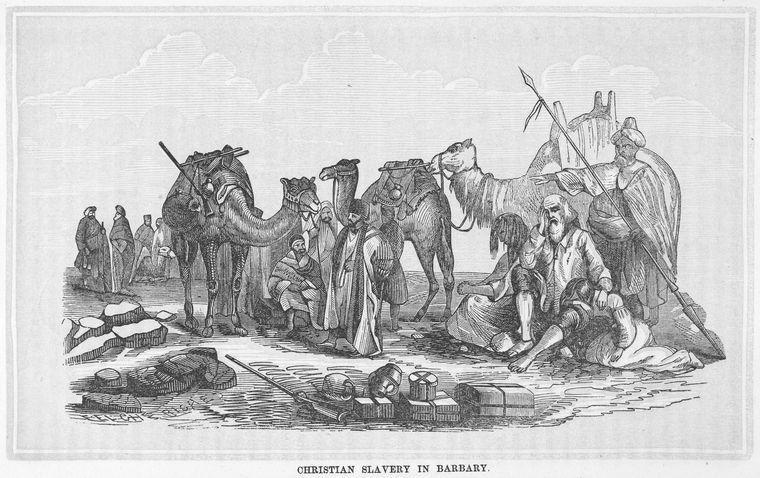 |
| European Christians enslaved in Barbary. |
The biggest problem with US slavery was that it assumed human inequality: it saw Africans as an inferior race who were better off as slaves. The Bible insists on the moral equality of all human beings, as children of God. Locke took this religious assertion, and from it developed his political ideas, later enshrined in the US Declaration of Independence: that all men are created equal, and that they are endowed by their Creator with certain inalienable rights, among which are a right to liberty.
This “right to liberty” was the doctrine that eventually ended slavery, and it came, says Locke, from the equality of man as asserted in the Bible.

