Playing the Indian Card

Showing posts with label sexism. Show all posts

Tuesday, February 21, 2023

The Pink Tax


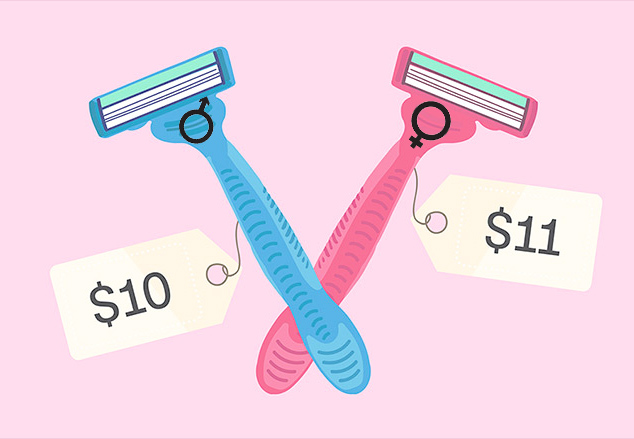
Ben Shapiro has come across a feminist on TikTok complaining about the “pink tax.” The problem, she says, is that identical items marketed to men or women coast ten percent more for the women’s version. This is discrimination against women.

But here’s a comparison. Identical food items cost more at Sobey’s than at No Frills.

Clearly, this is discrimination against those living in wealthier neighborhoods.

Or maybe, the free market being what it is, items are priced in part for how much the customer can or is prepared to pay. And the higher price for women’s goods is evidence that women have more money to spend than men.

They do. Women spend 80% of the consumer dollar. Men may make more money on average, or used to, but they don’t get to spend it.

If you think this is a case of oppression of women, here’s a simple test: if the male and female items are identical, why don’t women just buy the male item? That would end the practice immediately.

They don’t because women have enough money to be picky and not care about the cost. They will actually spend 10% more to get a pink razor instead of a blue one.

The same TikTokker notes that new drugs are always tested on men, not women. And this too is discrimination against women.

But by the same logic, it is more discriminatory against white laboratory rats and guinea pigs.

The eternal truth is that society considers men more expendable than women. If there is anything risky that needs doing, they use men.

Like trying experimental drugs.

Why do women insist that they are ill-treated? Because people will always listen and they get results.

Those who really are ill-treated are more likely to keep quiet about it and keep their head down. Because nobody will listen, and, if they do, it will just mean another blow of the lash.


Friday, October 07, 2022

Men Going Their Own Way


The Liberals are currently going hard after Pierre Poilievre because his videos on YouTube included the hashtag #MGTOW, which stands for “men going their own way.” This, Justin Trudeau and the mainstream press say, is a “misogynist” movement. Poilievre himself immediately condemned it and disavowed all knowledge of who put the hashtag on his videos.

But seriously, what’s the problem? It is the job of a politician to reach out to all voters; it is the job of an elected representative to hear all views. Why condemn a politician for sending his message to any identifiable group? Especially if their views are wrong, he is to be congratulated for trying to reach them.

Other than the literal meaning of the words themselves, it is difficult to say what “Men Going Their Own Way” advocates. There is no such organization. There is no organization hosting a website under that name. Articles condemning the “movement” cite a Reddit thread with the tagline. But Reddit has deleted it. All I find there is a thread called “ban MGTOW.” I did eventually find an online discussion board named https://www.goingyourownway.com/ . This may be the closest we can come to hearing what it is all about. And one obviously cannot legitimately object to an opinion until one finds out what it is.


They feature this “elevator pitch”:

First - relationships with today's women, under today's conditions, are not worth it. Relationships have always taken up huge amounts of time and money, but now they cost more: legal liability, alimony and CS (how many guys do you know who have been through the wringer?); and deliver less: women can't keep house, can't raise a family, are self-centred and entitled. Sure, today's women make a living, but so what? So do I. Sure they're "strong and independent" - how is that a benefit to a long term relationship? Today's women doesn't know how to wife and wouldn't do it even if she did. The only thing, the sole, singular, only thing today’s man needs, wants, or can realistically get from today’s woman is sex. Buying the cow is a worse deal now than it ever was.

Second - once you get realistic and opt out of relationships, or at least marriage, suddenly you need so much less money and have so much more time. You don't need a house. You don't need a [deleted]-magnet car. You don't need holidays at resorts. And with that need done away with, all of the things that you needed in your life to get more money become redundant. You don't need a suit. You don't need to spend hours a day commuting to two jobs. You don't need to socialise with people you despise.

There's a domino effect once you give up on the now-unattainable dream of marrying a good woman and living in a loving, lifelong family household. It's not that these things aren't great, it's that they are not in the offing anymore.

Let's be realistic. The sensible thing is to admit "defeat", and Go Your Own Way.

There is nothing misogynistic about any of that. It is criticizing feminism. Ideas are not just fair game—discussing them openly is essential. And these are good points. My own brother made this calculation, and decided never to marry. I saw the same problem, and sought to avoid it by marrying women from another culture. This is why so many European men now seek Asian wives.

As always, views are never suppressed because they are false. They are always suppressed because they are true, and threaten those in power.

Notably, the claim that marriage is a bad deal is exactly the claim made by feminism as early as the 1960s: “a woman needs a man like a fish needs a bicycle.” The criticism of feminism and the feminist society is surely no harsher than feminism’s criticism of “patriarchy.”

As a matter of fact, the opposition to MGTOW by the establishment press, the Liberal Party, Reddit, and Pierre Poilievre himself actually proves MGTOW’s central assertion: there is no equality between man and women in modern society. Women can say whatever they want, and are supported by the system. Men are silenced.


Monday, May 24, 2021

The Real World of Discrimination


The much-despised Tree of Life, in Kabbalistic symbolism: a representation of the attributes of God.

Caitlin Press in Tofino is calling for poems for an anthology about trees: ideally poems that “dispel the myth of hazardous and inconvenient trees.”

This is striking, because there are no such myths. In every known culture, trees are venerated. Which is why there is a market for an anthology of poems about trees. People love trees.


The much-despised Christian Tree of Life

This points to a common phenomenon. There is a persistent tendency to declare things or groups that are especially favoured to be or to have been discriminated against. Conversely, things or groups that have genuinely experienced discrimination get no love. In fact, this almost goes without saying: you are automatically not discriminating against any group you lament as being discriminated against.

For example, we are told endlessly that women have faced discrimination throughout history. Yet demonstrably, current laws discriminate in their favour in myriad ways. This is also true historically: women have always been put on pedestals. In many cultures, women were exempt from prosecution for any crimes; they were protected in times of war, rather than being sent to the front; and on and on. The exalted status of women has always been, in a phrase, a “motherhood issue.” And this is biologically hard-wired. Men are expendable, but women are not: they are needed to ensure the survival of the tribe.

We in Canada are told incessantly, and have always been told, that Indians have been discriminated against. Yet they are demonstrably given more rights than other Canadians: special treaty rights, a wide range of benefits not available to other Canadians. Any history of the Indian in literature reveals an unrealistic reverence for the “noble savage.” Everyone has always wanted to be an Indian, in Canada and in the US. And no, their land was never taken or stolen from them—a subject that might take us, for the moment, too far afield.

What about African Americans? Everybody agrees they have been discriminated against; and surely they have a legitimate grievance? After all, they were enslaved. But compare the Irish; the Irish too were enslaved in the New World, if not perhaps to a comparable extent. Indentured servitude. Moreover, the Irish, unlike the blacks, have been systematically oppressed wherever they lived for about five hundred years, including a mass starvation in the middle of the last century. About the same time slavery was abolished—after it was abolished throughout the British Empire. On balance, then, the Irish have arguably had a tougher time of it for longer. Yet there is little or no sympathy for the Irish. Current laws discriminate in favour of African Americans; and against Irish Americans.

It may be disturbing to accept it, but chattel slavery was thought throughout its existence to be of benefit to the African American slaves. They were understood to be unable to look after themselves properly, whether due to genetic incapacity or lack of civilization, and, like children, were to be taken care of. They were not hated or despised, any more than children are.

The Irish, by contrast, were hated and despised.

Who has authentically been persecuted and discriminated against, in recent times? The Jews. Within living memory, there has been a systematic and international attempt to exterminate the Jews. Compare African American slavery—never meant to harm, and abolished a hundred and fifty years ago. Anti-Semitic attacks are still the most common hate crime in Canada, and are on a rapid upswing across North America and Europe. Yet there is little public attention to it; if anything, it seems to be encouraged by some public figures.

The Poles. As many Poles as Jews were executed by Hitler in his camps; their country was carved up and enslaved in turn by Germany, Austria, Russia, and the Soviets. Yet Poles remain one ethnic group it is still acceptable to lampoon. Polish jokes are more or less okay in polite company.

There was something like an attempt to wipe out the Ukrainians within living memory. Yet Ukrainians remain another ethnic group it is still acceptable to lampoon. 

There was a concerted attempt to wipe out the Armenians barely a hundred years ago. It may not be fashionable to mock Armenians, but there is also no sympathy for them.

Who else has known great suffering in recent decades? The Koreans suffered a brutal occupation and something like a genocide under the Japanese, from 1911 to 1945, after which they lived through a devastating war. The Filipinos suffered more under Japanese occupation, reputedly, than any other occupied nation during the Second World War. It was not a matter of discrimination, but the Chinese and the Cambodians suffered holocausts of historic proportions within the lifetimes of many, and the Vietnamese lived through perhaps thirty years of scorched-earth war. Yet these groups are given no consideration in North America; instead, they are systematically discriminated against.

To be fair, African Americans, Indians, and perhaps women have a legitimate grievance, that they have not thriven despite the special help they have been given throughout recent history. Conversely, the Irish, the Jews, the Armenians, the Poles, the Ukrainians, have been successful, even notably successful, despite persecution.

But that is neither here nor there. Being coddled is not necessarily to one’s long-term benefit, because it strips you of self-reliance. It gives you unrealistic expectations, and, when they are not met, leaves you capable of doing little but complaining loudly.

These two unlucky fates, being genuinely discriminated against and being coddled, correspond to two common fates within a dysfunctional family. One child will be spoiled into arrested development, and will grow up to be a narcissist. The next child will be tormented, but, if they survive and survive without being permanently crippled, may even be stronger for the experience. They may grow up to be a hero.


Friday, May 07, 2021

Racism in Canada


I am pleased to see that some farmers in the US are filing suit against the federal government for racial discrimination.

The problem is worse in Canada. The Trudeau government is blatantly setting tax funds aside for female-run and black-run businesses.

Unfortunately, while racial and sexual discrimination is ultimately illegal in the US, it is legal in Canada. The Canadian Constitution has a carve-out:

“Subsection (1) does not preclude any law, program or activity that has as its object the amelioration of conditions of disadvantaged individuals or groups including those that are disadvantaged because of race, national or ethnic origin, colour, religion, sex, age or mental or physical disability.”

As well as a separate carve-out for “aboriginal people.”

Any government can therefore discriminate against any group so long as they declare their intent to be to balance out some supposed advantage.

Hitler insisted that ethnic Germans were disadvantaged by the Jews in 1930s Germany. Mussolini insisted that Italians were disadvantaged as a nation in the 1920s. Jim Crow began in the US South because white Southerners saw themselves as disadvantaged by the North.

And so it goes.


Sunday, November 25, 2018

There Is No "Good" Discrimination


My Liberal friend Xerxes writes that he rarely hears protests against “affirmative action” any longer.

That may be so. But it remains a grave injustice. He takes this instead as a sign of progress.

“Affirmative action” is a euphemism. The words “affirmative action” literally mean almost nothing; or might mean anything. Who can be against “affirmative action”? Like all euphemisms, it seeks to conceal an ugly reality. It is used as code for, literally, discrimination on the basis of sex or race. Discrimination on the basis of sex or race is always wrong.

Of course, Xerxes would justify it as “righting a previous wrong.” This is untrue. You might pretend it is significant and meaningful that someone else with the same skin tone or of the same sex as the person you are favouring now was discriminated against somewhere else in the past. But that is irrelevant. A skin color is not a person. Obviously, it is not the same person, and the person you are discriminating against now had nothing to do with the original discrimination. To argue “I am told a Jew once robbed one of my ancestors; so I have the right to take from any Jew now as a result” is extreme racism.

It is not justice to endlessly repeat a wrong with new people; a million more wrongs can never make one right. Each compounds the injustice.

And there are futher problems. Any claim of discrimination in the past is generally at least debatable, and should remain open to debate. How certain are we of our sources? Yet the present discrimination, by contrast, is beyond question; it is systematic, written in law, and openly professed. There is nothing we can really do about apparent discrimination in the past, at least past the death of the ones discriminated against. But we can end discrimination now. AS US Chief Justice Roberts put it, “The bes way to end discrimination is to stop discriminating.”

Historically, whenever and wherever discrimination has been widespread, it is always justified as “reverse discrimination,” exactly as is “affirmative action” now; there is nothing novel about this discrimination, and there is no special category of “reverse discrimination.” It is always advertised as helping out some group that has been previously oppressed. That, for example, was the standard justification for discriminating against Jews for generations. The Jews, after all, controlled all the banks and secretly owned everything, right? They were an international power conspiracy. Just like “Anglo cis males” supposedly are today.

That was also the standard justification for Jim Crow laws in the South: it was a matter of oppressed poor Southerners trying to protect their rights and their culture against an onslaught by the rich and powerful Northern carpetbaggers, who had crushed them militarily. If the main target in practice was local blacks, it was because they were feared as a fifth column. Almost exactly the same situation led to apartheid in South Africa. The poor Boers had been crushed militarily by the mighty British, denied their freedom, even herded into concentration camps. They naturally feared the African blacks as weapons of the oppressor to be used against them.

And so too with all the awful genocides in the Soviet Union, China, Cambodia, Korea: all in the name of defending the poor oppressed proletariat from the rapacious rich and powerful.

On top of all that, it is almost self-evident that any government-enforced or legally-mandated or even strongly socially-enforced discrimination like “affirmative action” will automatically discriminate in favour of those already socially favoured, and against those already discriminated against. Is social pressure likely to pull two ways at once?

So any new social discrimination, however justified, will always make the existing discrimination worse, never better. But it is really insane to even have to point this out. Few propositions come closer to being self-evident.

Saturday, August 04, 2018

Sarah Jeong's Racism


James Naismith, inventor of basketball.

A lot of people are becoming exercised about the New York Times' recent hire of a journalist named Sarah Jeong, on the grounds that she has for years been aggressively racist on social media. How come anyone who says anything that could even conceivably be considered racist or sexist referring to women or blacks gets fired immediately, but someone whose racism is extreme and directed against “whites” and whose extreme sexism is directed against men is A-OK? This seems to demonstrate a systemic racism and sexism.

But I think quite apart from her racism and sexism, the Jeong hire looks boneheaded purely in terms of competence. Her tweets and posts demonstrate profound ignorance and stupidity. What is the standard for journalism any more? Don't you need to be just a little aware of the meaning and significance of what you write? And if, as Jeong has been, you are a cultural journalist, don't you have to know just a little about the culture? What about awareness of little mechanics like punctuation and capitalization? Or the meaning of the word “literally”?

Someone has quoted from an old post of hers:

“have you ever tried to figure out all the things that white people are allowed to do that aren’t cultural appropriation. there’s literally nothing. like skiing, maybe, and also golf. white people aren’t even allowed to have polo. did you know that. like don’t you just feel bad? why can’t we give white people a break. lacrosse isn’t for white people either. it must be so boring to be white.” Or this: “basically i’m just imagining waking up white every morning with a terrible existential dread that i have no culture.”

So by her stated rules, nobody should be allowed to appreciate any culture not created by someone whose skin was the same hue. And specifically, you're not allowed to play any sports not invented by those of a reasonably similar skin tone.

Right, so as she says, that excludes people with pale skin from playing polo or lacrosse. I am sure that will hollow out many lives. Obviously, she says, they have nothing else. White people all spend their time playing polo and lacrosse.

On the other hand, what is going to be the consequence of her rule for black athletes? Now non-whites may no longer watch or play basketball. Did she really not know this was invented by “white folk”? Or football, for that matter, which evolved from rugby; or soccer, which is after all the world's most popular sport. Or baseball, or hockey, or golf, or tennis. Her rules would be a massive boost for the careers of any white professional athletes. Good old segregated baseball! She wants it back!

So what are the non-whites going to do instead, with their leisure time? It is painful to point it out. The standard complaint about European/North American culture has always been that the culture was entirely constructed by “dead white males.” Other voices, the left clamoured needed to be heard. And I, for one agreed--if not on which voices. This just does not fit well with the assertion that white males have no culture.

But back we go, then, in all the universities, to the old curricula that highlighted the classics, to Shakespeare, Twain, Milton, Dante, Goethe, Homer, Cervantes, and Moliere, to Beethoven, Verdi, Michelangelo, Picasso and Da Vinci. Non-white students should not even be admitted. It would be cultural appropriation.

She is an idiot.


Tuesday, August 22, 2017

Roses are Red, Butterflies Are Blue


Would that look better in blue?

Try, as I just did, typing the following string into Google’s search bar:

blue butterfly face painting toxic masculinity

I come up with pages of results, all referring to one story, now circulating in media social and conventional.

It is about a kid who asked to have a blue butterfly painted on his face at some local carnival affair, and his parents refused to allow it. They had the clown paint a skull and crossbones instead.

This seemingly trivial matter has been assigned a cosmic significance. It demonstrates where “toxic masculinity” comes from. It accounts for “male violence.” All because of a painted butterfly.

Isn’t this chaos theory or something?

I think the parents might have been too controlling in refusing the blue butterfly. But I can see where they are coming from. And it has nothing to do with inculcating in small boys a love of violence. That is pure fantasy.

True, their preferred image, the pirate’s skull and crossbones, seems to imply violence. But I doubt that is the message that would be taken by a young child. The immediate associations are freedom from restraints and adventure. See the opening scene of Monty Python’s “The Meaning of Life.”

Too violent for boys?

Sure, elements of a pirate’s, or a cowboy’s, life involve violence. But then again, you can get violence out of a butterfly’s life too, if you know anything about Darwinian theory. A toss up, from either the kid’s or the parents’ point of view, on that score.

I find it hard to believe in any case that any parents anywhere would actually want their kids to be violent. For one thing, it would be obviously against the parents’ own interest.

Nor was the problem of the butterfly that it suggested the child was sensitive to beauty. It might be, given a certain kind of parent, but this has nothing in particular to do with sex roles. Few parents would really begrudge their son a butterfly collection, for example. An appreciation of beauty is actually built or inculcated into boys and men more than it is in women. After all, men are more likely to be attracted to beauty in a mate than are women.

No, the problem was in putting it on his face. In wanting to have the butterfly painted on his face, the boy seemed to draw attention to himself and present himself as beautiful.

Not cool. This is a privilege allowed only to girls. Girls growing up are told they are beautiful princesses; their egos are constantly stroked. Boys are not told they are handsome princes. The thought is nauseating. Describe it being done with a boy, and you assume he is being spoiled into becoming a monster.

The reality is, we are a lot tougher on boys than on girls, growing up. (And in adulthood, for that matter.) The discrimination is all on that side.

But then, there is something to be said for learning the difference between good and evil, success and failure, where your rights end and the rights of the other begin. This dos not come from constant praise.

Boys are raised to be moral.

Girls are raised to be violent if they do not get their way.

This has been socially acceptable in the past because, by the time a girl, being physically weaker, was old enough to really be a problem, she was generally someone else’s problem.

It is that attitude that should probably change.


Friday, December 30, 2016

Putting Those White Males in Their Place


Blake, Africa and America supporting Europe.

Another example of the anti-white racism in our current culture
came down the pike the other day: “White authors are still writing racist books because white critics won’t call them out.” I get these regularly on Facebook. I tend to respond here rather than on Facebook, because otherwise I lose my “liberal” friends. It is not easy in academics not to be left-leaning.

Most obviously: it discusses racism in literature as only a problem of white male authors. What could be more racist than such an assertion?

“Racism in literature,” it begins, “manifests itself in myriad ways: characters whose personalities are reduced to their accents, cultural dress or foods;...”

Further on, it says that much of the problem of racism is that books are too often judged solely on literary merit (God forbid), instead of political considerations. But a case of a character who is distinguished only by his accent or dress or food is not racism. It is simply bad writing.

Does the author know what good writing is? Isn’t she supposed here to be an authority on it? She is identified as “an award-winning essayist, journalist, and literary critic” Or have the humanities discarded all such considerations now?

She goes on: her second example of endemic racism is “brown or black characters ‘rescued’ by white saviors...”

No doubt this happens in some stories. It is not easy, offhand, to think of an example. Robinson Crusoe, I suppose, published in 1719. But the complaint drips with irony. Has the author never heard of the literary character called “the magic negro”? It’s been a big deal in literary thinking recently. The common plot device is not to have the black character rescued by a white one, but the white one rescued by a black or brown one. The Green Mile, Gunga Din, Pocahontas, The Last of the Mohicans, the story of the first Thanksgiving, The Shining, Peter Pan, the Krishna cycle, One Flew Over the Cuckoo's Nest, and so on.

By this logic, these are all racist stories. But with the target being whites.

One wonders if the author has actually done much reading.

Another common example of racism: “... the ‘surprising’ friendship between a white character and a character of color...”

So showing a white character as not being racist is itself—racist.

“or, a white character’s journey to a ‘foreign’ or ‘third world’ country in search of ‘enlightenment.’”

Someone sure likes scare quotes.

Granted, this is a pretty common motif: the pilgrimage. Aside from Chaucer, it is pretty central to the image of Jerusalem in the Bible, or Mecca in the Quran. Or, in Taoism, the mythical islands to the East. Still, one would have thought this implied a positive, not a negative, attitude towards Jerusalem or Mecca, of said foreign country, as, say, possessing the real spiritual truth. It seems that, the instant a white mentions anything or anyone non-white, even with the highest praise, he is racist.

So are non-white authors equally racist if they mention anything white? Wouldn’t their writing in English, in the first place, count as cultural appropriation?

“The western or white gaze is unimaginative, misrepresentative [sic], and often harmful.”

Imagine substituting “the Chinese or Oriental gaze,” “the black or African gaze,” or “the female gaze” there. Sound good?

“As Pooja Makhijani writes in her review of Kevin Kwan’s China Rich Girlfriend: ‘We Americans erase layers of oppression by foisting our own frameworks, which reflect the specificity of our culture and history, on others.’ ‘The end result,’ says Lee, ‘is the reflexive default to ‘the western gaze.’”

Note the name of that author: Kwan. Our reviewer does not say it, but he is Singaporean Chinese. However, rather than concluding that racism is found in all races, both this article and the review to which it refers bizarrely blame Kwan’s supposed racism on Americans and the British. This is racism in both directions: in scapegoating white Europeans, and in infantilizing Asians. It supposes even a successful non-white author like Kwan is incapable of thinking for himself.

The poor dears. In the end, on this assumption, it was a darned good thing for their own sake that the British and Americans were there to take care of them for a few decades.

And they must have done very good job of it, if their influence is still so absolute generations after they left. Why, doesn’t that make a powerful argument for cultural superiority of some kind?

And why isn’t Kwan the guilty party, for “cultural appropriation,” for being so deeply influenced?

“Most book critics are white, and very often white and male,” Khakpour says. “Often those white males are not themselves very well-versed in issues of race, ethnicity, xenophobia, cultural appropriation etc. They are simply trained in reading books by white men, for white men, about white men.” … “Then there’s the reality that it’s much harder to recognize a problem you’ve never experienced. “

Odd, then, that most of the offending authors she cites, along with almost all of the critics, are either not white or not male. How did that happen—in a piece supposedly about white authors and white critics?

But never mind. There is a bigger logical problem here: if it is true that white males cannot have any insight into the lived experience of women or those with darker skins, it must be equally true that women and people of darker skins have no insight into the lived experience of whites or males. Who is the expert here? On what basis? Racial superiority?

Later, the author so much as says that white males “are simply not qualified to comment” on issues of race.

“Poverty enlightenment, a popular theme in narratives about white people traveling to brown or black countries, is similarly problematic when looked at through an anti-colonialist lens. ...”

The unfortunate reality is that, if a book portrays someone going to a “brown” or “black” country, said character is likely to see poverty. Is the author supposed to falsify this, or simply avoid setting any stories in “brown” or “black” countries? How would either of these options be less “racist”?

“Soniah Kamal, in a review of the [sic] Julie Feldon’s Karma Gone Bad (a memoir that proudly evinces its colonialist gaze in the title), notes that the author ‘sees beauty in the world after meeting a slum family, interacting with an orphan girl, and seeing a little barefoot errand boy. Does Feldon experience the same beauty when witnessing poverty in the US?’”

Ironically, the book the reviewer immediately goes on to criticise is a cheerfully comic novel about --- poverty in the US.

Then there’s Nell Zink’s 2015 novel Mislaid. Critics deemed it “infallibly irreverent,” “profoundly irreverent,” “a high comedy of racial identity,” or a “backwards route to examining oppression.”

So is the problem with seeing some kind of blessedness in poverty? If so, our author has just declared Jesus Christ racist. Has she never read the Beatitudes? It’s kind of hard to make much of Western civ as a whole without knowledge of the Bible.

“Mislaid harkens to blackface and slavery, when whites stripped Africans of their identities and forced them to assume their surnames.”

Okay, so maybe she was not a history major. But let’s set the record straight. Blackface might count these days as “cultural appropriation,” but it was obviously a sign of the general popularity of black culture. People would pay more money to watch if the performers pretended they were black. This popularity of black musical culture, after all, continues today. Is it racist to buy Mariah Carey records? The blackface minstrel shows were often banned in the South before the Civil War on the assumption that they were abolitionist.

Nor were Africans ever forced to take “white” surnames. Yes, they were required to take surnames. This was not about racism; it was a practical need in a complex society. Africans did not have surnames. When the slaves were freed, black Americans got to choose whatever surname they wanted. Nobody imposed a name on them: they were simply asked. Most of them chose “white” sounding names. Again, is the assumption that non-whites are incapable of thinking for themselves? And why is this not cultural appropriation?

Granted, Zink’s novel, although the central characters are in fact poor whites, could be interpreted as being really about black poverty in the US. When Zink complained there were no favourable portrayals of “US” poverty, perhaps she meant to exclude blacks as not being American. Nothing racist about that, right? But even so, if she is right, that there are few books or novels these days about poor whites, does that really suggest a preference for white people? Or does it rather suggest that the folks who write, edit, publish or read books don’t give a damn about poor whites? Or cannot see them sympathetically?

It is perhaps to easy to laugh, to see this as ridiculous. Nevertheless, the ugly fact remains that I received this article because I belong to a—more accurately, THE-- worldwide association or professional editors. This was sent out there as recommended.

Note then that, worldwide, nobody gets a book conventionally published without it going through a professional editor. One of these folks.

The same is true of entry to the professions, or to higher study. You don’t get to write books, either, without going through an academy where just this sort of thing is de rigeur.

Not just the overwhelmingly dominant viewpoint—a viewpoint that is largely enforced, and any dissent from which is likely to be punished.

Our system has become both stupid and systemically racist and sexist. Worldwide.


Sunday, December 04, 2016

Women Raping Men


Back when I was on the Standards Committee of the Editors' Association of Canada, we developed a course for prospective editors. One author wanted to make the point that it was not always necessary to use inclusive language: some things pertained only to men, or only to women. Her chosen example was rape: it was never necessary to say "he or she" raped "him or her." Since, of course, only men raped.

I objected at the time, for the obvious reason that I knew personally men who had been raped by women. And it turns out it is not uncommon.

http://www.theatlantic.com/science/archive/2016/11/the-understudied-female-sexual-predator/503492/?utm_source=eb

About time we drove a stake through the heart of this prejudice.

Monday, May 25, 2015

Men Prefer Smart Women


The results of this study are significant, because feminists are always saying the opposite: that men prefer dumb women.


Males value intelligence most as it's a sign a woman will be a responsible mother | Daily Mail Online:

The truth is that men prefer smart women, but smart women are never feminists.

A case in point: It is hardly suprising that feminists get less attention from men than do other women.

What is remarkable is that feminists can't seem to figure out why.


Saturday, July 04, 2009

The Plight of African Women

A friend, a left-leaning columnist, tells the heart-warming story of an Ghanaian woman who came to Canada to get her Ph.D. Not forgetting her homeland, she has set up a charity offering microcredit to the women of her home village. Her name is Vida.

Here is my response:

I'm not at all sure Vida's charity is a good idea. I am not at all sure it is doing more good than harm.

Your column claims that women in Ghana are notably deprived of an education. Not true, according to the statistics at Nationmaster. Male/female attendance at primary and secondary school is close to 50/50: 47.4% female primary, 44.7% female secondary. For comparison, in Singapore it's 47.6% female in primary school; Netherlands 48.3%; Canada 48.8%. Not too far off the mark; and especially impressive in the Third World, where a lack of jobs makes it less useful to educate women as a practical matter. Indeed, your own column contradicts the claim that Vida's family was opposed to educating women: her elder sister, you note, was able to finance Vida's education, because she held a job.

Your column claims that hospitals and health care in Ghana discriminate against women. But again, the statistics belie this: as in most parts of the world, women's life expectancy in Ghana is higher than men's: 60.35 vs. 58.65 years.

You further claim that, in Ghana, men control the money. If so, Ghana is nearly unique in world terms: almost everywhere else, women do. This includes Canada: since long before “women's liberation,” and still today, women control fully 80% of all consumer spending. The typical situation everywhere is that the husband earns the money, the wife spends it. And, in fact, your own column again belies this claim: obviously, Vida's own sister was able to control her own money, to the extend that she had a large enough disposable income to support her sister in school. Note too, in Vida's micro-credit scheme, that the women are able to back one another's loans. Obviously, they have some cash to work with, entirely at their own discretion, despite Ghana's poverty, or this would not be possible.

Anecdotally, you tell the story of a woman who had to sneak away from her husband to get birth control pills. This is not too surprising. In an agricultural society, another child is usually of overall benefit to the family—not just one more mouth to feed, but two more hands to work, and one more member of the mutual support network. Each further child helps guarantee the parents' welfare in old age. For the wife, specifically, though, it represents a risk: death in childbirth is not that uncommon. So the husband is normally likely to want more children, while the wife may fear it.

But of the two, who is right? Who is thinking of the greater good to the greater number, of their family reponsibilities? It seems to me that supporting the wife against the husband in this situation is likely to be to the overall detriment of Ghanians.

There seems, in sum, no objective justification for the radical discrimination against men that Vida's project proposes; nothing, perhaps, but cultural prejudice. And is radical discrimination really a good thing to promote in Africa, which has been rocked so many times already with ethnic genocides?

As noted, the wife almost always gets to spend the family money at her own discretion. So what, exactly, is the point of putting this money very publicly in front of the whole village directly into the women's hands, ad Vida's scheme proposes? The only obvious value of this is to dramatically cut men out of the family equation, and to humiliate them—to subvert the family role of the husband and father as provider.

This obvious direct attack on the Ghanian family structure is more likely to increase poverty than to reduce it.

First, it is a serious thing to subvert the family in the Third World, because in such poor countries the family is the only form of social insurance there is. There is no government safety net—indeed, government barely functions at all, and commonly you cannot trust anyone outside your own family even to deal with you fairly. Beyond the family, it is almost a war of each against each.

Second, what is the likely and demonstrated reaction of men to having their family role as provider removed? Daniel Patrick Moynihan did a famous study of this years ago, in relation to the US welfare system. Most often, men in this situation do one of two things—or rather, families do, as the women's wishes are probably also involved: either the men stop working and relax; or they leave. Either way, the whole family suffers, and especially the children. As a result, the black family in America has almost disappeared since the 1940s, creating a permanent welfare cycle, a permanent underclass. The same is likely to happen in Ghana to the extent that Vida's approach is embraced.

Make no mistake; the result will be worse than a zero sum game. What more money the mother makes will be cancelled out by less from the father, yes. But the father is unlikely, on the evidence, to embrace the idea of taking care of the children now that the mother is too busy with her business. He's more likely to get drunk and stay drunk. Or go. And stacks of studies show that children suffer greatly every which way from having fewer than two parents. So the next generation is being mortgaged for the sake of this present social experiment; Ghana's future prosperity is being mortgaged.

I cannot imagine a more perfect recipe for Ghana's permanent colonization.