If for any reason you cannot find the paperback version of Playing the Indian Card at your favourite bookstore or online retailer, please ask them to carry it. Protest and picket the store entrance if necessary.
A lot of folks, particularly doctors and public health professionals, are alarmed at the “obesity epidemic,” which is also increasing risks of heart disease and diabetes, in the North American population. But nobody seems to have a clear idea of why it is happening. My left-wing columnist friend, predictably, blames the "sugar industry," although how they are all controlling us in order to do this he does not say.
Ah, beautiful for spacious skies, for amber waves of grain...
I think there is a simple explanation, and a simple cure.
First, as is more or less self-evident, just about everybody likes sweet flavours. Second, sugar is cheap. Therefore, the makers of prepared foods of all kinds find it good business to add sugar to their products: it increases their market.
But if people make the same foods themselves at home, that is, when they actually see how much sugar goes in, they use much less. Prepared food tends to scrimp on other ingredients, and cannot be as fresh, and so, home-cooked food can taste as good as or better than prepared food without the sugar.
To a great extent, the same is true for fats. Fat is a quick and dirty way to make fast food more appealing.
Thanks to feminism and the breakdown of the family, people are relying more and more on prepared foods and fast food instead of doing their own cooking.
Slow food may be the answer.
Ergo, people are getting fatter.
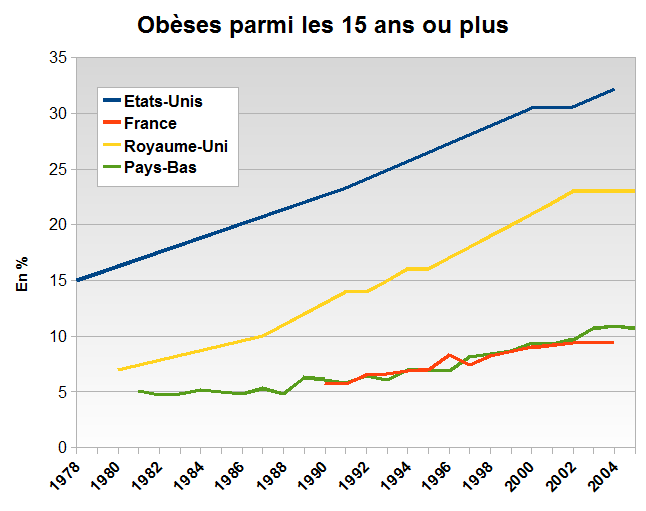
Note, in the chart above, how obesity is skyrocketing in particular in the US and UK, yet not in France. Why? Because France cares too much about food. They will not so readily accept processed foods as good enough.
Ideally, we should get rid of feminism and start supporting the traditional family. But that is a tough fix. There is a simpler one that would be pretty effective.
Only require that all processed foods display clearly on the label how much sugar is added, in whatever form, to their product. Require that this be expressed in teaspoon equivalents.
It would simply scare the trousers off most consumers to know that a soft drink contains 19 teaspoons of sugar; that each serving of spaghetti sauce includes two teaspoons; one squirt of ketchup adds one teaspoon; and so forth.
Do this, and I expect a consumer market would quickly appear for alternatives with less sugar. Note that the plateaus you see in the US and UK stats above as of the early oughts seem to reflect publicity given to the amount of sugar in soft drinks, and a corresponding drop in their sales.
In the meantime, this site, it turns out, illustrates the concept.
Of course, "Canadian cuisine" mostly means Montreal cuisine. I had a wonderful time of it this summer in Montreal going crazy with all the old favourites, and introducing some to my family for the first time. St. Hubert chicken, poutine, butter tarts, marshmallow cookies, bran muffins, smoked meat, feves au lard, fiddleheads ...
This piece argues that the higher education bubble in the US—if you agree that there is a bubble—is caused by a shortage of suitable jobs, driving the price of admission for those jobs up.
I don’t think that is the real story.
The history suggests that the movement has been mostly on the supply, not the demand side. As Anne Coulter has pointed out, at the time of the Second World War, the average American had a grade eight education. But immediately after the Second World War, there was the GI Bill, causing a flood of 2.2 extra students who might well not otherwise have been able to afford a higher education. You can see the immediate effects on the culture. Pop culture began to assume a mass market with a college education: The Lettermen, The Four Freshmen, The Four Lads with “Moments to Remember,” the folk boom, the Bohemian musings of Salinger’s short stories.
While the GI Bill was US legislation, the influence of American culture was so great that its effects were felt everywhere; going to college became the normal thing. So too with further US legislation.
The GI Bill sent through a second wave of 1.2 million students after Korea. Add in the “Sputnik Crisis” of 1957. The US’s immediate response to this demonstration of Soviet scientific prowess was to funnel, in the National Defense Education Act, billions of additional dollars into colleges across the US. College funding in the US increased sixfold.
Actually, he had cause.
And then there were the Sixties. The GI Bill was extended to all veterans in the Sixties, and their families: 6.8 million extra collegians. Then there is the issue of the draft deferment given to college students during Vietnam. This too must have had the effect of convincing a huge cohort of young people who would not otherwise have considered it to hang on and get a college degree, or two, or even three.
And so, over a generation or so, 1945-1975, the Baby Boom generation, we have a wholesale manufacturing of new degrees and degree-holders—a glut on the supply side, regardless of demand.
That alone might account for the Sixties. Suddenly you had a whole lot of people going to college who in earlier generations would not have gone to college. People who did not necessarily have a great interest in scholarship or study or the intellectual enterprise.
This was probably a lousy idea.
First, this painfully extended period of dependency is cruel to youth. No wonder, then, that we saw stirrings of rebellion almost immediately, in the 50s, with the emergence of the disaffected teenager and the generation gap; reaching full bore in the 60s. The painfully extended adolescence also surely called forth, almost demanded, the sexual revolution. Since young people could not afford to marry, they sought release in casual sex. It was and is unreasonable to expect otherwise. Societies that really expect celibacy also permit marriage during adolescence. Hence the breakdown of the modern family.
Second, it probably caused the demographic winter we now face throughout the developed world, which really threatens to destroy Western civilization. On the one hand, couples are discouraged from having children by the knowledge that they will now have to support them well into adulthood, in addition to the crippling burdens of tuition. On the other, young people going through their multiple degrees must put off marriage and childbearing for longer. They cannot yet afford it.
Thirdly, the effect on higher education itself has been awful. This one really is a zero-sum game: you cannot raise IQs. More people coming into higher education means the average quality of college graduates and college courses must decline. Rather than raise the general standard of education, for the most part all we have really managed to do is to begin to do in 16 years what we used to do in 12. In particular, the draft deferment has prompted a lot of people to go into graduate school, and then college teaching, who are not themselves scholarly by nature.
This has led in turn to a growing class consciousness. We saw it almost immediately in the 50s: a divide between greasers, who did not go to college, and listened to doo-wop and rock and roll, and the college kids, who listened to folk and jazz and read beatnik poetry. This original divide has blossomed since into the full-scale “culture wars.” Weirdly, during their formative younger years ,the upper class had no money, while the lower class had some, because they already held jobs. This has caused an odd distortion in our politics, so that the rich professionals see themselves as "leftist," while the working poor, the "rednecks," are supposed to be "right-wing."
Meet the new upper class
Now that college is no longer about scholarship or the pursuit of knowledge, it has had to redefine itself, essentially, as a kind of initiation procedure into membership into the broad upper class, the clerical or professional class. One gets a college degree, and especially a higher degree, not by hard work or intelligence, but by conforming to the imposed consensus, to the group interest.
This is the value of the college degree now, and it explains why they are still preferred by employees, even though the actual skills and knowledge gained can seem irrelevant to the job. It demonstrates a reliable commitment to the class/profession. One is going to go along and is not going to rock the boat.
Of all these ill effects, the college tuition bubble, and the college debt bubble, are probably the last and least. But it seems about to make the whole edifice unsustainable.
Democratic Presidential Nominee 2016. You saw it here first.
Hillary Clinton is not going to be the Democratic nominee. She’s standing at 65% in the Democratic polls, after all, with anyone else in single digits (except Joe Biden, at 10%). That looks unprecedented. That looks prohibited. But Hillary Clinton is not going to be the Democratic nominee.
First off, polls at this great distance from the election reflect little more than name recognition. They do not measure enthusiasm. The Democrats have almost no big names on their benches, except for Hillary Clinton and Joe Biden. The real news here is that Biden has no chance of the nomination. The Democrats do already know him, and they have clearly chosen not to support him. But since most Democrats have no idea who Martin O’Malley is, how can they support him?
This will certainly change. Democratic primary voters prefer dark horses. To them, politics is religion. They crave a savior figure, someone with superhuman qualities. A “lightworker.” Remember the posters that once read “JC (Jimmy Carter, not Jesus Christ) Will Save America?” Anyone too well known is off the list. Too many known warts and imperfections. To be plausible, you must start out as almost a blank slate in the public mind, so they can project their fantasies on you.
That’s not Hillary Clinton, is it? She was too well known to make it last time around; she is better known now. The very fact that almost any potential rival is a relative unknown, ironically, seals her fate. There is too much opportunity for opposition to coalesce around one savior figure. Some untested Howard Dean, or Barack Obama, or Jimmy Carter, or George McGovern or Bill Clinton is likely to surprise in Iowa, and then go on to storm through the primaries. It is just impossible to tell who it might be now. My best guess is that it will be a woman, because Democrats are not going to feel good about voting against a woman unless it is for another minority.
On the Republican side, there is the opposite situation: they have many plausible candidates. The key to their nomination is that any viable candidacy has to achieve dominance over one or another of the party’s constituent factions. Without this, they will not have the organizational power to survive the primary process.
Ted Cruz, the current poll leader, looks as though he has a solid grip, for now, on the Tea Party. Rand Paul is the obvious choice for the Libertarians. The party establishment seems to be behind Chris Christie. That leaves one major faction unaccounted for, without an obvious candidate: the Christian right.
Current slight favourite in a wide-open race.
The big name best positioned for raising their flag is Mike Huckabee, if he is interested. Rick Santorum’s current poll numbers are not encouraging for him. Bobby Jindal has a shot here, buoyed by his school voucher initiative. There is also opportunity here for a dark horse.
I see a realistic path for Jeb Bush as well. He has an automatic faction of establishment support, as a Bush. Christie faces serious challenges in the early primaries, like those Rudy Giuliani faced, or Mitt Romney, because, as a Northeasterner, he has inevitably taken positions that will not appeal to the Iowan grassroots. Florida’s early primary then becomes Bush’s possible ace in the hole to take out a faltering Christie. The establishment support would then move to him. He’s run well against a Democratic dark horse, too—as an experienced hand at the tiller, after the amateurism of the Obama administration.
Paul Ryan also has a shot. Because he comes from a nearby state, he could probably put together a good ground organization in Iowa, allowing him to score a possible upset—a result that makes him look stronger on the ground than in recent national polls. This then becomes the press lede, and he gets a lot of coverage going into New Hampshire.
The basic math is this: if any one candidate ends up as the champion of two of the four main Republican factions, libertarians, tea party populists, establishment, and Christians, he gets the nomination. Though in the past, the Establishment alone has often been sufficient. Who is most likely to do this?
And the Christian right is the one faction that seems most up for grabs.
Ted Cruz’s path looks clearest for the moment—Tea Party plus Christian right. But Tea Party support is rather fickle.
Next to that, I’d take Jeb Bush’s chances. Establishment plus Christian right. That’s the combination that put his brother over the top. But he starts from a position of dominating neither.
“Banned Books Week” has just concluded in the US, and this library display has been all over the Internet.
Great cartooning; but some of the claims it makes seem to be false. As far as I can tell, The Wizard of Oz has never been banned anywhere for “depicting women in strong leadership roles.” Some review did criticize it for this when it came out—i.e., in the very first years of the 20th century. Not exactly a clear and present danger. The Lorax was apparently pulled from some school libraries in California—in lumbering towns. Not because it “criminalized the foresting industry,” but because it might discourage local kids from going into that business. Is this really such a threat to our freedoms?
And then there is the bit about Winnie the Pooh being banned “because talking animals are an insult to God.” I can’t find evidence of this anywhere, but it makes no sense on the face of it.
First, there are talking animals in the Bible. Ever heard of the serpent in Eden? Balaam’s ass?
Second, there are talking animals in almost every children’s book written since Aesop.
Third, there are no talking animals in Winnie the Pooh.
Only talking stuffed toys, animated by Christopher Robin’s imagination.
Someone has been put on.
More generally, I’m afraid I cannot get too excited about school libraries and public libraries not stocking particular books. This is not censorship. Censorship is when you cannot legally buy a copy of a given book. It is just common sense that we have some limits on the books available to everyone’s children, and financed by the public’s taxes. Should school libraries stock Playboy and Hustler? Mein Kampf? The Anarchist Cookbook? At most, we are only debating whether these particular books should have been paid for and provided
I'm seeing repeated comments from academics saying Gilmour has no business teaching English, because he has no Ph.D.
Folks, supply and demand. Ph.D.'s are a dime a dozen. Successful novelists, on the other hand, are extremely rare. It is a far harder thing to do, and takes a lot more raw ability.
And who is really best qualified to give you good insights about literature? Someone who has read a lot of it, or someone who has written it?
Of course, the bottom line should be this: do good numbers of students sign up for his course?
Novelist David Gilmour has apparently made quite a stir with recent comments about the courses he teaches at U of T. Students are holding protest rallies. A fellow U of T professor has posted a rather personal online rebuttal. The chair of the U of T English department has publicly declared himself “appalled and deeply upset.”
Goodness—what exactly did Gilmour say?
The entire transcript is here. He says he only teaches books he himself loves, and, “unfortunately,” none of the authors happen to be Canadian, women, or Chinese. All of them seem to be “serious heterosexual guys.”
I find it hard to see anything objectionable here. I think it has to be either 1. that Gilmour is teaching only books he likes, as opposed to some official canon of great literature, or 2. that Gilmour does not happen to really like any books by women (except, he notes, Virginia Woolf), Chinese authors, Canadian authors, or openly homosexual authors.
But it can't be 2., can it? After all, there's no disputing taste. Gilmour's taste is certainly not the same as mine either, but to object to this would be ridiculous.
So it must be 1, that he is departing from the accepted canon? Yet Gilmour's chosen authors are in any way obscure: Tolstoy, Chekhov, Proust, Elmore Leonard, F. Scott Fitzgerald, Henry Miller, Phillip Roth. Surely all are, in fact, in the accepted canon, except perhaps for Roth, who is too recent to have a traditional place. So this can't be it.
And the bigger problem here is that English departments themselves have long ago departed from any accepted canon. Quite possibly they shouldn't have, but it's a bit late to blame Gilmour for this. The only issue should be whether the books and authors studies are clearly stated on the syllabus. Which, in Gilmour's case, they were.
So how, then, are books now supposed to be chosen for a course, if the traditional canon is to be ignored, yet it is not supposed to be the personal preference of the prof?
The answer, sadly, is painfully obvious. They are supposed to be chosen for political reasons, on the basis of affirmative action. Properly, whether the author is male or female, Canadian, homosexual, or Chinese, should not have any bearing on the literary quality of a book. But these days, English departments are all about politics, and have little interest in the literary quality of a book. One must include women, gays, and no doubt other designated groups in any curriculum. One need not, on the other hand, include heterosexual males; one can just bill the course "women authors," or "queer studies," and then it's okay to exclude men.
Indeed, quite apart from personal taste, it may well be, in the real world, that women have just not written as many good books as have men. This is quite likely, given that women have written many fewer books overall. It may well be, in the real world, that homosexuals have not written as many good books as heterosexuals. This is quite likely, given that homosexuals have written many fewer books overall. The same might be said of Canadians, or Chinese authors, at least Chinese authors accessible in English. Why should David Gilmour be held responsible for this? And why should students nevertheless be forced to waste their precious and expensive college time with inferior books in defiance of this fact?
A friend has sent me a link to this talk by Stephen Fry, “The Importance of Unbelief,” as the justification for their own atheism/humanism—and asked for a response.
Fry's main point, or at least the hook for the talk, is that you should not believe in an afterlife, because if you do, you will not make the most of this life. This is not really an argument against the existence of the afterlife: just because a thing is inconvenient, you cannot will it out of existence. But even on its own terms, this seems to me to be about the opposite of the truth. In either case, afterlife or no afterlife, you only have a predictably finite time in this life. If you believe in an afterlife, however, everything you do here matters; you are obliged to make the most of your time. If you do not, nothing you do now matters. You might as well just watch some more TV. You go for whatever seems most comfortable at the moment; which is generally making a living and indolence.
May I speak of myself? Believing in the afterlife, I have made rather a greater effort than most of my contemporaries to educate myself, to experience the best in art, and to see the world. But I can't hold a candle to, say, St. Francis Xavier or any of the other early Jesuits. It was the Church that invented the schools and universities, that inspired and supported all the great art, even that inspired the idea of travel (see pilgrimage), right up until quite modern times.
Fry then dismisses the argument for the existence of God from design—i.e., from the beauty of nature. But here he is confusing different things: he takes beauty to be the same as pleasantness and prettiness. There is awful death in nature? There is awful death in Hamlet, too, or Romeo and Juliet, or Oedipus Rex. Does that mean they are bad plays? Does that mean they are not beautiful?
Nature is beautiful in the true sense—true beauty is not prettiness, but must include the sublime.
Fry is left arguing that nature is morally unsatisfactory—a separate argument, and he must still account for why, if without a designing intelligence, it is beautiful. He does not; he cannot.
So we turn to the “argument from evil.” Is nature immoral? No, not in detail. Because animals, plants, viruses and volcanoes are not morally conscious beings, they cannot be acting immorally.
Does nature involve suffering? No doubt. Is suffering evil? Who knows?
What he means, then, presumably, is that nature overall seems to act unjustly. That does appear to be so—why is one person born beautiful while the next is born ugly? Why does one person die in infancy, while another lives to be eighty? This is the question famously raised by the Bible in the Book of Ecclesiastes. The world is unjust. On this, we all agree.
But then, this becomes an argument for the existence of God. If we have this unshakeable conviction that there ought to be justice, must be justice, despite all the evidence of the world as it is, where can this conviction come from? Obviously not from experience. Ergo, it must have been put there by God, Ergo, it is a sign of God's own true nature and his plan. Ergo, there will be justice. Ergo, there must be an afterlife.
Fry's next argument is that science has replaced the need for God. This is the essential premise of the new pseudo-religion of Scientism, which has done a great deal of harm in the modern world; not least to science. To begin with, science is a tool; science makes no claims to truth in the philosophical sense. If this were not enough, science can also tell us nothing about morality, meaning, or subjective experience. This last is important, because in the end, all that we really have is subjective experience. Everything else exists only theoretically.
Fry then insists that we have responsibility for “creating our own ethical and moral frameworks.” Can you see the problem here? If we have free choice over what is right or wrong, then we have the right to decide for ourselves that, for us, it is okay to torture and kill small children, for example. It is just our free moral choice, right? Then too, we have no business at all complaining about a Hitler or a Nazi Germany, do we? Killing Jews and such was just their free moral choice. Much less about a Church “imposing its morals on us.” That's just their own moral choice, isn't it?
Surely you, like me, are instantly repelled by this proposed state of affairs. No, we know in our hearts that it is wrong to torture and kill small children, right? Okay, let's leave aside abortion for now... In other words, we do not create our own ethical and moral frameworks. Morality and ethics are absolutes; we cannot legitimately violate them on our own say-so or choice. If we do, we are acting immorally. Reject this premise, and morality itself has no meaning.
But if morality and ethics are absolutes, regardless of what this or that person, or even all people put together, might think about it, where do they come from? The answer really has to be that they are from God, and an expression of his essential nature. Ergo, God is good. They also reveal his plan: his plan is for the moral good.
Fry contrasts his view that morality is something we decide on for ourselves with the idea that it comes from “words put down in a book.” This is the fallacy of the false alternative. Nobody I know believes that morality itself comes from the Bible, or any other book. Christians believe that the sense of right and wrong is inborn. It is called conscience.
... for those who did not know. Besides being a brilliant marketer, Nichol was a real and major contributor to Canadian folk culture--which is the only real culture there is. He changed Canadian cuisine.
I used to love his Insider Reports just for the sheer reading pleasure.
Kingston Penitentiary, Canada's historic maximum security prison, is closing down. The question on everyone's mind now is what to do with the building. Of course, most obviously, they should turn it into a museum. But it's a bit too large for that. Here's my proposed solution: make it a living museum. Besides the delightfully gruesome exhibits, it should rent rooms, like a hotel. This would of course not be everybody's idea of a fun vacation, but I suspect it would be a real draw for some people, especially young people, to spend a night in a cell that might have been used by Paul Bernardo or Clifford Olson. Great talking point once you get home. Especially great for class trips, with a double message: first, the history lesson, and second, why you don't want to end up here.
I imagine three room options: some cells could be kitted out to the maximum luxury possible without altering the essential structural integrity. Some could be kitted out just for a reasonable level of comfort. And some could be left exactly as they would have been for the last inmates. If this is still a bit plush, and I suspect it might be, a fourth level could retrofit to what the cells would have been like in the early 20th century. People could then choose their own particular adventure-to-comfort quotient.
Jailbird's eye view.
A restaurant would be needed, of course; for overnight and day visitors. The menu could offer traditional restaurant fare, for the conservative, plus, for those seeking the full experience, typical meals for prisoners from various stages in the prison's history.
Simply knocking down one exterior wall, the one facing Portsmouth Harbour, could give the prison a prime waterfront view with a marina. But if the other security walls are left up, they look as though they might make fine outdoor screens for nightly projections of classic crime and horror movies. You couldn't get much more atmospheric... And what a perfect setting for a live dinner theatre "murder mystery" evening.





 Posts