Playing the Indian Card

Saturday, May 26, 2012

Who's Up, Who's Down


I didn't post any predictions this year, did I?

Arnold Toynbee says civilizations and cultures rise and fall on the strength of conviction of their “creative class” that they are doing something worthwhile. Put another way—my words, not his—they rise and fall on the strength of their social world view.

This has, in fact, long been understood in the Far East.

A strong social world view that everyone believes in will sharply reduce corruption and selfishness; and corruption, as Mancur Olsen demonstrated, is the single overwhelming case for poverty at the level of a society.

Some of the great, successful social world views of the past have been Confucianism, liberal democracy, and Islam.

If Toynbee is right, China is more or less necessarily going down. For a few decades, Marxism worked as a social world view limiting corruption and fostering idealism; but the flaws in the theory are now obvious. Few in China seem to believe in Marxism any more. As a result, the Chinese ruling classes are becoming a kleptocracy. And, unfortunately for China, the regime has actively suppressed all alternative world views, so that the transition to something that works better will be quite difficult.

On top of that, China is doomed by demographics, thanks to the disastrous “one child” policy. This shortage of children is, apart from government policies to encourage or enforce it, a common symptom of a social world view in decline. It just stands to reason: having children is a dramatic vote in favour of an optimistic view of the society’s future. Not having children is the reverse. Darwin, in The Descent of Man, commented that a dramatic fall in fertility rates among more “primitive” people was a common result of first contact with Europeans.

So I continue to say China is going down soon, and going down hard, all the harder because it has boomed so much recently. Even when I was there in the early nineties, I smelt death everywhere.

Can India take up the slack? Corruption is an endemic problem there as well. I am not sure India's Hinduism can provide the necessary BTUs to allow it to really take off. Hinduism is a bit too relaxed and without a sense of social mission for this purpose; it is largely a national religion, without the sort of universal message that would prompt a country to become a world leader. And it tends to the individualistic and mystical rather than the social in its emphasis. On the other hand, this makes India fertile soil for the transplanting of liberal democratic ideals, which have proven so successful in America and Europe in the recent past. I expect to see India joining the first rank of the developed world; but I am not sure it will ever be a world leader in the way America or Britain have been.

The EU does well on the anti-corruption measures. But it looks increasingly as though its political and social world view is living on fumes. Europe has never recovered from the trauma of two world wars; it has been nursing a self-hate verging on suicide. As the current “Eurozone” crisis has tended to show, Europe does not have the stamina nor the idealism any longer for a great deal of personal sacrifice or deferred gratification. Everyone just wants a comfortable life.

Eastern Europe, where Marxism has collapsed as a social philosophy, is having trouble transitioning to a new world view, precisely because the Communist regimes, as in China, systematically repressed all alternatives. Poland is a notable exception—buoyed by the strength of its Catholic faith.

The Muslim world is wild card. Islamic revival offers an alternative social world view to liberal democracy. If successful, it might outstrip liberal democracy. If unsuccessful, it will hold the Muslim world back by preventing it from embracing liberal democracy. This is the conflict that has been working itself out in Egypt’s streets, in Iran, and elsewhere.

The fundamental problem Islamism faces, though, seems to be that, while popular with the bulk of the population, it is far less popular with Toynbee’s “creative classes.” It seems as though Iran, the model Islamist state, has not been successful. Turkey, the prime Muslim liberal democratic model, seems to be doing much better. However, it looks as though Egypt will go with the Islamist model. My suspicion is that Turkey is on its way up, for now, and Egypt is on its way down.

So who gets the mantle of leadership? I think it’s still the USA, for the foreseeable future. The liberal democratic model seems to have tarnished a bit over the years, but there is no rival that looks capable yet of taking over. And the one place where the liberal democratic model is still taken the most seriously is the USA. Unlike Europe, the US is not collapsing demographically, but maintaining a decent birth rate. It seems to be undergoing a religious revival. And it has only very recently launched the high-tech revolution, giving it in theory the sort of advantage England held for a century or so after the Industrial Revolution.

The same factor makes Africa look like a good bet for the near to mid-term. Most of sub-Saharan Africa is benefiting from a Christian religious revolution.

Tuesday, May 22, 2012

The Index of Banned Books

One hears a lot about the Catholic Church's old "index" of books good Catholics were not supposed to read. My great-aunt Mary, otherwise a committed Catholic, used to claim that she grew up choosing her reading material from the Index.

She must have been lying. Have you ever seen the Index? If you kept strictly to its precepts, you would miss out on very little good general reading, and very little controversy. The 1948 version is online here. Note there are no decent modern novels banned; not even Nietzsche, Marx, or Freud are banned. Neither is Martin Luther. The books banned are, sensibly and uncontroversially, books that by their nature and content might be supposed to be expressions of Catholic doctrine, but are not. Hence books by Blaise Pascal and Saint Faustina are banned. Nobody would make that mistake about Marx, Freud, or a modern novel.

But that means the books banned are mostly, for the casual reader, extremely dry; probably of interest only to theologians.

Saturday, May 19, 2012

Canada's Flying Saucer

Canada has a certain odd tendency to come up with strange "secret weapons"--that then were scrapped. I've long thought there was a good book in this--maybe a boy's book. There is the Canadian super cannon, Habbukak, the Canadian aircraft carrier made from ice, a Canadian atom bomb, the famous Avro Arrow--and now this.

Wednesday, May 09, 2012

Haskap

Here's something that looks like a real treat for Canadian gardeners. From the University of Saskatchewan.

Tuesday, May 01, 2012

Civil War News

This was a set of bubble gums cards familiar to me from my childhood in Montreal. Strikes me that putting such things on bubble gum cards is a fantastic way to teach almost any subject.

http://www.bubblegum-cards.com/Civil-War-News/index.html

Saturday, March 31, 2012

Planting the Seed


Gospel Jn 12:20-33

Some Greeks who had come to worship at the Passover Feast
came to Philip, who was from Bethsaida in Galilee,
and asked him, "Sir, we would like to see Jesus."
Philip went and told Andrew;
then Andrew and Philip went and told Jesus.
Jesus answered them,
"The hour has come for the Son of Man to be glorified.
Amen, amen, I say to you,
unless a grain of wheat falls to the ground and dies,
it remains just a grain of wheat;
but if it dies, it produces much fruit.
Whoever loves his life loses it,
and whoever hates his life in this world
will preserve it for eternal life.
Whoever serves me must follow me,
and where I am, there also will my servant be.
The Father will honor whoever serves me.

"I am troubled now. Yet what should I say?
'Father, save me from this hour?'
But it was for this purpose that I came to this hour.
Father, glorify your name."
Then a voice came from heaven,
"I have glorified it and will glorify it again."
The crowd there heard it and said it was thunder;
but others said, "An angel has spoken to him."
Jesus answered and said,
"This voice did not come for my sake but for yours.
Now is the time of judgment on this world;
now the ruler of this world will be driven out.
And when I am lifted up from the earth,
I will draw everyone to myself."
He said this indicating the kind of death he would die.

Sorry; really late with this one. I've been busy seeing the sights of Barcelona.

As usual, there is something funny in this gospel passage—funny odd, if not joke funny. A group of Greeks have come, no doubt from a long way, and wish to meet Jesus. Jesus is asked directly if they can see him—and he does not answer. Instead, he talks of the kind of death he is about to die.

What gives?

I think the point is that the arrival of Greeks seeking Jesus signals that it is time for the crucifixion. If the Greeks are aware of it, and concerned about it, that means the message of Jesus's death and resurrection will spread throughout the world. Most of the Ancient world was then Hellenized, as a result of Alexander's Empire plus the prestige of Greek culture in Rome; if the good news was spread in Greek, it would quickly reach as far as Spain and Britain in the West, and Afghanistan and what is now Pakistan in the East. From there, trade routes could carry it further east--as in fact happened.


Whoever loves his life loses it,
and whoever hates his life in this world
will preserve it for eternal life.


There is a passage in the “Hail Holy Queen” that refers to the human condition as “mourning and weeping in this valley of tears.” A priest friend of mine scoffed at that, insisting that all things were really for the best in this best of all possible worlds. I thought he was wrong then, and this gives clear Biblical warrant that he was. If you are happy with this life, something is wrong. The “ruler of this world” is plainly not God, as this passage makes clear; it is Satan.

Friday, March 30, 2012

It's a Man's World


What a hellish century the past century has been, especially for men. Let's review: first, the Great War. If you happened to survive the trenches, and the influenza epidemic, and were lucky enough not to be in Russia for the Revolution and all that followed, or an Armenian, you got about ten years' breathing space before the Great Depression hit. Maybe you starved; at best, you lost everything. With luck, you were not in Spain for the Civil War, or in the Ukraine to be systematically eliminated; but the Depression segued straight into the Second World War, with the Holocaust. Hard not to get killed in that; but suppose you survived. About fifteen or twenty years to recover from the dislocation—not counting Korea or Vietnam, which most folks avoided, and the new threat of nuclear annihilation or another general conflagration in the Cold War. And if you were lucky enough not to be one of the 20% of the world population living in China for the Great Leap Forward and the Cultural Revolution. Or in Cambodia. Then you were hit full in the face with feminism and the breakdown of the family. You were suddenly the oppressor, and had some massive social debt to pay, for being a man.

About then, given a normal lifespan, having survived all this, you died of natural causes.

Moral: there is no justice in the world.

And something got seriously screwed up here.  

Sunday, March 25, 2012

Archaeology

When I was young I wanted for a while to be an archaeologist. But I wonder now about the legitimacy of the entire enterprise. First of all, a lot of it is grave-robbing, and the rest is mostly digging through someone else's garbage. Isn't that pretty disrespectful of our fellow human beings?

And do we learn anything justifying this? From all I've seen, we get nothing out of it all but wild guesses. Worse, every archaeological dig is destructive. We are cleaning out all the eras between the present and the time we happen to be interested in, and so losing the evidence of these other times. In Greece, we always dig down to the classical, Periclean period, discarding the Byzantine, the Ottoman, the Roman. We happen to be interested these days in the Periclean period; what happens if, twenty or a thousand years from now, we are instead interested in the Ottoman? Too late; we've destroyed all the evidence with our digging.

Even if we are still interested in the Periclean times, it is quite likely that our evidence is now being damaged by archaeological techniques that, in a hundred years, will seem terribly primitive and inadequate.

Monday, March 19, 2012

Sunday's Reading


Jesus said to Nicodemus:
"Just as Moses lifted up the serpent in the desert,
so must the Son of Man be lifted up,
so that everyone who believes in him may have eternal life."

For God so loved the world that he gave his only Son,
so that everyone who believes in him might not perish
but might have eternal life.
For God did not send his Son into the world to condemn the world,
but that the world might be saved through him.
Whoever believes in him will not be condemned,
but whoever does not believe has already been condemned,
because he has not believed in the name of the only Son of God.
And this is the verdict,
that the light came into the world,
but people preferred darkness to light,
because their works were evil.
For everyone who does wicked things hates the light
and does not come toward the light,
so that his works might not be exposed.
But whoever lives the truth comes to the light,
so that his works may be clearly seen as done in God.


Sounds easy, right? Just believe in Jesus, and off you go to heaven after death.


But what then is this bit about “works”?


And what does it mean to “believe”? To “believe in the name of the only Son of God”? It certainly does not mean to believe in the name “Jesus”--for that was not his name. It's a Latinized version of it that he would not have answered to. We're not even sure what his real name was—something like “Yeheshua,” perhaps.


It also does not mean believing that Jesus really is the Son of God. According to the New Testament, the Devil himself acknowledges this. And he is not saved.


“Belief” here means something more like trusting. We must trust in God, which is to say, trust in Jesus, who is the “name,” the Word or Logos.


After all, it is philosophically impossible to believe that God does not exist—he must necessarily exist as a concept, or we would have no concept of him. So that whole debate, “does God exist?” is a con. Self-proclaimed atheists never seem to really disbelieve in God; if they really did not believe he existed, why would they be so angry at him? Why would they care? What does not exist cannot hurt them. Do they make such a fuss about not believing in sea serpents?


So believing that God exists, for the religious, is certainly not enough. There is no merit in believing in God in this sense. Rather, are we prepared to raise him up before us on our journey, as our standard, our guide, our protector, as Moses did with the brazen serpent in the desert? That is belief: commitment.


Those who are not prepared to do this, the passage explains in turn, are not prepared to do so for a predictable reason. When one has done something wrong, and does not want to admit it, truth itself becomes the enemy. One does not want truth, and so becomes the enemy of truth. One does not want justice, and so becomes the enemy of justice. One does not want light, and so becomes the enemy of light. One does not want things to be clear; one does not want the ways straight, the truth known, or the light to shine into closets.


This tendency is a basic principle explaining the world as it is. It explains why things are so often the reverse of what they seem to be; why we seem to live in a Looking Glass World. “Choice” means abortion; “affirmative action” means discrimination; “reproductive health” means contraception. We want to do something; we know it is wrong; we justify ourselves by lying about it, even to ourselves; and, over time, we become enemies of truth. This is why John the Baptist, as herald of the incarnation, saw his task as “making the ways straight for the Lord”; because, in the normal course of things, most people had been busy for uncounted generations changing all the signposts. Confucius, asked what was the first task of good government, said, “the rectification of terms.”


All of us are brought up in a Matrix, sold a complex and systematic distortion of the world at school, in the media, and by governments.


The way to salvation is to break out of this and see things in the light, as they are.

Saturday, March 17, 2012

Fly Aer Lingus to Purgatory


Medieval map showing location of purgatory and the island of Brazil


Did you know that purgatory was in Northern Ireland? This was an established fact already by the late Middle Ages; it once regularly appeared so on world maps.


The entrance was a two-foot by three-foot cave on an island in Lough Derg, in County Donegal.


St. Partrick discovers the mouth of purgatory.


By legend, the cave was originally discovered by St. Patrick in a vision. He used it as a proof to the Irish of the reality of the afterlife and the need for repentance. And, by all accounts, it worked. It grew to become a major pilgrimage site for people from all over Europe. We have several literary accounts of actual pilgrimages, which include vivid descriptions of the tortures of the underworld. Having been on the pilgrimage to Patrick's Purgatory established a reputation similar to that of having been initiated into the mystery religions of ancient Greece. It was understood to be truly life-changing.


One of the sights of purgatory, according to a Medieval traveller's account.


Oddly, considering the great tourist potential, the cave entrance has been sealed since 1632. The consequences of doing otherwise may have been too terrible to contemplate.


Happy St. Patrick's Day!

Saturday, March 10, 2012

Reading for March 11


Since the Passover of the Jews was near,
Jesus went up to Jerusalem.
He found in the temple area those who sold oxen, sheep, and doves,
as well as the money changers seated there.
He made a whip out of cords
and drove them all out of the temple area, with the sheep and oxen,
and spilled the coins of the money changers
and overturned their tables,
and to those who sold doves he said,
"Take these out of here,
and stop making my Father's house a marketplace."
His disciples recalled the words of Scripture,
Zeal for your house will consume me.
At this the Jews answered and said to him,
"What sign can you show us for doing this?"
Jesus answered and said to them,
"Destroy this temple and in three days I will raise it up."
The Jews said,
"This temple has been under construction for forty-six years,
and you will raise it up in three days?"
But he was speaking about the temple of his body.
Therefore, when he was raised from the dead,
his disciples remembered that he had said this,
and they came to believe the Scripture
and the word Jesus had spoken.

While he was in Jerusalem for the feast of Passover,
many began to believe in his name
when they saw the signs he was doing.
But Jesus would not trust himself to them because he knew them all,
and did not need anyone to testify about human nature.
He himself understood it well.

John 2: 13-25


School of Hieronymous Bosch

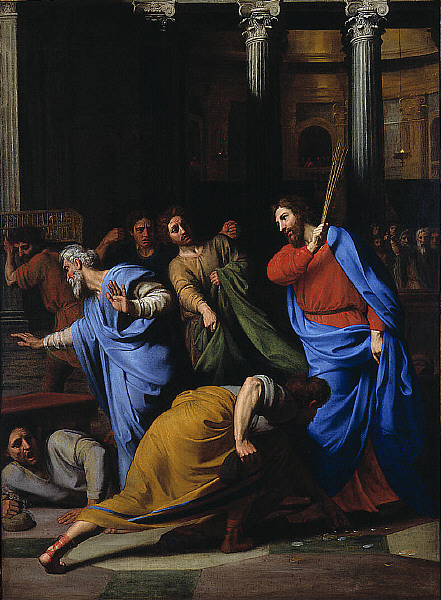
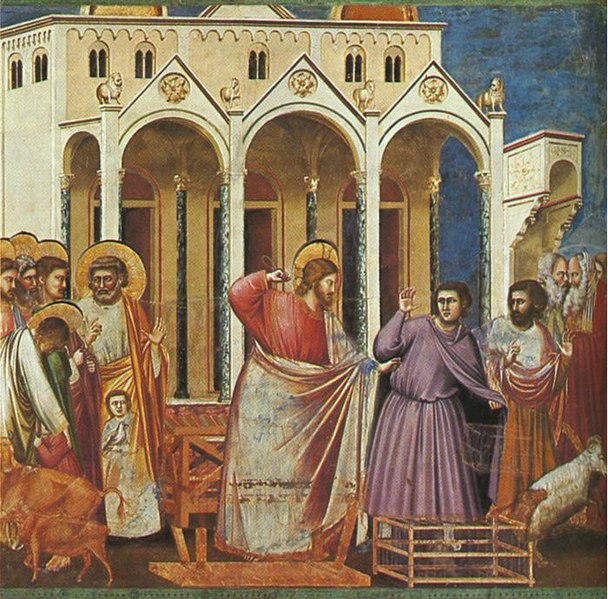
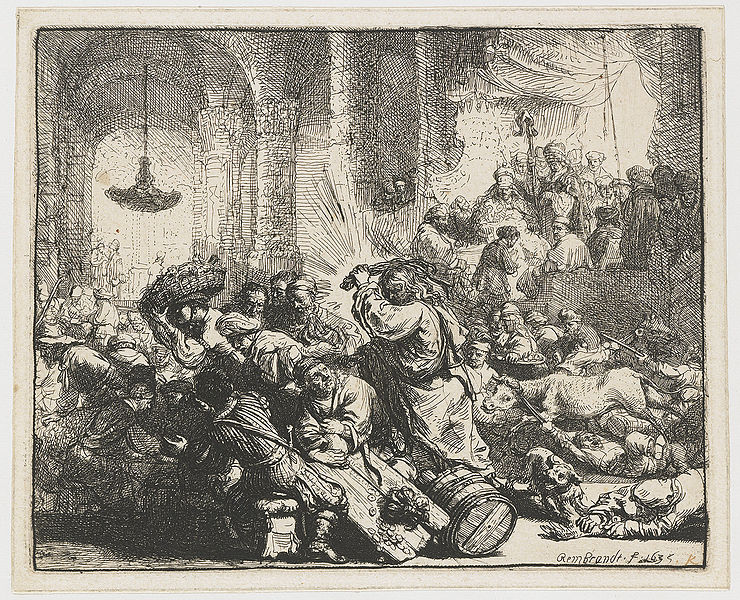
So why does Jesus come after the moneychangers? There is surely no great evil here. Just some small businessmen trying to make a living. And their trade was not, on the face of it, disrespectful to the temple. It involved meeting the requirements of Jewish law. They were selling animals to sacrifice, and exchanging Roman coins, which had the emperor's face on them, for Jewish shekels, which did not, so that one's offering did not offend the ban on graven images. What's wrong with that? After all, Jesus doesn't lose his temper in this way towards tax collectors, publicans, prostitutes, or Roman centurions.

Durer


I think the point is symbolic. It is not that these people were doing something wrong, and it is not that Jesus was really angry. He was proclaiming the new covenant.

He overturned the tables of the moneychangers, because the prohibition against graven images was now no longer in effect. The problem had been the impossibility of portraying God, who is pure spirit, as a creature. Yet now he himself, after all, was God, and at the same time man. We could now therefore legitimately portray God with a human face. The moneychangers were no longer needed. Worshippers had, at the same time, been released by God from this burden.

Giotto.

In the same way, he dispersed the sellers of doves, oxen, and sheep, and their animals, because the days of blood sacrifice had now ended. Now, he himself would be the sacrifice, as he is daily in the Mass; releasing both animals and humans from this bondage.

Rembrandt.

And what is this about speaking of the Temple as his body? Again, this is the New Covenant. Before, the temple was the one place where the divine and human worlds met, making it the only proper place for true worship and sacrifice. Now, however, the divine and human met instead, and more completely, in him. He had become what the temple was previously. And the tearing down and then in three days raising up this new temple of his body was the foundation of the New Covenant.

Tuesday, March 06, 2012

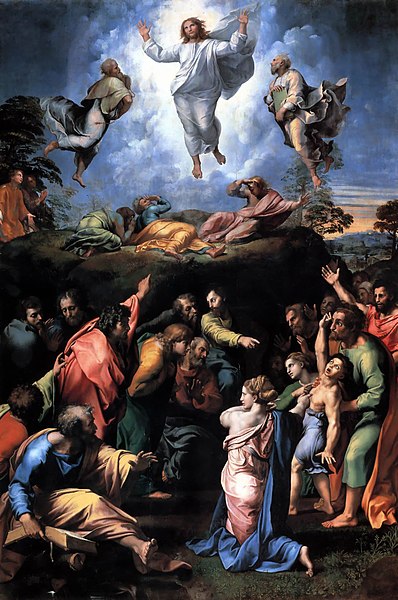
The Transfiguration


Rubens.


Jesus took Peter, James, and John
and led them up a high mountain apart by themselves.
And he was transfigured before them,
and his clothes became dazzling white,
such as no fuller on earth could bleach them.
Then Elijah appeared to them along with Moses,
and they were conversing with Jesus.
Then Peter said to Jesus in reply,
"Rabbi, it is good that we are here!
Let us make three tents:
one for you, one for Moses, and one for Elijah."
He hardly knew what to say, they were so terrified.
Then a cloud came, casting a shadow over them;
from the cloud came a voice,
"This is my beloved Son. Listen to him."
Suddenly, looking around, they no longer saw anyone
but Jesus alone with them.

As they were coming down from the mountain,
he charged them not to relate what they had seen to anyone,
except when the Son of Man had risen from the dead.
So they kept the matter to themselves,
questioning what rising from the dead meant.

--Mk 9: 2-10.

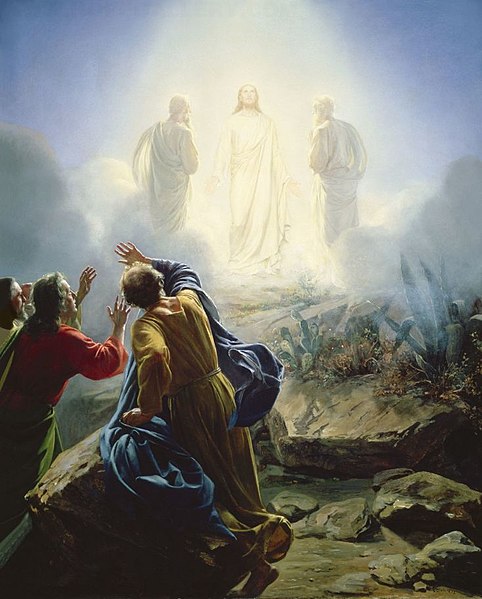
Bloch


As usual, today's gospel is a funny bit. The punch line is Peter's offer to build three tents, one for Jesus, one for Elijah, and one for Moses. Elijah and Moses; long dead. How could they need tents to shelter them from the elements? And he knows very well who they are—he cites them by name.

The gospel says he is confused; but what is he thinking?

Raphael

One would necessarily assume that a dead person is an entirely spiritual being, would one not? If there is survival after death, it is only the spirit, and not the body, that survives. We see the body rot. The natural assumption, therefore, on Peter's part, should have been that Moses and Elijah, if they have reappeared, have done so purely as apparitions—visions, wraiths, ghosts, that sort of thing.

The point of his offer, and perhaps of his confusion, must be a strong impression, nevertheless, that these men before him were not, in fact, apparitions. To all appearance, they must have been plainly there physically, solid flesh. The impression must have been so strong as to overcome the obvious assumption that they were disembodied spirits.

Rather like the man the apostles met, later, on the road to Emmaus, who actually ate with them, as an apparition could not.

Russian icon

The passage notes that Jesus himself, undeniably still in the flesh, was “transfigured.” In what way the gospel does not say, but his clothing became supernaturally white—a perfect white. Might it therefore be that Jesus here assumed his perfected body, as all our bodies will be perfected at the Resurrection. As the cosmic Christ, he was of course capable of doing this; and after his own resurrection from the tomb, he seems to have assumed just this transfigured, perfectged body. This body was able to eat, but could also pass through walls, or be in two places at one time.

But given that Jesus had been transfigured onto his post-resurrection body, what about Moses and Elijah? Might, they too have appeared in their perfected post-resurrection bodies, and so be genuinely physical?

This seems to be what the gospel suggests. But then, what are Moses and Elijah doing in their post-resurrection bodies before the resurrection? Jesus can do these things; he's God. But they are just men. Or, indeed, what are they doing popping up at all before the resurrection of Jesus? Isn't everyone supposed to be in Hell, or in Sheol, until Jesus harrows it, between Good Friday and Easter Sunday, cancels the stain of original sin, and opens the gates of heaven?

Byzantine icon

It all has to do, I think, with the nature of eternity. Eternity is not, cannot be, an infinite extension of time. All real, as opposed to theoretical, extensions into infinity are logically impossible, as is demonstrated by the Kalam cosmological argument. So that is not what eternity is. But what it is seems perfectly obvious. It is a state of not being bound by time—in which time is perfected, and has no limits.

In our temporal, earthly, physical experience, we can move through time in only one direction, from the past through the present into the future. Isn't that an absurd limitation? It is as though we could only walk in one direction. Conceptually, then, eternity is a simple matter of being able instead to move at will from past to future or future to past. Or, indeed, to jump suddenly about, out of any necessary sequence. That would be a genuine eternity, but does not require the logical contradiction of an infinite extension in time.

This is how Jesus is able to assume at any time his post-resurrection body. This is how Moses and Elijah, too, can assume their post-resurrection bodies, before Jesus opens the gates of heaven, and before the Last Judgement.

Greek icon.

It explains what happened to the righteous who died before Jesus was crucified: the grace of his sacrifice effects the past as well as the future.

It explains a lot more that is otherwise puzzling in the Bible. This is why Jesus might say, “it is given to man once to die, and then the judgement.” There is no distinction between the particular judgement, that we each face at the moment of death, and the general judgement that comes at the end of time. At death, we enter eternity, and have immediate access to the end of time.

It explains how he could say, two thousand years ago, “the kingdom of heaven is at hand,” and that the Kingdom of Heaven shall appear on earth before all of his listeners, the present generation of his time, would pass away. This was no failed prophecy: it was the literal truth, and remains the literal truth for every generation that reads the Bible.

And it explains how Jesus could say on the cross to the good thief that he will join him that very evening in paradise, despite a prior engagement harrowing hell.

Monday, February 27, 2012

The Temptation in the Wilderness: This Sunday's Gospel


Russian icon


The Spirit drove Jesus out into the desert, 
and he remained in the desert for forty days,
tempted by Satan.
He was among wild beasts,
and the angels ministered to him.

After John had been arrested, 
Jesus came to Galilee proclaiming the gospel of God:
"This is the time of fulfillment.
The kingdom of God is at hand.
Repent, and believe in the gospel."

Monreale Cathedral mosaic
 

Jesus goes out into the desert. Why? Besides the obvious privations, as the passage notes, he risks being torn apart by wild beasts. And for what? For the opportunity of being tempted by Satan? Don't we pray, “lead us not into temptation?” Where's the upside here?

Yet all the prophets, up to and including John the Baptist, preceded him in this pilgrimage out into the barrens. So have many monastics after him, beginning with St. Anthony of Egypt. So, in fact, did the Native Americans—young men were supposed to spend a time exposed alone out in the wild on the cusp of adulthood.

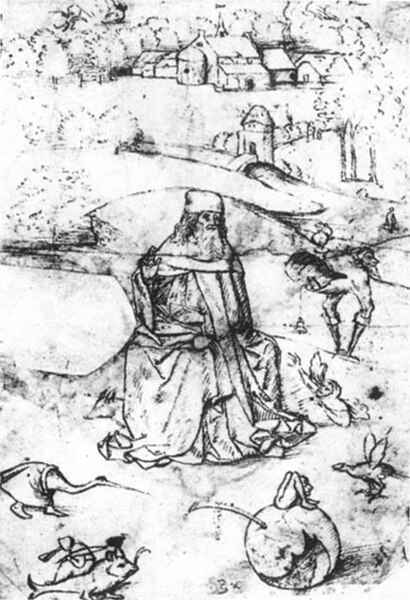
Temptation of St. Anthony attributed to Bosch.

The first moral I take from this is that the religious are not, contrary to much popular misconception, the shy wallflowers of the world. They are not the Father Mulcaheys. They are not ignorant of evil, and they do not avoid evil. Instead, virtue is heroic. It is a matter of meeting with temptation, and battling it eye to eye and hand to hand.

This only stands to reason. If one does not sin simply because one is not tempted, one is not acting morally. It is only with temptation that we have the opportunity to be moral beings.


Accordingly, it is only after a heated struggle with evil, with suffering, and with temptation, that one is ministered to by angels. It is in this solitary setting, along with the wilder spirits, Lilith and her kind, that God himself speaks clearly. It was in Sinai, in the desert, and alone, that Yahweh spoke to Moses. Artists, too, commonly find themselves liberated, and their muses made chatty, by solitude, or exile. Our Christian Lent is a reflection of this, and the Catholic tradition of penance, and the Catholic tradition of “retreat.”

There's more. In order to come into proper contact with the spirit, we first need to shut out the incessant din, not just of the material, but even more, of the social. The world of spirits, which we then contact, includes beings and experiences both good and evil. Rick Santorum, as it happens, is right. There really is a Devil. That's rough; that's what happens when you have free will; but the good includes the Highest Good.

Saftleven, Temptation of St. Anthony

This uncovers a tragic problem with modern psychiatry. The last thing in the world any psychiatrist or psychologist worth their degrees will tolerate is a patient's solitude. All solitude or desire for solitude is thought pathological. Never having been to the desert themselves, the good doctors see it as the typical townsman sees it, only as a barren and dark place full of dragons. They do not know what happens if you ever slay those dragons. They themselves have never ventured out of doors.

The result, I suspect, is often if not always to turn what should be a life-fulfilling spiritual quest, indeed, the point of life itself, into a state of life-long torture. Get repeatedly yanked back into town, and you just get the monsters, again and again and again.

Grunewald, Temptation of St. Anthony

The best treatment for “mental illness” might also be the cheapest. Basically, let the poor pilgrims work it out on their own, and stop harassing them.Take the welfare cheque they would be due in any event, and use it to rent a simple cabin somewhere in the woods. Not hard to find such a thing in Canada, especially in the winter, when the tourists have gone home. Instead of an expensive physician, who knows not what he does, just hire someone local with a truck to deliver the necessities of life to the cabin door weekly. I'd suggest stocking the cabin with a little bit of reading material as well—such as, oh, I don't know, say, a Bible. No problem if you want to get non-denominational and add a Book of Mormon, a Qur'an, the Bhagavad Gita, and the Tao Te Ching. The more, the merrier. A few psychiatric pills would probably do no harm.

Then just wait until the blessed hermit phones and says he's ready to rejoin the world.

Wijnen, Temptation of St. Anthony

In Canada, what could be simpler?

I have heard former schizophrenics claim they actually cured themselves with a procedure like this. I have heard many people who were mentally ill pine for this, saying they thought this would be the way they might be cured.

Why not?

Better yet, perhaps we could prevent much “mental illness” in the first place if, like the Native Americans, we all did this at a certain point in our lives, as a matter of course.

Bosch, Temptations of St. Anthon

Thursday, February 23, 2012

The Devil and Rick Santorum


Rick Santorum is accused by Drudge Report of saying, at Ave Maria University, that Satan is attacking America.

Pleased to meet you. Hope you guessed my name.


Satan is, of course, doing exactly that. Santorum was speaking at a Catholic gathering at a Catholic university in proper Catholic theological terms. Check the Catechism of the Catholic Church. Satan is real. He is pure spirit. He attacks both individuals and societies. his action may cause grave injuries - of a spiritual nature and, indirectly, even of a physical nature- to each man and to society” (CCC, para 395). If no presidential candidate is permitted to say this, even in a religious setting, then no Catholic is permitted to run for president.

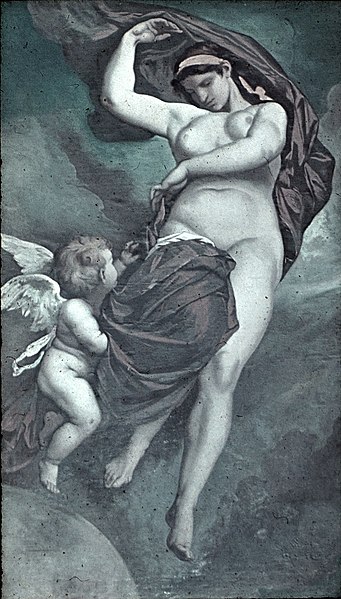
Gaea by Feuerbach. Wikimedia.


So too with Santorum's remarks that Obama's environmental policy is based on a “theology that does not come from the Bible.” It ought to be self-evident, surely, that he was referring to the quasi-religious beliefs of radical environmentalists. Yet the Obama White House, along with many commentators, objected immediately that Santorum was impugning Obama's Christianity. Obliquely, I suppose he was, but surely in a perfectly legitimate way, in saying that his environmental policy is not in keeping with Christian ideas. It isn't. Radical environmentalists consider humanity a kind of cancer on the suffering body of the goddess Gaea. Ask David Suzuki. This is incompatible with the Christian idea that man is above nature—let alone that nature is not divine.

The problem here, I think, is just that too many people, notably including journalists, are theologically illiterate.