Playing the Indian Card

Showing posts with label old age. Show all posts

Sunday, September 06, 2015

Why Faust Is Depressed


Conscience: Le Falher.

A friend of mine, 79, went to his doctor recently. It happens, when you’re 79. The good doctor asked if he was ever depressed these days. “It happens to most people your age,” he explained, reflecting, I believe, received medical wisdom. “Eventually, you realize that you aren’t going to live forever.”

Now that’s a shocker. Who knew?

In other words, this bit of received wisdom among the medical profession makes no sense to me. Haven’t most of us always understood we weren’t going to live forever? And so what? If there is an afterlife, we can perhaps look forward to something better. If there is not, we face nothing worse than going out like a light. Yes, of course, there is the option of hellfire… I suppose that is reason for depression.

Interestingly, the medical consensus apparently does not tally with the real world most of us inhabit. Most people, after sixty, just get happier and happier. Multiple studies show this.

How to explain this discrepancy? My guess is that it shows there are two kinds of people. You might call them the sheep and the goats. The good news is, most of us are apparently sheep.

But maybe doctors are mostly goats.

I mentioned this strange discrepancy in perceptions to a Pakistani friend. He told me in response a tale of a man from his own village. This man had faced terrible struggles and adversity throughout his life. Though he was a good man, honest, hard-working, kind, he could never get a break.

In his old age, he was uncommonly happy. Asked why, he replied, “happiness is the reward for a clear conscience in old age.”

Saint Paul said something similar:

For I am already being poured out as a drink offering, and the time of my departure has come. 7I have fought the good fight, I have finished the course, I have kept the faith; 8in the future there is laid up for me the crown of righteousness,
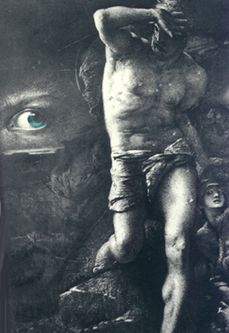
Conscience: Chifflart.

This need not be about anticipated reward in heaven, either. This is about not being haunted by a bad conscience, and the realization that too soon it will be too late to set things right.

I worry, however, about those who rely on doctors for advice—including psychiatrists. G.K. Chesterton once wrote that psychotherapy is simply confession without absolution. Psychiatrists will work on improving your “self-esteem,” and try to convince you that everything is all right as it is. They have a personal, vested interest in believing this is so—the world and sheer self-centredness has so far been good to them. But your conscience is telling you you must change.

Caught in the middle, you may never heal.

Monday, January 13, 2014

Sailing to Byzantium


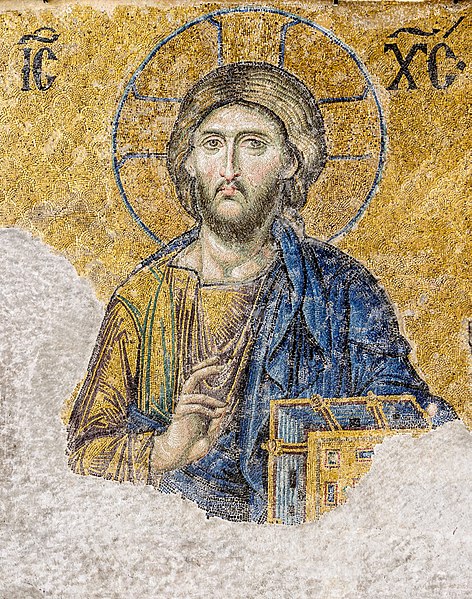
Christ Pantocrator, Hagia Sophia
That is no country for old men. The young
In one another's arms, birds in the trees
– Those dying generations – at their song,
The salmon‐falls, the mackerel‐crowded seas,
Fish, flesh, or fowl, commend all summer long
Whatever is begotten, born, and dies.
Caught in that sensual music all neglect
Monuments of unageing intellect.

An aged man is but a paltry thing,
A tattered coat upon a stick, unless
Soul clap its hands and sing, and louder sing
For every tatter in its mortal dress,
Nor is there singing school but studying
Monuments of its own magnificence;
And therefore I have sailed the seas and come
To the holy city of Byzantium.

O sages standing in God's holy fire
As in the gold mosaic of a wall,
Come from the holy fire, perne in a gyre,
And be the singing‐masters of my soul.
Consume my heart away; sick with desire
And fastened to a dying animal
It knows not what it is; and gather me
Into the artifice of eternity.

Once out of nature I shall never take
My bodily form from any natural thing,
But such a form as Grecian goldsmiths make
Of hammered gold and gold enamelling
To keep a drowsy Emperor awake;
Or set upon a golden bough to sing
To lords and ladies of Byzantium
Of what is past, or passing, or to come.
-- W.B. Yeats

Because we take all our formal education when young, the most important things in our cultural heritage never get properly studied. We learn by and large only what is important to young people; we do not learn what is important to the old.

Now that we are supposedly living longer, and have the institution of retirement, wouldn’t it make sense to create courses for the old in what is most valuable to them in the accumulated thought of the ages? After all, they now have the time to study and to reflect. Now is the time for the Humanities!

In fact, in many traditions—the Jewish, the Hindu—you are not supposed to look at the deeper philosophical questions until you are at least 40.

Sunday, August 26, 2012

Too Old for Despair


The night before last a voice spoke to me in a dream. No, seriously. Jet lag can do that, I guess. It said, “You have gotten too old for despair.”

Never mind where such voices come from—from God or from my subconscious or from the Land of Oz. I think the point was a good one. Despair is an indulgence of young Werthers. When you are old enough, there is no longer any point in it.

Yes, okay, sure, absolutely, this world is a desert. Anyone who is not in existential crisis is just not paying attention, or is uncommonly thick. All is vanity. There is no justice. Ninety-five percent of everything is garbage, and the other five percent is dross.

This is a shattering thing to admit when you are young, and expect to be trapped here for another fifty years or more. When you are yourself fifty years or more, it is hard to get worked up about it. It is almost funny.

No, it is funny. Hope is tragic, but despair is funny.