 |
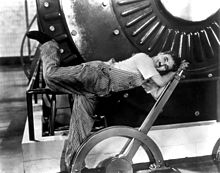
| Modern Times |
The public schools transparently do not teach us what we need to know to be successful in life. This has to be deliberate, since the private schools to which the rich send their scions almost always do.
The first thing you really need to get somewhere, in any field, is training in rhetoric. This may sound fancy and arcane: if you prefer, call it “salesmanship.” Same thing. Warren Buffet, who did not benefit from a private school education, claims that he learned everything he needed to know for business success, not in college, but by taking a Dale Carnegie course. You have to be able to persuade, one on one or before an audience, and there are known rules and techniques for doing this. Why shouldn't everyone learn them?
For current examples of the power of rhetoric, consider how effective Carly Fiorina and Donald Trump have seemed in the ongoing presidential stakes in the US. They may or may not have had formal training in rhetoric—Trump, having been a private school kid, almost certainly did—but their business success was necessarily built on special talents in this regard, and these talents show through on the political stage. They may be outsiders to politics, but their ability to sway an audience has been honed in boardrooms and in presentations to employees. Steve Jobs is another great master of the craft.
Is there something disreputable about all this? Only if it is not guided by moral principles. Any good pastor, too, must develop skills at rhetoric. That's what gave us Mike Huckabee.
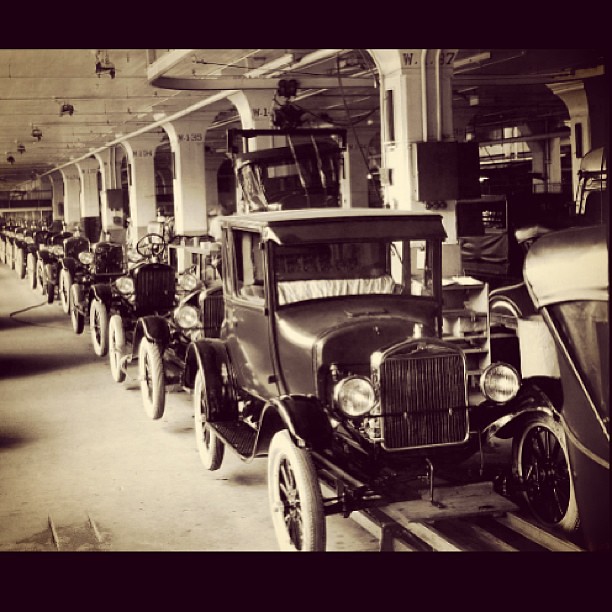 |
| Early assembly line |
The second thing you need is parliamentary procedure. If that sounds fancy, try “how to run a meeting.” As per Robert's Rules, or Bourinot's Rules of Order. Without this, it is impossible to organize others to get anything done. It therefore seems quite sinister not to teach students at high school age how meetings work; it seems to deliberately exclude them from power. While that might make school administrators' lives easier, the lack of knowledge of proper procedure is therefore endemic in our organizations, public and private. The price we pay for this is appalling. People commonly come out of meetings not knowing what, if anything, has actually been agreed upon, and certainly without a sensed moral commitment to do anything. As a result, usually nothing gets done. Businesses atrophy, and democratic politics tend not to work.
The third thing you need is some knowledge of fair debate. Everyone should be able to recognize and explain the classic logical fallacies. Without this, for all practical purposes, you cannot think. If you cannot think for yourself, you are too easily led. You can be taken in by any unprincipled party. Or you can be pushed around. Debating skills are like intellectual martial arts.
Public schools claim all the time that they want to teach their students how to think, to foster “critical thinking skills”--which lie is why I feel obliged to call this subject “debate” instead of “critical thinking skills.” Because schools commonly conceal under that latter title its opposite, indoctrination in approved political positions. “Debate” at least implies that, as standard practice, two contrary positions are both examined on equal terms, by the same objective criteria.
The fourth thing you need, and are systematically not taught, is mnemonics. How to remember is, quite simply, how to learn, and it is deliberately suppressed in public schools. The term blatant malpractice comes to mind. The reasoning commonly given is that memorization is simply and purely mechanical. Very well; if so, so is mathematics. So is being able to read.
 |
| New model assembly-line school, 1913. |
But it is not so. Properly used and properly understood, mnemonics involves the development of the imagination. It is a fundamentally creative activity. And if you are going to go on to study medicine, or law, or science, or anything at all, you are going to need it.
The fifth thing you need is cultural context. That is, you need to know the basic history of your culture, and its important cultural milestones, as understood by the upper classes. Without these, you are effectively excluded from the conversation at these higher levels, because, as E.D. Hirsch has demonstrated, it is largely written and spoken in a cultural code based on such shared knowledge. Perhaps it is wrong that this is so. Perhaps not; some ideas are probably too complex to express except through allusion. Nevertheless, either way, this is so. You need to be aware of at least the plots of the most important pieces of literature, and at least the outline of history. You need to know the choicest quotes from Shakespeare and from a variety of other important figures. Without them, you are going to miss all the allusions. Reading, perhaps you can now Google it. Speaking, you cannot. In any case, terms like “sour grapes,” “Pharisee,” “Pyrrhic victory,” or “Orwellian” tend to be too complex in their implications to be quickly picked up on the fly.
It is telling, surely, that the public schools are currently systematically removing history and canonical literature from the classrooms.
So there you have it: the five essential high school subjects. Rhetoric, parliamentary procedure, debate, mnemonics, and cultural literacy. I add theology and ethics for any religious school, and all schools should be religious on principle. Other stuff is window dressing, and I include science and math. There is probably not the time for this. The “three R's” should be under their belts by this time. They need now to finish this basic platform. Specialization can be left to the tertiary level. As has often been observed, most people never need to use either the math or the science they learn in high school.
Next question: why are the public schools systematically failing to educate students in what they most need to know? Individual reasons are given for cutting out this and that, but it all adds up to something that looks like a deliberate attempt to keep the average student down. And that is because it is.
The “progressives” of Woodrow Wilson's time, back in the early years of the assembly line, saw the new efficient factory model as the ideal model for education as well. No more one-room school houses. They decided the public schools were there to produce the little cogs and willing wheels needed by industry. We simply did not need a nation of leaders. Best not to let the peons think above their station. This tradition is continued, energetically, in the current fetish for STEM education (science, technology, engineering, math). These things will earn you a good pay packet, sure, for a few years or maybe more, but not a seat in the boardroom. The tradition is also well entrenched in the growing fetish for the idea of “efficiency” in education, and for clear, measurable results. Teaching must be a “science.” Except, of course, for their own kids.
It may well be true that we only need so many leaders. I frankly doubt that. My impression is that we are training too few. As globalization and automation increase, leadership may be the only career available. On the other hand, if so, these leaders ought not in a democracy be selected by right of birth. Every child who shows the capacity for it ought to be educated for potential leadership, and let the best man or woman win. The society as a whole would benefit.
Confucius had it right. “A gentleman,” he observed, “is not a tool.”





 Posts
Posts


