




 Posts
Posts


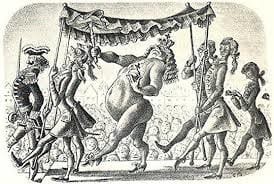 |
| The Emperor's New Clothes |
They came to Capernaum and, once inside the house,
he began to ask them,
“What were you arguing about on the way?”
But they remained silent.
They had been discussing among themselves on the way
who was the greatest.
Then he sat down, called the Twelve, and said to them,
“If anyone wishes to be first,
he shall be the last of all and the servant of all.”
Taking a child, he placed it in their midst,
and putting his arms around it, he said to them,
“Whoever receives one child such as this in my name, receives me;
and whoever receives me,
receives not me but the One who sent me.”—Mark 9: 30-37
The gospel reading at last Sunday’s mass sounds like an endorsement of the Romantic notion that childhood is a state of blessedness to which we must aspire.
Matthew 18:1-5 is similar:
At that time the disciples came to Jesus and asked, “Who, then, is the greatest in the kingdom of heaven?”
He called a little child to him, and placed the child among them. And he said: “Truly I tell you, unless you change and become like little children, you will never enter the kingdom of heaven. Therefore, whoever takes the lowly position of this child is the greatest in the kingdom of heaven. And whoever welcomes one such child in my name welcomes me.
Yet if the ideal is to be a little child, there is no reason for this life, with its sufferings, or for creation. God could have had us all born into heaven.
Everyone who has had children, or who has been one, knows that children are not moral paragons. They can lie; they can be greedy; they can be cruel to small animals.
But, as Father Flanagan, the founder of Boys’ Town, observed, "no boy ever wants to be bad.” Children can do bad things. However, no child has yet become vicious. They have not committed themselves to any vice; they are too young to have formed such a habit. To entertain and sustain a vice is, over time, to turn away from virtue in principle. That is how the sheep becomes a goat. That is when denial begins, and we turn away from truth itself.
Which is to say, we turn away from God.
We turn away from God, towards what? Towards self—that is, to satisfying our selfish urges. In this sense, we become big—our selves become big. To reverse this is to become again small, like children.

