Playing the Indian Card

Showing posts with label dreams. Show all posts

Thursday, December 09, 2021

What Dreams May Come


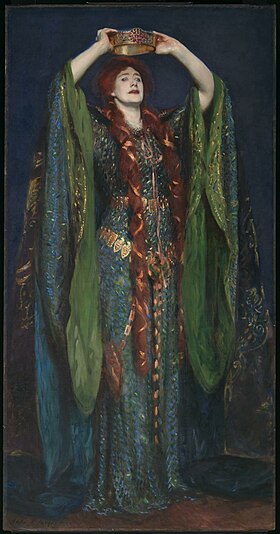
John Singer Sargent

One argument against the proposition made here recently that dreams are visions of an eternal world, in which we will live after death, is that most of us have both good and bad dreams. So are we bound for heaven, or hell? Shouldn’t good people have only good dreams, and bad people only nightmares?

But that would not be useful. If one had only good dreams, one might stop making an effort. And one might seek death, life by comparison seeming unbearable.

True, those who commit evil are more likely to have nightmares. MacBeth, having murdered Duncan, speaks of “these terrible dreams that shake us nightly.” Lady MacBeth sleepwalks, acting out her sense of guilt. We treat others well so that we sleep soundly at night. 

On the other hand, some good people too seem plagued by nightmares.

The point is presumably to warn us that something is wrong. It may be that we have done evil, and are bound for the pit unless we repent. Or it may be that evil is being done to us, and that we must do something to protect ourselves from it. This, after all, is what bodily pain is for.

To know which requires a careful consideration of the dream. 


Tuesday, December 07, 2021

Butterfly Dreams


In the 4th century B.C., Chuang-tzu asked the question. “Am I a man who dreamt last night of being a butterfly, or am I a butterfly dreaming I am a man?”

Has anyone satisfactorily answered this question?

Descartes asks himself the same question:

“At this moment it does indeed seem to me that it is with eyes awake that I am looking at this paper; that this head which I move is not asleep, that it is deliberately and of set purpose that I extend my hand and perceive it; what happens in sleep does not appear so clear nor so distinct as does all this. But in thinking over this I remind myself that on many occasions I have in sleep been deceived by similar illusions, and in dwelling carefully on this reflection I see so manifestly that there are no certain indications by which we may clearly distinguish wakefulness from sleep that I am lost in astonishment. And my astonishment is such that it is almost capable of persuading me that I now dream.”

We pinch ourselves to see if we are awake. But of course this does not work. It should be entirely possible to pinch ourselves in a dream.

Descartes ultimately resolves the question by proposing that God, being by definition all-good, would not delude us; and so what we perceive as clear and distinct must be the reality. And we perceive daily reality, he says, more clearly and more distinctly than we do our dreams.

But does this work?

To begin with, is it obvious that we experience our daily lives more clearly and distinctly than we do our dreams? Or is this just our perception when we are awake? How clearly do we remember how clear and distinct our dreams were, when we are awake? For that matter, how clearly do we remember how clear and distinct our daily life is when we are dreaming? Aren’t dream worlds perfectly clear and distinct while we dream, and our “real” daily life, if we are aware of it at all, vague and distant?

And even if this is so, even if dreams are less clearly perceived than the turnips we had at lunch, doesn’t Descartes’s own logic argue that the world of dreams is also real? Others can lie to us; we can lie to ourselves, causing delusions. We can misinterpret what we see, and mistake a reflection for an oasis. But dreams come neither of our own free will or from others. Nor do they involve the interpretation of some sense perception, introducing human error. While we might also misperceive this or that in a dream, why would God allow them to systematically deceive us?

By Descartes’s logic, he would not. And I do not think anyone else has ever given a batter response to Chuang-tzu. If we accept the world of our senses as real, as referring to a real place, we apparently must accept that the world we perceive in our dreams is also real, referring to a real place. God would not so deceive us.

Most human cultures, at all times and places, have accordingly assumed so. Dreams are either the language in which God talks to us, or they are a window into a real, objectively existing spiritual realm. Or both.

This explains the fact that the images that appear to us in dreams are not arbitrary, but predictable. Although dragons do not occur in the sensed world, the dragon is familiar to cultures all around the world. So is the phoenix, the unicorn, the sea monster, and so forth. Wherever the Greeks or Romans conquered, they had no trouble identifying the local gods as versions of their own gods. Jung traced the same motifs in the dreams of his Zurich patients and in ancient texts from India and elsewhere. He called these archetypes, but never gave a clear and consistent account of where they came from. The structure of the brain?

Why not see them, with Plato, as ideal forms, eternally existent in the spiritual realm?

When Jesus said “the Kingdom of Heaven is within you,” or “among you,” was he referring to its imaginative perception in dreams? Are we given a foretaste of the afterlife, both heaven and hell, in our dreams? Is this where we will live after the physical world fades away, just as it is where we live every night, when we lose consciousness of the physical world around us?

I think it is the obvious assumption.


Friday, September 17, 2021

The Interpretation of Dreams


Freud, apparently homosexual without knowing it, fingers somebody's penis.

It is unwise to listen to the psychologists about dreams. Most of what we think we know from psychology is from Freud. Freudianism has no scientific basis. He just made stuff up. 

Are his notions right? All we can do, since we have no evidence for them, is, first, to decide whether they make sense; whether they are at least internally consistent. Second, we can ask whether they conform to previous beliefs about dreams, which, while we equally may not know what evidence or reasoning they are based on, at least reflect the wisdom of the ages.  

On both counts, the answer has to be no. Freud is nonsense.

To begin with, Freud’s concept of a “subconscious” of repressed memories or urges has been debunked. Troubling memories are not repressed; if troubling or alarming, they are far more likely to be conscious. We have known this at least since Aristotle. Everybody remembers where they were on 9/11, for example, precisely because the experience was traumatic. Repression of urges, in turn, is not subconscious. It requires a conscious effort to fight urges. We have known this at least since Moses. That’s why we have the Ten Commandments.

One common idea about dreams is that all the characters in a dream are aspects of oneself. That is from Jung more than Freud, but Jung too has no scientific basis. When it is not based on Freud, Jung’s ideas come from old gnostic texts, which he apparently misunderstood. Even if he did not, there is a reason why Gnosticism is not a living school of thought—it did not survive the test of time.

You could say the same of the characters in Shakespeare—that they are all aspects of Shakespeare’s own mind. True, but only trivially true; Shakespeare is not trying to explain or understand himself, but the world. It makes more sense to see dreams as the working out in symbolic and narrative form of the problems we face during the day. Some of our problems may be with our selves; but some with other people, or God, or nature, or fate, or the post office. Think of the seven conflicts: man vs. man, man vs, self, etc. Dreams are stories, and all stories are based on these seven conflicts.

Perhaps the craziest idea about dream interpretation that we inherit from Freud is that things in dreams mean the opposite of what they say. This notion, absurd on its face, has become “common knowledge.” Freud seems to have invented the principle so that he could make anything mean anything he wished. For example, there is no trace of Freud’s “Oedipus complex” in the actual legend of Oedipus. Oedipus has no desire to kill his father or have sex with his mother. His father, on the other hand, wants to kill him, and his mother wants to have sex with him. Yet Freud cites this as his main literary evidence for the “Oedipus complex.” A cigar can be a cigar, if Freud wants it to be a cigar; or if he prefers, it can mean anything else.

Unfortunately, Freud has poisoned pretty much everything we think of as psychology, even if real psychology has mostly disavowed him, or thinks it has.

Best to assume that whatever you have heard from “psychology” is wrong.