Posts


Jesus said to the Pharisees:
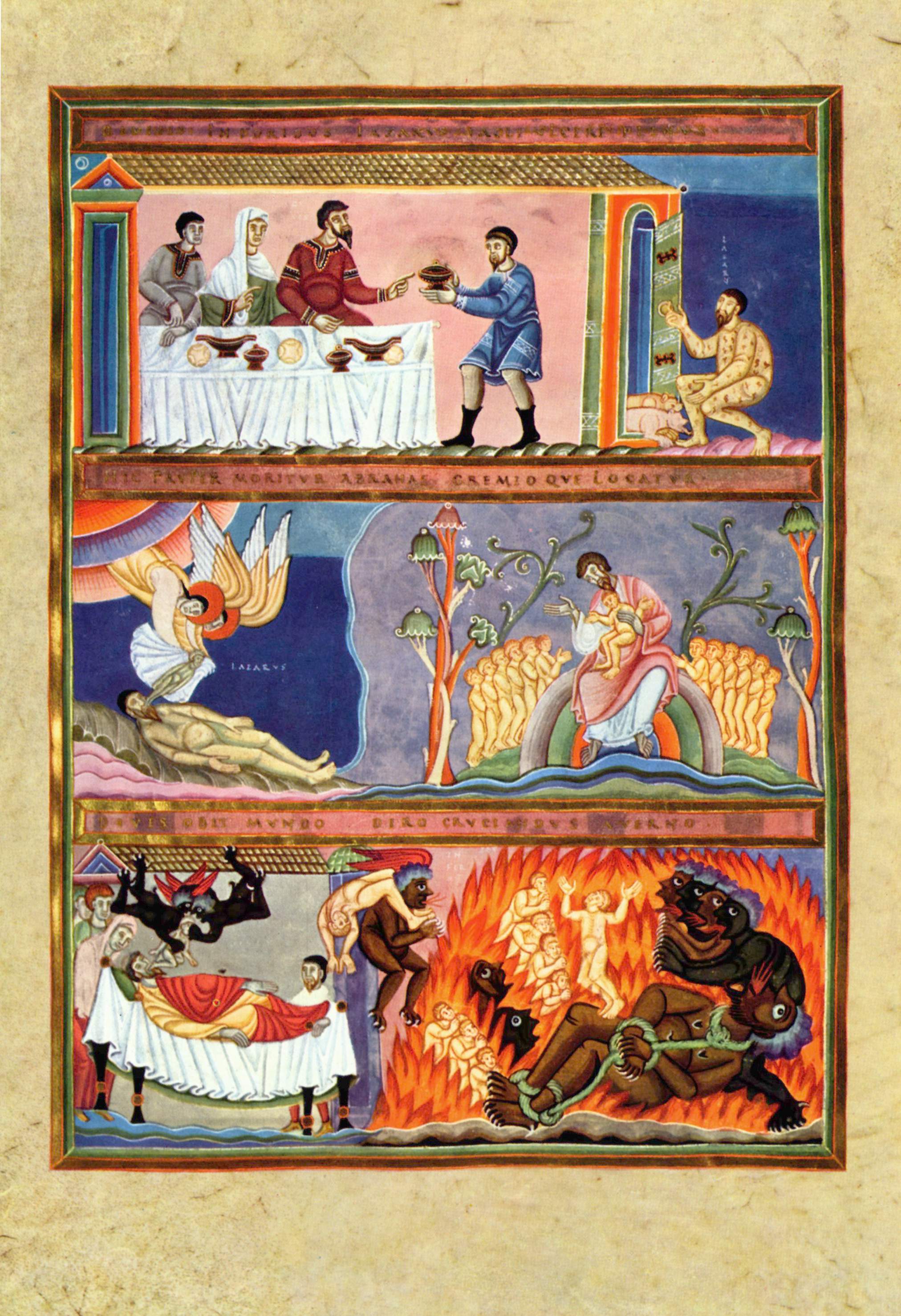
“There was a rich man who dressed in purple garments and fine linen and dined sumptuously each day. And lying at his door was a poor man named Lazarus, covered with sores, who would gladly have eaten his fill of the scraps that fell from the rich man’s table. Dogs even used to come and lick his sores.
When the poor man died, he was carried away by angels to the bosom of Abraham. The rich man also died and was buried, and from the netherworld, where he was in torment, he raised his eyes and saw Abraham far off and Lazarus at his side. And he cried out, ‘Father Abraham, have pity on me. Send Lazarus to dip the tip of his finger in water and cool my tongue, for I am suffering torment in these flames.’
Abraham replied, ‘My child, remember that you received what was good during your lifetime while Lazarus likewise received what was bad; but now he is comforted here, whereas you are tormented. Moreover, between us and you a great chasm is established to prevent anyone from crossing who might wish to go from our side to yours or from your side to ours.’
He said, ‘Then I beg you, father, send him to my father’s house, for I have five brothers, so that he may warn them, lest they too come to this place of torment.’
But Abraham replied, ‘They have Moses and the prophets. Let them listen to them.’
He said, ‘Oh no, father Abraham, but if someone from the dead goes to them, they will repent.’
Then Abraham said, ‘If they will not listen to Moses and the prophets, neither will they be persuaded if someone should rise from the dead.'”
Luke 16:19-31.
This passage, the gospel reading at last Sunday’s mass, is rich with significance. Because Lazarus is named, it does not appear to be a parable. From it we understand that either hell or heaven are eternal fates: one cannot move between them.
It strongly suggests that suffering in this life will be rewarded in heaven. Nothing here indicates that Lazarus led a particularly moral life, full of good deeds. No, he is given heaven as a reward expressly in recompense for his suffering. “Now he is comforted here.”
This speaks against the self-satisfied “happy happy joy joy” form of Christianity that I so dislike. To be contented in a world of want is an indictment.
It also seems to me to endorse Judaism. Jesus was not sent for the Jews. There is no need for Jews to convert. So long as they listen to Moses and the prophets, they are good. If they do not listen to Moses and the prophets, Jesus’s coming will make no difference to them.
This also affirms my own dislike of the argument that the resurrection is proof of the Christian faith. The passage itself says it is not sufficient proof, and not necessary proof. One believes in Christianity because one listens to the words of Jesus, or listens to the words of Moses and the prophets, and knows one is hearing the voice of God. One knows in one’s heart. And of course one knows, because God created us to hear and respond to his word. “Let those who have ears to hear, hear.”
This also seems to be the point of the tale of doubting Thomas: “blessed are those who have not seen, and yet believe.”