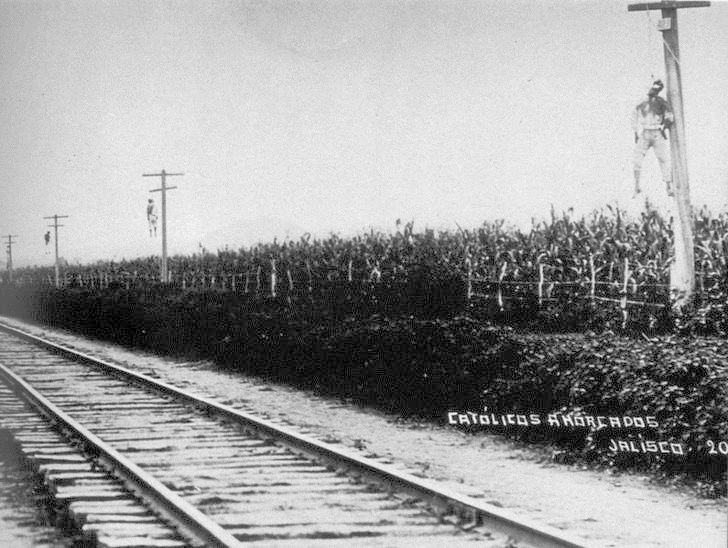
It’s sad and it’s funny. Over the last couple of nights, I have been able to watch the recent movie “For Greater Glory: The True Story of Cristiada.” On
Rotten Tomatoes, it scores very low among professional critics: one star, a rating of only 18%. Yet the audience rates it very high: 80% like it. That compares with 87% for
Titanic, their top rental.
How can there be such a divergence of opinion between critics and the public? I think it reflects the culture wars. I think the movie critics are giving the film low marks entirely because they disagree with it politically and philosophically, and are probably not even self-aware enough to realize this is the case.
Let’s look at a few of the posted criticisms.
Roger Ebert writes:
“It is well-made, yes, but has such pro-Catholic tunnel vision I began to question its view of events. One important subplot involves a 12-year-old boy choosing to die for his faith. Of course the federal troops who shot him were monsters, but the film seems to approve of his decision and includes him approvingly in a long list of Cristeros who have achieved sainthood or beatification after their deaths in the war.”
Hmm… so being too pro-Catholic is “tunnel vision”? It could not possibly be the most accurate view of events? Even if his suspicions are correct, what do they have to do with anything? Getting the history wrong has never been a major issue with Hollywood, has it? Did anyone worry much about the accuracy of “Schindler’s List” or “Inglorius Basterds” (the latter, of course, entirely fictional)? And Ebert has no reason to doubt the history—he just cannot accept it ideologically.
And what is troubling about becoming or celebrating a saint? Surely Ebert is implying that there is something fundamentally wrong with ... being Catholic.
Rotten Tomatoes summarizes the film:
“It has laudable aspirations, but For Greater Glory ultimately fails to fulfill its goals due to an overstuffed script, thinly written characters, and an overly simplified dramatization of historical events.”
Hmm… “an overly simplified dramatization of historical events.” Sounds like Ebert's problem. Wasn’t “Saving Private Ryan” or “The Longest Day” a pretty simplified view of World War II? Didn't they only tell the story from one point of view? Wasn’t “First Blood” a pretty simplified view of the Vietnam War? Was that a major problem? No, it is not that the story is simplified. Name a Hollywood movie that is not white hats vs. black hats. What the critic is saying is that it is not okay to tell a story from the
Catholic point of view. The black hats are not supposed to be the leftists and the secularists. The white hats are not supposed to be the Catholics.
“Thinly written characters”? The film shows obvious character development. The adult lead moves from atheism to joyfully giving his life for the Catholic Church. The child lead goes from throwing rotten fruit at the local priest to being canonized. This is “thinly written” to this critic only because it moves in a direction he does not expect and cannot understand, from doubt to faith. He imagines, I suspect, that it is only humanly possible to move from faith to doubt.
 |
| The Cristero Flag |
The first review quoted on Rotten Tomatoes:
“As generic as the title, this historical drama spares no cliche in depicting Mexico's Cristero War of the late 1920.”
Generic? In fact, the film fits no current Hollywood genre. Cliched? The usual Hollywood fare is nothing if not clichéd. You can almost count on looking up at the screen at about the 1:10 mark and seeing some sort of car chase--a legacy of Mac Sennett and the nineteen teens. In a Hollywood film, you can tell within the first ten minutes of their first appearance who is going to die, and who isn’t, by the end of the film. Not here. One can go on and on.
This film defies almost any Hollywood cliché you could mention. Right down to relatively small details. It has, for example, the adult lead chomping on a cigar repeatedly; a thing so counter to prevailing mores and expectations that the producers saw need to add a disclaimer to the credits explaining that nobody made any money in the film from the display of tobacco products.
And so it goes. It is not that the critics are a bit off about this film. They are 180 degrees off. And yet I think they are on the whoel sincere in feeling there is something fundamentally wrong with the film as a film.
One sees this often in the world: large groups on given issues get things not just a little wrong, but 180 degrees wrong. And often not, it seems, willfully. I think it is strong evidence of the existence of a spiritual entity causing this--a permanent adversary of the truth, a Devil.
Go see
For Greater Glory. The Devil does not want you to see it.





 Posts