Playing the Indian Card

Showing posts with label philosophy. Show all posts

Sunday, April 28, 2024

Influencers


Ramakrishna

I challenged a Chinese student to reflect on the influences on his thinking: whom did he trust? Whom did he accept as an authority?

It is a useful exercise in these times, when authorities seem untrustworthy. It is time to reestablish our bedrock.

So I propose to outline my own influences.

I cannot trust the government. I cannot trust the priests, bishops, cardinals, or even the pope. I cannot trust the legal system. I cannot trust the academy. I cannot trust “the science.” I cannot trust the professions. I cannot trust my doctor. I cannot trust artists.

But there are still the older authorities, who, although dead, can speak to us. There are the great minds of the past.

First is Plato’s concept of the ideal forms. I believe it is absolutely true, vitally important, and generally suppressed. As Blake said, the mind must enter this world as a garden fully planted. I do not trust Plato on politics. Politics and metaphysics take a different kind of thinking; a philosopher who is good on one seems inevitably bad on the other. 

On politics, I trust John Locke. I’d add John Stuart Mill on freedom of speech, and Jefferson’s Declaration of Independence. Everything good in government can be extrapolated from these.

But I think Locke’s ontology and epistemology is absurd.

George Orwell is also an influence in politics. Milton Friedman is an influence in economics.

Probably my main influence among philosophers is Descartes. I think his conclusions in the Meditations are the foundation of all possible knowledge, and definitive on the nature of the human soul. I then accept Berkeley’s resolution of Descartes’ “mind-body” conundrum: that is, how these categorically different spheres of being, mind and body, can interact. Simple: there is no body. I do not believe anyone can refute this. Blake: “the body is that portion of the soul perceptible to the five senses.”

William Blake has also been a profound influence on me. He was really my door into philosophy, and into monotheism. He is usually thought of as a poet, or if not that, an engraver. But he was a universal genius.

I believe Anselm’s ontological proof of the existence of God is irrefutable. But it is only one of many; I also find Craig’s Kalam cosmological argument irrefutable.

The Greek myths, Aesop’s fables, Shakespeare, Dostoyevsky, and the fairy tales are authoritative on human psychology. Accept no substitutes.

Then there is the Bible. Even if you do not consider it the revealed word of God, you must accept it as all the vital information our ancestors gathered over the millennia, which they wanted to convey to us. If you are going against the Bible, you know you are wrong.

Confucius’s Analects are also authoritative. They have kept China in good order for millennia. Alarms bells should go off if you are clearly going against anything there.

I cannot point to any one other specific source in Eastern thought. I have learned much from Buddhism, and from Hinduism, but in the end it all pointed back to ethical monotheism. As Ramakrishna put it, “I want to taste sugar; I don’t want to BE sugar.”


Sunday, November 06, 2022

There Are More Things in Heaven and Earth, Horatio...


A Japanese ghost


“Those who are deemed worthy to attain to the coming age

and to the resurrection of the dead

neither marry nor are given in marriage.

They can no longer die,

for they are like angels;

and they are the children of God

because they are the ones who will rise.

That the dead will rise

even Moses made known in the passage about the bush,

when he called out 'Lord, '

the God of Abraham, the God of Isaac, and the God of Jacob;

and he is not God of the dead, but of the living,

for to him all are alive."


- Today’s Mass reading. Luke 20:30-38


Xerxes, my muse, observed in his latest column that it is a bit absurd that we continue to celebrate Hallowe’en, because no one any longer believes we commune with the dead, that the dead participate in our lives.

I called him on that. No one? 

All Catholics are supposed to believe it. That is what the communion of the saints is about. I think of Chesterton’s definition of tradition as true democracy, because it includes a vote for the dead. Chinese folk religion also believes the dead remain in contact—the famed “ancestor worship.” All shamanic systems believe so—that is who the shamans talk to. 

We are getting up to a large chunk of the world’s population by this point—quite possibly a majority.

I begin to suspect Xerxes does not get out much. Perhaps he speaks only with mainstream Protestants and atheists.

But I want to go further. One of the biggest lies of modern life is that only the physical world is “real,” that spiritual beings do not exist. I remember in first year philosophy, a visiting professor dismissing some branch of philosophy with the comment that it would allow that unicorns exist. In other words, the non-existence of unicorns was insisted on a priori. No arguments allowed.

That bugged the heck out of me at the time, and has bugged me ever since. That is not philosophy. That is blind faith.

But a grossly materialist blind faith.

In the real world of philosophy, Berkeley has demonstrated that the very existence of the material world is an arbitrary hypothesis, and one that violates the principle of Occam’s Razor, which we take as given in science. Plato posited and argued, I think convincingly, that the material world is just a reflection of an “ideal” world, a world of ideas. Were this not so, mere sense perceptions could never spontaneously form themselves into ideas.

It seems to me that unicorns exist. They exist as a coherent image, which we can discuss. Everyone knows what I mean when I say “unicorn.” They exist as an idea; and a transpersonal idea, an idea that exists objectively.

So too with other spiritual beings: the classical gods, fairies, djinn, and the souls of the dead.

To be seen is not to exist. To exist is not to be seen. Otherwise love too does not exist. Neither does justice, or happiness, or freedom, or any other of the important things of life.

So suck it up, unicorn-deniers.


Wednesday, July 14, 2021

Putting Descartes before the Horse


Bishop George Berkeley

I pointed out to a correspondent of late that Descartes, to arrive at his famous statement “I think, therefore I am,” had assumed a stance of radical doubt. He then realized that the one thing he could not doubt was his own thoughts, whether or not they referred to anything outside themselves. And if he was experiencing thoughts, then he existed too. It took him several further steps to come to the conclusion that the physical world existed.

And that conclusion was soon successfully challenged by Berkeley. Berkeley points out that there is no logical necessity to posit the existence of any physical world that corresponds to our perceptions, our thoughts. Therefore—Occam’s Razor—it is improper to do so.

I think I am correct in saying that nobody has successfully challenged Berkeley on that point. Most of us just live our lives ignoring it.

My correspondent reacted badly. 

Of Descartes, she wrote, “Descartes could NOT have affirmed rationally that the brain did not exist! All humans who think and behave normally have brains. No humans who do not have brains can think or behave normally. THAT much science was known to Descartes.”

Of Berkeley, she wrote that he was “delusional and lost in the ego-centricity of his right-brain so that he can no longer interact rationally with the rest of the human and physical world.”

What I see here is “cognitive dissonance”: it is a common cognitive dissonance. It is why we commonly just ignore Berkeley. The idea that the reality of the physical world is open to question is so unexpected to us Moderns that we cannot assimilate it. We simply refuse to entertain the thought.

Meaning we are all mad.

It is demonstrably true that the existence of the physical world is debatable; because it has been debated throughout history. Aside from Descartes and Berkeley, Plato and the Neoplatonists doubted its existence. It was only shadows of puppets reflected on the wall of a dimly-lit cave. The thing was so obvious to Plato that he did not even think to make an argument. And Plato has been pretty well-respected throughout the history of Western philosophy. The medieval school of philosophy called “Realism” rejected attention to the physical world in favour of concentrating only on what was “real”—that is, the ideal forms, which exist only mentally.

The Buddhist world, similarly, considers the world of the senses “maya”: “illusion.” “The power by which the universe becomes manifest; the illusion or appearance of the phenomenal world.” So does Taoism. So does Hinduism. The same insight is critical to understanding Canadian indigenous people’s traditional beliefs: far from being modern ecologists, they did not believe that nature was real. We in the modern West are actually in a minority in assuming the importance of the physical world.

Now, realizing that the physical world may not be real is pretty mind-expanding. Real or not, it is an important insight that our experience of the spiritual is immediate and undeniable, but our experience of the physical is indirect and dubious. “Scientism”—our modern pseudo-religion—has this backwards. It is a profoundly inadequate account of reality. Much or most of what we call “mental illness,” I suspect, is caused by this inadequacy. Mental illness happens when we discover our actual experience does not conform with the official world view, or we see flaws and inconsistencies in the matrix, and do not know how to interpret it. It is vital to have a bullet-proof world view—to see the world as it truly is. Our “scientistic” world view has too low a ceiling. Leonard Cohen speaks of a “spiritual catastrophe." 

Even if there is a world that corresponds to our sense-perceptions, we have a second, epistemological problem: how does it correspond, and how can we know that correspondence? Does our experience of the colour “blue,” for example, tell us anything meaningful about the external quality “blue”? Or is the real blue a chuckling demon blinking in semaphore? Do you perceive what I perceive as blue, as what I would call red if I saw with your eyes? For the first thing is mental, a thought in the mind. The second thing remains, in principle, unknown in its essence.

Philosophy is more fun than LSD. And safer. 


Saturday, October 03, 2020

Resolved: Philosophy Is Racist


Hegel, hapless victim of his own racism.

We suddenly find ourselves in the belly of the beast: an essay explaining why philosophy itself is racist: “Philosophy’s Systemic Racism.”

Or at least it seems to claim to. Then it focuses on Hegel. So that the case, even if made, would appear to be not systemic racism, but individual racism.

But the inconsistencies or confusions of terms do not end there. The author calls “explicitly racist” the postulated view that “Black and Indigenous peoples the world over were savage, inferior and in need of correction by European enlightenment.”

Only one element of that statement implies racism: that black or indigenous people might be “inferior.” Savagery is not genetic; neither is being in need of correction. Yet these are all thrown together, as though one’s culture and one’s system of government were racially determined. An ideal justification for colonialism or indeed slavery, coming from the present author.

Does he go on to make a case that Hegel considered black or indigenous people inferior?

“Hegel certainly was an explicit racist. He believed, for example, that Black Africans were a ‘race of children that remain immersed in a state of naiveté’. He further wrote that Indigenous peoples lived in ‘a condition of savagery and unfreedom’. And in The Philosophy of Right (1821), he argued that there is a ‘right of heroes’ to colonise these people in order to bring them into a progress of European enlightenment.”

Nothing here implies racial inferiority. It implies that their social organization, their government, is inferior. By this logic I would be guilty of anti-black racism for saying the black slaves in the antebellum US South were being held in a state of unfreedom. And if I do not support the government of Michigan, I am an anti-Michigander racist. “Explicitly.”

At the same time that he condemns Hegel for supposedly thinking that indigenous social systems or culture were inferior to European ones, and calls this “racist,” he condemns Rousseau as “racist” for thinking that indigenous social systems or culture were superior to European ones. “Unlike Hegel, however, he thought that he was reading about people leading idyllic lives.” He then condemns Schiller as racist for thinking that European and indigenous cultures simply had characteristic strengths and weaknesses, and could learn from one another through contact.

On this basis, the only possible conclusion, surely, is that “racist” is simply for this author a synonym for “European.” Or, to use the racist term beloved of racial theorists, “white.” 


Saturday, April 04, 2020

Trapped in a World You Never Made?


What, after all, is the meaning of life?

The common (post)modern stance is that we do not know. We wander our wasteland, waiting for Godot, and Godot does not show.

Some say the meaning of life is 42. Good joke. We are less than laboratory rats.

Or it is up to each of us to simply invent or construct a meaning. As if it were possible to immaculately conceive meaning from meaninglessness, something from nothing.

This sad conception has led to ugly things. It seems to me that it has led to the present cancel culture, rampant censorship, unfriending, shouting down those with whom we disagree. Everyone is losing all their friends. Many are losing livelihoods. To do such things amounts to spiritual murder: when we stick our fingers in our ears and refuse to listen, we are declaring the other a non-person. And it leads on an unwavering trajectory to actual physical murder, perhaps on a mass scale.

For what, after all, can we do, if we have invented our meaning by some act of will, and it conflicts with the next guy’s meaning? As it inevitably will. There is no higher authority to which to appeal. So there is no way to settle the conflict but to pretend he or she does not exist; to silence them; or to eliminate them.

At the same time, from the same cause, at least in the developed world, indications are that the incidence of “mental illness,” and suicide, and death by overdose, alcohol, or “accident,” is growing by spiraling upward seven-league strides.

We have gotten ourselves into a dark place, with this notion that life has no meaning.

Is it right? Is it all Godot’s fault?

It is worth pointing out that life does have meaning. At least, everyone thought it did until quite recently. Until the early 20th century, the meaning of life was uncontroversial. And no, it did not depend on anyone’s particular sect or religion.

The meaning of life was to seek the Good, the True, and the Beautiful. This was understood by the ancient Greek philosophers, and did not change with the coming of the great monotheisms—except that they called the ultimate Good, Truth, and Beauty “God.”

As did the Hindus, independently. Classifying in terms of the human experience of God as opposed to God’s own qualities, they arrived at a similar trinity: Sat, Cit, Ananda, roughly translating as Truth, Consciousness, and Bliss. Bliss describes the aesthetic experience, and corresponds to Beauty. “Consciousness” corresponds to the Good—morality is at base the awareness of the independent consciousness of others, treating another as an independent sentient being instead of a thing.

But, you say, there is no Truth, just as there is no God. You have sought and sought, and found none.

Let us point out first that that claim is contradictory. “There is no truth” is a claimed truth. Of course, if true, it is false.

All you can say, then, is that you have not yet found truth; you cannot claim you know there is none. And if you do say there is none, of course, you are not looking.

Were you ever really looking? Speaking from my experience, those who claim to be such perennial seekers of Truth are those who recoil most dramatically from anyone who claims to have found Truth. Religious believers, most notably. This is contradictory: they seem to dismiss out of hand the possibility that anyone has found Truth. If so, they cannot really be looking for it.

It seems to me that the claim that they cannot find Truth is also easily and trivially disproven. If you insist you have found no truth, are you really prepared to deny the Pythagorean theorem, or that 2 + 2 = 4? Are you prepared to ignore the Law of Gravity in your own daily actions?

But, you will say, if there is Truth, there is no Good. Morality is just what each society agrees on: it is “socially constructed.”

That leaves you with no possible argument that Hitler did anything wrong. He was, after all, the duly elected social authority. You similarly have no argument against such cultural practices as child sacrifice, slavery, or widow burning.

To the contrary, Kant has shown that the moral imperative is self-evident and beyond question. It is enshrined, almost word for word, in all known moral codes: do to others as you would have them do. Respect other sentient beings.

You will then say, at least, that there is no Beauty. Beauty is in the eye of the beholder. We all know that much.

This is a consolation for physically ugly people like me; we all know it is not really true. While not everyone will find a given thing beautiful, results of a survey will be far from random. Balance, harmony, clarity, seem to be consistent elements. We say that beauty fades, or is often a matter of trickery; but then we mean gross physical beauty, not the Beauty referred to as transcendental. The beauty of art is something else, and does not trick or fade.

Next you will say, but why are these three qualities, the Good, the True, and the Beautiful, to be valued? The question cannot really be answered, because their value is self-evident. It is in our ROM. Rather, we determine the value of all other things by the degree to which they are either good and useful, true, or beautiful. Posit, if you like, a divine programmer. There is a point beyond which, in self-knowledge, we cannot go.

How then did we get so knocked off the path in modern times? Why are we sleeping in ditches in Eliot’s Waste-Land?

I can only speculate. I think it was and is a disease of the Humanities. Before the Enlightenment, knowledge was unified by religion; theology was the queen of the sciences. The first schools and the first universities, everywhere, were religious institutions. This is true in Christian, Jewish, Buddhist, Muslim, Hindu or Confucian lands. It is universal. Knowledge therefore had a plot and a direction.

With the success in the West over the last few centuries of empirical science, it gained such prestige that it tended to supplant religion and philosophy as the perceived centre of knowledge: now physics and not theology was the queen of the sciences.

For all its impressive success, science does not work well in this role. It is not possible to unify all knowledge on physical terms; most of the real world and of real human experience is on the metaphysical, spiritual plane. We are more than robots with sensing organs.

With the growing prestige of the sciences, the Humanities, over the past two hundred years or more, have been struggling to be “scientific.” This has spawned the “social sciences.” Yet as is increasingly apparent with each generation, every attempt to put the human world on a scientific basis has failed. It must always necessarily fail. Marxism seemed promising, but was wrong. Freudianism was wrong. Behaviourism was wrong. Chomsky was wrong. Keynes was wrong.

All this while physical sciences were building towers and bridges, arcing from strength to strength. No surprise if it was demoralizing. The Humanities/Social Sciences are depressed.

Yet rather than realizing or admitting that they have been hunting in the wrong place with the wrong dogs, scholars in the humanities/social sciences have thrown up their hands and said, increasingly since the Second World War, “There is no truth.” “There is no meaning.” This is the sin of acedia, of spiritual sloth, of despair.

They have then extended this to empirical science as well. It is just not tolerable to accept that science has truth, and they do not. This is the sin of pride; for acedia and pride are interlinked.

But you, gentle reader, need not be so misled. You need not retreat into some personal “reality,” some cherished hallucination, whether drug-induced or otherwise. And you need not then murder your neighbour to maintain it.

Wake up. Smell coffee. Seek truth.


Wednesday, January 08, 2020

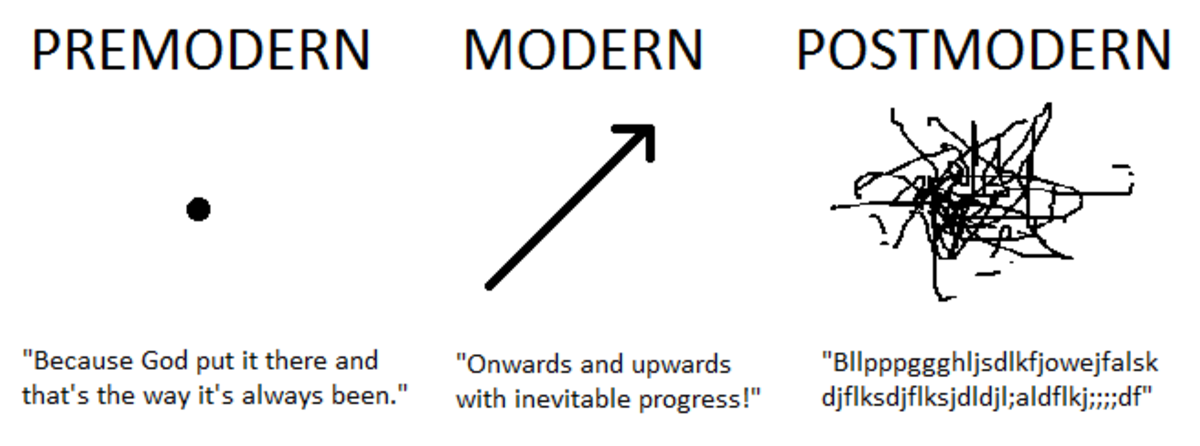
A Postmodern Sampler


Courtesy of Owlcation

A choice bit of postmodern prose recently came my way. The overall heft of the essay seemed to be to discredit Descartes’ thesis, based on a set of prior logical arguments, not here addressed, that clarity and distinctness of perception was a measure of truth.


Here’s the thesis statement for the essay.

 “While truth as overall result or effect is readily understood by everybody, it is a far cry from the accuracy and plausibility sought by scientists. The ability to accomplish and get things done, however tenuous and ill-defined, is a very old notion even if it does not lend itself to statement or claim. As instinctive wisdom would have it, there is a truth to everything, the truth of a place ( its overall effect), the truth of a job, the truth of a relationship, the truth of a sculpture, the truth of a material. It is recognized ( often belatedly) by its closeness to, or fidelity with, experience. Nitty-gritty to the core, it is often talked about mythically as if belonging to a different order. This is but a backhand way of saying we are in the presence of a field phenomenon defined only by interaction, at once environmental and many-sided. In what follows we propose to explore what it is that instant replay brings to the table no matter the circumstances.”

It is tiresome to try to extract the meaning from such prose.

The obvious task this paragraph is here to perform is to define the meaning of the word “Truth.” There is an obvious and simple way to do this: quote a standard dictionary. Instead, the author goes on for a paragraph saying vague, disconnected things.

Is truth at least in some sense readily understood by everybody? Sounds like a dubious assertion. If so, why are we prompted to discuss it here, and so often throughout the history of philosophy?

Is truth an “overall result or effect”? What can that mean? Are causes as opposed to results untrue? Eh? If causes are not real, how can they produce effects?  

He suggests that scientists measure “truth” by “plausibility.” But to be true, a thing has to be more than merely plausible. To be true means it is certain. He might be using the wrong word here, or he may just be spinning words—to sound “plausible.” One simple way to sound plausible is to use the word “plausible” a lot.

“The ability to accomplish and get things done, however tenuous and ill-defined, is a very old notion.” It is unclear why this sentence is here—presumably the author means that “the ability to accomplish and get things done” has something to do with truth. But an ability is not a notion; an act is not an idea. What does he mean here, then? What does it mean to call an action “ill-defined”? In what sense is an action “defined”? Unless it is something like a dance step, it just is.
And is he asserting that “truth” is the same as “getting things done”? Who says that? So if I swat a fly, I have discovered some truth?  Or have I created a truth? Does the fly not exist, since nobody has “gotten it done”?

“Instinctive wisdom” seems to be a contradiction in terms. Wisdom is “the quality of having experience and knowledge.” Making decisions based on experience and knowledge is the opposite of making decisions based on instinct. One might use such a paradox to draw attention to a point, but there is no point. It is not explained.

And again, is it instinct to suppose “there is a truth to everything”? That means there is a truth to a lie, a truth to a hallucination, a truth to an error, and so forth. Really?

“The truth of a place” is described as “its overall effect.” But does that mean that no place exists except as experienced? If nobody visits Australia, it is not there? Its effect on whom? Me, you, the average person, the most recent person to experience it, only those currently experiencing it, or God? If true, why are places specified? Why would this not be equally true of other things experienced?

And so on and on. It is a word salad. Without the vinegar.


Friday, February 16, 2018

Jordan Peterson: Sounding the Tocsin


Nietzsche in his final madness.

Suddenly Jordan Peterson is everywhere. On YouTube, he offers hours of lectures. He is being interviewed by everyone. His book is top of the NYTimes bestseller list, and similar lists in Canada, Australia, and Britain. How did this happen, so quickly?

A lot of us feel we owe Peterson admiration and support for his principled stand against Bill C-16 and compelled speech. I myself recently gave him high praise for his performance in a debate/discussion with William Lane Craig on the meaning of life.

But now that I have seen more of what he says on YouTube, I begin to be alarmed. He obviously has a lot of positions on a lot of other issues beyond free speech, and he is eagerly exploiting his new fame to push them. It is almost as if the free speech thing was a gambit to get the publicity and the opportunity. It is almost as if he had it all waiting to ship.

And these other views look alarming.

To begin with, I am concerned with the simple and basic fact that he is giving out “Rules for Life.” That is a pretty pretentious thing to do. What gives him the authority? Or, more precisely, what makes him think he has the authority? It speaks of narcissism. He now seems to have an opinion on almost everything, and his opinions do not seem on the whole to be backed up with reasoned arguments, but are stated as if intuitions or revelations of the truth.

I have checked him on a few now, and they seem to be unsupported by the facts or by the current research. Some are, some are not. It does not seem to matter.

But the big red banner is that Peterson keeps quoting Nietzsche. And with high praise. Good people, quite simply, do not cite Nietzsche as their authority or inspiration.

Nietzsche leads by a pretty direct path to Nazism.

Yes, I know, you will have heard he has been exonerated of this accusation. The Nazis misinterpreted him. His sister, his literary executor, was a Nazi, and she twisted things. He was not an anti-Semite at all. No, no! He was against anti-Semitism.

This misses, or deliberately avoids, the datum that Nazism was about more than anti-Semitism. No, it would not have all been okay if Hitler had just left the Jews alone.

There is no way, surely, to read Nietzsche as other than a bad man promoting evil.

The core of Nietzsche’s philosophy, his key assertion, is that all philosophers before him were not actually seeking or asserting truth. No, they were just asserting what they wanted to be true. Philosophy was wish-fulfillment.

If Nietzsche is right, then this must also apply to his own philosophy. Including this assertion, this claim about other philosophers. We have a right, therefore, to dismiss it; Nietzsche just wants it to be true.

But then, we need to accept that everything else in Nietzsche’s own philosophy is just wish-fulfillment. This is necessarily true whether or not Nietzsche is right about anyone else. If Nietzsche is right, his philosophy is just wish-fulfillment, and has nothing to do with reality. But if Nietzsche is wrong, his philosophy is just wish-fulfillment and has nothing to do with reality. It is perfectly self-refuting.

But Nietzsche’s core assertion here, nonsensical as it is, is the central premise of all narcissism: Things are true because I want them to be true. Things are good because I consider them good for me.

This, then, is the essential rule for living Peterson is promoting.

It is also strikingly similar to Hitler’s basic argument in Mein Kampf. But perhaps I digress.

One you hold this view, that you are the ultimate arbiter of truth, and truth and good is whatever you want, you face an obvious and immediate problem. What about everybody else? There appear to be other human beings around you, and some of them do not accept “your truth,” or are not giving you whatever you want. So what are you supposed to do?

Given Nietzsche’s assumptions, you have every warrant and right to either silence or destroy them.

There is no way this does not end in Holocaust.

Among other fun ideas, Nietzsche despised Christianity and Judaism as “slave morality.” The superior man follows a “master morality” instead. This is much better. It basically means he gets what he wants, if necessary by subjugating others. Being master, he gets to make all the rules, and they get to be whatever he wants.

According to Nietzsche, of course, most famously, “God is dead.” He has been defended as not really an atheist by people claiming that he was not happy about this. Does not stand scrutiny: to assert that it is possible for God to die is to deny he ever existed. It is to presume he is a human creation.

“Christianity,” Nietzsche wrote, “is called the religion of pity. Pity stands opposed to the tonic emotions which heighten our vitality: it has a depressing effect. We are deprived of strength when we feel pity.”

Hitler was on about pity in the same way. The goal is to be pitiless—and to destroy anyone weaker than yourself. It is a direct appeal to resist your own conscience.

Nietzsche titled a book “Beyond Good and Evil,” and declared the division of acts into good and evil a “calamitous error.” If this is not a clear call to do evil, I cannot imagine what is. This is the devil talking, with a contract in his hand, and urging you to sign on the dotted line.

If good and evil, or conscience, or compassion, are not to guide our actions, what is?

Nietzsche says “the will to power.” Hitler took this one to heart: “The triumph of the will.” Life is all about trying not just to achieve your own will, but to ensure others do not achieve theirs. That is what “power” consists of. Making others do things they do not want to do.

And then there is Nietzsche’s concept of the “ubermensch,” the “superman.” He based this on Darwin, and this is the reason so many religious people have for so long been so concerned about Darwin. No, it has nothing to do with a literal interpretation of the first chapter of Genesis. It has to do with the risk of seeing Darwinism as a moral guide. Based on Darwin, Nietzsche explicitly rejected the concept of human equality. Of course humans are not equal; some are smarter, stronger, than others. The logic of evolution says these smarter, stronger people have the right and the duty to kill all the weaker ones so that only they reproduce. They are creating a new species, the “superman.” And, indeed, everyone has the natural right to assume they are this “superman,” and to destroy everyone else with whom they cannot breed. Their success in this endeavour is enough to prove their righteousness in this endeavour.

“The superman does not follow morality of common people since that favors mediocrity but instead rises above the notion of good and evil and above the ‘herd.’”

So, by declaring yourself a superman, you get to do whatever you like, and have a moral right to take whatever you consider in your own interest from anyone else. And, if you do not do this, you are simply proving yourself inferior and worthy of destruction. You, and other such weaklings, are only pissing in the gene pool.

It worries me in this context that Peterson is so big on “bucking up” and taking personal responsibility.

Nietzsche:

“You have made your way from worm to man, and much in you is still worm. Once you were apes, and even now, too, man is more ape than any ape... The overman is the meaning of the earth. Let your will say: the overman shall be the meaning of the earth... Man is a rope, tied between beast and overman—a rope over an abyss ... what is great in man is that he is a bridge and not an end.”

This is a direct and explicit rejection, not just of Christian morality, but of all morality. Kant said, morality consists in treating other human beings “not as a means, but an end.” “Love thy neighbour as thyself” says essentially the same thing in different words; as does “do unto others.” Nietzsche says the opposite: treat all others as a means, not an end. They exist only to be useful to you in your struggle. Your kampf.

Nietzsche went full-tilt mad, psychotic, in his later years. His supporters are adamant that this had nothing to do with his philosophy. It was long claimed that this psychosis was all due to syphilis. More recently, however, it has been pointed out that his symptoms were not consistent with syphilis. Had he had syphilis, for example, he should have died within months of the onset of psychotic symptoms. He lived like this for eleven years.

I think it is only too obvious that his madness was directly related to his philosophy. I was simply the philosophy stated plainly; the philosophy is mad. Nietzsche had set himself up as God: he had the right to do whatever he liked, and since reality was a matter of will, he had created the world, the universe, himself. Perfect narcissism. This is exactly what he says, in what are called his “mad letters.” He declared himself the god Dionysus, and Jesus Christ, and simply “God.” He says he created the world. He orders the pope jailed and the Kaiser shot. After all, both have impudently claimed power over him. It all follows.

“God is on the earth. Do not you see how all the heavens rejoice? I have just taken possession of my empire, cast the Pope into prison, and let Wilhelm, Bismarck, and Stöcker be shot. [signed] The Crucified.”

I hope I am wrong, but it looks as though this is what Jordan Peterson is pushing. This is apparently what he has to sell.

It may be that he is not a “white nationalist,” as is so often claimed. Just as Nietzsche was no anti-Semite. But we seem to be missing the forest for the trees. Peterson actually looks far more dangerous, to his followers and to everyone else, than a mere “white nationalist.”


Tuesday, January 30, 2018

The Meaning of Life


Just a few days ago, a marvellous event was held at U of Toronto. You can see the video on YouTube. A debate or panel discussion on “The Meaning of Life,” featuring William Lane Craig and Jordan Peterson. It reveals some fascinating things.


This is what universities, at their best, are here for. Congratulations to Wycliffe College and U of T.

Willie Craig is a hero of mine. He brings the same beautiful clarity that I love in Benedict XVII.

I have been until recently less enthusiastic about Jordan Peterson. He’s the local hero, and has been making a lot of news recently for opposing, bravely, the enforced use of invented gender pronouns for the “transgendered.” I certainly agree with him on that, but, more generally, I have previously found him rather rambling and incoherent. My first inkling that he was a legitimate intellect was when he KO’ed British interviewer Cathy Newman just a week or two ago. Have you seen that?


Still, I expected Craig to mop the floor with him. I expected a mismatch.

What I saw surprised me, and now I think at last I get where Peterson is coming from. He’s a Buddhist.

Nobody remarked on it during the discussion, and nobody on the panel may have noticed it, but what we really had at the Toronto event was two very fine minds, the one outlining the Western religious position, Craig, and the other outlining the Eastern religious position, Peterson. Both did a great job. The third panelist, Rebecca Goldstein, and I think the moderator, described these two views as being in conflict. I do not think they were at all. Reviewing what the two said, however, Craig and Peterson, gives a good summary of East vs. West. I guess we can all decide for ourselves whether we think there is a disagreement there.

First, on Peterson being Oriental in his thinking: I feel he must have been consciously schooled in the Oriental traditions. He begins his opening comments and his summing up with the same point the Buddha begins with, in his Four Noble Truths: the basic truth of existence is suffering. His take on Genesis, on all morality being founded on calling things by their correct names, is Confucius’s starting premise: good government begins with “the rectification of terms.” It also explains why he saw the use of proper gender pronouns, rightly, as a hill worth fighting for.

His resistance to philosophizing is both Buddhist and Confucian. The Buddha says, “What else matters when your house is on fire?” Peterson says “What else matters when you see a child suffering?” At the same time, Peterson’s resistance to abstraction is based on Confucius’s insight that the good is a priori: the danger is that, if we philosophize, we open ourselves up to rationalizing out of our moral obligations.

The difference is that Peterson and the East take a psychological, practical, and empirical approach. Craig and the West take a philosophical approach. Buddhism and Confucianism are absolutely right from a psychological perspective; Christianity is absolutely right philosophically. Not only are they reconcilable; they are mutually reinforcing. Peterson suggested this: he gave us a useful new lesson from Genesis, and a psychological justification for Christianity with his dream narrative.

Granted, there was a criticism of the Western view in Peterson’s comments: that philosophizing can take us away from out immediate moral duty. True enough. My response, which Craig did not give, is that the Eastern approach gives us little to build on. If the correct moral response is more or less spontaneously evident, you cannot go anywhere else from here. You cannot, for example, do much to improve society. The Western approach, on the other hand, gives a deeper foundation, on which further things can be built. “Upon this rock, I build my church.”

It is a trade-off. Sometimes the one approach is called for, sometimes the other.

The third member of the panel, Goldstein, was the contrast: the “naturalist,” the secularist. I think her position was revealed as untenable; Craig brought her up short just as Peterson brought Newman up short in that interview, by pointing out that she contradicted her naturalistic claims when she said morality was getting better since the Enlightenment. By what objective moral standard? She was dead in the water. He might also have questioned her claim that morality was clearly getting better: it was her naturalistic view that brought us the Holocaust, after all, and the worse slaughter of the Communists. But that would have distracted from this more fundamental point.

The fact that it was Craig who was able to bring Goldstein up short, and not Peterson, perhaps demonstrates the value of Christianity's philosophical underpinnings. Could the Buddhist Peterson have responded?

She wanted to base meaning on the idea that “Everyone’s life is meaningful and important to themselves.” Therefore, our lives have meaning. Yet, as even she herself mentioned, apparently without registering the contradiction, the depressed commonly do not feel their lives are meaningful. Neither do Buddhists. This “it has meaning because it is mine” is not a satisfactory answer to any thoughtful person. If it were, it would never have occurred to anybody to hold or to attend a panel discussion on the question.

Her argument was also immoral. It was an appeal to egotism: “everyone’s life has meaning to themselves, because it is their life.” This is the poison commonly promoted in the modern academy. The morality that follows from that is, “if I want something for myself, my getting it is the moral good, because I want it.” Simple selfishness; a war of all against all. Which is the root of all evil. She gave the example of someone stepping on her on the beach: obviously, instinctively, that is wrong, she insisted. But, tellingly, she did not think to present it the other way: what could possibly be wrong with her stepping on someone else on the beach? One wonders. Would she see it?

Her actual behaviour at the talk showed such egotism. She was repeatedly pleading for special consideration for herself: I am owed something because I am a Jew. I am owed something because I am a woman. I am owed something because I am against Trump. Look at me, look at me; gimme, gimme, gimme. And, of course, she wanted to make everything “personal.”

Welcome to the modern university. Welcome to modern life. And so much for improving morality.


Wednesday, February 22, 2017

Fast Notes on a Few Philosophers


Confucius

Confucius is probably the most influential philosopher who ever lived. But he did not really leave us a philosophy. Rather than carefully reasoned argument, he left aphorisms, short pieces of advice on how to live, without explanation or justification.

How can this have been so influential? Why should we take Confucius’s word for it?

This, I think, is because rather than appealing to reason, he appealed to conscience. Given a conscience, if the moral right is simply demonstrated or pointed out, it is undeniable. Resorting to reason, by contrast, might just rationalize wrong. This illustrates Confucius’s most important point: that people are best governed by example, not by laws. If the ruler is visibly virtuous, the people will be virtuous. If the ruler is visibly dishonest, the people will not care about virtue.

A moral and social philosopher, Confucius analysed all human relationships as of five types: parent-child, sibling-sibling, husband-wife, friend-friend, ruler-subject. Each implied specific obligations, and if everyone followed their proper role, society would always function well. Some object that this implied a rigidly hierarchical society, always with superiors and inferiors. This is wrong: it is like the game of rock-paper-scissors. If you must play the subordinate in relationship A, you are going to be the superior in some other relationship.

It worked very well for China and East Asia for thousands of years. If there is a problem here, however, it is that the reliance on direct appeals to conscience instead of general principles can leave gaps. For example, since a foreigner or a stranger does not obviously fit into one of the five relationships, he or she can become a ghost, of no account. Consider the story of the Good Samaritan for comparison. If violence or injustice is done outside your sight, similarly, it may be felt to be less troublesome.

There is this example from Confucius’s follower Mencius:

The King was sitting up on the pavilion. There was an ox being led past the pavilion. The King saw it and said, "Where is the ox going?" Someone responded, "We are about to consecrate a bell [with its blood]." The King said, "Spare it. I cannot bear its frightened appearance, like an innocent going to the execution ground." Someone responded, "So should we abandon the consecrating of the bell?" [The King] said, "How can that be abandoned? Exchange [the ox] for a sheep."

Mencius commends the king for doing right, and says “This is just the way benevolence works.[4] You saw the ox but had not seen the sheep.”

To my mind, however, this is unjust. One ought to care as much for those one does not see. This is why codes of law like the Ten Commandments are, in the end, useful. Even though St. Augustine says, in the spirit of Confucius, “Love, and do what you will.”


Descartes

Descartes set out to doubt everything he could doubt, and came up with one certainty: “I think—even if I doubt—therefore I am.” He could not doubt that he was doubting. So the self exists, “I,” if nothing else. He goes on, then, to point out that at least some of the thoughts do not come from him, nor did he create himself, and so at a minimum God too exists. The existence of God, in turn, is a warrant that anything we perceive clearly and distinctly is likely to be real and true. A good God would not deceive us.

Ironically, Buddhism is based on what seems to be the opposite premise: its core doctrine is anatman, “There is no self.” Does this disprove Descartes? I don’t think so. Both assertions, I think, can be true. We cannot doubt the existence of the perceiving subject, but the point Buddhism is making is that this subject, this “I,” has no content. Or if it does, we cannot know what it is. We cannot perceive it directly--”I” cannot be both subject and object. A mirror cannot reflect itself. We do not really know what it is, we cannot say anything about it.

The second common criticism of Descartes is for “Cartesian dualism.” He posits two distinct realms of existence, the mental or spiritual and the physical. Many have argued that it seems logically impossible for two separate realms like this to have any influence on one another. Like parallel lines, they should never meet. How does that physical cat out there somehow get into our mind? How does our thought make our arm rise up? I do not really see any problem here, however. On the analogy of hardware and software, it seems perfectly reasonable: they are two separate realms, in just the same way, but they do interact. The other solution is more radical: why assume there is a physical world? Maybe everything is spirit!


Rousseau

Rousseau is best known as a social philosopher, although he said important things about education as well. I think his basic premise can be stated in this way:

God exists. God is perfectly good. God created all things. Therefore, all things must have been created perfectly good. “Nature” is a model of perfect goodness. All evil in the world must come from change over time to the original, natural pattern God set. All change from what is original and natural is a falling away.

I see an immediate problem here. It means anything men try to do is a bad thing. Rousseau believes that all art and all science is in error, is a result of human “pride,” like the Tower of Babel. Do we presume we can do better than God?

I think that the Biblical advice “by their fruits ye shall know them” disproves Rousseau in practical terms. To follow his philosophy, nobody would ever try to make the world better. Everyone would just do what they first wanted to do, because that is what is “natural” to them: sex, drugs, stealing, laying about, and so forth. As a result, trying to put Rousseau’s ideas into practice, as in the French Revolution, seems to have always ended badly.

The response to Rousseau, I think, is the idea of original sin; his philosophy is sensible only because he rejects original sin. If there was indeed an original sin, human nature cannot be assumed to be spontaneously good; nor can nature be trusted as a model of the way things ought to be. Both, as we know them now, are in a fallen state.

I think Rousseau’s assumptions also do not work well on his own initial premise, that God is supremely good. If God is supremely good, would he have created a world that must inevitably decay over time? Would he have created man with nothing useful to do? By contrast, the idea that God created an essentially good world, with free will, which is also good, but original sin caused it to fall, leaves the possibility of a process leading to a more perfect world. Therefore, this is the world God would have created.


Saturday, July 17, 2010

The Meaning of Life

I’m working on a theory of life, the universe, and everything. It’s not really original; why need it be? I’m trying to get at truth here.


First principle: God is. This is beyond dispute, and need not be argued here.

Second principle: it is of the essential nature of God, that he is good.

If he were not good, there would be a second principle, goodness, that would in some sense transcend him; it would be greater than him in a moral sense. Therefore, absolute goodness must be essential to his nature, along with absolute existence, absolute power, and absolute knowledge.

We can draw many conclusions from this certainty that God is good. Most importantly, he did not create us as conscious beings, with our ability to suffer, in order to suffer, or to see us suffer. He does not want us to suffer. All evil must, as the old Catholic formula goes, come from man.

He must have put salvation, salvation from suffering and from evil, close to hand. It must be within arm’s length, metaphorically, in plain sight, of each of us.

The purpose of life must not, therefore, be heroic deeds, great intellectual achievements, fame, fortune, or any sort of success that distinguishes us as somehow from the common run of our fellow man; for God loves all of us, and most of us are necessarily not capable of excelling others.

Hence the true successes in this life are the “little ones” of the Beatitudes, the “salt of the earth.” The true path to salvation and spiritual joy must be St. Therese’s “little way.”

This is not a question of going “back to nature”: it is clear enough that nature is imperfect. If nature alone were sufficient, there would be no need nor purpose for man. Either nature is fallen with man, as the classic formula had it, or nature was designed by God to be incomplete, so that man could perfect it; or both. However, it does seem to follow that, in all areas, the best and most worthwhile things are common, everyday things. The simple things are the best things, like the classic example, Shaker furniture.

One important reason we are not happy, I suspect, is that we perversely cannot seem to appreciate what is too easy to acquire. We always want to “become as gods,” to reach higher on the branches of the tree, to depend on our own efforts, to build our lofty towers.

Consider the lilies of the field… become not as gods, but as children. Seek only what is as common as salt on the Dead Sea shore.

I used to think my wife was deprived as a child, living in a poor family in the Philippines. She had no store-bought toys. But then again, she had a carabao—a water-buffalo—to ride; what could be more fun than that? She had chickens and ducks and piglets around the house, a swimming hole a few meters away, and other kids always filling the living room. Toys? She had all of tropical nature to play with. When my own kids go there, they love it. They certainly are not bored.

The best food in any country also seems to be the standard peasants’ meal: a “clean out the refrigerator” dish. Nasi goreng; bibimbap; pizza; borscht. The cheapest, easiest source of complex carbohydrates is probably the lowly potato. Honestly, what tastes as good as a potato? Protein? What is easier to grow than beans? Yet they are almost infinite in the variety of their tastes.

Isn’t the pattern plain?

Consider, indeed, the lilies of the field. In northern climes, we spend a huge amount of time and worry trying to get rid of dandelions. And yet, what flower is more beautiful? And every single part of the dandelion is edible, almost a full menu in one plant: leaves like spinach or lettuce; the flowers make a wine like champagne; the roasted roots make a drink like coffee. The stems and the seeds are marvellous toys.

We reject what God gives us, and that is our perversity. Perhaps it is part of the Fall.

What makes us happiest? Not wealth; studies prove it. So getting more money is a waste of time. Not fame; those who are famous are clearly not happy, and it stands to reason. Becoming famous only isolates you. Not power: those who try for great power seem invariably instead to become captives, if only of their own paranoia. Stalin, for example, reputedly died frightened of everyone.

What makes us happy, first, is our relationship with God—this used to be understood, and monasteries were seen as places of supreme joy. Next to this, other people: our children, our wives, our best friends. Yet they come to us for free.

Well, except for the wives.

Next to these are the beauties of art. Art can be extremely expensive, in one sense; but not, again, the best art. Expensive art is mostly expensive for the hype, not the quality. Folk art is the best art, and folk art is available to everyone with a little time.

I am not advocating asceticism, or self-denial. That is another kind of striving. I am also not advocating heroic deeds of charity—that is another kind of striving, and the poor you shall have always with you. It is enough to deal with the evil that comes daily within your arm’s reach. The point here is not to conquer evil—we cannot do that, only God can. It is to do what it right at each moment. You see someone suffering on the road, you help them. You see a way to make someone smile, you try to do it.

Friday, September 04, 2009

We Have Met the Enemy ...

The world is full of Pharisees, phonies, mountebanks, and charlatans. We knew that, right? It's too obvious. A writerly friend loves to quote the adage “95% of everything is bunk.” This much is old to anyone who has read the New Testament.

But here’s a recent thought that's new at least to me: it’s not just the fault of the Pharisees. All of us are egging them on.

This revelation came to me while watching one of CNN’s house ads in a hotel room in Abu Dhabi. It was describing all the fascinating, controversial, interesting people you would encounter on one of their programs. “Mavericks!” the voice-over rang out breathlessly, as a photo of Al Gore appeared on the screen.

Al Gore!?!? A former Vice President of the US? When has he ever bucked a trend, as opposed to settling in for the ride? Whose opinions on anything have been more utterly predictable? Who on earth can be left to represent the political establishment?

It’s not as if the current US political street doesn't offer more obvious candidates to illustrate the term: Joe Liebermann, Arlen Specter, John McCain, Ralph Nader, Jesse Ventura, Ron Paul, Pat Buchanan … Assuming the people who run CNN have a minimal knowledge of their own business, how do they come up with such a non sequitor?

Because, is seems to me, most people prefer a lie to the truth. It is Pharisaism with which they feel most comfortable—just like the mob that cried out “Give us Barrabbus.” It was safer in their minds, and it is safer in ours, to free a known murderer than a genuinely honest man. Without this sentiment from the mob, the Pharisees wouldn't last a day.

Jesus was a maverick, if anyone was. The very concept of a maverick, someone who thinks for himself instead of following the established consensual line, is necessarily frightening to anyone invested in a lie. As just about all of us are, in one way or another: the lie that we deserve all the money we have, say, or that we are really much smarter than everyone else, or that we will never actually die, or ...

Any real maverick threatens this. It seems wisest, therefore, to co-opt the term; ideally, to co-opt it for its opposite. Lies persisted in breed bigger and more terrible lies, to protect themselves, hiding the truth everywhere behind double-switchbacks. If you cannot damn “mavericks” as such, damn them instead for being “conformists.”

I’ve seen this double-lie happen politically many times in my 56-odd (very odd) years. When some golf club a few years ago would not admit Tiger Woods to play in a tourney, another friend of mine, the oft-mentioned left-wing columnist, lamented this example of “systemic discrimination.”

It was, of course, the opposite of “systemic discrimination”: currently, the “system” discriminates aggressively in favour of African Americans. It was an incidence of personal prejudice, shared by a small group of individuals in defiance of the system. But “systemic discrimination” is a comfortable lie, because it absolves all of us, as individuals, of any present or past guilt. The devil made us do it, so to speak.

If, on the other hand, real “systemic discrimination” came up and bit us on the nose—why, that wouldn't be discrimination at all. For admitting it was would be bucking the system, questioning the shared consensus, and where would we be then? Obliged, sadly, to confront truths bare. Consider “feminism”--really the systemic discrimination against men. Compare, after all, the historic fate of women with that of American blacks—a group truly and obviously discriminated against. Blacks had to give up their seats on the bus; women were the first ones seated. Blacks were served last at restaurants; women always went first. Blacks were obliged to work at hard, manual labour until they dropped in the open field. Women were excused from any manual labour as soon as their family circumstances or society's circumstances permitted it. And so on and on: the term “discrimination” has been co-opted to describe the opposite, and to justify and add to the special privileges privileged members of society already have. The rich get richer, and the poor get further stigmatized, so we needn't feel guilty about it.

Skillful Pharisees are merely able to exploit this bottomless public appetite for being deceived. David Suzuki springs to mind: when environmentalism gained enough steam to look mainstream, he, already entirely an establishment figure, was able to rush to the front of that parade and claim leadership. People embraced him, over the real founders of the movement, because Suzuki, being establishment, could be trusted not to really rock the boat in the end. He could rail and shake his tiny fists; everyone knew he was fully invested in the status quo, and would never do anything that might actually rattle our morning teacups. So everyone now could pretend to be an “environmentalist,” blame the poor, outlaw the real environmentalists, do something symbolic, and carry on as before.

So again, when some politician suddenly changes his or her stripes, in blatant response to an opinion poll or the sentiment of some new electorate, we almost always happily go along with the sham. We act entirely as though we still consider their newfound political views principled, though all of us must know they are not; it's very much like the “willing suspension of disbelief” needed to appreciate a good novel. We all now accept that Mitt Romney is a conservative, for example. Far from being troubled, we feel we can now trust him, because he has made public his final Pharisaism. No danger here from Mormon principle: we can trust him, like the rest of us, to predictably behave in his own self-interest, instead of inconveniently seeking truth, justice, or any nonsense of that sort.

This craving for charlatans over the genuine article makes the world go round. We always want a charming rascal, not an honest man, in the van.

It is the source, I suppose, of such cryptic sayings as “The devil is the god of this world,” or “the devil is a gentleman.” The entire social sphere is corrupted, fallen, from this tendency, so much so that it constantly breeds wild conspiracy theories. Everybody knows there is a vast selfish conspiracy in control of the world, deliberately manipulating it; and they are right.

What they fail to realize is that we ourselves are the conspirators.

Sunday, November 18, 2007

Perennial Philosophies

There are only a few basic philosophies of life, and they are perennial.

The Cynics of ancient Greece basically took the same approach as the Buddhists of India and the Far East, and Christian monastics: to achieve happiness, limit your desires.

The Stoics, the Confucians, the Secular Humanists, and the Marxists took and take another approach: life is harsh, but one must bear it bravely and do what one can to build a better society. Happiness comes only from such striving.

The hippies of the Sixties merely revived the simple notions of the Epicureans: if it feels good, do it.

The Hindu Vedanta and Greek Neoplatonism seem also of one school: all is secretly one, and one seeks bliss in unity with all.

Ethical monotheism forms another strand, running through Judaism, Islam, Zoroastrianism, Christianity, and Amidist Buddhism: the point of life is to submit to a higher will and do good. Happiness comes from this, if not in this life, then in the hereafter.

Romanticism is also everywhere: in the English Romantics, the Medieval Romances, the Tantric forms of Hinduism, Taoism in China, Shinto in Japan, and Gnosticism throughout Europe and the Middle East. This tradition believes in shock therapy, arriving at truth through an inversion of prevailing ideas. Happiness is achieved through the intellectual liberation this produces, and is conceived as a return to an original purity.

I suspect that all the world’s systems and paths of life can be fitted somewhere in this schema.

I have found myself at various times attracted to all of these philosophies. However, in the end, I am an ethical monotheist.