Playing the Indian Card

Showing posts with label Holy Spirit. Show all posts

Tuesday, February 20, 2024

The Synodal Way and the Narrow Way


A prayer intention that I had not heard before was added to the mass this Sunday: “Lord, keep us in communion with the Holy Father, Pope Francis in Rome.” 

This is perhaps an indication of the turmoil in the church: schism seems a possibility, perhaps immanent. And if it happens, Francis is responsible. It is he who is stirring things up. The latest word is of a proposed reconciliation with the Freemasons. Whom prior popes stretching back centuries supposedly simply misunderstood. 

Good Catholics do not know which way to turn. If good Catholics are now to believe that the popes and councils prior to Francis got it wrong, how can we have confidence that Francis has it right? On what authority?

“The blizzard, the blizzard of the world
Has crossed the threshold and it has overturned the order of the soul”

I have no sense that the local bishop, or the local priest, are particularly traditionalist. Some parishioners clearly are. The weekly bulletin dutifully reports on the synod on synodality in the same terms used by the Vatican. It calls for a “listening church,” seeking to know what the Holy Spirit wants. And reports that two representatives from the parish will be sent to a new regional synodal confab in March.

Given that there is a continuing need to know what the Holy Spirit wants, that the Holy Spirit has perhaps changed His mind on something, how does one discern what the Holy Spirit wants? How does one listen to the Holy Spirit?

The path is well known and marked. It does not have to do with meeting in groups. In such groups, one is not listening to the Holy Spirit. The voice of the Spirit is there drowned out by human voices. One goes out into the desert, alone. Or to the monastic cell.

Abraham did not hear the voice of God by listening to the polytheists around him, but by breaking away from them, packing his bags and leaving Ur. Noah likewise; his neighbours no doubt thought him mad. Lot likewise; he was not even to look back on the cities of the plain. Moses likewise; he met God in the desert, as a fugitive. Elijah or Isaiah likewise; John the Baptist likewise. 

The synodal way of breaking into small groups to discuss topics for three minutes each, is not listening to the Spirit, but to the world.


Tuesday, November 07, 2023

Listening


The main theme of the current “synod on synodality” at the Vatican, which just wrapped up its 2023 session, is listening: it seeks “a Church of sisters and brothers in Christ who listen to one another and who, in so doing, are gradually transformed by the Spirit.”

But this is fundamentally backward. 

The point of a church is not to listen to one another; that’s a social club. One does not need a church to have a chat with a neighbour. Mainstream Protestant denominations have gone down this road, and it leads to irrelevance, then extinction.

And if this is what the seeker wants, why be Catholic? Lots of other churches will offer exactly the same: agreeing with your opinions and endorsing your wants, whatever they might be.

One needs a church to listen to God, and learn what God wants. The revelation we have been given in the gospels, in the Bible, and in the apostolic tradition. Some may have special expertise in this: we listen to them. Just as, if we are ill, we do not discuss it with our neighbours; we go to a doctor.

Granted, we should also listen to the Spirit, as the synod documents aver. 

But that does not mean listening to anyone. That means the prophets, who are, literally, “inspired,” channeling the Holy Spirit. You find them, too, in the Bible, the deposit of faith.

Might that include prophets alive and speaking today? 

Sure; any great artist is also “inspired,” and at least some will be inspired by the Holy Spirit. Martin Luther King Jr., or Gandhi, also probably counted as modern-day prophets. However, such prophets do not lay down new doctrine or alter morals; God would not have concealed truths from us until now. The prophet’s job is to call on us to repent, and to adhere to the established doctrine. Already in the Old Testament, that was their function.

There are, of course, false prophets—those who claim to be inspired, but for ulterior motives. The gospel warns us of this, repeatedly. 

"Beware of false prophets, who come to you in sheep’s clothing but inwardly are ravenous wolves. You will know them by their fruits. Are grapes gathered from thorns, or figs from thistles? So, every sound tree bears good fruit, but the bad tree bears evil fruit. A sound tree cannot bear evil fruit, nor can a bad tree bear good fruit. Every tree that does not bear good fruit is cut down and thrown into the fire. Thus you will know them by their fruits."

I take “good fruits” to mean beauty; the alternative explanation that it means “good deeds” is inconsistent with what Jesus says soon after this, that one must do one’s good deeds in secret.

Accordingly, no doubt the Church, and certainly the individual believer, must respect and attend to the message of great art, of Shakespeare, say, or Dante, or Dostoyevsky; or the beauty of King’s rhetoric. God raises such prophets as the times demand

But one does not listen to the Spirit by breaking into small groups, as the synod proposes. Just the reverse; the artist always works alone. He is out in the desert eating locusts. He needs solitude, precisely to drown out all other voices.

The very voices the synod wants us to listen to instead.


Monday, May 02, 2022

Taking the Road More Travelled


Matthew 12: 31:

And so I tell you, every kind of sin and slander can be forgiven, but blasphemy against the Spirit will not be forgiven. 32Anyone who speaks a word against the Son of Man will be forgiven, but anyone who speaks against the Holy Spirit will not be forgiven, either in this age or in the age to come.

What is the unforgivable sin? The question is of ultimate importance. For it seems this is the sin that sends you to hell—other sins can be forgiven, the passage implies, not just in this world, but if necessary in the next. They send you to purgatory, but not hell.

A widely-read Orthodox catechism explains clearly and simply:

“’Blasphemy against the Holy Spirit’ is conscious and hardened opposition to the truth, because the Spirit is truth (I John 5:6). Conscious and hardened resistance to the truth leads man away from humility and repentance, and without repentance there can be no forgiveness. That is why the sin of blasphemy against the Spirit cannot be forgiven, since one who does not acknowledge his sin does not seek to have it forgiven.” – Archpriest Alexivich Slobodskoy, The Christian Faith

The ultimate sin is denial. Without an admission of guilt, no forgiveness is possible, from either God or man.

Sadly, it is a common sin. Too many of us are too ready to deny good and evil, and avert our faces when we see evil done. It even seems the social norm.

Who cares if there are a lot of Jews being held in some distant camps?

Who cares if so many babies are aborted?

Why get involved in a war between Russia and Ukraine? No doubt they are both to blame.

More broadly, and less obviously, many of us seem to think we have a right to believe what we want to believe, instead of seeking truth. If we want to be a woman instead of a man, we can simply declare it so. If history does not suit our purposes, we can construct our own “narrative.”

And on it goes; on the high road to hell.


Friday, September 25, 2015

Gifts of the Spirit


John Boehner was sobbing through much of yesterday's papal speech to congress.

I know just how he feels. Really. I had the same reaction to Pope John Paul II when I attended the papal mass in Toronto in 1984. The immediate presence of the Spirit can do that to you. It turns out Boehner is not just a cynical pol. He has a soul.

The ability to evoke this response is no Catholic monopoly. Wasn't it the essence of a Billy Graham revival, for example? But it does speak well of the church, that the charism—the gift of the Holy Spirit—does seem to be predictably present in its leadership.

More generally, isn't it undeniable that Catholics tend to be charismatic? Marco Rubio, for example, stands out among the current contenders for the US presidency as charming, as did John F. Kennedy in his day, or Pierre Trudeau in Canada. All Catholics, born, and, importantly, bred. An Evangelical Protestant background can produce something similar: Elvis, Bill Clinton, Mike Huckabee, Martin Luther King Jr. But in either case, surely, you can sense the religious upbringing in the man.

Charisma is plainly not a guarantee of individual goodness. Hitler, after all, was said to have it. And this makes sense. It is, after all, by definition, a “gift.” It is not a reward for good behaviour.

What it is about is not moral goodness, but an inner awareness of fundamental truth. A charismatic person radiates “savoir faire,” which is to say, an unshakable sense of knowledge of some ultimate. Such a sense must most naturally and fully come from true religion.

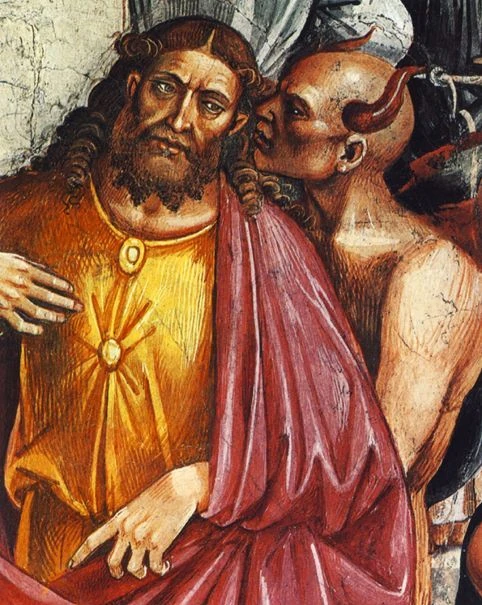
This, not incidentally, is why Hitler cannot be excused by suggestions that he simply had his own consistent morality of survival of the fittest, and stuck to his peculiar principles. No, his very charisma shows that he knew the Truth with that capital T, and so knowingly turned from it, like Faust. This is what gives Lucifer his charisma in turn: he has known the true presence.

Lucifer departs the divine presence.

So charisma can be used for good or ill. Either way, it is powerful. Someone who is in touch with ultimate truth is less likely to be swayed or frightened by immediate events. The bomb goes off behind him, but the guy with charisma does not flinch, continuing to walk steadily toward the camera.

So, no surprise, that “tough guy” roles seem to be something of a Catholic specialty in Hollywood. Gary Cooper, Nicholas Cage, James Cagney, Liam Neeson, Sean Connery, Clark Gable, Mel Gibson, Al Pacino, Robert De Niro, Gregory Peck, Arnold Schwarzenegger, Martin Sheen, Sylvester Stallone, Spencer Tracy, John Wayne, Patrick McGoohan (Secret Agent, The Prisoner—perhaps the most charismatic actor ever), Jean Claude Van Damme. Not everybody—Humphrey Bogart, for example, was Episcopalian—but an impressive showing for a minority group.

Patrick McGoohan's stage presence was so powerful that Leo McKern reputedly suffered a nervous breakdown from acting the role of his adversary.
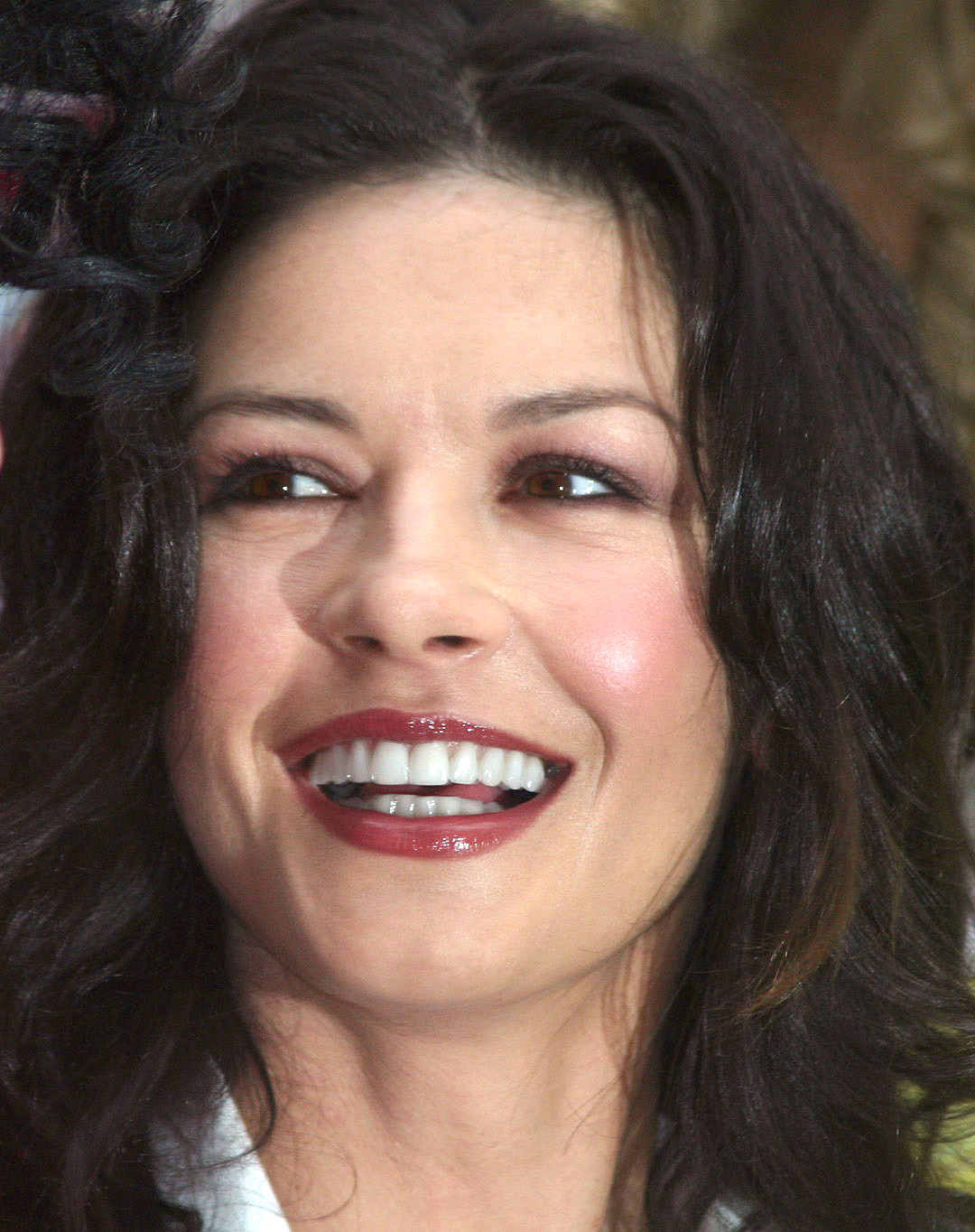
Now how about the most charismatic women? Here, the case is perhaps best made by beauty pageants, which measure not just beauty, but poise and presence. How often have they been won by Miss Venezuela again? Answer: for Miss Universe, Venezuela 7 times, second only to the US with 8. And the US has home field advantage. Catholic Puerto Rice third, 5 times. For Miss World, Venezuela leads with 6 wins. The UK, with home field advantage, comes second. For Miss International, Venezuela leads with 6 wins, Catholic Philippines second with 5. For Miss Earth, Venezuela is in a three-way tie for first place with Brazil and the Philippines, all Catholic countries. On the screen, we can cite Catherine Zeta-Jones, Jessica Alba, Katharine Hepburn, Sophia Loren, Brigitte Bardot, Raquel Welch, Faye Dunaway, Suzanne Somers, Jennifer Lopez, Angelina Jolie, Nicole Kidman, Julia Roberts, Mae West, Mary Pickford ...

By their fruits, ye shall know them.

Nice fruits, eh?


That Jones girl.