If for any reason you cannot find the paperback version of Playing the Indian Card at your favourite bookstore or online retailer, please ask them to carry it. Protest and picket the store entrance if necessary.
Yesterday in Saint John, there were two opposing demonstrations scheduled: the second One Million March for Children, protesting sexual orientation and gender ideology in the schools, and “Love is Louder than Hate,” demanding sexual orientation and gender ideology in the schools. All over Canada, there are large demonstrations protesting the genocide of Jews by Hamas in Israel, and competing demonstrations protesting the genocide of Arabs by Israel in Gaza. And this on top of the longstanding demonstrations for and against abortion.
Opposing demonstrations are not in themselves alarming. But these positions seem irreconcilable. There seems to be no room for calm debate or compromise. After all, to the one side, it looks like the other side is committing genocide. To one side, it looks like the other is trying to harm their children.
It looks like civil war is coming inevitably closer all the time, and seems the necessary ultimate result. “A house divided against itself cannot stand.” Sooner or later, here or somewhere, competing demonstrations are going to clash violently, there will be a body count, there will be calls for vengeance, and the fighting will spread. One thinks of “Bleeding Kansas.”
The underlying problem is that we have lost or abandoned all our shared values or principles. Any society needs shared values to function: some underlying set of shared premises from which to argue and eventually come to an agreement. We used to all agree, or nearly all agree, on Judeo-Christian principles and the principles of liberal democracy. Now a large portion of the population no longer do.
The only way to prevent a civil war is either a wholesale return to these values, or general adoption of some new set of shared premises. Marxism offered one, based on material progress and “dialectical materialism”; but, leaving aside its philosophical flaws, Marxism has surely by now been discredited in practice. Bad things happen wherever it is tried. Nazism offered one, a new morality based on the Theory of Evolution; but I think we can agree that did not turn out well. Islamism is one current candidate; but the state of the Muslim world does not inspire confidence.
I vote for a return to Judeo-Christian principles and the principles of liberal democracy. To be clear, that means restrictions on abortion, absolute preference for Christian and Jewish over Muslim immigration, and no mention of sexual orientation or gender ideology in the schools.
It is not generally understood, but Western civilization shattered sometime in 1917.
Son of man, You cannot say, or guess, for you know only A heap of broken images, where the sun beats, And the dead tree gives no shelter, the cricket no relief, And the dry stone no sound of water. – T.S. Eliot
Before this, the culture was a mirror, in which you could see the face of man. This is Shakespeare’s “Mirror held up to nature.”
Since then, what do you see?
Only a shattered land, a shattered landscape, only shards of mirror reflecting each another’s emptiness.
Had occasion in the course of my teaching to watch a video of the Futurama ride at the GM pavilion, New York Worlds’ Fair, 1964-5. I was there at the time, in 64; I remembered some of it. But this time I was struck by how our attitude towards the future then was so different from today. GM was confident the future would be abundant, thanks to improvements in technology. Progress marches on! Roads through the tropical jungles, bringing goods to market! Submersibles reaping the limitless harvest of the seas! Vast cities of light.
Nowadays, rather than celebrate technology, we fear it as the enemy. Even though technology has indeed brought us many marvels since 1964: the Internet, the smart phone, longer lifespans, abundance of food from the green revolution. So why did we sour on it?
Granted, the GM exhibit might not have been fully representative of all the voices of 1964. Or rather, 1962 or so, when the exhibit was presumably designed. This was big business talking. But the ride was highly popular during the fair, a reprise of one of the most popular pavilions of the 1939 Fair, and did not get any pushback at the time for overplaying the wonders of technology. It seemed to express the broad consensus. Science conquers all.
I have long thought that western civ lost its nerve in the carnage of the First World War. I think of Eliot’s “The Waste-Land” emerging at about that time. Or W.B. Yeats’s discovery that “We are but weasels fighting in a hole.”
But watching this video, I had another thought. It seems to be our view of technology in particular that has changed. This seems to be the pivot.
Perhaps the underlying cause, even the cause of WWI in the first place, is what Alvin Toffler called future shock. Since about the second half of the 19th century, and especially with the personal computer revolution beginning circa 1980, things have been changing rapidly due to technology. In effect, none of us lives any longer in the land or in the culture we were born into. This can cause, and perhaps has caused, a general trauma, a sense that we are losing control of our lives. “Stop the world; I want to get off!” Perhaps this is seen in Kipling’s 1897 lines:
For heathen heart that puts her trust
In reeking tube and iron shard
Already, to him, technology is the enemy.
Toffler’s “future shock” is based on the known phenomenon of culture shock.
I know a little bit about culture shock. Alarmingly, governments and medical establishments seem not to. I have lived through culture shock more than once. It is no trivial thing.
For the first little while in a radically new culture, say the first three months, you are on vacation. Everything is new and wonderful. What you feel the most is that all the old constraints of daily life back home are gone. All the weary chains of habit and social convention that we secretly resent are gone, and we want to run naked in the woods. We want to hook up. First of all, nobody knows you, so you need not worry about your reputation. Screw up, and you just take the plane home. And the first impression when faced with new rules is that there are no rules. You can go ahead and just do as you want; as you always wanted.
This crazy optimism somewhat describes, in cultural terms, the Fin de Siecle, the Edwardian period, the period just preceding the First World War. The automobile, the airplane, the moving picture, the phonograph, were rapidly transforming individual lives. In politics, “progressivism” was born: the application of science and technology to society would solve everything.
For another good representation of this state, see Margaret Meade’s “Coming of Age in Samoa.” Any old foreign hand should have seen she was in the first stage of culture shock. But for decades, it was taken as solid anthropological work. Yeah, everyone In Samoa just had sex whenever they wanted. None of our Western hangups.
This is also why “exotic dancer” is a synonym for “erotic dancer”: the nearest foreign country is usually imagined to allow free love. Absurdly, this was the reputation of the Muslim Middle East in the Victorian Era. Those guys with the women in abayas. Even in my youth, the most famous stripper in Montreal went by the name “Fawzia Amir.”
Ironically, the same culture shock leads young Muslim men coming to northern Europe to think it is okay to rape young local women. After all, here in the “Wicked West,” anything goes.
In England, syphilis was long known euphemistically as the “French pox.” In France, it was called “the English malady.”
And so it goes, as Billy Pilgrim would say.
An expat can get themself in a lot of trouble during this stage.
Now imagine a government that welcomes large numbers all at once from a quite different culture. What do you think might happen? But I digress….
But the next stage is worse. After about three months, in the usual course of expat life, you come to the impression that the rules no longer apply both ways. These foreigners have no morals; and they are insane. Nothing here makes sense. And this is not a vacation; you realize you cannot go home again. You are stuck here.
At this point, a large proportion of expats sink into a state of depression, and never recover. They cannot bear to go out in the street. They want to stay in their apartment, the only place they feel safe. Or they begin to haunt the expat bars, where they sit there all evening getting drunk and complaining to other drunken expats about this godforsaken hellhole. Every foreign station has such an expat bar.
A college I worked in, transported virtually wholesale from Canada, after a few months redesigned the “learning centre” to look like Fort Apache, with the foreign teachers on raised platforms behind high counters. This was all psychological; there was no threat of violence or threat on campus. It was soon all “us” and “them.”
And this may explain the First World War, and the Second. They were nativist outbreaks, nationalist outbreaks of paranoia at how their distinctive culture was threatened by this rapid change.
Similarly, Darwin chronicled in “The Descent of Man” how, whenever European adventurers encountered some primitive people, the primitives seemed to stop working and reproducing. They started to drink heavily, and their numbers rapidly declined. Everyone was experiencing culture shock at once’ everyone was depressed. And for groups like the Canadian “First Nations” or the Australian aborigines, this state of culture shock and depression has continued to this day, for centuries. One might suggest that the same culture shock lingers among American blacks, their ancestors suddenly uprooted from tribal cultures in Africa. That’s how severe culture shock can be, if the cultures are sufficiently different.
Now imagine again what might happen if you rapidly introduce into your country large groups of people from a widely different culture.
A not insignificant proportion of expats undergoing culture shock have a psychotic break. When nothing around you makes sense anymore, almost anything you imagine might seem true. I have experienced this myself briefly once or twice. In some it seems to be more serious, and last longer. And some may act out their fantasies in dangerous ways. There are stories in every expat enclave of how old Tom or Bertha went off, and did something like take all their clothes off in front of the class. Or decide that their daughter was the current incarnation of a Bodhisattva.
And this is what we may be seeing now throughout Western society. Nobody can count on the old verities any more: marriage, children, the female role, the male role; even the accepted meaning of words; even the meaning of such words as pronouns. A growing proportion of us get depressed and want to retreat to some “safe space,” or start acting in destructive ways, becoming violent; treating neighbours as deadly enemies. A certain proportion take to alcohol and drugs. Others, in fear , retreat to group think, become NPCs, increasingly afraid of any new ideas. A certain proportion imagines that now everything is permitted, “conventional morality” no longer applies, and they can do whatever they want. And almost all of us now sit around complaining about technology and imagine it is destroying the world. It’s causing pollution! It’s using up all available resources, and soon we will starve in the dark! It’s causing climate change! Climate change will soon kill us all!
Rather than being able to manage matters and reassure, those in charge are the most fully culture shocked and hysterical. They are most threatened by the earth moving unpredictably beneath them. Their status depends on the status quo. This explains why governments and big corporations are rapidly getting oppressive and controlling: wanting censorship, wanting to arrest development with more and more regulation, imagining bogeys under every bed.
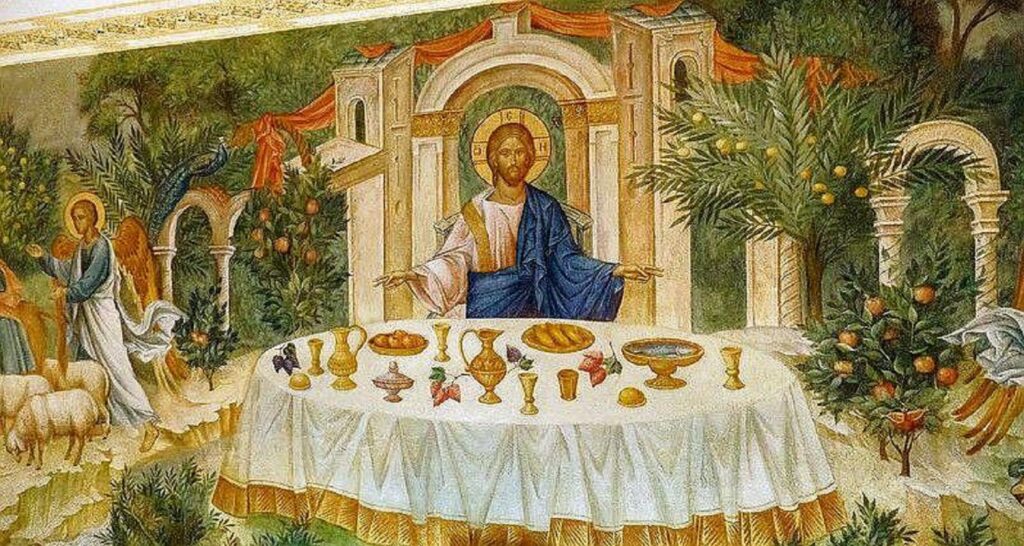
And Jesus answering, spoke again in parables to them, saying:
2 The kingdom of heaven is likened to a king, who made a marriage for his son. 3 And he sent his servants, to call them that were invited to the marriage; and they would not come. 4 Again he sent other servants, saying: Tell them that were invited, Behold, I have prepared my dinner; my calves and fatlings are killed, and all things are ready: come ye to the marriage. 5 But they neglected, and went their own ways, one to his farm, and another to his merchandise. 6 And the rest laid hands on his servants, and having treated them contumeliously, put them to death. 7 But when the king had heard of it, he was angry, and sending his armies, he destroyed those murderers, and burnt their city. 8 Then he saith to his servants: The marriage indeed is ready; but they that were invited were not worthy. 9 Go ye therefore into the highways; and as many as you shall find, call to the marriage. 10 And his servants going forth into the ways, gathered together all that they found, both bad and good: and the marriage was filled with guests. 11 And the king went in to see the guests: and he saw there a man who had not on a wedding garment. 12 And he saith to him: Friend, how camest thou in hither not having a wedding garment? But he was silent. 13 Then the king said to the waiters: Bind his hands and feet, and cast him into the exterior darkness: there shall be weeping and gnashing of teeth. 14 For many are called, but few are chosen.
This was the reading at last Sunday mass.
Whatever else it might reveal, it puts to bed the notion of many, including Bishop Barron, that there might be nobody in hell, that we can at least hope that everyone gets to heaven. Rather, “few are chosen.”
The first and most obvious puzzle: why would all the respectable people, the upstanding citizens, not want to come to the king’s feast? Why would they treat the servants who delivered the invitation badly, even put them to death?
This is the anomalous detail always needed in a parable or allegory to tell us we are not talking literally. For a literal marriage feast, this would make no sense. But if this refers to the persecution of the prophets, it fits with the marriage feast really being the kingdom of God. The prophets call us to God’s kingdom, and they are inevitably persecuted for it. Just like Dostoyevsky’s Grand Inquisitor, those in authority in this world are fundamentally opposed to anyone speaking truth directly, because it upsets the status quo, or risks upsetting the status quo, and so threatens their status. They are the status quo.
Of course, their attitude is illogical. They are refusing a feast, and ensuring their destruction. But evil is always illogical.
The second puzzle: according to the parable, “both bad and good” enter heaven. Can that be right?
But that is why we have part two of the parable, with the man not wearing a wedding garment being cast out. There is a second weeding out. Only at this point are people “chosen,” as opposed to choosing themselves whether to come. And not just this one man is rejected; “few are chosen.”
The first triage is genuinely seeking truth—these are the people who are summoned from the highways, and who answer the call. They are the honest seekers; those who refuse the call are those who do not want to hear the truth. But once hearing the truth, once in God’s presence, the obligation to do God’s will is apparent. This is the second triage: are you prepared to dress, and act, accordingly? And so at this point one can still be rejected, and many are.
Why a marriage feast? Who is getting married?
You are.
Each individual soul is getting married to God. It is a two-step process, the engagement and then the full commitment.
Delighted to discover that Daily Wire, aka “Bent Key,” has announced a live-action remake of Snow White, starring Brett Cooper. This is just so smart and funny at first I could not believe it. Best troll ever. And they released the announcement, complete with teaser trailer, on the 100th anniversary of the founding of the Disney company. It’s too good.
But it’s real.
I hear Disney is threatening to sue. They can’t. They’ll lose. Snow White is public domain. They do not own the story; they took it themselves from the Brothers Grimm. All Bent Key needs to do is make sure that Snow White’s dress is different from that in the original animated feature, and the Seven Dwarfs have different names. Everything else is from Grimm.
Brett Cooper is perfect for the role: naturally pale skinned and dark-haired. She fits the role better than Disney’s Rachel Zeigler. She is also a skilled actor. She has a big fan base from podcasting. I bet a lot of people will want to see the movie because she is in it.
People who loved the original animated feature, or the Grimm’s Fairy Tale, are angry at Disney for changing the characters and story line, for attempted indoctrination of children, and for expressing contempt for the original. Many will be desperate to pay to see the Bent Key version just to show their dssatisfaction with Disney.
Bent Key slyly refers in the trailer to the “true love” theme of the original story;
“Once upon a time, in time a prince would come
Once upon a time, but now that time is gone…”
- the “one day my prince will come.” Which Disney’s Rachel Zeigler scorned and said would not be in the Disney remake.
The teaser also opens with the sound of a cuckoo or cuckoo clock—emphasizing the tale’s German origins, deleted by Disney’s version.
So this will be the REAL Snow White—and with a lot of luck, in future Snow White may be a Bent Key, rather than a Disney, franchise in the minds of the public.
Bent Key will not have the production budget Disney has. But how important is that in this story? I see no need for special effects. Just costume and makeup. I suspect many others, like me, are tired of all the computer-generated special effects anyway. They’ll have to find seven dwarf actors; but they presumably cost no more than other actors. Scenery needed is a forest, a rustic cottage with small furniture, some scenes that look like a room in a castle; child’s play. The biggest issue I see is that they need to compete musically to become the “real” Snow White; and they do not have access to the original songs from the animation, as Disney does. They’ll have to find some first-rate songwriters.
Even if the quality is not there, it’s a brilliant troll.
Friend Xerxes, the left-wing commentator, for some reason this week hearkens back to the Satanic child abuse scares in Saskatchewan back in the eighties and nineties. And his conclusion seems to be that the fatal error that led us astray was believing in the Devil.
“Unfortunately, there’s no tab in the corner of our mental screens to ‘Hide Satan.’”
Wanting a tab on your mental browser to “hide Satan” sounds like whistling past the graveyard: “if I don’t look, he can’t see me.” Denying evil exists is not a wise strategy; but a sadly common one.
The Saskatchewan hysteria, and the paranoia all around the world for a couple of decades over imaginary child abuse cults, was founded on two gross fallacies: a belief in repressed memories, and the claim that “children never lie.” (Unfortunately echoed more recently with the mantra that “women never lie about rape.”) These two obviously false claims led people into the hysteria. I remember, circa 1984, proposing in a Banff workshop a book arguing against the idea of repressed childhood memories, and getting shock and horror from a female member of our group. Didn’t I care about child abuse? Was I such a monster?
This was also the first time I ever heard of a speaker being shouted down on a Canadian college campus: some speaker at McGill pointing out that there was no evidence for repressed memories. I would not have thought such a thing possible; now it is the norm.
People only want to shout things down when they are true: never when they are false…
But the idea of repressed memories obviously defied common sense. If something genuinely traumatic happens to us, we do not forget it. Just the reverse: the memory haunts us, and we find it hard to turn away from it.
And nobody who has been around children can honestly believe kids never make things up. Ask them who took a cookie from the cookie jar. Small children even start out having difficulty distinguishing imagination from reality.
Why did people want so badly to believe in ritual child abuse rings? So badly that they would rid themselves of basic reason to do so, and refuse to listen to argument? I suspect it was projected guilt over abortion, fully legalized at almost the same time. People needed a scapegoat, some other, so they could still think of themselves as loving and defending children despite supporting abortion.
Significantly, the pedophilia hysteria broke out at about the same time: the panic about pedophile priests, pedophilic orphanages, the idea that pedophiles once convicted must be identified to all neighbours whenever they moved, the idea that they must be either chemically or physically castrated, and can never be rehabilitated.
Of course, pedophilia is a problem; but I can recall how much more casually it was thought of and dealt with in my youth. Something had changed, and it was not the pedophilia.
So too, I suspect, how much more protective we have become of our children in general, not allowing them to do anything without supervision. Giving them “safe spaces” wherever they go, never letting them be “triggered.” It is all overcompensation for abortion. Although the moment our own interests are impacted, the kids are a ready sacrifice: get them all vaccinated, shut down the schools, although the vaccine is more dangerous to them than the virus, and the hiatus in their education is liable to harm their future. After all, otherwise they might infect adults.
The residential schools hysteria is a continuation, a culmination, of this same mass psychosis. The accusations are all the same as the Satanic cult panic: sexual abuse, torture, children being secretly buried in mass graves, and so forth. The projection is perfect: the guilt over abortion gets assigned to those who object to abortion. Most notably the Catholic Church, which ran most of the schools.
No surprise that no bodies turned up in any mass graves.
The residential schools charges rely on the same evidence as the earlier satanic cult legends: the tacit assumption that Indians, being childlike innocents, can never lie—the romantic myth of the “noble savage.” That childhood memories are reliable—memories from childhood are much of the “evidence.” And that indigenous “oral history” is reliable—in any other context, the term for this would be “urban legend.” Many of the charges can indeed be found elsewhere as urban legends.
And of course, it is about the children. That hints at its origin in guilt over abortion. Although Indian children on reserve are being driven to suicide, and young Indian women keep going missing, and we continue to allow that to happen instead of dealing with the problems of the Indian family.
Whether the Devil actually exists is not relevant here. It will not do to doubt there actually are such things as Satanic cults. That is a matter of record: the Hellfire Clubs of the 18th century, Aleister Crowley and the Golden Dawn, Anton LaVey and the Church of Satan, Gnosticism tracing back to the early centuries AD, Hindu Shakti cults, Haitian voodoo, and so on. To shift the question from the existence of child abuse to the existence of Satan is a red herring.
Of course, child abuse really does happen, more often than we want to admit. So does child sexual abuse, sadism, and pedophilia. So does evil in general. To recognize as much is not hysteria. Refusing to recognize it is hysteria. Nor is it hysteria to believe in Satan as a personal spirit, with an independent will; as have most of the greatest minds of history.
The hysteria, the paranoia, is in what we accept as evidence.
Thanks to Freud, the concept of a “subconscious mind” has seeped into our culture. People even hail it as an important scientific discovery, similar to the law of gravity or theory of evolution. But the concept is self-contradictory.
It posits a part of self that is independent of self (“ego”). It posits a part of consciousness of which we are not conscious.
These characteristics are definitive of “other.”
There is no subconscious mind.
The concept is constructed from our experience of memory. Memories emerge into consciousness from some unknown place, where they abide when we are not thinking of them.
But before Freud muddied the waters, we had Plato’s concept of the ideal forms, the Buddhist concept of a “storehouse consciousness,” Coleridge’s “primary imagination.” Put simply, an objectively existing spiritual world. And this is the only coherent explanation.
The fact that memories continue to exist whether or not we or anyone are thinking of them, identifies them as not subjective, part of ourselves, but independent objects of consciousness. This is simply true by definition. Just as the fact that the corner lamppost seems to exist whether or not we are looking at it, demonstrates that it is not a part of us and our consciousness, but an independent object.
If the memories we encounter seem by and large to be entirely personal, that does not make them a part of ourselves. Our sense experiences are also personal: we see only what is around us in space. They may be only a small part of a wider world, just as Africa exists, or Alpha Centauri, although we have never seen it.
But Freud actually finds that memories are not personal; in the house of memory, there seems to be wills operating independent of our own. The subconscious makes us think, say, even do things contrary to our will.
We always knew this too: these wills are the independent spiritual entities identified worldwide as angels, demons, fairies, gods. We know they exist on exactly the same evidence that we know other human or animal spirits exist, that the things we see are not all simply objects: because they are clearly not subject to our will, but follow their own wills.
Just to make the matter clearer, or more confusing if you hold to the Freudian formula, Jung has demonstrated that we are capable of remembering things we have never seen nor heard. Dragons, for example, unicorns, phoenixes, vampires, zombies, and so forth. These are not individual memories, and not individual “imaginings” either; for the same creatures and characters recognizably appear in myths, legends, and folk tales all around the world.
The Freudian “subconscious” is just an alibi, a spooky tale told at bedtime to frighten off further questioning, an attempt to explain away the spiritual aspect of existence, because it contradicts the materialistic dogmas of scientism. But the thesis itself violates all the basic tenets of science as well as philosophy. One of which is that one must go with the simplest explanation to account for the facts.
Which, in this case, is the existence of a spiritual dimension that exists independently of the material.
Friend Xerxes laments that the typical religious service ought to be more of a feast for the senses than it is, and especially ought to consider the sense of touch. Touch, after all, is our largest sense organ, he notes, covering our entire body.
He ought to try Catholicism. The old high mass, at least, was the original multimedia virtual reality event. The bright multicoloured light streaming through stained glass windows; the statues and paintings, the awe of the dome or arched nave; the music and the hymns, the intonations, the responsorial prayer, perhaps more purely aesthetic in their appeal when in Latin, adding the beauty of mystery; the incense, the little bells tinkling and the big bells sounding; the mighty organ swelling; and perhaps not least, everyone in their Sunday best.
Granted that taste and touch were rarely engaged directly; I think because they are the two senses most associated with physicality as opposed to spirituality, in which basic instincts are least able to be sublimated. Touch is, after all, as Xerxes notes, coextensive with the surface of the body, and taste tends to involve assimilating some physical thing. You do not see taste and touch engaged with much in art generally. And when, say, a posh restaurant makes a claim to art, it always feels like an alibi for gluttony or else a con. Never mind touch… treated “artistically” in various back alleys, or under neon lights.
But even they were there, taste and touch, by implication, in the old High Mass. As for taste, there was the fast, and then the special brunch right after mass, and that was part of the full experience. As for touch, there was the self-anointing with holy water, and sometimes a sprinkling by the priest walking up and down the aisles. And kneeling was a special touch experience one did not get outside church.
But these in particular tended to be chastisements of these two senses as much as celebrations of them. The point was to sublimate and spiritualize the senses, as art, not to indulge them.
More broadly, being a Catholic is or is supposed to be living a life as a work of art. One crafted oneself into something better; a conquest of nature by art.
There were many beautiful signposts along the way. Not just the mass on Sundays, but Christmas, and Easter, and Lent, and Mardi Gras and Ash Wednesday and (yes, it is a Catholic festival) Hallowe’en, to mark the seasons.
And then, to mark the seasons of your life, there were sacraments like First Communion. It marks the age of reason, age seven, before which a child does not understand the concept of sin, does not have a fully formed conscience, and so cannot properly receive communion. I still remember fondly the day of my First Communion; all the little girls posing on the steps of the church, wearing their white dresses and with lace doilies bobby-pinned in their hair. And me wearing real button-up trousers and a jacket and clip-on tie. It is a great event in the life of a child.
As I remember fondly those of my two children.
And I have on my desk before me the carefully preserved little Catechism my younger brother Gerry, now gone, received as a gift for his First Communion.
Such ceremonies consecrate a life to beauty: confirmation, the doorway you stride through into adulthood; the joy of matrimony; watching your children pass though these doorways in their turn; then extreme unction, and the more solemn beauty of the funeral service.
These leave all the memories that make an ordinary life meaningful. One’s memories are always of family, and one’s family memories are always of these holy events.
We are losing this; we have let it slip away. The church itself is losing this. The current mass does away with much, most, of what was most beautiful.
I agree wholeheartedly with Andrew Klavan in this interview: all Jew hatred is God hatred. Jews are hated because they represent the moral law, the demand to make something better of ourselves. Everything else is alibi.
Michael Knowles is here as the voice of Catholicism, but I strongly agree with Klavan and not him in understanding Christianity as a branch emerging from the Jewish tree, not something that supersedes Judaism. Any more than the covenant with Noah was cancelled by the covenant with Abraham, or the covenant with Abraham by the covenant with Moses. God does not renege on his promises. This point is made repeatedly in the New Testament.
“Do not think that I have come to abolish the Law or the Prophets; I have not come to abolish them but to fulfill them. For truly I tell you, until heaven and earth disappear, not the smallest letter, not the least stroke of a pen, will by any means disappear from the Law until everything is accomplished.”
Klavan also points out that Israelis are not colonizers. This is another example of the attempted mind control through the illegitimate use of language I posted about yesterday. A colony by definition lacks self-government, and is controlled by some parent state. Israel has no parent state.
Should pro-Hamas, anti-Israel protests be made illegal in Canada, as in France? Technically, they already are illegal, because they violate the “Hate Laws.” But inevitably, such laws are always used selectively, to suppress groups out of favour. They are of no help in the face of real hate.
I understand why such demonstrations make Jewish Canadians feel unsafe. I still oppose banning them; this is where free speech is put to the test. Were I a Jew, I would feel safer knowing where the threat is coming from. The Devil’s favourite con is convincing us he does not exist: then he gets to act with impunity.
Should the US bomb Iran over this? As things stand, the average Iranian is pro-American. Getting bombed would rally many behind the corrupt and hated government. And taking out Iran’s oil facilities is not a great idea either. We’re already boycotting Russian oil, and refusing to allow fracking and pipelines at home. Why not just bomb Washington and London and get it over with?
Should Israel, as is being suggested in some quarters, just expel everyone from Gaza? Not possible. No Arab country will take them in, because that would be abetting Israel’s ethnic cleansing. No Western democracy should, because that would mean endangering their existing Jewish population.
The IDF can huff and puff, but there is no military solution here. I think of this passage from Heart of Darkness:
In the empty immensity of earth, sky, and water, there she was, incomprehensible, firing into a continent. Pop, would go one of the six-inch guns; a small flame would dart and vanish, a little white smoke would disappear, a tiny projectile would give a feeble screech—and nothing happened. Nothing could happen. There was a touch of insanity in the proceeding, a sense of lugubrious drollery in the sight; and it was not dissipated by somebody on board assuring me earnestly there was a camp of natives—he called them enemies!—hidden out of sight somewhere.
You cannot subdue a hostile population with weapons, if they are not prepared to accept defeat.
You must all henceforth refer to me in the plural, and as the Queen of Portugal
Disturbingly, I recently had to fill out a form that had a field for my preferred pronouns”—and it was a required field. One more in an ever-growing list of restrictions on freedom of speech and freedom of thought. Now nobody is allowed to hold the self-evidently true position that pronouns are an element of English grammar, not subject to personal choice. Any more than you can just decide to require others to stop using the terminal “s” on verbs in the simple present, third person singular. And everyone else must fall in line.
This is sometimes claimed to be simply a matter of being polite, or of considering the feeling of the person referred to. But the pronouns required are always in the third person. The person spoken of is normatively not present; otherwise you would address them directly. So this cannot apply. The point is purely power and control.
There are too many other multiplying examples of enforced speech used to control thought: all the invented “phobia” terms, used to preemptively imply that anyone who raises an objection to homosexuality, Islam, transvestitism, or whatever, is irrational, if not insane. The terms “native,” “aboriginal” or “indigenous” applied to North American Indians and other cultures: no people on Earth is aboriginal or indigenous, so far as we can tell. And all of use are native to the land where we were born. “First Nations,” similarly, requires us to pretend that some band of a couple of thousand people is a “nation.” It violates the dictionary and the anthropological definition. The proper term for what we are referring to here is actually “primitive”; or “tribal,” or “Stone Age.”
A similar case of mind control is the use of the word “gender” beyond the field of grammar and not as a mere synonym for sex. There is no such thing as gender distinct from these two uses; the word is invented and enforced to force us all to think or pretend there is. Similarly, we are forced to call men women and women men, on command.
And that is the key element of all these restrictions: the thing we are forced to say and to aver is always something obviously false. The truth does not need to be imposed; only lies do.
Which is one reason why we must recover freedom of speech.
I have a lot of Jewish friends. I also have a lot of Muslim friends. The horrors Israeli Jews have suffered in the last few days depress me beyond measure.
Putting aside anger, and even right and wrong, how do we ever end this? It has been going on since 1948. No matter what Israel does, the Palestinian Arabs and many Muslim powers surrounding Israel will not be reconciled to its existence. The transplant has failed.
The supposed reason for Israel was so that the Jews could avoid pogrom and persecution; at last they could escape historic European persecution and defend themselves. But this has turned out to be a false hope. The last few days have been as bad as any old Russian pogrom.
Israel is a relatively small number of people on a small patch of land surrounded by a vastly larger number of hostile neighbours. Who are gradually developing technologically. For sheerly demographic reasons, sooner or later, Israel is going down, going down in blood, and in the meantime there will be massacre after massacre after massacre of the Jews.
Israel is a mistake.
In the Torah, the Jews are called to be a leaven and a light unto the nations. It seems obvious this was God’s desire. The return to Jerusalem and the rebuilding of the temple is supposed to happen only in the last days. To have tried to force the issue as a purely secular matter seems presumptuous. Presumptuous as the Tower of Babel.
Of course, the recreation of Israel was also never fair to the Arabs. Why was it up to them to surrender some land? Why did they have to yield sovereignty to the Jews, and not, say, Germany or Russia or Poland, whose borders were fungible in 1948? Why not the US, Canada, or Australia, with large sparsely populated areas?
To be a light or leaven unto the nations, the Jews must disperse to all lands; as the leaven must be worked though the bread, and the light must not be hidden in a bushel. Any land not of idiots ought to be desperate to have them. There is a world depopulation crisis; developed countries calculate that they need immigrants in larger numbers. Why not this group of naturally adaptable, mobile immigrants, who contribute more to the culture wherever they go than any other group ever?
Consider English Canadian culture without Leonard Cohen, Irving Layton, A.M. Klein, Ed and David Mirvish, Wayne and Schuster, Sharon, Lois, and Bram, William Shatner, Jack Granatstein, Frank Gehry, Moshe Safdie, Avie Bennett, Mordecai Richler, the Bronfmans, Mel Hurtig, Jonathan and Barbara Kay, Ezra Levant, Moses Znaimer, Heather Reisman, Eugene Levy, Howie Mandel, Rick Moranis, Robbie Robertson … there would be nothing. That’s what leaven is like.
The best thing Canada could do in the current crisis is to open unrestricted immediate citizenship to any Jew coming from Israel. Best for the Jews, who would surely face less persecution in Canada than in the Middle East. What the Arabs would prefer, not want to live with the Jews. Best for Canada. Best for the world. God’s stated desire.
Hear ye another parable. There was a man, a householder, who planted a vineyard, and made a hedge round about it, and dug in it a press, and built a tower, and let it out to husbandmen; and went into a strange country. 34 And when the time of the fruits drew nigh, he sent his servants to the husbandmen that they might receive the fruits thereof. 35 And the husbandmen laying hands on his servants, beat one, and killed another, and stoned another. 36 Again he sent other servants more than the former; and they did to them in like manner. 37 And last of all he sent to them his son, saying: They will reverence my son. 38 But the husbandmen seeing the son, said among themselves: This is the heir: come, let us kill him, and we shall have his inheritance. 39 And taking him, they cast him forth out of the vineyard, and killed him. 40 When therefore the lord of the vineyard shall come, what will he do to those husbandmen? 41 They say to him: He will bring those evil men to an evil end; and will let out his vineyard to other husbandmen, that shall render him the fruit in due season. 42 Jesus saith to them: Have you never read in the Scriptures: The stone which the builders rejected, the same is become the head of the corner? By the Lord this has been done; and it is wonderful in our eyes. 43 Therefore I say to you, that the kingdom of God shall be taken from you, and shall be given to a nation yielding the fruits thereof.
This passage, the gospel reading at last Sunday’s mass, is commonly taken to mean the the covenant with the Jews has been replaced by the Christian covenant; that Jesus is rejecting Judaism. Last Sunday’s sermons might have suggested as much.
I don’t think this is a plausible reading. To begin with, Jesus quotes several lines from Psalm 118:
“The stone the builders rejected has become the cornerstone; the LORD has done this, and it is marvelous in our sight.”
It therefore seems significant that this Psalm begins with
“Give thanks to the Lord, for he is good; his love endures forever. 2 Let Israel say: ‘His love endures forever.’ 3 Let the house of Aaron say: ‘His love endures forever.’ 4 Let those who fear the Lord say: ‘His love endures forever.‘”
A repeated promise that God will never abandon the Jews—or the priests, the house of Aaron.
Moreover, it follows that, if the stone that the builders rejected has become the corner stone, the temple and the builders of the temple—the Jews—must still be in the picture. It must be them raising the stone to its position.
Moreover, Jesus is, after all, quoting from the Hebrew scriptures as authoritative.
Accordingly, it is only those, gentile or Jew, who reject and do not repent of their rejection of this stone who shall lose the kingdom of heaven:
“Anyone who falls on this stone will be broken to pieces; anyone on whom it falls will be crushed.”
Anyone.
What is the stone? Not Jesus. For in the parable, the rejection is not only of the son of the vineyard owner, but also of the servants and messengers—the prophets. All prophets.
The stone might better represent the stone tablets of Moses on which the law was inscribed. It is the law and lawfulness, divine justice, that is rejected.
Those who will lose the kingdom of heaven are any, Jew, Christian, Muslim, or none of the above, who reject God’s rightful dues, however he sends for it: through Moses, through the Hebrew prophets, through the prophet Muhammed, through Krishna, or through the gospel and the Christ.
I have long been intrigued by the strange attractiveness of the zombie meme—to me as much as anyone. It seems clear to me that it must reflect a common life experience. Indeed, I have long been aware that it reflects my own. Many people these days seem zombies, NPCs.
More recently, I have seen it confirmed that zombies have always been with us. They are in the Bible.
Matthew 8: 21-22
Another disciple said to him, “Lord, first let me go and bury my father.” But Jesus told him, “Follow me, and let the dead bury their own dead.”
Most people, the gospel is saying, are zombies. They move about, they die again in some sense, so as to occupy graves, but they are actually dead; dead in spirit, dead within.
And that to me seems exactly right. Many people seem to live lives no more significant than those of cockroaches: taking advantage of whatever the day offers, grabbing whatever is within reach, eating, mating, dying. They operate on instinct; the instinct for sex, the drive for power, or money, or prestige. All of which counts for nothing once you’re dead, and does nothing for future generations. They drink alcohol or take other drugs or seek purely escapist entertainment to dull whatever higher faculties they have. And then they die, and their life never mattered. Maybe to a small circle of friends and relatives; but then, if these friends and relatives in turn are doing nothing but operate on instinct, that only delays oblivion and meaninglessness for another generation or so.
This seems actually more true of highly “successful” people in most walks of life than of anyone else. They have generally wasted more, wasted more God-given potential, if they have accomplished nothing of eternal significance. It was my overwhelming sense at the death of Ruth Bader Ginsberg: that it was a wasted life.
So what’s the alternative?
According to this brief passage in the gospel, the alternative is to follow Jesus, and with full commitment—to drop everything else.
What does it mean to follow Jesus?
It is not enough to mouth the name. “Not everyone who says to Me, ‘Lord, Lord,’ shall enter the kingdom of heaven, but he who does the will of My Father in heaven.”
It is not enough just to be baptized. One has to be born again: “Very truly I tell you, no one can enter the kingdom of God unless they are born of water and the Spirit.”
Baptism is the water. But as the child is not yet fully self-aware, the rebirth of the spirit cannot yet occur. That must wait until past the age of reason.
This is the significance of the sacrament of confirmation in the Catholic tradition; in evangelical Protestantism, it is the experience they call “being born again.” But it does not happen automatically when the bishop anoints you with oil and slaps your cheek: the spirit, the will, must be engaged.
It is a moral commitment each of us makes, usually in early or mid-adolescence, of our lives either to gross self-interest or to the truth and the good as we perceive it. Christians call the truth and the good “Jesus.”
“I am the way, the truth, and the light. No one comes to the father except through me.”
Either one serves one’s instincts to sex, power, and prestige, or one serves truth, justice, and beauty. This is as true for pagans as for Christians; it has always and everywhere been true. But there is a second step for Christians: it is not just a commitment to truth in the abstract. That is not yet enough. We must see truth in personal terms, as a person and an independent will, and have a personal relationship with it—with him. Because, as Blake explained, no human can conceive of anything greater than a perfected human. Therefore, so long as our conception of truth, beauty, and justice does not have a personality and a human face, we do not sufficiently value or understand it. It remains, to us, mere abstraction, and subject to self-interested rationalization.
We must, in a sentence, love it: with our whole heart and mind. Blake again:
“Picture a cloud as holy: one cannot love it. But picture a holy man within the cloud: love springs up.”
We must have a personal relationship with Truth and Justice and Beauty, we must love him with an all-consuming love. We must speak to him as a person, at our rising and our lying down, with gratitude when our instincts are satisfied, and at random moments during the day. As we might text a lover.
Is it a terrible burden to do so?
Is it a terrible burden to be in love? In a sense, it is; yet we all crave it.
What proportion of mankind does this? What proportion has ever done this? It is surely a minority. Perhaps a small minority.
A special grace: the choir at church today--a new and wonderful choir--sang my favourite prayer, one I pray every day, and sang it in Latin: the Salve Regina. No trite mock folk music by the St. Louis Jesuits dripping Hallmark sentiments here.
Salve, Regina, mater misericordiae; vita, dulcedo et spes nostra, salve.
Responding in Toronto to a man who refuses to shake his hand, Trudeau looks like he has seen a ghost.
Justin Trudeau and his Liberal government seem to be committing suicide.
The Atlantic provinces were a stronghold for them; now they are losing it by pushing forward with their carbon taxes.
Muslim Canadians were supposed to be their client group, a reliable constituency; recently, Trudeau branded Muslim parents “hateful,” and refused to apologize when the largest Muslim body in Canada asked for one.
A few weeks ago, the Prime Minister picked a senseless public fight with India. This might play well with Sikhs in Canada, or those of them who are anti-India; but surely risks losing support among the 66% of Indo-Canadians from India who are not Sikhs.
Last week, or the week before, the House of Commons entertained a Nazi. At a minimum, Trudeau’s government did not vet him, despite the obvious questions raised by someone who fought against Russia in the Second World War—and this turns Trudeau’s favorite attack on any and all opponents, that they are “Nazi sympathizers,” against him. He probably dares never use it again. The necessary level of incompetence here seems so high, the alternate explanation seems more plausible: a death wish.
And a death wish is plausible. We all have one. When our conscience tells us we are doing harm, not good, or have worn out our welcome in this world, it begins to nag at us. Not necessarily that we go and commit suicide; but our system mysteriously shuts down, and we die of one thing or another. Unless, that is, we seek and find redemption.
Serial killers almost always take greater and greater unnecessary risks until caught. As one famously marked in lipstick on his victim’s mirror: “For God’s sake stop me, before I kill again.” Similarly, regimes that no longer feel they are legitimate begin to act recklessly—as if to see how much they can get away with.
Like picking fights with the voters. How much will they take, the peasants! Let them cancel Disney Plus! Like trimming your toenails or reading a newspaper during parliamentary debate.
The legacy media as a whole also seems to have a death wish. Faced with growing competition due to technology, they have dropped all journalistic standards, anything that might give them a claim to being a superior source, and begun to report only what they feel like. Disney Corporation seems to have developed a death wish. Everything they invest in any longer seems to go directly against their financial interests. Bud Light did: directly insulting their customers, and not backing down. The LA Dodgers did, honouring an anti-Catholic hate group in front of their Hispanic Catholic local community. The LGBTQ et al movement, the trans movement has; “We’re coming for your children.” Probably no further comment necessary. Pope Francis seems to have such a death wish, becoming increasingly open and reckless; as well as a desire to kill off the Catholic Church.
It resembles those times and days when people believed, for one superstitious reason or another, that the end of the world was at hand. A large proportion of them would then just drop everything, any pretense of morality, let the cattle stray, and begin fornicating on the hilltops. Eat, drink, and be merry, for tomorrow we die.





 Posts