Playing the Indian Card

Showing posts with label progress. Show all posts

Friday, October 20, 2023

The Ghost of Future's Past


Had occasion in the course of my teaching to watch a video of the Futurama ride at the GM pavilion, New York Worlds’ Fair, 1964-5. I was there at the time, in 64; I remembered some of it. But this time I was struck by how our attitude towards the future then was so different from today. GM was confident the future would be abundant, thanks to improvements in technology. Progress marches on! Roads through the tropical jungles, bringing goods to market! Submersibles reaping the limitless harvest of the seas! Vast cities of light.

Nowadays, rather than celebrate technology, we fear it as the enemy. Even though technology has indeed brought us many marvels since 1964: the Internet, the smart phone, longer lifespans, abundance of food from the green revolution. So why did we sour on it?

Granted, the GM exhibit might not have been fully representative of all the voices of 1964. Or rather, 1962 or so, when the exhibit was presumably designed. This was big business talking. But the ride was highly popular during the fair, a reprise of one of the most popular pavilions of the 1939 Fair, and did not get any pushback at the time for overplaying the wonders of technology. It seemed to express the broad consensus. Science conquers all.

I have long thought that western civ lost its nerve in the carnage of the First World War. I think of Eliot’s “The Waste-Land” emerging at about that time. Or W.B. Yeats’s discovery that “We are but weasels fighting in a hole.” 

But watching this video, I had another thought. It seems to be our view of technology in particular that has changed. This seems to be the pivot. 

Perhaps the underlying cause, even the cause of WWI in the first place, is what Alvin Toffler called future shock. Since about the second half of the 19th century, and especially with the personal computer revolution beginning circa 1980, things have been changing rapidly due to technology. In effect, none of us lives any longer in the land or in the culture we were born into. This can cause, and perhaps has caused, a general trauma, a sense that we are losing control of our lives. “Stop the world; I want to get off!” Perhaps this is seen in Kipling’s 1897 lines:

For heathen heart that puts her trust

In reeking tube and iron shard


Already, to him, technology is the enemy.

Toffler’s “future shock” is based on the known phenomenon of culture shock.

I know a little bit about culture shock. Alarmingly, governments and medical establishments seem not to. I have lived through culture shock more than once. It is no trivial thing. 

For the first little while in a radically new culture, say the first three months, you are on vacation. Everything is new and wonderful. What you feel the most is that all the old constraints of daily life back home are gone. All the weary chains of habit and social convention that we secretly resent are gone, and we want to run naked in the woods. We want to hook up. First of all, nobody knows you, so you need not worry about your reputation. Screw up, and you just take the plane home. And the first impression when faced with new rules is that there are no rules. You can go ahead and just do as you want; as you always wanted.

This crazy optimism somewhat describes, in cultural terms, the Fin de Siecle, the Edwardian period, the period just preceding the First World War. The automobile, the airplane, the moving picture, the phonograph, were rapidly transforming individual lives. In politics, “progressivism” was born: the application of science and technology to society would solve everything.

For another good representation of this state, see Margaret Meade’s “Coming of Age in Samoa.” Any old foreign hand should have seen she was in the first stage of culture shock. But for decades, it was taken as solid anthropological work. Yeah, everyone In Samoa just had sex whenever they wanted. None of our Western hangups.

This is also why “exotic dancer” is a synonym for “erotic dancer”: the nearest foreign country is usually imagined to allow free love. Absurdly, this was the reputation of the Muslim Middle East in the Victorian Era. Those guys with the women in abayas. Even in my youth, the most famous stripper in Montreal went by the name “Fawzia Amir.” 

Ironically, the same culture shock leads young Muslim men coming to northern Europe to think it is okay to rape young local women. After all, here in the “Wicked West,” anything goes.

In England, syphilis was long known euphemistically as the “French pox.” In France, it was called “the English malady.”

And so it goes, as Billy Pilgrim would say.

An expat can get themself in a lot of trouble during this stage. 

Now imagine a government that welcomes large numbers all at once from a quite different culture. What do you think might happen? But I digress….

But the next stage is worse. After about three months, in the usual course of expat life, you come to the impression that the rules no longer apply both ways. These foreigners have no morals; and they are insane. Nothing here makes sense. And this is not a vacation; you realize you cannot go home again. You are stuck here.

At this point, a large proportion of expats sink into a state of depression, and never recover. They cannot bear to go out in the street. They want to stay in their apartment, the only place they feel safe. Or they begin to haunt the expat bars, where they sit there all evening getting drunk and complaining to other drunken expats about this godforsaken hellhole. Every foreign station has such an expat bar. 

A college I worked in, transported virtually wholesale from Canada, after a few months redesigned the “learning centre” to look like Fort Apache, with the foreign teachers on raised platforms behind high counters. This was all psychological; there was no threat of violence or threat on campus. It was soon all “us” and “them.”

And this may explain the First World War, and the Second. They were nativist outbreaks, nationalist outbreaks of paranoia at how their distinctive culture was threatened by this rapid change.

Similarly, Darwin chronicled in “The Descent of Man” how, whenever European adventurers encountered some primitive people, the primitives seemed to stop working and reproducing. They started to drink heavily, and their numbers rapidly declined. Everyone was experiencing culture shock at once’ everyone was depressed. And for groups like the Canadian “First Nations” or the Australian aborigines, this state of culture shock and depression has continued to this day, for centuries. One might suggest that the same culture shock lingers among American blacks, their ancestors suddenly uprooted from tribal cultures in Africa. That’s how severe culture shock can be, if the cultures are sufficiently different.

Now imagine again what might happen if you rapidly introduce into your country large groups of people from a widely different culture.

A not insignificant proportion of expats undergoing culture shock have a psychotic break. When nothing around you makes sense anymore, almost anything you imagine might seem true. I have experienced this myself briefly once or twice. In some it seems to be more serious, and last longer. And some may act out their fantasies in dangerous ways. There are stories in every expat enclave of how old Tom or Bertha went off, and did something like take all their clothes off in front of the class. Or decide that their daughter was the current incarnation of a Bodhisattva.

And this is what we may be seeing now throughout Western society. Nobody can count on the old verities any more: marriage, children, the female role, the male role; even the accepted meaning of words; even the meaning of such words as pronouns. A growing proportion of us get depressed and want to retreat to some “safe space,” or start acting in destructive ways,  becoming violent; treating neighbours as deadly enemies. A certain proportion take to alcohol and drugs. Others, in fear , retreat to group think, become NPCs, increasingly afraid of any new ideas. A certain proportion imagines that now everything is permitted, “conventional morality” no longer applies, and they can do whatever they want. And almost all of us now sit around complaining about technology and imagine it is destroying the world. It’s causing pollution! It’s using up all available resources, and soon we will starve in the dark! It’s causing climate change! Climate change will soon kill us all!

Rather than being able to manage matters and reassure, those in charge are the most fully culture shocked and hysterical. They are most threatened by the earth moving unpredictably beneath them. Their status depends on the status quo. This explains why governments and big corporations are rapidly getting oppressive and controlling: wanting censorship, wanting to arrest development with more and more regulation, imagining bogeys under every bed.

How do we escape this? Faith.


Friday, September 13, 2019

An Early Thanksgiving


Irish ancestors, 180 years ago--the 1840s.

I have recently been despairing about the lack of truth in the world today. But that is not the whole story, and I ought to acknowledge this. Thanksgiving is almost here. It is worth remembering that a lot of things have gotten better in the world. I should be grateful.

When I was young, Ireland was dirt poor. Ireland had always been dirt poor. All of Southern Europe was poor. Even Scandinavia was poor. Mass starvation was more or less normal in India, Africa, or China. We were told the world was running out of food. It was only going to get worse.

Famines are now increasingly rare, the side-effects of war: there has been a “green revolution.” India has been exporting food for some time; that would have been unthinkable not long ago. Ditto China, Thailand. The possibilities of GMO suggest greater abundance still is coming. Returning to Toronto after 25 years, it seems to me that, while the prices of some things have risen astronomically, the cost of food is not that different. We are evidently getting more efficient at agriculture, even in the developed world.

When I was young, a third of the world, by conventional reckoning, was behind the “iron curtain,” unfree, and a civilization-ending nuclear war seemed possible at any moment. Families built bomb shelters in their back yards. I remember the air raid system being tested in Montreal. That entire complex of concerns evaporated in about 1990, as though it had all been a dream—something almost nobody had imagined to be possible a few years earlier. Poland, Latvia, Bulgaria—all members of NATO and the EU.

Aside from the Communist world, when I was young, democracy was rare. Even in Europe, Spain, Portugal, and Greece were run by dictators. So was most of Latin America, and East Asia. Now most of these countries are functioning democracies, and the freedom tide seems to keep rising. We more or less assume now that it must eventually triumph everywhere.

Even a decade ago, we were supposed to be rapidly running out of oil. After which all the lights would go out. Tankerloads of cash were being floated annually from the West to dubious governments and unproductive economies mostly in the Middle East, much of it probably funding terrorism. And the Middle East was not a promising place to which to mortgage our future.

Now the US is the world’s largest oil exporter. Followed by Canada, with the fracking revolution barely begun elsewhere.

A lot of strategic headaches are therefore gone. If Iran were now to try to close the Straits of Hormuz, the old fear, the main loser would be Iran. Anti-American Venezuela is in economic freefall. Putin cannot count on the cash to fund his military adventurism to continue.

I remember back during the Iranian Revolution and the hostage crisis, Red Buttons did an over-the-top patriotic turn on American TV insisting that good old American ingenuity would someday solve the oil crisis. It looked then like vapid jingoism, wince-worthy; and it turned out to be exactly right.

In real terms, we are all clearly growing wealthier. Aside from food, I note that the price of cheap manufactured items, those little things you need around the house, is lower. I do not need to count the cost as my parents did before buying a new toaster. Improved technology, improved transportation, globalization—a lot of things are now made more cheaply in China, or India, or Southeast Asia.

Riding the bus today—and may I say, buses and streetcars are much more comfortable than they were in my childhood—I overheard a kid talking about her school’s recent trip to Costa Rica.

Costa Rica? When we had school trips, it was Ottawa or Quebec City. My grandparents’ idea of a big vacation was to get in the car and drive. Maybe as far as Virginia. If you ever made it across the ocean, you had made it, full stop.

In terms of entertainment and far more, the internet has improved our lives incalculably. They had radio and cinema and a phonograph, later black and white TV. With three channels to choose from. Now, whenever I need to know anything, instead of rummaging through libraries, perhaps even having to take an advanced degree, I can Google it up instantly. More often than not, I can even watch an instructional video—all free. It blew my mind the first time I was able to send an email to someone in Tokyo. Now I can move anywhere and remain in instant contact with friends everywhere. I can read or watch the news from any given city, generally free. I can also publish directly anything I choose to, in print or image or video, free. If anything happened anywhere, now, someone has a cell phone and is recording it, and it is quickly up online.

My kids cannot get interested in any toys or games or sports equipment we buy them; they sit in an unused pile, and we have learned to stop adding items. There is too much entertainment of all kinds on the Internet, free. We complain about their lack of activity, but really, the bottom line is that they have infinitely more options than we did. We were often bored. And beyond an internet connection, all this is equally available to poor kids.

The internet is also rapidly reducing the cost of many services; replacing older, more complicated systems. Uber makes transportation cheaper; AirBnB makes staying overnight in some new city cheaper. It has become dead easy and convenient to find a dentist. We probably no longer need such middlemen as real estate agents.

And smart phones. We forget how recently they arrived in our lives. Over just the last few years, smart phones have put all the world in our pockets, available at all times. Consider only the increased safety: lost? GPS. Fallen on a mountain hike in the wild and broken a leg? Call home; call emergency. Calculator, map, flashlight, translator, camera, video camera, always in your pocket. In China, you can make payments with your phone. In North America, debit cards serve pretty well; it was not long ago that I had to go to the bank weekly, stand in line, and withdraw the amount I thought I would need for the next seven days. While everyone else in town was doing the same.

And tablets. I did not at first see the point. Steve Jobs did. Tablets have vastly improved my own life. My daughter came to refer to my first ebook reader, which first allowed me to devour print from the net offline, as “Daddy’s toy.” Big enough to read on, small enough to curl up with, I am inseparable now from one tablet or another. So are the wife and kids.

When I was a kid, we still had the March of Dimes and Easter Seals, fighting for a cure for tuberculosis and polio. We kids all suffered through measles red and German, mumps, chicken pox, whooping cough, maybe three or four less common afflictions. My kids never had to bear any of that.

It is rather common suddenly for people to live into their nineties. We never expected this: seventy was a good run. My grandfather died at 61. And it may be uncool to mention it, but is how much better have some retirements become since Viagra appeared? It seems still only a few years ago. Nobody expected that one. In the nineties, everyone was terrified of AIDS: a rapidly growing plague, and a death sentence. Now we hardly hear of AIDS any longer; instead, of people “living with HIV.”

Despite the voices of doom that we always hear, and that we have always heard, the truth is that in material terms and in terms of comfort, life has been getting better and better for more and more people since the awful disruptions of the earlier 20th century. Which were themselves it seems only a temporary detour on a longer path of human progress that most of us used to believe in, and probably ought to again.

The downside, however, I think, is that as life gets easier and more comfortable, we all tend to forget the spiritual values. And in the end, we need them more than any material things. And suffer more from their lack.

Lord God of hosts, be with us yet--
Lest we forget. Lest we forget.

Monday, October 06, 2014

Progressivism


One of the strongest myths of our times is the “Whig view of history.” Unconsciously, it seems to have been generally accepted on both the left and the right. In brief, at least as I would describe it, this is a general understanding that it is possible to foresee the political future, that one side in the current debate is for the future, and the other is for the past; and that the left is the party of the future. Hence those on the left commonly call themselves “progressives,” while William F. Buckley Jr. Once said that his stance was “standing athwart history, yelling 'stop.'”

It is not the same thing as believing in human progress. It is believing that human progress is predictable and moves in a straight line, corresponding to a particular political programme.

It might be convenient if this were true, at least for opportunists. For they could then simply ally themselves with the left, and expect to always eventually come out on top. Indeed, this may explain why many people support the left.

But it is obviously silly. No one can really foresee the future, and human beings are far too complex to be predictable in what they are going to think in twenty or fifty years. Or rather, they are going to be no less complex than the mind trying to figure this out.

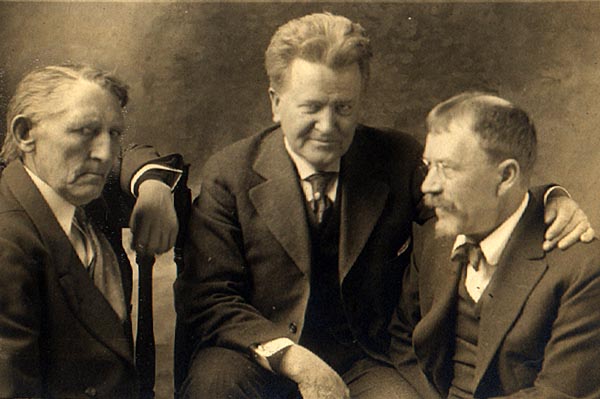
Left to right: Labour leader Andrew Furuseth, Seantor Robert LaFollette, Lincoln Steffens.

In the real world, it would be easy to enumerate many visions of the political future, “progressive” causes, that have turned out to be dead ends. One thinks immediately of Lincoln Steffens's comment on visiting the Soviet Union in 1919: “I have seen the future, and it works.” Even as late as the 1970s, most Western intellectuals were talking of the inevitability of “convergence,” of the West becoming more like the Communist Bloc as well as the reverse—if not of the inevitability of the Communist Bloc taking over. That future, or those futures, are now ashes.

So is the future of the 1980s in which Japan was to dominate world commerce. 

Boccioni, "Unique Forms of Continuity in Space": probably the best-known example of Futurist sculpture.


Fascism, too, was, in its day, the way of the future. It was the political application of the latest scientific insights, those of Darwin and of Einstein. The aesthetic movement associated with Fascism called itself “futurism.” Nevertheless, a recent piece in Time magazine had so completely bought the Whig view that it actually defined Fascism as “the rejection of modernity.” One ought to be able to expect better of an organ like Time, but that's how pervasive the myth is.

There's more—lots more. Nothing was a more progressive idea at the turn of the 20th century than good old prohibition. It was during Woodrow Wilson's “progressive” administration that the worst of Jim Crow was enacted in the US South. Most “progressives” up to the Second World War were also active advocates of eugenics, until Hitler so thoroughly urinated in that pool.

In the Victorian period, cultural and moral progress was generally measured by the modesty of women: early missionaries to Korea considered that country relatively advanced because their women did not go abroad during the day. Indeed, one of the great accomplishments of Victorian progressivism was legislation limiting the work of women outside the home.

Stepping back a little further in time, England's “Glorious Revolution” of 1688 established the supremacy of parliament over the crown, produced the English Bill of Rights, and led directly to the American and French Revolutions and to much of what we now call liberal democracy and the doctrine of human rights. All “progressive” causes of the time, and still considered core “progressive” values today. But the immediate cause of the Glorious Revolution was the desire to prevent a Catholic from taking the throne. Anti-Catholicism and the open repression of Catholics was an essential element of “progressive” thinking in both England and the US for perhaps two hundred years. There was certainly no concept that any of these rights were to extend to non-Protestants—as there was no concept later that they should extend to Africans. The whole original idea of the “right to bear arms” was in order to protect oneself from Catholics out in the boondocks of Ireland.

I'd guess that the left is right about the future about fifty percent of the time, and the right gets it right the other fifty percent of the time.

But that should be irrelevant in any case, unless you are an opportunist. One's politics should be formed on principle, not as if a bet.

Wednesday, April 03, 2013

My New Theory of History and Everything


Cantino Planisphere, 1502 - What the Portuguese knew as of that date.
When adventurers heading to the gold fields during the Yukon gold rush wintered in Athabasca, Alberta, their camp was commonly known as “the Bohemian camp.”

This says something, I think, about the type of people who were drawn west. Robert W. Service spoke of “the men who don’t fit in”--men discontented with life in general, but in particular with social life. They seek freedom, not in the purely political, but in a deep, existential sense. These were not immoral men, mind; those came later. As Bob Dylan once said, “to live outside the law, you must be honest.” There is no profit in robbery until those around you have established themselves in some way. It is when the scoundrels arrive, in the second or third wave of immigration, that government and law and regulation become necessary. The first men off the wagons are, on the whole, unusually intelligent, brave, inventive, curious men.


Bohemian Camp, Bennett Lake, 1898

The reason for this is that the world is tailored, inevitably, to the average man. Not only in a democracy, but anywhere, regulations are mostly made by average men—because, on average, it will always be an average man in charge. This is no different in the universities, or in the professions, than anywhere else; although there are exceptions elsewhere. By their nature, as well, any regulations eliminate not just the substandard, but just as automatically anything very superior to the standard.

As a result, settled life in an established society is more or less constant torture for the highly intelligent. They will always be in the wrong. And, unlike the stupid or lazy, they can never “learn better.”

And so a prime need of the highly intelligent in order to survive, let alone thrive, is to escape in some way from social constraints.

One measure of this need of the highly intelligent is the fact that the greatest writers, artists, philosophers, or scientists commonly choose exile from their homeland. Li Bai; Picasso; Einstein; Joyce; Descartes; Columbus; Voltaire; Yeats; Rumi; Kubrick; Hitchcock; Hemingway; Hesse; Dante; Da Vinci; Aristotle; Plato; Leibniz; Berkeley … it is the usual and expected thing. Other geniuses have accomplished about the same by dropping out of society in place for a reclusive existence: Mendel, Newton, Salinger, Darwin, Kant, Aquinas, St. John of the Cross.

But having a new wilderness to go to is even better, especially for the brilliant who are not either well –educated or born well-off. The ability of America, if only through geography, to offer a free frontier beyond the reach of law for generations was a profoundly important thing. It preserved the most intelligent and adventurous in the population, their creations, and their posterity. Elsewhere, they would have been “mute, inglorious Miltons,” beaten down and then forgotten. In the US, they had the option to move on, and experiment, and if necessary move on again.


New Harmony, Indiana, as proposed, 1838

Reading recently about the “Burnt-Over District” of Western New York, it is striking how much it resembles an earlier version of California. Buffalo and the Erie shore was really the original “West Coast” of America, full like California of crazy new ideas and social experiments like Mormonism, Spiritism, Shakerism, or the Oneida Community. This was the result of the Erie Canal opening up Western New York in the early 19th century to settlement by the most adventurous dreamers living on the Atlantic littoral at the time, with the promise of the vast northwest territories beyond if things did not work out.

In the next generations, the Bohemians headed for the Midwest, the Great Plains, the Great Basin and the Pacific Coast, each time bringing a taste for freedom, a creative ferment and a tendency to try crazy new things. You can track the same path for American folk culture: the Appalachians, the myths, legends, songs, and poetry of the cowboy; Mark Twain’s writing; jazz and blues and gospel along the Mississippi; Zane Grey, Jack London, John Steinbeck, Upton Sinclair, Sinclair Lewis; essentially, America.

To a significant extent, the same thing was also happening in America’s cities on the East Coast. New waves of adventurous and intelligent and creative malcontents were arriving in from Europe each generation, and causing their own famous ferment. But I suspect on balance we overestimate the value of the latter, and underestimate the former. Firstly, up until the 20th century, it was the former, the opening of new lands westwards, that made the latter possible. Secondly, there is a difference between emigrating to another, established society, and emigrating beyond the reach of civilization itself. The latter, obviously, gives more room for raw freedom and experimentation.


We have recently, I think, been predisposed to overestimate the value of cultural mixing; that is the whole idea of "multiculturalism," and fits well with the fall of Constantinople as the origin of the Renaissance. But it may be that escape from one's home culture is the greater inspiration. After all, most of the famous exiled writers we mentioned did not as a result add a major part of their new host culture into their work. Joyce and Yeats are not remarkable for any great injection of French culture into Irish letters. Some assume elements of the new host culture; some ignore it. But both find the expatriate experience preferable.


Is this the true secret of America’s political, social, cultural, and economic success? I suspect it is; why wouldn’t it be?


Growth and Decline of the British Empire


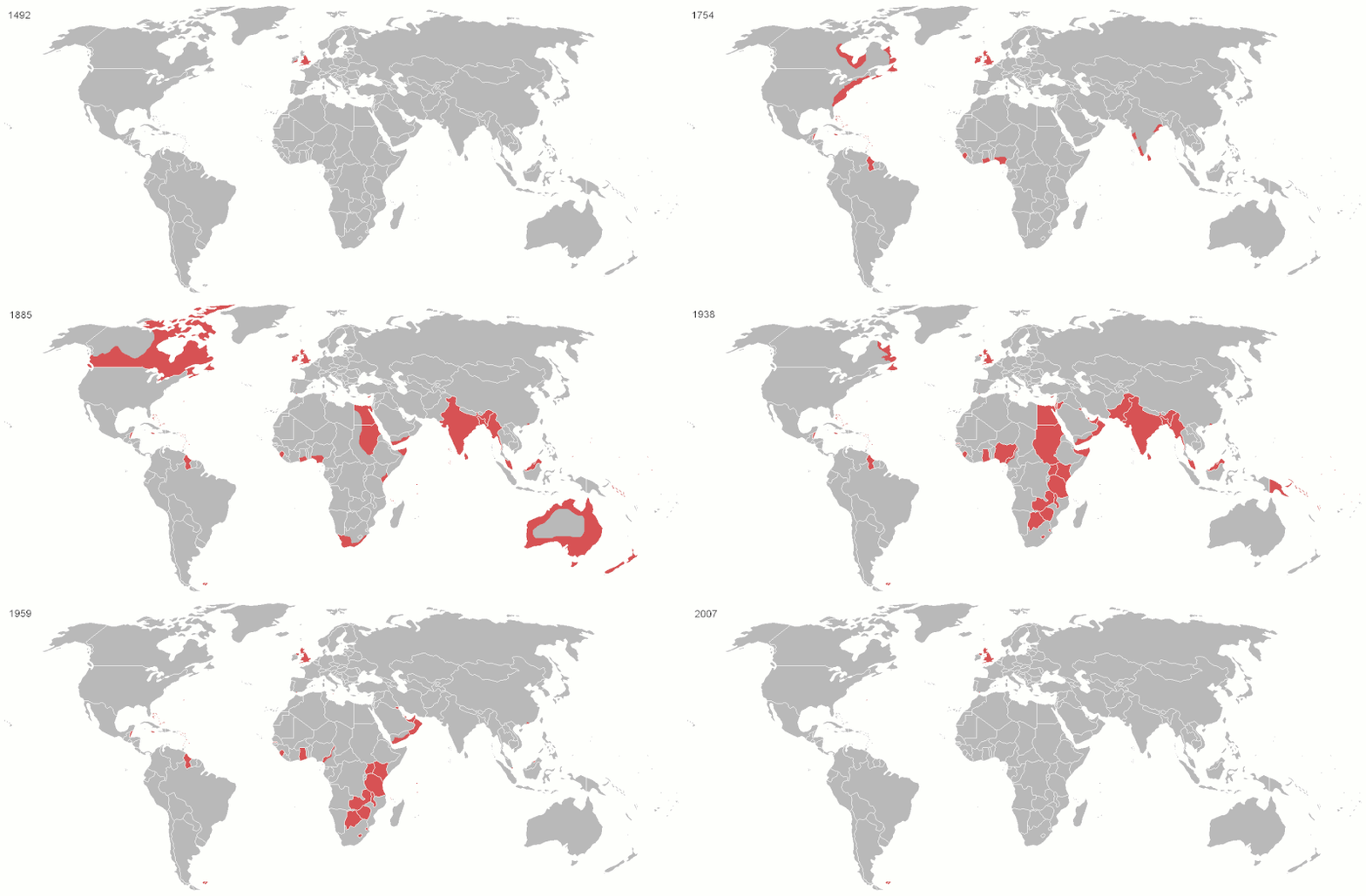
Britain’s earlier success seems built on a similar model: Britain had the sea, and the adventurous and discontented could hope to find a tropical island somewhere or some other outpost of Empire with which to escape the oppression of social conformity. And this, simply, is why the Industrial Revolution began in Britain. Let’s date its start, as Wikipedia does, from 1760. What else was happening at about that time? From 1744-1760, Clive was busily securing India. In 1759, Wolfe took Quebec and Canada, securing as well the American colonies. In 1770, Cooke took Australia. Odd coincidence in timing, that; nor can the Industrial Revolution be credited with the expansion of Empire, which came before it. The causation has to be the other way around: the sudden opportunity to emigrate inspired the burst of technical and scientific innovation. Not to mention the burst of innovation in the arts we now know as the British Romantic period; starting, traditionally, with the publication of Lyrical Ballads in 1798.

How about the Western European Renaissance? The most popular explanation for this sudden flowering of inventiveness and cultural progress is the fall of Constantinople, and the flight west of so many Greek scholars. But it is also strikingly coterminous with the first great surge of Western exploration. Some dates: 1402 - Castille begins to colonize the Canary Islands. 1420 – Portuguese discover and colonize the Madeira Islands. 1427 – Portuguese discover and colonize the Azores. 1434 – Portuguese sail past Cape Bojador, traditionally considered the limit of the navigable world. 1441 – Portuguese sail past Cape Blanco. 1444 – Portuguese sail past Cap-Vert and into Sub-Saharan Africa; huge new trade route opened up. 1450 – Gutenberg discovers the printing press. 1453 – Constantinople falls. 1462 - Portuguese trading as far south as Sierra Leone. 1488 – Dias reaches Cape of Good Hope. 1492 – Columbus discovers America. 1495 – Da Vinci, The Last Supper. 1498 – Da Gama reaches India. 1503 – Mona Lisa. 1504 – David. 1509 – Erasmus, In Praise of Folly. 1512 – Sistine Chapel. 1516 – More, Utopia. 1519-1522 – Magellan circumnavigates the globe. 1543 – Copernicus, De Revolutionibus.


Portuguese map of claimed territory, 15th century.

In this timeline, we see three possible triggers for the Renaissance, three early epochal events: the invention of movable type, the fall of Constantinople, and the first striking out westward to trade with the wild unknown lands beyond. The dates are, respectively, 1450, 1453, and 1402. Obviously, an event in 1453 cannot cause one in 1450; only 1402 accounts for all three. Suddenly, the European imagination was unleashed, by the opportunity to pack up everything and head for the open sea. With the discovery of Madeira, the original "desert island" was found--previously uninhabited, virgin land. And there was obvious promise of more in the same direction; every few years after this point, the Portuguese or the Spanish were finding another uninhabited but habitable island group off the coast of Africa or further to the West. When, in 1444, the Portuguese arrived south of the Sahara, a wandering life at sea also suddenly became much more viable, with the new possibilities for trade.

Nor was this opportunity limited in any sense to the Portuguese. Western Europe in general, and Southern Europe in particular, was not yet divided culturally into nation states. Everyone who read or wrote wrote Latin. Italian seamen like Columbus and Cabot could sail just as easily under the flag or in the ships of England or Spain, and the two men who took the Canaries for Castille were French. The early settlers of the Canaries came from all over Europe; as did the early settlers of the Azores.

The westward and southward expansion inspires creativity in those who stay at home as well. Even if they never leave, they know they have this safety valve. They can experiment freely, and escape punishment or ruin if necessary by packing a bag and catching the next ship.

It occurs to me, moreover, that the very same conditions would have held in ancient Greece, explaining the great flowering of that civilization 2,500 or so years ago. The Greeks too had the sea, and were busily setting up colonies all around the Mediterranean and Black Sea coasts. Any individual or group dissatisfied with their polis could easily move out and on.

Might this not be the secret of cultural greatness generally? That is, the possibility of escape for the unusually intelligent to some virgin territory? The period of Western cultural dominance has lasted from the moment the Portuguese rounded Cap-Vert until now, but has shifted within European culture to whichever area had the best immediate prospects for outward migration.

But if this is indeed the secret of cultural growth, we seem to have fallen on bad times. Worldwide, emigration is much more difficult now than it was only a few generations ago. Government and its regulations are becoming stronger and more pervasive everywhere. The creative American cadre that spread west as far as California has hit the inevitable barrier of the sea; the American frontier disappeared officially in about 1890.

And it is not easy to see any new lands to settle. Yes, we can go to the moon and Mars; there is even a fair bit of empty terrain left in places like Canada. But this is not the same. One needs empty terrain on which one can settle as an individual. These remaining places are only possible with huge amounts of organization and government machinery. Once there, it is not obviously possible to make a living without retaining complex relationships with the original society. One cannot simply subsistence farm, or set up a trading post and live by barter.

A generation ago, however, the lingering sons and grandsons of the frontier, in California, created cyberspace. That offered many new opportunities for creative minds. That too is starting to get fenced in and regulated; but there is some hope that new cyberlands will still be found. With new cyberlands, it becomes possible in turn for people to homestead in currently remote areas, and make a living online.

So there is hope for the future of mankind.

And, dare I say it, there is one more possible option for the very bright, in the English speaking world. It is called English teaching.

Laugh if you like. If you do, you have no idea what a stimulating bunch of Bohemians the typical ESL faculty is in any non-English-speaking college or university.

There are strong drives afoot to fence in these fields too, and pass it all on to the drudges. I have hopes, though, that the nature of the life will prevent this; as it has, elsewhere, with circus people or gypsies. Conventional people don’t thrive on culture shock.