
Playing the Indian Card

Wednesday, November 02, 2011

The Second Coming


What rough beast?


I am interested in Yeats' “The Second Coming” currently as it illustrates my thesis that Western Civilization has never recovered from the First World War. It, along with Eliot's “The Wasteland,” is perhaps the great poetic statement of this in English—though there certainly are many others. “There Will Come Soft Rains” was also written in the year or two after the war ended.

I gather the usual interpretation of “The Second Coming” is that it speaks of Yeats' concept of “The Great Year,” with the idea that after two thousand years Christianity has had its day and is about to be replaced by some new paganism. Fair enough; but there is no need to read it this way. After all, it is no suprise to any Christian that the Second Coming of Christ would involve first the appearance of a “rough beast”--that much is in the Book of Revelations. There is to be a period of tribulation, and it is to last as long as a thousand years. All quite orthodox, in fact.

Durer's Apocalypse, with two rough beasts apparent.


I imagine the notion that the poem is non-Christian, indeed somewhat anti-Christian, comes from the identification of the “rocking cradle” that “vexed to nightmare” “twenty centuries of stony sleep” with the birth of Jesus. This would then imply that Christianity, if only over millennia, actually caused the blood-dimmed tide now unleashed by the rough beast of mere anarchy. But there are multiple problems with this identification.

First, the birth and infancy of Jesus is not, theologically speaking, as important as his death and resurrection. So the poem, if this is its focus, would have slightly misfired here. Second, it is common knowledge, and an essential element of the mythos, that Jesus was not born in a cradle, but in a manger. With Yeats' sensitivity to symbol, it seems incredible that he would have muddled this—to actually make the synecdoche of a cradle represent Jesus himself. This alone, I think, makes the identification impossible, and care has been taken to ensure that this is so.

But it also makes no sense in terms of cause and effect to see the cradle referred to as the cause of both the “twenty centuries of stony sleep” and the “vexing to nightmare.” These are two different and quite disparate things. If the twenty centuries of stony sleep refers to Christianity, the vexing to nightmare cannot.

Finally, Yeats himself elsewhere considers the height of civilization to have occurred in the Byzantine Empire—a resolutley Christian context, the paradigm of a time and place where Christianity ruled both the intellectual and the political world. If things started to go wrong, it must have happened sometime after 1000 AD.

The essential question in the poem, therefore, the climax to which it all points, is the puzzle: who is the baby in that rocking cradle?

Or, indeed, is there a baby in that rocking cradle? For only the cradle, not the baby, is mentioned, as if it were empty. Indeed, implicitly, it must be empty, in order to be filled by the “rough beast” slouching to Bethlehem “to be born.”

If one wracks the good old Spiritus Mundi for some obvious and necessary referet for this rocking cradle, it seems to me the first and strongest reference is to the best-known English lullaby: “Rock-a-Bye Baby.” This nursery rhyme also refers, in a way, to a cradle that is empty—at least, the baby and cradle both fall. This feature of the rhyme is quite odd, and so conspicuous—for centuries, people in English-speaking countries have in fact lulled their babies to sleep with a story of some poor child coming to disaster.
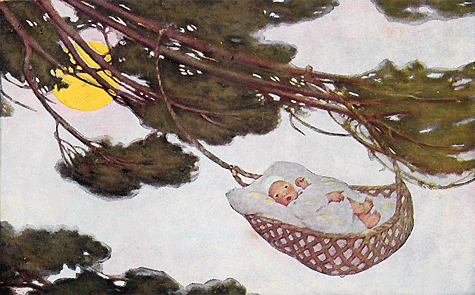
Bad parenting.


But then who is the baby in ths nursery rhyme?

There are a range of theories, and no agreed answer, but I thing the most valuable piece of evidence is the tune to which it is sung. It is a variant of an old Irish tune, as Yeats would surely have known, “Lilibullero.” And Lilibullero is a song about the Glorious Revolution of 1688, which overthrew James II of England and replaced him with King William of Orange, with historic consequences for both England and Ireland.

It seems reasonable then to guess that the words of “Rock-a-Bye Baby” also refer to the same event. And such coded references were indeed commonly necessary in such turbulent times, and commonly used in Ireland. There are a lot of historical examples of satiric rhymes used as political weapons in Ireland.

It seems to me the suspicion is reinforced by the perfect irony of using what was composed as a military march, a war song, as a baby's lullaby. This sounds like deliberate parody. It makes it all seem quite ominous.

Edmund Burke


If this is true, the tree in which the baby rocks is the tree of state, an image of the nation popularised by the Irish statesman Edmund Burke, and influential enough that it is still the logo of the British Conservative Party. The tree represents a society's natural hierarchy: at the top of the tree, “in the treetop,” is the royal family. This identification is in fact explicit in one version of a later verse of the lyrics of the nursery rhyme: “Rock-a-bye, baby, thy cradle is green, Father's a king, and mother's a queen...”

British Conservative Party logo.


The baby, therefore, is a new heir born to the royal family. And this is just what caused the Glorious Revolution in 1688. It was kicked off more or less immediately by the unexpected birth to King James II of a male heir, James Francis Edward. This caused great consternation in some quarters, because James II's wife was openly Catholic, and little James Francis was certain to be raised as a Catholic. The “wind” that blew this innocent child off the top of the tree of state, was then the famous “Protestant wind,” an unseasonably favourable wind that blew William of Orange's ships from Holland to England in 1688. This “Protestant wind,” a catch-phrase of the time, is referred to as well in one popular version of the lyrics to “Lillibulero.” Parliament cut a deal with William, naming him the new king in return for ceding a great deal of the royal prerogatives to Parliament, and James Francis Edward fled into exile.
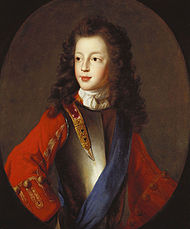
James Francis Edward Stuart


This would seem to make Protestantism and the Reformation the true cause of the rough beast of the Apocalypse. This may be so; Yeats was nominally Protestant, but was not practicing, and was surrounded by an overwhelmingly Catholic mileu. While considerations of class may have prevented him from converting, a portion of his subconscious, at least, might have favoured the old church. Nevertheless, the religious angle does not quite fit. The Glorious Revolution and the deposing of James II was not in this regard an epochal event in the history of the world, only of the British Isles. If the Protestant Rebellion was the trigger for the apocalype, it should have far more naturally been traced back to something like the nailing of Luther's theses to the door of Wurms Cathedral.

But something else about the Glorious Revolution was epochal. It effectively transferred British sovereignty from the king to the people; and this was a first for Europe and for the post-Byzantine world. Parliament, not the king, was now supreme, demonstrated by the ability of Parliament to depose a king. At the same time, the Glorious Revolution established the principle that the civil society was supreme over religion: the people could also depose a church, and dictate to the conscience of a king. This was both novel and revolutionary. The Glorious Revolution led in a straight line, and quite soon, to the political musings of Locke, and quite explicitly to the doctrine of “no taxation without representation” that triggered the later American Revolution, faounded on Lockean doctrine, which in turn triggered the French, which triggered the doctrine of Marx, the many revolutions of 1848, the ideal of nationalism, the Chinese Revolution beginning in 1911, the Russian Revolution of 1917, and the many revolutions, falls of monarchies, and general drowning in blood of all ceremonies of innocence following World War I, at the time that Yeats was writing this poem. Indeed, the doctrine of nationalism can also be blamed for the carnage of the Great War. Note that all the4se subsequent revolutions also shared the essential feature of believing that politics was and ought to be supreme over religion. This poison pill of “Liberalism” caused it to be oppsosed by the Church for many decades.

Widening gyres all beginning with the gentle rocking of one cradle.

The loss of the religious centre of a society, “the ceremonies of innocence,” is indeed a cause of social decline. It implies a fundamental failure of the social consensus which allows societies to function. This fact has been recognized almost everywhere and at all times. It was understood by the Romans to be the cause of the decline of the Roman Empire. Constantine then deliberately revived it for a further thousand years through the formal adoption of Christianity. It was the reason for the sudden rise of Islam in the seventh century. It was the reason for the decline of the Koryo dynasty in Korea; and on and on. A society must be united in its ideals.

Constantine, founder of Byzantium


The modern hope, which reached its apex in the nineteenth century, was that society could find a new centre around the doctrines of liberal democracy and science. New cathedrals were built, even higher than the early Christian ones: the Washington Monument, the Eiffel Tower. But this imagined centre has been losing mass rapidly since the First World War. The poets and artists saw it first, in the 1920s. The general population have taken a lot longer, busy destroying Christianity in the name of false science and a false liberalism for most of the years since, but are gradually coming, I think, to feel the same thing in their guts. Perhaps in another fifty or a hundred years, it will even occur to the academics, naturally the most conservative element of society.

The whole darned thing, Western Civ, looks like it is winding down to its final whimper.

Saturday, October 29, 2011

Liberal Books


It's all quite simple. One of my Arab students explained today that he loved reading, and he read both religious books and “liberal” books. “What are liberal books?” I asked. Another student explained: “books that believe that government and religion should be kept apart.” “Bad books,” another student elaborated.

Nobody contradicted this assessment.

There's the current conflict between the Muslim world and the West in a nutshell.

Tunisia, a few days ago, given the opportunity to select its government democratically, gave a plurality of votes to an Islamist party. Get ready for this to happen everywhere else in the Arab world. The West is going to have to accept that this is what democracy will mean in a Muslim country.

Let's get this clear. There is no contradiction between Islam and democracy. Islam is democratic to its core. There is no contradiction between Islam and human equality and human rights--both are profoundly Muslim concepts. The problem is right here--with secularism.

The idea of the separation of church and state has no status in Muslim culture, founded as a political and military as well as a religious entity from the beginning. Islam cannot be happily positioned as just one more religious alternative under an umbrella of secular humanism on which everyone can agree—not without negating much of the spirit of Islam. While Christianity can cheerfully say “render unto Caesar what is Caesar's, and unto God what is God's,” Islam will not, but will insist that Caesar too is subject to God.

I consider myself a liberal, but I am also troubled by secularism in the same way Muslims commonly are. Religious tolerance has in recent years been allowed to become in the West a radical religious intolerance, a denial of religion and indeed morality in public life, which is a recipe for both depravity and disaster.

I think a solution both sides can live with is not hard to find. But we must understand what the sticking point is. No cant or rant or bigoted jive.

Political Correctness


The one thing to understand about “politically correct” speech is that it is systematic lying. Otherwise there would be no need to qualify the word “correct.” Conversely, if politically incorrect speech were merely incorrect, there would be no politics involved. If it were simply not true, nobody would get upset about it. If it were not true, it would be permissible to say it.

It is, therefore, positively immoral to use politically correct terms, let alone to enforce its use by others.

Friday, October 21, 2011

The War of 1812


Coupland's "War of 1812," Toronto


I would have thought that commemorating the War of 1812 was a no-brainer. In fact, I have written in the past about my concern that it is not better commemorated. What future does any country have that will not celebrate its history?

It seems, however, that there is real resistance to the idea in Canada today. Senator Grant Mitchell has posted a strong dissent on the Liberal Senate website (http://www.liberalsenateforum.ca/blog/14326_rss).

His first and main complaint is that remembering history is “dragging us back into the past.” This is an interesting variant of the usual politician's doublespeak that they are “leading us into the future.” Easy for anyone to say, but perfectly meaningless—time being one-dimensional, it is impossible to lead anywhere else but into the future. Conversely, it is nonsensical to speak of “going back into the past.” Except in the sense that all knowledge is necessarily a reach into the past, that is, into memory. To be against going back into the past in this sense is simply to be against knowledge. Which may suit some agendas perfectly, of course...

Mitchell then gives his objections in point form:

  1. Given that the US is our friend, why would we want to remind them that they lost this war and that our forces set the White House on fire?
Burn, baby, burn!


First, let's clear up a common misconception. Canadian forces did not set the White House on fire. The British Navy did, and no Canadians were likely to have been involved. Time to put that old saw to rest.

But as to the larger point, that Canada should not alienate a present friend by celebrating a past dispute: on this advice, Britain had better pull up all those columns with Nelson standing at the top, and rename all those Wellington Streets. After all, France has long been a good friend and important trading partner. And France in turn had best can those D-Day celebrations; Germany is now their closest ally.

But of course, nobody worries about this. It is precisely because these nations are now friends and allies that such commemorations are not provocative. And it is the general course of history, and a good thing, that former enemies usually become friends later. This ought to be pointed out, and celebrated, not suppressed. If it is suppressed, moreover, just about all history is impossible.

  1. It bears no real relevance to the development of the Canadian nation.


    Tecumseh


This claim is a radical bit of historical revisionism. More commonly, it has been felt by historians that the War of 1812 was the true birth of Canada as a nation. In the words of Pierre Burton and the Canadian Encyclopedia, “Canada owes its present shape to negotiations that grew out of the peace, while the war itself - or the myths created by the war - gave Canadians their first sense of community and laid the foundation for their future nationhood. “ By showing they were prepared to fight, even against overwhelming odds, to preserve their independence from the US, Canadians showed their commitment to Canada. Anglophones, Francophones, and aboriginals saw a common cause and fought as one, shoulder to shoulder. If this all bears no relevance to the development of the Canadian nation, one must ask urgently, what does Senator Mitchell imagine the Canadian nation to be? Was it invented by Pierre Trudeau in 1982?

  1. It glorifies war when the war was not necessary or justifiable (to the extent that any war ever is).

Is pacifism ever justifiable? It glorifies moral cowardice. The greatest sin of all is to stand idly by and let evil triumph. God forbid that this should ever become the Canadian way, for it never has been.

As to the War of 1812 specifically, from the Canadian perspective, it was a perfect example of a just war. The US declared war on Britain; Britain did not declare war on the US. The US might or might not have had legitimate grievances against Britain that justified this aggression, but if so, these had nothing to do with Canada. The US invaded Canada; Canada did not invade the US. The Canadian strategy at the beginning of the war was purely defensive. If Canadians had refused to fight, the likely result would have been, quite simply, the end of Canada.

Senator Mitchell is saying, in sum, that the existence of Canada is not necessary or justifiable.

  1. If it means anything to anyone, it certainly does not have a national resonance of any kind, being pretty much irrelevant to the West.

The two-thousand-mile-wide battlefield (part)


Right. By that logic, the US similarly has no business commemorating its War of Independence, which involved, after all, only 13 of the present 50 states. We should also chuck out Canada Day and all this fuss about commemorating Confederation in 1867, since it involved only 4 provinces.

Nice to see the Liberals finally acknowledging that Canada has a West, and that America is our ally, though. This could be a breakthrough.

Sigmund Freud Was in Denial


Sigmund Freud was in denial about the central drama of family life, and perhaps the dirtiest secret of human civilization. Freud claimed that children essentially all wanted to kill their parents—kill Dad, sleep with Mum, or kill Mum, sleep with Dad. But the plain message of both history and story is just the reverse: parents essentially all want to kill their children.

Goya: Saturn devours his children.


Freud missed this even in the Oedipus cycle. In the story, after all, Oedipus has no desire whatever to either kill his father or sleep with his mother. Both happen by mistake, and he is utterly appalled. But Freud entirely glosses over the fact that Oedipus's father deliberately tried to kill Oedipus in the first place—leaving him exposed to die on a mountainside.

And, while parricide was essentially unheard of, then or now, and considered unspeakably evil, the exposure of unwanted infants was perfectly acceptable, then and, in the form of abortion, now. It was standard practice not only in Greece, but in pre-modern China and Japan. The ritual killing of children was everywhere among the nations surrounding Israel in the Hebrew Scriptures; the Romans report is as prevalent later in Carthage. It seems to have been the standard everywhere before the advent of ethical monotheism (Judaism, Christianity, and Islam). We see survivals and echoes in the story of Abraham and Isaac, or indeed of Jesus as the sacrificed Son of God.

Rembrandt: Abraham and Isaac


In Greek mythology, the motif is absolutely primordial: Kronos/Saturn devoured his children. Tantalos sacrificially killed his son Pelops. Jews were suspected of killing Christian children in order to make their Passover matzohs. Herod killed all the male children; and so did Pharaoh. Atreus murdered the children of Thyestes and fed them to him. Agamemnon sacrificed his daughter Iphigenia. Romulus and Remus, founders of Rome, were left exposed to die, but rescued by a she-wolf. Everywhere, the motif of child-killing is present, and primordial, at the beginning of every story.

Moloch


We are all looking the other way on this, and have been most of the time for millennia. But it simply makes sense. It is not just that we all want unrestricted access to sex without having to worry about the responsibility and expense of children. It is not just that children can sometimes be annoying. The child represents the mortality of the parent—it represents life going on without him or her. And so there is a kind of sympathetic magic that says, if you kill the child, you will live forever. If the child lives, his life replaces yours. This is a sort of existential truth, and so ever in the back of our minds. And it is explicitly the math propounded by Gilles de Rais,who killed an uncounted number of children in late Medieval France.

Gilles de Rais, Satanist.


It is perhaps also behind the many “hazing” or “coming of age” rituals of many cultures, which seem unnecessarily cruel. Circumcision is the least of them. The long years of schooling are perhaps the worst. If they do not kill and eat them, adults at least seek to punish the young for their existence, to get a bit of their own back.

To be clear, most parents are good to their children, and self-sacrificing. There are maternal and paternal instincts, thankfully, that work against this dark urge, not to mention the influence of religion and conscience. But I would feel a great deal more confident about our treatment of children generally if we openly acknowledged this dark history and tradition. It seems sinister in itself that we do not. It is perhaps the great cause, not only of our time, but of all time.

Tuesday, October 18, 2011

A Thought on the Unveiling of the MLK Memorial

In theory and in popular mythology, the civil rights movement elevated black men to the same status as white men. But this is not what really happened. Instead, it lowered white men to the same status as black men, and left us with a much smaller social elite: white women.

Friday, October 07, 2011

Trumpets of Doom

I am not any kind of expert on economics; but the current rumblings about sovereign debt sure have me worried. The head of the European Central Bank, after all, has said we are facing perhaps the worst economic crisis the world has ever seen, and it is his job to steady the markets by downplaying the dangers. Britain has begun, like the US, just printing money, and Britain looked more financially secure than the rest of Europe. We seem to be moving almost inexorably to a sovereign default by Greece, which looks increasingly as though it will set up a domino sequence that could cause Italy, Portugal, and Spain to default as well. If that happens, ... almost guaranteed to be a worldwide financial collapse, with huge amounts of wealth wiped away. 

Friday, September 30, 2011

The British Empire: An Idea Whose Time Has Come?


A Steampunk Vision of the New World Order


It is, in the end, rather odd that the significant English-speaking nations are not united, especially given their proven talent for creating federations. You will laugh, of course. The idea of a united Anglosphere died with the United Empire movement in the 1920s, didn't it? Instead, we all broke up into independent states.

I imagine, though, the preference for independence may have had something to do with always having the good fortune to have one of our number at our back as the world's leading nation. This so, there was little need to unite, and some advantage to complete self-government.

Suppose, though, that China does get close to surpassing the US in economic or military power. What then? Might things then look a little different? Just as Europe, after centuries of fierce fighting, saw the wisdom of unity over being superceded by Russia and America?

Speaking of which, of course, there is also the awkward fact that Britain has already committed itself to a different union, the EU. But then, isn't the EU starting to look a little frayed? Some are actuallty speaking of it coming apart over the current sovereign debt crisis. Even if it does not, if the rest of the English-speaking world began to coalesce, could Britain stand to be left on the sidelines?

So why not a grand federation, with an Imperial Parliament, after all? It might have been impractical in the 1920s. Improved transportation and communicatrions make it much more doable now. As with the EU, members might retain most sovereignty, but speak with one voice on trade, in defense, and in foreign affairs.

I theorize four qualifications for membership in this federation, with prospective members needing to meet three of the four.

First, English should be either the majority language or the de facto lingua franca. This for the sake of social cohesion. It more or less automatically implies some shared culture: a shared legal tradition, some shared history.

Second, the nation should be a functioning democracy with respect for basic human rights. We want to avoid a dictator's club, for all the reasons the United Nations is ineffective. Moreover, given this requirement, the union could serve as a guarantee of democracy and human rights for all member citizens.

Third, the nation should be an island or peninsula. This is important for defensibility, with the assumption that the union would be primarily a sea power. Otherwise, a military union might get itself into commitments it could not afford to keep.

I would add a fourth qualification, personally: that a majority of the citizens of any member state should be declared monotheists. I think this is important as a guarantee of shared values, without which the federation as a whole would lack direction, principle, or cohesion, and is the practical bare minimum in this regard.

Who would be in the federation? Britain, of course: if it could be teased out of the EU. Ireland too, on the same condition. Just as the EU protects it from undue influence from the UK, so would this alternative. Australia and New Zealand plainly qualify. The USA fits, but for not being a peninsula. Canada, with or without Quebec; an assortment of Caribbean islands, from the Bahamas to Trinidad. It looks to me as though the Philippines could get in, and ought to be welcome. Singapore seems to qualify as well. India looks like a marginal possibility.

A pretty formidable nation, if it were fully coordinated. One on which the sun might never set.

I hold out for Detroit as capital. Defensible, on the border with Canada, and lots of cheap real estate.

Thursday, September 29, 2011

How to Fix the Economy


Okay, we're all doomed. This current crisis over sovereign debt is not caused by the 2008 crash, and it is not just a cyclical downturn. The offal is hitting the ventilating system. Because of declining birth rates and growing government, we have rached the point of unsustainability, just as forecast by Ibn Khaldun, the founder of social science, four centuries ago. Government has outgrown the ability of the economy to support it. We cannot just keep borrowing money—there is a limit to the number of lenders and the amount of capital that can be soaked up, and it is being taken from more productive uses. We cannot just boost taxes—doing so will simply depress the economy further. The only option is to boost the non-government economy by cutting government.

Here's how.

  1. Outlaw strikes in the public sector.
  2. Set public sector pay rates automatically as a set percentage below the average rate for comparable pay in the private sector.
  3. Rescind current pension rates in the public sector in the same way.

This will fix the specific problem that has most directly gotten us into the current situation. Strikes in the public sector are simply a blank cheque written out to public employees. If the current incumbents in the public sector do not like this, no problem. There is a backlog of unemployed. Fire them all and hire anew.

But there is a lot more we can do. The cost of education, for example, has been spiralling out of control, while the results obtained, by most measures, have been holding steady or declining. Here's how to fix it by actually spending less money:

  1. Go to a full voucher system to introduce competition to the market.
  2. Eliminate any legal requirement for teacher certification. With the market able to decide, there is no need, and this works only as a restraint on trade.
  3. Remove any kind of government subsidy for the social sciences or the teaching of the social sciences at any level. They have had a couple of hundred years to show verifiable results, and have failed. They are conceptually in violation of human rights. Time to stop spending public money on them.

Health care is even more an area of spiralling costs. Here are a few simple ways to save:

  1. Allow pharmacists to dispense without prescription. This automatically eliminates a huge number of unnecessary doctor visits, and is more in accord with basic human rights. Pharmacists are knowledgeable enough to advise in many cases.
  2. Introduce a nominal user fee or deductible to discourage frivolous doctor visits.
  3. Introduce competition by allowing private, for-profit care providers.
  4. De-fund abortion.

Deregulation is the one obvious way to boost economic activity without spending more government money. A few simple ideas:

  1. Remove all limitations on employers hiring whomever they choose. This is a human right in any case, the right of free association, ends unjust discrimination, would boost efficiency throughout the economy, and would do away with a large bureaucratic structure.
  2. Remove all laws regarding sexual harassment in the workplace. Again, this eliminates a vast bureaucracy and a vast extra expense for most enterprises. Sexual harassment laws in their application are plainly sexually biased, and so produce systematic injustice. And they accomplish nothing of significance: if one is sexually harassed, one has the obvious remedy of finding a different job.
  3. Go to a flat tax. Simplifying the tax code ends efficiency-destroying distortions in the free market and eliminates the need for enterprises to hire expensive expertise in order to play the system. It makes the future predictable, and so makes investing more secure. It would also eliminate another huge government bureaucracy.
  4. Remove all restrictions on foreign investment. Investment is good.


It is perhaps too late to fix the demographic problem in the near term; but we need to give more support to the family in any case in order to allow it to replace government as the essential social structure.

One simple measure: strictly limit the liability for alimony or child support in case of divorce. This will remove an actual disincentive for wealthy people to marry and have children, and an actual incentive for some to divorce.

Wednesday, August 31, 2011

"Pro-science" and "Anti-science"

Why does the Left get to pick which issues are the benchmarks for “science”? Why can’t the measure of being pro-science be the question of heritability of intelligence? Or the existence of fetal pain? Or the distribution of cognitive abilities among the sexes at the extreme right tail of the bell curve? Or if that’s too upsetting, how about dividing the line between those who are pro- and anti-science along the lines of support for geoengineering? Or — coming soon — the role cosmic rays play in cloud formation? Why not make it about support for nuclear power? Or Yucca Mountain? Why not deride the idiots who oppose genetically modified crops, even when they might prevent blindness in children?

--from NRO's The Corner 

Friday, August 26, 2011

The Irish in Canada


The size and significance of the Irish presence in Canada is widely underestimated. We are the invisible ethnicity.

Nicholas Flood Davin gives the math for 1877: Ontario then held 559,440 Irish, 328,889 Scottish, and 439,429 English. Canada at Confederation contained 846,414 Irish, 706, 369 English, and 549.946 Scottish—the Irish numbers second only to the French. In the West of Montreal, “les Anglais” of the day were in fact 19,394 Irish, 7,974 Scottish, and only 9,099 English. So, if we are indeed going to speak of “two founding nations” in Canada, those two are: French and Irish.

But even that is not the whole story. Estimates are that the “French” population of Quebec, through intermarriage, is up to one quarter Irish by blood. Marguerite d'Youville's stepfather was Irish. Loius Riel's ancestor changed his name to Riel from Reilly. Louis Saint Laurent's mother was Irish; so was George Vanier's.

I submit that this has left a massive stamp on the Canadian culture and character. There is a real mainstream Canadian culture, and it is essentially Irish.

Irish-Canadian culture is also different from Irish-American culture, or Irish-Australian culture, for several reasons. Notably, the Irish of Canada came mostly from Ulster, and were primarily Protestant. Those in America and Australia came mostly from the south and west, and were primarily Catholic.

Unlike the US, the Irish were also already well established in Canada before the Great Famine. However, even at the time of the famine, there were more Irish emigrants to Canada than to the USA, and those who landed in Canada tended to be the poorest and most destitute. The passage to Canada was significantly cheaper—because there were fewer safety and health regulations in Canada, and because the lumber trade meant many ships were otherwise empty on their westward journey.

Daycage

Maclean's magazine, July 14, reports a survey in Manitoba showing "kids, after many of their parents began taking advantage of the province's new low-cost daycare, did worse on a basic vocabulary test."

We are sacrificing the rising generations for present comfort. This is a culture committing suicide.

Saturday, August 13, 2011

The Shiners' War


Joseph Montferrant ("Big Joe Mufferaw") takes on the Shiners.

My native Eastern Ontario was torn in the earlier years of the 19th century (1837-45) by what is called the "Shiners Wars." The Shiners were recent Irish immigrants working in the lumber camps, who generally raised trouble and terror up and down the Ottawa Valley.

Besides raising hell, the Shiners apparently also had a political agenda. At one point they flooded a meeting of an agricultural society, and had their leader elected the society's president. At another they tried to take over Nepean Township, but were outvoted.

Canadian troops were actually called in to restore order.

Generally considered a case of the boys just getting rowdy. But nobody knows why they were called "Shiners."

I have a theory. The term "Shinner" was actually common in Ireland in the early 20th century. It referred to the members of Sinn Fein, the Irish nationalist organization. "Sinn" is pronounced like "shin." Could the "Shiners" be "Shinners"?

At first, it looks improbable. Sinn Fein was founded by Arthur Griffith in 1905, long after the days of the Shiners. But "sinn fein" is also an Irish phrase. It means "ourselves," with the implication "on our own." And it is found in English-language nationalist songs from early in the 19th century. It seems likely that Griffith, a speaker of Gaelic as a second language, because it already had a certain cachet, and it may have been quite common for some time in Gaelic.

So "Shiner" might have been a recognized reference, to the Irish of the Valley, to "Sinn Feiner." With the implication that the lumbermen's true aim was some form of self-government for themselves as Irishmen, in the new world if not in the old.

This was, in fact, a common thought among Irishmen throughout the Irish diaspora. We have all heard of the Fenian movement in the US, I presume? And you have heard of Ned Kelly, the famous Australian outlaw? Except he was not just an outlaw. His hope was to establish at least a part of Australia as an independent Irish republic. In 1798, inspired by events in the US and France, the United Irishmen rose in a rebellion that lasted for six years. In 1800--bet you never heard this--Irish in Newfoundland rose in the same cause.

Now note again the year the "Shiners Wars" began. 1837. Do you remember, from your history, anything else that was happening in Canada in 1837?

Two things, actually. In Lower Canada, the Patriots took up arms. Probably the only name you know from that rebellion is Papineau, and you imagine it purely a Francophone thing. Not so. As prominent as Papineau among the rebels was Edmund Bailey O'Callahan, the MLA for Yamaska and editor of the Montreal Vindicator. To make the matter plain, he was the leader of the Irish community in Quebec at the time.

And in Upper Canada, William Lyon Mackenzie also took up arms.

You can see something was in the air.

It is amazing how all this Irish Canadian history has been suppressed. I believe it has mostly been suppressed by the Irish themselves. Canada defines itself as the Loyalist half of North America; Being opposed to the British Empire has no doubt not always been a politically comfortable position. It became less comfortable thanks to the Fenian raids of the latter half of the 19th century, when being Irish in Canada must have put my ancestors under a suspicion similar to that German Canadians would have felt during the First World War, or Japanese Canadians during the second. Indeed, it must have been awkward for Irish Canadians again in the First World War, when the Easter Rebellion happened in Dublin. It was seen at the time by the British as treason during wartime, after all. And this on top of the usual prejudice against Irish and Catholics.

Someone needs to revisit this history, and tell the truth about it.

Wednesday, August 10, 2011

Moloch Lives!

In order to understand Western civilization, grasp one fact: the ancient peoples of the Levant killed their own children. They sacrificed their children to their gods. Every first born son was burned alive at age six or so.


Remember that the next time you hear that the God of the Old Testament seems to be a bit of a warmonger. Yahweh's moral revulsion towards the Canaanites is questionable only on the fashionable modern creed of cultural relativism, that all mortal cultures are created equal. Consider Nazi Germany, or Imperial Japan—worth preserving? Were we not justified in employing whatever means necessary to wipe them from the face of the Earth? How much more so a society that held the murder of innocents as its core cultural value?

Yahweh, God of the Bible was not the only one who was horrified. The pagan Romans were too, when they encountered the practice in the Carthaginians. Everywhere else, Romans were notable for their clemency in victory. But Carthage? They burned it to the ground and salted the fields.

Echoes ring through the Old Testament. Moses was a firstborn son, born under sentence of death. Abraham and Isaac? Understanding that sacrificing one's first son was the required custom in the land, its significance is the reverse of what you might otherwise imagine: Abraham's great proof of loyalty to Yahweh was not in preparing to sacrifice Isaac, but in staying his hand at the angel's command. This was the one thing that distinguished him from everybody else in his day.


The moral depravity of the surrounding culture made morality, ethics, that much more important to the Jews; it became, along with their monotheism, their defining religious characteristic. “Ethical monotheism.”

This factor also explains the uncanny result of the Punic Wars. As a rule, in any war between a land power and a sea power, the sea power wins. Control of the sea allows one to attack any enemy beyond it unexpectedly, at multiple points—his border is much longer than yours. But Carthage was a grerat sea power, at the beginning of the Punic Wars across the Mediterranean from Rome, and Rome knew nothing of ships. It should have been no contest.

The only explanation for Carthage's loss, it seems to me, is a lack of resolve—that, and perhaps deivine intervention i nthe cause of right. And that is, interestingly, just what the historical record seems to show. Several times, Carthage even sought to concede, but kept fighting only because the Roman terms were too onerous. In contrast, when Hannibal was stomping around Italy with his elephant army, the war looked lost for the Romans. But they did not sue for peace.

This, I think, shows the force of moral right. The Romans, in the end, were fighting for their children. The Carthaginians, in the end, might have half-hoped their gods could be proven ineffective.

The power of right is a real thing, so real that the joust or the duel were once considered a just resolution to most disputes. God and a clear conscience give greater resolve and greater strength.

Now here's the dark side of this thought. Who now is killing their children? Who is even holding it up as a core cultural value, part of the universal doctrine of human rights, “reproductive rights” or the “right to choose”?

A just God will need, once more, to wipe out such a civilization.

Tuesday, August 09, 2011

This is Getting Grim

The US downgraded. Japan laid low by a tsunami and a nuclear meltdown. Italy on the verge of default. Rioting in London. It is starting to look a little like civilizational collapse.

I'm still betting it ain't, I say technology is going to pull us out of this one. But it looks like the times they are a changin'. I say it is a collapse of the current elite, the current ruling class, that we see happening.


From Today's Toronto Star

"Orthodox Christians differ from Roman Catholics in their belief that the Pope is a human being, not a divine figure."

Religious illiteracy is everywhere!

Wednesday, July 06, 2011

Perfidious Albion


Heading to the UK in a few days. Thinking about it, reading about it, I am aware of an overall sense of darkness. Why? Why does the UK, why has the UK always, frankly, given me the creeps?


It is the sense that there is no religion there, no spirit. The UK is the exaltation of the material and social above the spiritual. It is a nation without a soul.

I grew up strongly under the influence of British culture—in a Canada still conscious of Commonwealth, if not Empire. When I studied English Literature in college, they took the “English” part seriously. There were no Canadian authors on the curriculum, much less American.

Granted, I was also conscious myself of being Irish, not English; I was raised as a Catholic. And I was in some contact with an alternative culture in French Canada. That may have caused me troubles with the wider culture I would not otherwise have had—I doubt it—or it may have been my salvation.

It all begins with the separation from Rome under Henry VIII. This established the basic, blasphemous principle that the civil authority was supreme over the spiritual, and spiritual matters were under the state. This continues to this day: the Queen is still head of the English church, and its bishops sit in the House of Lords.

The situation in Catholic countries, even with an established church, is different: here instead the civil is at least nominally subservient to the spiritual--the reverse situation--because the supreme religious authority is beyond the mountains, in Rome, beyond the reach or control of the civil government.

In the mess of English literature, I could see for myself that Shakespeare was sound. Shakespeare, after all, was still culturally Catholic. But after him, if you strip English literature of all the Catholic and the Celtic (i.e., non-English) writers, there is practically nothing left. And English music and visual arts? There was practically nothing in the first place, until quite recently, and that recently thanks to Irish immigration. Art is not religion, but it is another expression of the spirit. The two are normally, and should be, working together. Both seek the Good, the True, and the Beautiful.

There are many other consequences here, beyond the alienation of the arts from the rest of society. One is the resistance to intermarriage. The Portuguese, Spanish, or French, when they sailed about the world and built their empires, always intermarried with the inhabitants, tried to convert them, and, if converted, accepted them as equals. The English saw intermarriage as a sin and a crime—misogyny. Why? Because their religion was largely based on nationality; non-English were, essentially, profane, by their nature. Hence there was also no similar attempt by the English to convert. They either killed the inhabitants, or ruled and remained separate from them. The good news was, this made it easy for them to pull out of their empire when the time came.

Because they made the material and social world the foundation of their religious faith, the English rather naturally became very good at social and material things. They became the world authorities on how to organize governments, how to organize voluntary associations, how to organize corporations, markets, shops, economies; how to make money; how to borrow and lend, how to insure; how to engineer, for either military or civil purposes. The whole science and technology thing, on top of the whole government and economics thing. The rest of us have benefitted from their expertise in these areas, and ought to continue to respectfully learn from them. But their expertise here is based on the simple principle that one devotes the best of one’s efforts to whatever one holds to be most important. In the English case, the physical and the social world, not God or the spirit.

This is still all a reversal of values, so that it ultimately leads us in the wrong direction.

The peculiar English love for social ritual and convention also comes from their veneration of the social—ritual of this kind is normally a part of one’s religion.

The unwarranted emphasis on the material and social has been inherited by the Americans. I recently finished listening to Sinclair Lewis’s Main Street as an audio book. I think the reversal of the spiritual and the profane is the heart of the conflict in that book, between typical American social values, on the one hand, and a young woman who is naturally spiritual without, sadly, being able to associate this spirituality with religion. In Sinclair Lewis’s book, she finds no way out.

Her Lost Generation, when they could, found their escape in Paris. The nearest port beyond the Anglo-Protestant cultural sphere.

I think exactly the same problem, and the same spiritual conflict, produced all the tumult of the Sixties. Young people were aware there was something missing, that the world around them had things upside down, lacked spirit, without being able to see any solution. Instead, born and bred materialists and communitarians that they were, they mistook drugs for imagination, sex for emotion, and politics for religion. They never got past the bars of the cage, saving perhaps the Jesus freaks and the Hare Krishnas.

Wish me luck.

Saturday, July 02, 2011

Silly Brits

Unfortunately, my current landlord has supplied me with a cable TV service that features only one English-language channel: BBC News. And it’s beginning to get annoying.


I don’t mean the BBC’s celebrated left-wing bias, or the odd fact that one rarely sees an Englishman on the BBC. I mean an overall lack of standards. Maybe I’m a naïve colonial, but I had always associated the BBC with a certain rigour—fact-checking, precision of pronunciation, and so forth.

And I’d especially expect them to get it right when the story is about Canada. After all, they used to run the place.

But no, BBC, “God Save the Queen,” when played in Canada in the presence of the Queen or her heirs, is not “the British national anthem.” It is the Canadian royal anthem. No, the Vancouver hockey team that so recently and so slenderly lost the Stanly Cup playoffs is not the CANucks; this is the standard nickname for Canadians, fercrissakes. The capital of Manitoba, once the third-largest city in the Dominion, and featuring frequently in your weather reports as the target of an impending cold front, is not “Winny-peg.” And the stress in “Newfoundland” is not on the second syllable.

Makes you wonder what else they get wrong, elsewhere. And these guys recently ran a quarter of the world?

Okay, the veneer of sophistication is now off. So while I’m, at it, let me also advise you pommies right here and now that “Fiona” is not an appropriate name for a human. Neither is “Penelope” or “Rebecca.” Anything more than two syllables is putting on airs, and nobody will like you for it. Proper people names are “Gordon,” Howie,” “Donna,” or “Anne.”

There’s more, while I’m at it. Ditch that pommy accent. Everyone thinks it’s gay.

Words end or don’t end in “r” for a reason.

Everyone knows you won the Second World War. Time to move on.

Those James Bond films aren’t fooling anyone. We know you’re not still secretly running the world.

And you had to hire Scots and Irish to play the part. The English are not suave. Two words: Mr. Bean.

And must you always say "thank you very much indeed"? When you always say it, it only comes across as insincere. A simple "thank you" will do.

Where are we? Your women are ugly, your food is inedible, and your weather is awful. No wonder you left to conquer the world. What choice did you have? I would have left too.

Winny-peg indeed.
 
Seriously, though, just kidding, guys. I really want to give all you Brits a big hug.
 
Only trouble is, if I did, you'd probably have a heart attack from the unfamiliar human contact.