Playing the Indian Card

Showing posts with label ten commandments. Show all posts

Friday, September 25, 2020

Ten Rules for Life


It is essential to have an objective moral code. Our conscience is the best guide; but it is too easy to rationalize. It needs an “education.”

At the same time, the meaning of the Ten Commandments is itself often ambiguous. They are worth looking at more closely.

1. You shall have no other gods before Me

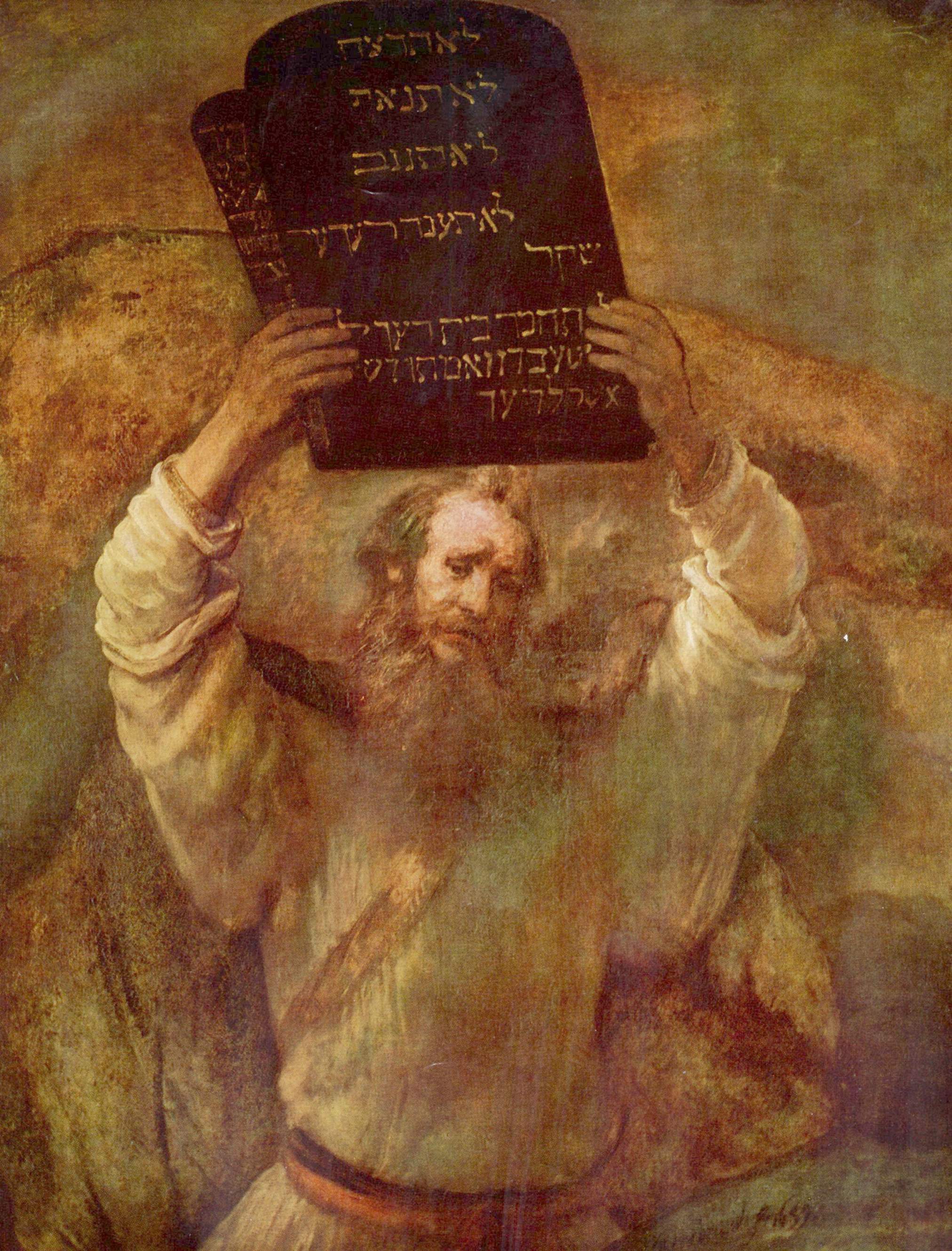
As numbered by Catholics, Jews, and Lutherans, this first commandment includes a prohibition specifically against worshipping “graven images.”

You shall not make for yourself a graven image, or any likeness of anything that is in heaven above, or that is in the earth beneath, or that is in the water under the earth; you shall not bow down to them or serve them; for I the LORD your God am a jealous God, visiting the iniquity of the fathers upon the children to the third and the fourth generation of those who hate me.


Based on this, many Protestants and Jews consider the statues and paintings in a Catholic or Orthodox Church illicit.

I have dealt elsewhere with why this literal interpretation is not tenable: briefly, the commandments themselves were engraved on tablets, and referred to in Exodus itself as “graven images.”

The prohibition is not against making such images, but bowing down and serving them.

“Graven images” can be broadly understood as all the works of man. All the works of the human mind are graven images in the metaphoric sense. We think with images, mental representations, not with the things themselves. We must not worship the works of man.

We must also not worship anything in the sky, on the earth, or in the waters. In other words, we must not worship nature.

This is not a prohibition against worshipping Zeus, or Thor. That is a trivial issue; the temptation is not present. It prohibits putting too much value on Nature, or Science, or Evolution, or Reason. Which probably most people do.

Breaking this commandment expressly causes harm to the third and fourth generation of your descendants, according to the passage. This is a fundamental misorientation of values. It is a matter of world-view. It is hard for a child to break free from the world-view of their parents. If that world view is fundamentally wrong, it blights their life. As Jesus says elsewhere, it would be better for that parent to be thrown into the ocean with a millstone around their neck. This sort of fundamental misorientation is a social disorder, the kind of thing that, in the Old Testament, leads to direct divine retribution, for the sake of future generations. Sodom and Gomorrah, the Canaanites.

2. You shall not take the name of the Lord your God in vain.

People think this is a prohibition against using “bad language.” Even short Anglo-Saxon terms for organs and bodily functions. Which is childish and silly and a dodge to avoid having to follow the real commandment. It is a prohibition against breaking promises. When you say you are going to do something, and do not do it, you do the other party real harm.

3. Remember to keep holy the Sabbath day.

This is commonly understood as a commandment to go to church, but the commandment was given before the first church was built. The implicit significance is that you must regularly stop what you are doing and reflect on matters. Are you on the right path? Do things make sense? If you simply motor along without undertaking your own spiritual quest, you are liable to be going nowhere.

I think of Ruth Bader Ginsberg, who spent her life busily—yet her net contribution to the world seems harmful.

Elsewhere, the Bible observes, “the wicked cannot rest”; often misquoted as “no rest for the wicked.” They cannot rest from ceaseless doing, because a moment’s real reflection would allow the still small voice of conscience to convict them.

4. Honour your father and your mother.

This is commonly understood as a command for children to obey their parents. This is obviously wrong: children do not need such advice, because their parents can enforce obedience, and children, below the age of reason, in principle cannot sin. None of the commandments are for them.

The original Hebrew here translated “honour” means something more like “repay.” St. Paul notes that this is the only commandment that comes with a quid pro quo: “that your days be long in the land.”

It means you owe a debt to your parents for taking care of you in childhood, when you could not take care of yourself; and so you must look after them if they need such assistance in their old age.

5. You shall not kill.

This commandment cannot be taken to mean “kill” literally, since the Old Testament requires the death penalty for some crimes. It cannot justify pacifism, for Yahweh also directed Moses himself to go to war. And it obviously does not include animals, which we use for food. It is often rendered as “You shall not murder,” but this is not satisfactory either. Murder is a legal term, defined by the state. Merriam-Webster: “the crime of unlawfully killing a person especially with malice aforethought.” Oxford: “the unlawful premeditated killing of one human being by another.” “Unlawful” is part of both definitions.

Trusting morality to the state implies trusting Nazi Germany to always do the right thing.

The original Hebrew word translated here as “murder” literally means “to tear apart, destroy.” That makes more sense. Of course we must not murder people, but that is a fairly remote concern on most days. More pressing is a Satanic urge in all of us, when we see something good or beautiful, especially if it is not ours, just to break it. We see it in the mobs currently pulling down statues. The word “Devil” comes from “dia-bol,” literally, tear apart.

6. You shall not commit adultery.

Strictly speaking, adultery is sex when one or another of the partners is married, and not to one another. It does not include fornication--sex when neither party is married.

But that needs to take into account that according to Hebrew tradition, and tradition everywhere in Europe until relatively recently, the act of fornication automatically made you married. This idea endures in the concept of “common-law marriage.”

So it means sex with only one person, for life. We have strayed far from this.

7. You shall not steal.

This too is controversial. It requires assuming that God recognizes property rights. The authors of the Declaration of Independence changed the three prime inalienable rights to “life, liberty, and the pursuit of happiness,” replacing John Locke’s original “life, liberty, and property,” to avoid making this assertion. And, of course, the right to own property is not recognized by socialism.

The interesting question is, if property is from God and not from man, government and the law, what determines that a thing is my property and not yours?

Locke makes the comprehensive argument that it is one’s labour. To the extent that one alters an object in nature, that makes it your property. It being your property, you also have the natural right to sell it to another, or give it to them, and so forth.

8. You shall not bear false witness against your neighbour.

This is generally interpreted as “you must not lie,” but it allows “white lies.” The commandment is against saying something untrue about someone else, or that will harm someone else. It is against calumny, slander, and malicious gossip.

9. You shall not covet your neighbour’s wife.

10. You shall not covet your neighbour’s goods.

These two commandments are combined in the Protestant numbering. They do seem to be the same: a prohibition against envy.

You shall not covet your neighbor's house; you shall not covet your neighbor's wife, or his manservant, or his maidservant, or his ox, or his ass, or anything that is your neighbor's.


Why give it as two commandments? Because it corresponds to two other commandments, also given separately: “you shall not steal,” and “you shall not commit adultery.” To combine the two into one would suggest that envy is a lesser sin than theft or adultery. The Catholic or Lutheran numbering prevents that.

Discounting the seriousness of the sin of envy seems to be a common problem. We do tend to think it is far less serious to envy someone his home or marriage than to steal his home or have sex with his wife.

But envy is more dangerous than we think. The great danger of envy is that it always by its nature operates in secret. It plunges its knife in the victim’s back.

And then feigns innocence.

Taken together, this is a powerful life mandate. Looked at carefully, it is striking how far our society is today from following it.


Saturday, March 14, 2020

The Sins of the Fathers


Orestes pursued by Erinyes.

“You shall no t make for yourselves an idol, nor any image of anything that is in the heavens above, or that is in the earth beneath, or that is in the water under the earth: you shall not bow yourself down to them, nor serve them, for I, Yahweh your God, am a jealous God, visiting the iniquity of the fathers on the children, on the third and on the fourth generation of those who hate me…”

Note this second part of the first or second commandment, depending on how you parse them. That makes it near the core of the Judeo-Christian message. It says that children and grandchildren are punished for a parent’s or grandparent’s sin.

Indeed, you get the same idea in the doctrine of original sin. Or that of redemptive suffering. One person can suffer for the sin of another.

And it is troubling: how can an all-loving God be so unjust? How can he punish Tom for Jerry’s sin?

Nevertheless, we have to accept that this is a fair description of reality. All of us either suffer or benefit from actions of our ancestors; these inform the circumstances of our birth and upbringing. Since God could intervene to prevent this, he is ultimately responsible.

But there must be more to this, too.

For this then is a case of God taking direct responsibility for human sin. Which is not theologically correct. We have free will.

And if a parent is morally depraved, it is probably not going to change their mind to hear that their children will suffer for it. That would trouble only a good person. In fact, this is what a narcissistic parent actually wants and tries to do. They inevitably choose one or more children as a scapegoat, and blame and punish them without cause. Most often, they are innocently punished for the very things of which the parent is guilty. That is what “scapegoat” means.

So it seems both false and fruitless for God to declare this commandment to the bad. And after all, if they are idolators—the specific sin which this commandment prohibits—they are not listening to God in the first place.

Nor to the already righteous parents, who care about their children. They are, after all, already righteous, and listening to God, not worshipping idols.

It has to be that he is speaking to someone else.

It has to be that he is speaking to the children. He is speaking to the grown children of the iniquities of their fathers.

Children, especially less thoughtful children, get their worldview and many of their unexamined opinions from their parents. Denominational beliefs, politics, and prejudices of all kinds run in families for generations. This is demonstrated often in demographic surveys, were it not self-evident. In our earliest years, our parents are the font of all knowledge; and this assumption never entirely fades.

Yet we all also have an innate conscience, from God, and must be conscious as well of contradictions, between this and what our parents taught us. And we all have a moral duty to actively seek the True and the Good.

It is perhaps vitally significant that this passage comes at the end of the prohibition against idolatry.

The essential and most dangerous idolatry may be this idolatry of the parent; and what Francis Bacon called “the idols of the tribe.”

The word translated here as “iniquity” is actually closest to the English “crookedness.” It is an image of a thing being bent.

That indeed makes it plausible that it refers to a distorted, dishonest world-view.

And it seems to bookend with Jesus’s condemnation in the New Testament of those who would “cause one of these little ones to stumble.” It is a condemnation of parents who fail in their children’s moral education.

One can see, then, how this commitment to sin is both passed down from the parent, and a matter of personal responsibility. We all have the moral obligation to see past such idolatries—this is what the commandment is telling us. If in an oddly oblique way, as if aware of the necessity at the same time not to upset the authority of the family—the foundation of all social order.

Happily, this conflict between God and parent is not great in most families. However, one can easily see in it the basis for original sin. Every human ancestor must, like Adam, fall somewhat short.

A similar concept of guilt running in families was known to the ancient Greeks. See, most obviously, the Oresteia trilogy: it ends in a formal trial, in which by the grace of Athena the parent is found at fault, and the child not guilty. Plato too speaks of ancestral curses for which a descendant must atone, through bouts of “divine madness” and through rituals of purification.

Plato is referring to melancholy, which is much of what we call mental illness; or at least to depression and mania (now “bipolar disorder”). In the Oresteia, the same experience is represented by pursuing Furies. This, depression, then seems to be a product of the dissonance between parental influence and eternal verities.

But those raised by a narcissistic parent who do not suffer through the ordeal remain in sin. They have broken the first commandment.


Thursday, January 30, 2020

The Ninth Commandment--and the Tenth


A noble knight of God confronts the Seven Deadly Sins.


“You shall not covet your neighbor’s house. You shall not covet your neighbor’s wife, or his male or female servant, his ox or donkey, or anything that belongs to your neighbor.”

This passage is awkwardly split into two commandments in the traditional Catholic, Lutheran, and Jewish formulation. This requires a bit of rewriting:

9. You shall not covet your neighbour’s wife.

10. You shall not covet your neighbour’s goods.

The argument for this is that otherwise you are classifying spouse as a belonging, which is wrong—not just to us moderns, but to traditional Jewish thought.

On the other hand, this would seem to condemn the same sin, “covetousness,” twice.

But one covets a person in a special way. The Hebrew word here can mean either “covet” or “lust.” One does not lust after Lamborghinis.

So it is two sins, lust and covetousness. You shall not lust after another’s wife or husband; you shall not covet anything that belongs to another.

Most interesting about these two commandments is that they presuppose the ability to control our desires. They are saying the desire is sinful, regardless of the action.

This goes against current received wisdom, which holds that desires and urges are like the weather; we can only control whether we act on them or not.

And the modern teaching, thanks to Freud, is that we should indeed whenever possible act on them. Otherwise we are repressed. And will no doubt over time go mad.

Yet we also know this is not true, if we stop and think for a moment.

Because, after all, we hold people responsible for “hate,” and punish them for it. When we marry, we vow “to love and to cherish.” Obviously, we could not do so if we thought the ability to love or cherish was out of our control.

No doubt it takes discipline to learn not to lust, not to envy. It takes discipline to be moral in general. Emotions can be addictions, and grow worse if we indulge them.

Developing good character is a matter of fighting such addictions.


Wednesday, January 29, 2020

Eighth Commandment: People of the Lie


Lucas Cranach the elder.


“Thou shalt not bear false witness against thy neighbour.”

In the World English Bible translation:

“You shall not give false testimony against your neighbor.”

The Catholic Church understands this as a prohibition against lying. Strictly speaking, it seems to refer only to perjury, to lying in a legal case. However, given that it was originally presented to a people wandering in the desert, court proceedings were probably different from, and far less formal than, we would be familiar with. There was probably little difference between a court case and any other dispute among parties.

A couple of chapters later, the Book of Exodus seems to elaborate:

Exodus 23

“Do not spread false reports. Do not help a guilty person by being a malicious witness.

“Do not follow the crowd in doing wrong. When you give testimony in a lawsuit, do not pervert justice by siding with the crowd, and do not show favoritism to a poor person in a lawsuit.”

These seem to cover instances in which people might otherwise suppose they are telling a “white lie,” a justifiable lie, not covered by the commandment.

The prohibition extends to malicious gossip. It extends to helping people by lying as well as harming them with one. It includes favouring the supposedly disadvantaged, as many modern governments and current judges seem inclined to do. See, for example, Canada’s “Gladue reports.”

It seems best, therefore, to take the commandment to indeed be referring to lies in general, so long as they involve material consequences. “Polite lies” would be exempt, just as would be jokes, fiction writing, dramatic performances, showmanship, and Donald Trump’s tweets.

Most interesting is the inclusion of the warning not to side with or follow the crowd. We might not automatically see that as lying. Many if not most people seem to hold the opinion that whatever “everybody says” or “everybody knows” is truth.

The prohibition here suggests that, to the contrary, anything “everybody says” should be presumed to be a lie.

And the warning is repeated: “do not follow the crowd”; “do not pervert justice by siding with the crowd.”

And you are as morally responsible if you do not assume this as if you had made up the lie yourself.


Sunday, January 26, 2020

The Seventh Commandment


You shall not steal.

Here we have a perfectly clear and simple obligation. No infringement on private property.

Or do we?

The word we render in English here as “steal” apparently refers in Hebrew to people, not things. Jewish authorities read this as “you shall not kidnap.”

Did you see that one coming?

Locke suggested three human rights inalienable by government: life, liberty, and property. Apparently, this commandment addresses not the third, property, but the second, liberty. One has no right to take from another their natural freedom of action.

It is, then, a prohibition against slavery—against the ownership of human beings.

This must come as a surprise to all those who say that the Bible sanctions slavery.

This was based in part on the claim that the Bible never expressly prohibited slavery—as it does here—and in part on translating the Biblical term usually rendered “servant,” as more correctly “slave.”

“Bondservant,” “bondsman,” “bondsmaid” might be better: it was indentured servitude, the system that populated early America. One was bartering one’s labour over a period in return for some financial consideration. All such contracts lapsed after seven years as a maximum.

This is now classed as “slavery,” and prohibited, by the UN; leading to recent charges, for example, that America and the Caribbean was full of enslaved Irish before Africans arrived.

The essential point in terms of Bible ethics is that this was a contract, entered into voluntarily by both parties. So it was not “kidnapping.” Other than the length of the servitude, what is the fundamental difference between such an arrangement and, say, being employed at an hourly wage or monthly salary? For that hour or that month, the employer has the right to tell you what to do, to limit your freedom of action.

But now we are left with a second problem: so stealing, according to the Bible, is not wrong? No private property? That sounds revolutionary.

No, that is still covered by a separate commandment, “Thou shalt not covet thy neighbor’s goods.”

But there is also a critical distinction here. The sin, then is in the coveting, in the motive, not in the action of taking itself.

This is an important distinction, recognized both in traditional Catholic ethics, and by John Locke, but seemingly lost on most currently.

In principle, all property belongs to God, who created it, and so is to be shared equally, or rather, as needed. One acquires a personal right to any property through investing labour: then one has earned a special claim to it. If you pick the apple, then it becomes your apple. You have labour invested in it. More so if you planted and pruned the tree. If you plough the field, it becomes your field—you have buried your labour in it. If you build a business, by honest means, it is your business.

But this right to property is obviously only relative: the thing itself remains largely God’s. You only have a stronger claim than the next person.

The current idea that aboriginal people have some residual ownership of the land in many parts of Canada is based on a misunderstanding of this principle. Neither they nor even their ancestors have, by and large, invested much if any labour in this land. They have only survived on what it naturally produced. Accordingly, they have no ownership of it.

Now suppose someone else comes along who is in dire need. You do not need it; you only like having it. This then can trump your claim. If they just take what they need, it might be stealing under the law, but it is not immoral—because it was done of practical necessity, not covetousness.

This is the foundation for the Catholic doctrine of a “preferential option for the poor.”

This is also the essence of the story of Dives and Lazarus: Dives goes to hell for not sharing his wealth; which, without understanding this commandment, seems unfair. Wasn’t it his to do with as he pleased? In moral terms, since Lazarus needed food, and Dives had far more than he needed, he was sinning by not sharing it—he was stealing it from Lazarus.


Wednesday, January 22, 2020

Pleading the Fifth


The painter did it.
You shall not kill.

Brief and to the point. What could be simpler? Yet this commandment too has caused much disagreement. Is war prohibited? Is self-defense? What about killing animals, for food?

Many Hebrew scholars argue that the word translated “kill” here—retzach—properly means “murder.” Some Bible translations have the commandment as “You shall not murder.”

But this too is dubious, and troublesome. “Murder” is a legal term: “unlawfully kill.” This leaves the sin to the absolute discretion of the civil authority; which is not a reliable moral guide. Hitler killing Jews in Nazi Germany would be okay.

And the same word is used elsewhere in the Bible when it cannot mean “murder”: for example, it is used to describe actions of God.

Yet “kill” is also not accurate. Retzach cannot mean “kill,” in the English sense, for the Bible itself, and Exodus itself, presents killing in war and capital punishment as not just proper but at times commanded by God.

Perhaps, to get to the sense of the commandment, we need to back up to the fundamental question: why is murder wrong? We all know it is wrong, so that asking the question seems outrageous. But we need to ask: how do we know that killing is wrong?

After all, God kills everyone—sooner or later. He could have made the world differently; he did not.

And for the just, death is a reward. So killing a good person is not harming him or her.

We know that killing is wrong, I submit, because we know that, in the eyes of God, or from any objective view, all human beings are equal in basic worth. Accordingly, no one person has the right to kill another; that would be radically elevating self over other.

So the essential issue addressed by the commandment is a mortal human taking upon him or herself an action reserved to God.

Meaning killing out of self-will, as self-assertion.

Killing in war, or in self-defense, would be licit, given that one is killing under necessity or command. The war itself might be licit or illicit. Capital punishment could be licit, if necessary to preserve public order. But this is a dubious claim in modern times and ordinary circumstances. It might become licit in a time of war, emergency, or insurrection.

Killing of animals for food, or for other purposes, is licit, because animals are not our spiritual equals. Once you extend the commandment beyond fellow humans, you get into trouble. Is it murder, then, to swat a mosquito? To kill a cancer virus?

Obviously, human life often requires us to kill other creatures for our survival.

We should no doubt avoid cruelty to animals, and frivolous killing. Just as we should avoid excessive force in self-defense, or bloodthirsty methods in war.

For my part, speaking for myself, the commandment inspires me to be vegetarian. After all, I can survive quite comfortably in most situations without killing any sentient animals. So is it perhaps an expression of selfishness to do so?

The bulk of the Christian monastic tradition, at least, agrees.

But, outside of Lent and Fridays, the same obligation has never been considered general. It is good to be vegetarian, It is not necessary to be vegetarian to be good.


Tuesday, January 21, 2020

The Fourth Commandment


Finding Jesus in the temple: Tissot
“Honor your father and your mother, so that you may live long in the land the Lord your God is giving you.”
This is often cited as a requirement to obey your parents. This is probably the context in which most of us know it best, because we probably heard it presented this way repeatedly as children—and quite possible not since.

But this cannot be the core meaning.

It makes sense to advise children to obey their parents; their parents, being adults, will usually know best. But the Commandments are not for children. Below the age of reason, seven according to traditional thought, children cannot sin. Above the age of twelve, they are apparently under no obligation to obey their parents. Because Jesus clearly did not in the Gospels.

That is, he did not depart Jerusalem with his parents, but remained in the Temple, declaring it his true father’s house—implicitly denying his biological parents had any authority over him.

At the Wedding at Cana, when Mary asks him to help by performing a miracle, his immediate response is “What have I to do with you, woman?”

Below the age of twelve, was little Jesus obedient to his parents? There is nothing in the gospels. The one source we have is the Infancy Narratives of Thomas, from the First or Second Century. In it, Jesus is notably disobedient and disrespectful, to parents and teachers, and his relationship with his mortal father Joseph is tense. The Thomas Infancy Narratives were never accepted as authentic by the Church. But some of its incidents are repeated in the Quran. Obviously, some significant group of people took them seriously, for them to be preserved until today and spread beyond the Roman world in the days when all manuscripts were hand-copied.

So obedience to parents or deferring to their authority, is not the meaning of this commandment.

Which ought to be self-evident in any case. The average parent is, necessarily, no better a moral guide than the average person. Greater experience may give them an advantage over someone younger, especially in the case of a young child. But we know this is not conclusive. Otherwise, we would not bother with elections; we would just make the oldest among us king. It is entirely probable that, in any given case, an adult child will be a better judge, or more moral, than their parent.

And after all, deferring to another for moral judgements is an abdication of conscience; we are moral agents because we choose between right and wrong. It is what raises us above the animals.

From this perspective, an adult child automatically submitting to their parent’s will is being immoral.

To defer to another adult is also a violation of the concept of human equality. The consistent teaching of the Gospel is that we are all brothers, and all children of God. To defer to some fellow mortal instead of to our true father becomes an idolatry. Jesus even said, “Call no one father but your father who is in heaven.” “He who does not despise his father and his mother for my sake is not worthy of me.”

The Catholic Church extrapolates from this commandment an obligation to respect civil authority. This seems right. Even though the law is often wrong, even though the government is often corrupt, it is important to obey it in most ordinary circumstances to preserve public order. The same surely applies within the family, as a social institution—so long as it is operating as such. If everyone just does as they want, no social institution can function; the result is chaos. So clear lines of authority must be established.

But then, just as there can be just wars, despite the commandment not to kill, there can be just revolutions. Governments can be oppressive.

In such a case, resistance become a duty. So Augustine, long before the American Declaration of Independence; so Aquinas. Von Stauffenberg led the plot to assassinate Hitler as a devout Catholic. St. Thomas More was executed for treason. Jesus was executed by the civil authority—on the charge, even if false, of insurrection.

So too with a bad parent. Suppose, as with Huckleberry Finn, your father is a hopeless alcoholic. Is it your moral duty to go out and find him more gin?

Jewish sources understand the word we translate as “honour” to mean something like “repay a debt.” And it is a Hebrew word. That is, given that your parents supported you in childhood, you are morally obliged to support them in their age. This explains why the commandment is followed by a promise or a justification: “so that you may live long.” If we make a point of taking care of the aged, we all get to live longer. The alternative, in uncivilized societies, if often to leave the aged on the ice to starve, once they become a burden.


Saturday, January 18, 2020

The Third Commandment


God creating the universe; from a 13th century English psalter.

“Remember the Sabbath day, to keep it holy. You shall labor six days, and do all your work, but the seventh day is a Sabbath to Yahweh your God. You shall not do any work in it, you, nor your son, nor your daughter, your male servant, nor your female servant, nor your livestock, nor your stranger who is within your gates; for in six days Yahweh made heaven and earth, the sea, and all that is in them, and rested the seventh day; therefore Yahweh blessed the Sabbath day, and made it holy.”

The Sabbath is a gift to man, as Jesus elsewhere asserts, rather than something that might go against our natural inclinations: who does not want a holiday? It seems odd, therefore, that it is in the Ten Commandments, as a moral imperative.

The commandment does go on to demand not only rest for ourselves, but for anyone in our employ, or under our direction. This may require self-sacrifice; it often seemed to under Ontario’s old “blue laws.”

But this does not explain why the commandment not only includes but leads with the need to rest ourselves.

It is perhaps therefore significant that unlike almost all the other commandments, it does not begin with the words “Thou shalt,” or “Thou shalt not.”

It begins with the word “remember.”

It is perhaps a call to what Buddhists call “mindfulness.” Although often misunderstood to mean attention to the immediately sensed, the original word translated “mindfulness” is actually closer to this English word: “remember.”

The Sabbath many be set aside for remembering. The sense of the first four words of the commandment may really be, “Remember on the Sabbath day, in order to keep it holy.”

Here in Exodus, in context of citing the commandment, we are reminded of the creation of the cosmos by God. When the commandment is reiterated in Deuteronomy, reference is made to the Passover and the escape from bondage in Egypt. We are called to remember these things.

“Remembering” here does not only mean our personal memories. It does not in Buddhist “mindfulness,” for to Buddhists each soul has memories of past lives in many realms of existence. And it demonstrably does not here—we do not personally remember either the creation or the exodus.

Limiting the memory to the personal is a modern convention, that Plato would have scorned as much as Jung. Memory in this Platonic sense assumes a vast store of innate knowledge. We are born, as Blake said, like a garden fully planted, programmed by the Creator.

But we need not go that far. Memory obviously includes not just personal sense experience, but all that we have read, or been taught, or even dreamt. It includes the stories that form us: the vast literary landscape of the Bible, the Odyssey, the Ramayana, Aesop’s fables, the legends, the fairy tales.


Friday, January 17, 2020

The Second Commandment


Something smells.

“You shall not misuse the name of Yahweh your God, for Yahweh will not hold him guiltless who misuses his name.” (WEB)

Aka

“Thou shalt not take the name of the Lord your God in vain.”

This is ambiguous; so much so that Judaism has chosen to prohibit using the name of God, in any variant, in any circumstances, just to be safe. This is why English Bibles commonly refer to God as “Our Lord,” or “The Lord,” avoiding the use of the proper name.

But why is this a problem? Who is hurt by the misuse of a word? Would not, as Shakespeare said, a rose by any other name still smell as sweet?

It is commonly understood as a prohibition against making a false oath; against perjury, and against breaking promises or contracts. This seems reasonable, since in the Bible itself oaths are taken in the name of Yahweh.

But then, why not say so directly? Why be this circumspect?

Catholics believe this is a prohibition against cursing. Which again seems reasonable enough.

But again, why not say so directly?

Perhaps because it is about something more literal as well.

Literally, to misuse a name, or use a name in vain, is to apply it to the wrong person or thing: to look at a cat, for example, and call Puss a dog.

This may be an important issue; because Confucius, in the East, more or less makes it the first commandment in his moral system. Asked what would be his primary task if given power, he responded, “the rectification of terms.” 

Master Kung--Confucius.
“A superior man, in regard to what he does not know, shows a cautious reserve. If names be not correct, language is not in accordance with the truth of things. If language be not in accordance with the truth of things, affairs cannot be carried on to success. When affairs cannot be carried on to success, proprieties and music do not flourish. When proprieties and music do not flourish, punishments will not be properly awarded. When punishments are not properly awarded, the people do not know how to move hand or foot. Therefore a superior man considers it necessary that the names he uses may be spoken appropriately, and also that what he speaks may be carried out appropriately. What the superior man requires is just that in his words there may be nothing incorrect.” – Analects 8:3:4-7, Legge trans.

This may not matter on the simple physical level: if you call a cat a dog, it just seems silly. If you call a rose a stinkweed, it fools no one. It increases in importance as the things referred to become more abstract; it matters a great deal more, for example, if you call lust love, or prejudice justice. The potential for deception is far greater, and the consequences far more severe.

Logically, then, the greatest danger begins with misidentifying the most important entity, God: and this can stand for the whole issue.

This is more or less the same point Orwell made with Newspeak in 1984. It is vital that language should always be in accord with objective reality, and not manipulated for political purposes. Otherwise you can just declare “freedom is slavery,” and start enslaving with abandon in the name of liberty. All manner of evil can thus be justified. Perhaps this is why, in turn the Devil himself is called the “Father of Lies.” Tinkering with the language itself is a kind of primordial meta-lie.

Jesus declares in the New Testament that “blasphemy against the Holy Spirit” is the one unforgivable sin. It is the same sin cited here:

“Then one possessed by a demon, blind and mute, was brought to him; and he healed him, so that the blind and mute man both spoke and saw. All the multitudes were amazed, and said, “Can this be the son of David?” But when the Pharisees heard it, they said, “This man does not cast out demons except by Beelzebul, the prince of the demons.”

Knowing their thoughts, Jesus said to them, “Every kingdom divided against itself is brought to desolation, and every city or house divided against itself will not stand. If Satan casts out Satan, he is divided against himself. How then will his kingdom stand? If I by Beelzebul cast out demons, by whom do your children cast them out? Therefore they will be your judges. But if I by the Spirit of God cast out demons, then God’s Kingdom has come upon you. Or how can one enter into the house of the strong man and plunder his goods, unless he first bind the strong man? Then he will plunder his house.

“He who is not with me is against me, and he who doesn’t gather with me, scatters. Therefore I tell you, every sin and blasphemy will be forgiven men, but the blasphemy against the Spirit will not be forgiven men. Whoever speaks a word against the Son of Man, it will be forgiven him; but whoever speaks against the Holy Spirit, it will not be forgiven him, either in this age, or in that which is to come.”

The sin itself is illustrated by the passage: the Pharisees, knowing that Jesus had exorcised by the power of the Holy Spirit, said it was done by the demon Beelzebul. They were, in effect, calling the Holy Spirit the Devil. They were taking the name of the Lord in vain. 

Jesus exorcises the man both blind and mute.

There is another subtext here: what opens the eyes and allows us communication is from God; what closes the eyes and prevents effective speech is from Satan. Correct use of terms and concepts allows things to be seen clearly, and allows dialogue to occur.

Again, Jesus gathers together; Satan scatters. Devil, “dia-bol,” literally means “to scatter.” And an obvious instance of scattering is to separate the word from the object.

For every word is a “sym-bol,” a drawing of things together: most fundamentally, word and referent. The sound or visual character, and the thing it represents.

The image of the strong man being bound also seems relevant. Given the context, an exorcism, the plunderer would be the possessing demon. The demon gains possession of the will by first binding the self with the misapplication of terms.

This may be why, in turn, an essential act, perhaps the essential act, in any Christian or Muslim exorcism is getting the demon to clearly state his name. Rectify terms, and the possession must end.

Perhaps this is also why John the Baptist came before Jesus: in order to make the Truth apparent, we must first “make the ways straight for the Lord,” and this is a speech act. For that is what the Baptist does: he speaks. He is a herald.

This tendency to falsify language is, sadly, becoming endemic in our society. It is the driving force behind political correctness. Abortion is called “choice.” Government expenditures are “investments.” We are now required to assert that, if a man says he is a woman, he is a woman. And we must say he is, despite all appearances to the contrary, or face serious consequences. The list is growing faster than it can be enumerated. It is all, to quote Orwell, to “make lies sound truthful, murder respectful and to give an appearance of solidity to pure wind.”

There is another curious part of the passage. So curious it must hold some special meaning:

“If I by Beelzebul cast out demons, by whom do your children cast them out? Therefore they will be your judges. But if I by the Spirit of God cast out demons, then God’s Kingdom has come upon you.”

Why this reference to children? Would it not be more natural to say, “by whom did your fathers cast them out”? Wouldn’t that have made his point stronger, showing that this was established usage? Wouldn’t it be more natural to warn that their forefathers, not their children, would judge them for such a sin? Do children commonly judge the acts of parents?

It seems there is something peculiar about this sin that inverts this more natural order.

It sounds like Hans Christian Andersen’s fable of “The Emperor’s New Clothes.” 


The sincerity of a child is a threat to any corrupt social order based on a shared falsification of terms. Given such a situation, in which fundamental concepts are being falsified, it is children who are going to be best able to spot it. Because they are looking at it all with fresh eyes, without preconceptions—in this case, falsified preconceptions.

This may be why “a child shall lead us,” as the New Testament says. This may be why Jesus says “suffer to come unto me the little children; for of such is the Kingdom of God.”

This may explain in turn why, as Freud and many others have observed, it is the brightest and most perceptive children who come to be abused in any dysfunctional family.


Saturday, May 21, 2016

Eight New Commandments


After all, they weren't carved in stone. Oh, wait. I guess they were.

My leftist columnist friend has recently proposed that the Ten Commandments are obsolete. All very well for a small desert tribe, perhaps. But progress! Morality marches on!

We Catholics were always able to derive everything we needed from the original ten in the traditional examination of conscience. But he does have something of a point; sometimes it takes a bit of a stretch. Not all the commandments are as clear as they possibly ought to be. For example, there is no “Thou shalt not lie.” There surely should be. The Devil is “the Father of Lies.” We are able to deduce the general point, sure, from “Thou shalt not bear false witness against thy neighbour,” but that seems more oblique than it needs to be.

So okay, here are a few additional commandments that might usefully be added to the mix. No, morality does not change or evolve. But certain sins are currently conspicuous, and part of the problem might just be that the prohibition is not as clear as it should be.

The same principle, after all, holds for the commandments as a whole. All of them, as Jesus notes, could really be replaced with “Do unto others as you would have them do to you”; or “Love God, and love your neighbour.” Love, as St. Augustine said, and all will be well. But while the Golden Rule, or “Love, and do what you will,” or Kant's categorical imperative, or simply following the voice of conscience, ought to do the whole job, humans are perverse. They will look for loopholes. Things often need to be spelled out, or we will rationalize our way out of them. Given this tendency, the ten commandments could probably always be expanded. And always have been. Feeling the ten are not sufficient, Rabbinical Judaism expands them to 613 specific prohibitions.

So, a few new ones, to address some common sins.

Confucius


To begin with, I like Confucius's answer, when asked what he would do first if put in government. “First,” he said, “is the rectification of terms.” It is, I think, a profound moral issue not to tinker with the language, with the standard meaning of words. It is a form of lying, and an especially insidious form, for it becomes a great obstruction to anyone later seeking truth. Playijng with gender pronouns, changing the meaning of words like “bright” and “gay,” changing pro-abortion to “pro-choice,” when it refers only to one particular choice by one particular actor, and so forth. The tendency is everywhere.

Moreover, this commandment needs to be understood as fundamental, as Confucius said, because without it, all other commandments can be easily overturned, simply by changing the meaning of a crucial word: “kill,” or “covet.”

So I offer a commandment close to the heart of any editor:

1. Thou shalt not falsify or manipulate the meanings of words.

Also close to my heart, for almost the same reason:

2. Thou shalt not attempt to prevent another from sincerely expressing their mind, or refuse to listen to and consider what they have to say.

If you do not follow this commandment, you are not yourself sincerely seeking truth--see John Stuart Mill on this. Worse, when done in the public sphere, you are preventing others from finding truth. If you are not sincerely seeking truth, you do not love God, for God is Truth. No shouting down, no ad hominems in argument, no government censorship, no hate speech laws. This is obviously a growing problem today.

3. Thou shalt not judge a person before hearing what they have to say in their behalf, or, depending on the circumstances, observing how they act.

This simply and properly defines prejudice. Prejudice is a failure to honour the second core commandment, to love your neighbour as yourself. It seems necessary to spell it out, not just because it is a frequent sin, but because the nature of prejudice is often these days misrepresented as its opposite. Any freedom from prejudice is now declared prejudice. For example, people actually say, if you have white skin, you are racist; if you have dark skin, you cannot be racist. This is a statement of quite extreme prejudice.

There is a corollary to this, which probably needs to be stated separately, because it is even more often overlooked.

4. Thou shalt not favour a person over others except as is justified by their own merits, or one's prior commitments to them.

This is really the same as the previous injunction, or at least its necessary corollary. Unjustly favouring someone is just as evil as unjustly condemning another. In practice, it amounts to the same thing: you cannot favour one without discriminating against another. But because it looks like “being nice” from one very limited perspective, people commonly think it is okay. Hence moral crimes like nepotism or “reverse discrimination.” Thou shalt not play favourites.

The bit about one's prior commitments is needed, I think, to clarify that you do indeed owe special consideration to some, like your children or your spouse, because of prior commitments you have made to them of your own volition (by, for example, begetting them), or debts to them you have incurred.

"Envy plucking the wings of fame"

5. Thou shalt not envy.

This is, to my mind, already definitively covered in commandments nine and ten, Catholic numbering (“Thou shalt not covet”) but recent discussions with this same leftist friend, and indeed a Web search, suggest that this is still ambiguous to many. He takes those commandments as prohibiting, not envy, but materialism. Not immediately clear to me how this refers to coveting thy neighbour's wife… but that might be separate injunction against lust.

Envy deserves its own clear prohibition in any case. It is a common sin, and it is one of the seven deadly ones. If your neighbour has more than you have, or is smarter than you are, or is better looking, you have no right to resent them for it. You should celebrate their good fortune.

Might I point out that most leftist politics are based on this sin? If anyone does not have enough to live on, that is a problem to be fixed. Money can of course be acquired in immoral ways, but the mere fact of having money is not a moral issue--except that, if you object to it in another, you are simply indulging envy. Even worse when the envy is based on another's intelligence, which is at least as common a problem. A particularly bright person might produce great benefits for mankind as a whole: a cure for cancer, a pollution-free energy source, a symphony, a solution to some great problem. Yet the envy of others can hold him or her back from this. Even at a more pedestrian level, everybody benefits if the druggist behind the counter is the best druggist available, the brain surgeon operating on you is the best brain surgeon, the engineer designing the structure is the best engineer. Envy is the primary force preventing this from being so, and it is cumulatively massively destructive.

6. Thou shalt not outsource thy morality.

This is a major omission: it is a prohibition against hypocrisy, the key issue in the New Testament. And it remains a key issue today. Tooo many people try to sidestep their own moral obligations by instead placing moral obligations on others. For example, it is moral to give money to charity. There is nothing moral, however, about advocating a law requiring others to give a percentage of their income to charity. It is moral to limit your air miles in order to conserve limited natural resources, or to prevent the emission of “greenhouse gases.” It is not moral to lobby to pass laws forcing others to limit their air miles for this reason. It might be advisable in practical terms, but it is not a moral act. A particularly common, and particularly egregious, example: if you are paid for a job helping people, you are no more moral than the next guy who has a job doing something else, given that your pay rate is the same. If you are being paid for it, it is not your charity.

7. Thou shalt not openly forgive another who has not admitted a misdeed.

This will probably not sound Christian to many—this is why it needs to be said. It is a very common moral error. If someone sincerely apologizes, you have a moral duty to forgive. This too is commonly not done, but at least just about everybody seems to understand that you should. The more common error is the opposite. If someone does not apologize, and you publicly and openly forgive them, you are saying that what they did was really okay. This is putting their soul, and even those of any onlookers, in mortal peril.

It is especially important to make the point, because non-Christians are always trying to beat Christians over the head with their duty to forgive, when what they almost always really mean is that the Christians ought to accept that a sin is not a sin.

Of course, there is nothing to prevent you from, in the meantime, forgiving another in your heart. But even this is not really a moral issue. It is something advisable for your own peace of mind.

"Honour your father and your mother"is another present commandment that seems often misunderstood, and used for nefarious purposes. It does not mean "obey your father and yor mother,"and it is not addressed to children. It is too often used by bad parents as a stick to beat their children. Read this way, it directly contradicts must of the New Testament, in which Jesus tells a prospective disciple who asks for time to first bury his father, "let the dead bury their own dead," and, "call no one father but your father in heaven," And,  after all, obeying your parents if theyu ask for something immoral, or giving them honour above their deserts, would be itself immoral. What if your Dad is Hitler, and your mum Karla Homulka? What the commandment is really about is looking after your parents in old age, and allowing them a digified dotage. That is "honour." Hence it should be recast as

8. Support and respect your parents in their age.

Many are not following this commandment. The common problem is not abandoning the old, in terms of their physical needs, but dropping them off in a nursing home and forgetting them. They are owed not just food, bedding, and physical care, but dignity and  a stake in the continuing life of the living.