 |
| James FitzGibbon |
Joni Mitchell has remarked that Canada is no good at honouring our heroes. I think she is absolutely right. I grew to maturity with the cockeyed notion that Canada did not really have any heroes, or not many—even though I had read with great interest, as a child, the exploits of Billy Bishop, Bill Barker, Raymond Collishaw, and Madeleine de Vercheres. This crazy notion can only have come from the fact that we do not honour them properly.
Sure, we do have our memorials and our place names for Brock and Wolfe, Frontenac and Vancouver and Simcoe and the like. Worthy chaps, for the most part. The only problem is that they are not Canadians. That and the usual fact that they achieved their place in history largely from being born into the right class, a thought that ought to be anathema in democratic, egalitarian Canada.
Then we have things like the Canadian Walk of Fame in Toronto. Here, the problem is that the metric is mere fame, not merit. This becomes a self-reinforcing loop: if Canadian heroes are not sufficiently publicized, they never will be by such a project, which relies on prior publicity. Those most likely to be honoured here are, inevitably, those who have made their mark not in and for Canada and Canadian culture, but abroad, where individual achievements are more openly honoured. You want to be on the Canadian Walk of Fame, you'd better leave early for Hollywood.
We need, somewhere, something like a Canadian Westminster Abbey, which would honour genuine contributions to the Canadian nation, in whatever field. My choice of venue, largely no doubt since it is my home town, is Gananoque, Ontario's modest sculpture park. It is conveniently equidistant, more or less, between Montreal, Ottawa, and Toronto. It is already a tourist destination. And it already has a sculpture park. Sadly, the current sculpture park, I fear, is a failure, because it is all modern, and most modern sculpture is deadly boring. It looks more like a scrap metal yard at present.
Proposed selection criteria:
1. avoid the well-born. It is part of the essence of Canada that Canada is of and for ordinary people living ordinary lives. These should be figures the average Canadian child can aspire to emulate.
2. no foreigners. One may of course be foreign born and become a Canadian, but Canada is not, and must stop seeing itself as, a hotel. That is the colonial mentality.
3. subjects must be creators of Canada, as opposed to merely famous. Their accomplishments must have had this effect. Again, a colonial mentality tends to make us favour people who become famous somewhere else, for doing something mostly irrelevant to Canada: no Norman Bethune, no Mary Pickford.
4. by the same token, subjects should be advocates for and defenders of Canada as a united country and culture, not just for this or that special interest group. So, no Nellie McClungs, Louis Riels, William Lyon Mackenzies or Tecumsehs. This means all politicians are at least questionable, as they are partisan figures. In any case, they tend to get their memorials elsewhere.
5. in general, subjects should not be famous for one single act; their lives as a whole ought to be exemplary. So, no Laura Secords or VC's. These folks are admirable, but less useful as a model for the young.
6. in the sculptures themselves, faces must be recognizable; we do not want abstraction. Part of the point is that Canadian kids feel themselves in the presence of a person much like themselves.
7. no high pedestals or outsize proportions. Poses should be relatively casual and inviting. We want honour, but we want no idolatry or civil religion. Part of our point is that heroes are human.
8. To avoid momentary passions and fads, no subject should be honoured here during their own lifetime. We don't want to have to later write off the cost of a Bill Cosby statue, either.
And now, of course, I inevitably have my own list of favourite nominees.
The first guy I think of is James FitzGibbon. Almost bloodless victor at Beaver Dams. Almost single-handedly responsible for preventing Toronto from falling to the rebels during the Upper Canada Rebellion in 1837. In between, he did a tremendous job keeping peace among Protestant and Catholic settlers, setting the tone and standard of tolerance that has characterised Canada ever since. The lack of recognition has has suffered before and after death is a national scandal.
My second thought is Lucy Maude Montgomery. Author, of course, of the Anne books. Her influence on subsequent Canadian literature cannot be overstated. Every subsequent Canadian literary heroine, and to a large extent Canadian hero, has been a type of Anne. She made children a special focus of Canadian culture generally, and the story of Anne is our national epic.
Three: Stephen Leacock. The second great founder of Canadian literature, Leacock gave Canadian culture its special focus on humour and on everyday small town life. I see him portrayed in a good suit, a “fantasie,” with a straw hat in his lap: another summer in Mariposa.
Fourth: Robert W. Service. The third great founder of Canadian popular literature. The inventor of the Canadian West. In a buckskin shirt that is caked with dirt.
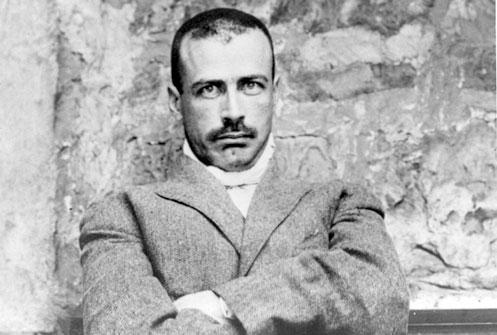
Fifth, in order to represent Canadian literature in French, I nominate Emile Nelligan. Besides often being considered the father of Canadian poetry in French, the tragedy of his life cries out for some remembrance. I would prefer him portrayed in his later years, with that haunted stare of someone who sees the other world.
 |
| Emile Nelligan |
So far, I am obviously favouring literature, which is my pet interest. What about the visual arts? I'm less qualified here, but one thing I do feel strongly: no Group of Seven or Emily Carr. First, far from representing anything original, they paint pretty much like European landscape artists of their time. The only thing that is different is the Canadian landscape. Second, their subjects—the northern wilderness—tend to have been accessible only to the rich and well-born of their time. Third, their interest in the landscape without the human smacks of European tourism rather than a deep human connection to this place.
Among the artists, then, I would rather honour William Kurelek. Kurelek captures the feel of ordinary life among ordinary people, the visual equivalent of Leacock. This is the true Canadian idiom.
Next, and by no means in order of merit, I'd love a statue of Alex Colville at his easel, painting a picture of the sculpture park in which he is placed. He too speaks of ordinary life, and shows its mysteries.
Our third representative of the true Canadian visual medium ought, I think, to be Duncan Macpherson, the longtime political cartoonist. Political cartooning is a real Canadian speciality, part of the wider Canadian tradition of humour. There is nothing anywhere else in art more brilliant than Macpherson's depictions of John Diefenbaker.
For music, I think preference has to go to those who wrote songs with Canadian topics, as opposed to pure musicians. Not only is this more obviously Canadian in nature, but it also expresses Canada's folksy soul, the interest in the common man. Purely instrumental music tends to be for the upper classes.
First up, Stan Rogers. He always wrote and sang about Canadians, and he always wrote about the common working man. Second, Stompin' Tom Connors. Third, Mary Travers, La Baldoc, who largely founded Franco-Canadian folk music as we know it, a blending of French and Celtic strands.
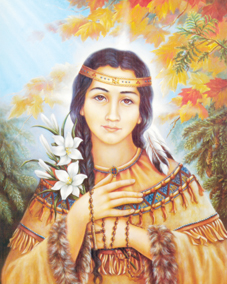
When we think of culture, it is wrong to leave out religious culture. No doubt this is controversial, but excluding religion from the mix is hardly a neutral stance. We need to include saints. First, I think of Kateri Tekakwitha, the first native-born North American saint of the Catholic Church. Her spiritual influence has been enormous on Canadian Catholics, and not just on Catholics: Leonard Cohen, though Jewish, has been deeply inspired by her story. She represents a cultural bridge, between Mohawk, Algonquin, and French, that represents Canada as a whole as a union of cultures. Her ability to consecrate and make great an ordinary life of daily affairs is a model of the Canadian ideal. And she needs to be portrayed, for once, accurately. Statues and pictures of her are always romanticised into a treacly Pocahontas stereotype. She ought to be portrayed as she was, with scars from smallpox on her face, and with a blanket over her head. She always wore a blanket, either out of modesty or to cover the scars on her face. Our one portrait from life seems to show her in a white buckskin dress.
 |
| barf |
We can balance Kateri for Protestants with Barbara Heck, commonly credited with co-founding Methodism, traditionally Canada's largest Protestant denomination, in both the US and Canada. She is also almost a local hero, having settled in nearby Prescott.
Also a saint, but worthy of inclusion even on other grounds, is Marguerite Bourgeoys. She deserves recognition as Montreal's and perhaps Canada's first teacher, and for championing the common man. Who is more important in sustaining a living culture than teachers?
Although a politician, I think we need to include Thomas D'Arcy McGee. We know him as a Father of Confederation; but more than that, he was the ideologue of Confederation, and the great ideologue of Canada as an independent and distinct country, with its own culture. Not incidentally, he was also very largely responsible for turning Canadian Irish away from thoughts of revolution and towards committing fully to the building of a new nationality on this continent. And he seems to have done this, in the end, at great personal cost. Without him, the Fenian raids, for example, might have had a very different result.
Also up (no doubt with groans from those who consider themselves sophisticated) is Pierre Burton. Yes, he is a popular historian, not an academic. But cultures are built on popular histories, not articles in academic journals.
The reader is welcome to add his or her own suggestions in the comments.





 Posts
Posts







.jpg)