Playing the Indian Card

Showing posts with label gratitude. Show all posts

Monday, October 13, 2025

Thanksgiving


Today is Canadian Thanksgiving. It is a time to thank God for our many blessings.

The most obvious thing to be thankful for today is the release, after two grueling years, of the last twenty surviving Israeli hostages. We can hope as well for an end to the war in Gaza. Not for justice over the initial terrorist assault, perhaps; not in this life. But an end to their suffering, and an end one hopes the suffering of the people of Gaza.

I, for one, and I am not alone, am thankful for President Trump. I was originally skeptical; I thought his nomination in 2016 was a disaster. But he seems to have worked miracles for the US, and set an example for the world, perhaps pulling civilization itself back from the brink.

I am thankful for Pope Leo XIV. No; to be honest, I do not know yet how Leo’s pontificate will turn out. I am really grateful for the end of the pontificate of Pope Francis. I feel immense relief at Francis’s passing. Not to prejudge his fate in the next world, he was terrible as pope. Leo seems at least a conciliatory figure. And I feel it is a good thing to have a pope from the USA.

I am thankful for the general apparent collapse of the “woke” culture; the culture war seems to be over and won. We are in the mopping up phase. The importance of this is beyond calculation. Culture is everything.

Connected to this, I am thankful for what appears to be a renaissance of interest in Catholicism and serious Christianity in the US and in Europe. Celebrities are publicly converting; Christianity and theism have won the intellectual battle over the “New Atheists” and scientism. This will move through the culture over the coming years.

I am grateful for the death of modernism in architecture. We lived recently through an awful era of public ugliness. We seem now to be in recovery. Everybody now acknowledges modernism is drear.

I am thankful for the improvements that technology has brought into our lives. We so readily forget how much has changed in the computer age. Many things were more difficult and expensive before smartphones, before desktop computers, before the Internet, before AI. Entertainment of all kinds is now at our fingertips, and much of it free. Information of all kinds is now at our fingertips, and without filter, to the alarm of established powers, much of it free. Anyone can in effect own a printing press and a broadcast studio; all voices can be heard. We can speak to and even see people anywhere in the world, in real time, at will.

Just think back a few generations ago: party line telephones, long distance was too expensive except for special occasions. Airplane flights were too expensive for most. Entertainment was a black and white TV, radio, and visits to the local cinema. For information, you had the newspaper, two or three news shows for one half hour a night, newsmagazines, and your local library. My grandparents had no indoor plumbing.

For all this—let’s be honest—we owe gratitude to “capitalists,” at least to a certain sort of “capitalist,” the entrepreneurs, who are men of vision. Entrepreneurs like Elon Musk, Jeff Bezos, Sam Walton, and Steven Jobs. They ought to be celebrated culture heroes.

I am thankful for all the food we now have available to us in all seasons. Not just the fresh and frozen produce, where earlier generations had to weather the winter on canned fruits and vegetables, pickles and preserves. Also the discovery of and access to a variety of cuisines earlier generations knew not: Indian food, Korean dishes, Thai dishes, Middle Eastern dishes, Mexican cuisine. Conversely, these countries are now familiar with hamburgers and poutine. In my youth, my Canadian hometown did not even have a pizzeria. Food is a central part of life; improvement here is a significant life improvement.

We are not as aware as we should be of the general decline of starvation and poverty worldwide. The whole world is developing. When I was young, even Southern Europe was desperately poor. China was starving, India was starving, Africa was starving. We do not hear any longer of mass starvations. The typical modern “Third World” problem is traffic: too many people can suddenly afford cars, and the infrastructure is not ready for it.

As a Canadian, I am profoundly grateful to have the USA next door. In this, we could not be luckier—other than being Americans ourselves. The US shares our culture and is the richest and most influential nation in the world. It is easy for us to emigrate, as most people around the world would love to. And we benefit from being next door, just as an individual would benefit from living next to the richest man in town; and perhaps running a convenience store. In many ways, it gives us a free ride.

We can be grateful that, as Stephen Pinker has shown, war and violence has declined over the years. There are conflicts and tensions today, but at a lower level than even in my youth, when we had Viet Nam and fears of imminent nuclear holocaust. The horrors of the early twentieth century begin to look like a historical anomaly; general war may indeed have become unthinkable. Nuclear weapons may have made it impossible. And any future war, should it occur, may be fought entirely remotely, with drones and robot vehicles.

The evil empire Reagan spoke of, the Communist Bloc, which once looked so sinister, evaporated like a mirage 35 years ago, freeing Eastern Europe. Vietnam has largely abandoned communism; China has opened up, at least economically. Cuba looks like it is in its last throes as a Communist system. Twenty percent of the population, mostly the top professionals, have emigrated recently.

We no longer need to fear the diseases that were once scourges, the greatest fears we faced. And no so long ago: tuberculosis, scarlet fever, polio, smallpox. Even AIDS; we all so recently feared dying of AIDS. Now we only speak of being “HIV-positive.” Perhaps slower than might be the case, medical science is reducing pain and extending life.

I feel uneasy expressing gratitude to God for personal things, for it seems to lack empathy for those who are not so lucky. But for all these things, I think all Canadians can be thankful.


Monday, July 03, 2023

Happy Freedom Weekend


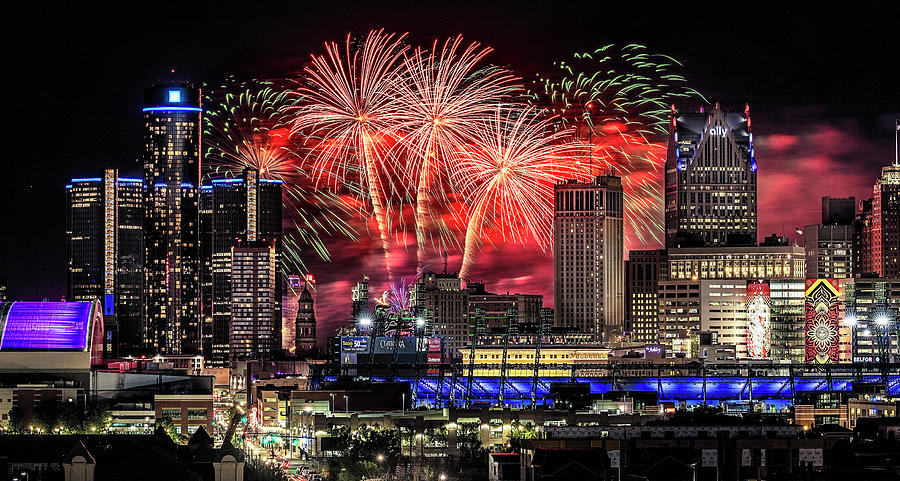
Fireworks from the Detroit-Windsor Freedom Festival

It is perhaps time, on this Dominion Day and Independence Day weekend, freedom’s birthday, to express some gratitude: God is still in his heaven, and the world is not just getting worse. Most notably, we have had several great US Supreme Court rulings as birthday presents, ending systemic racial discrimination in college admissions, restoring freedom of conscience, and killing Biden’s plan to rob from the poor and give to the rich on student loans.

I see much angst online among leftist friends. One points out, incorrectly, that all the judges who opposed the overturning of affirmative action were members of minorities, and those who voted to overturn were from the racial majority. (Kagan is not more obviously a member of a minority than Amy Coney Barret; or Ketanji Brown Jackson than Clarence Thomas). As if, even if true, this showed the ruling was racist. But on the other hand, one would equally expect people who got their positions through racial preferences to support racial preferences. It is racist to suppose that only “white” people can be racist.

But even on the left, something may be happening. RFK Jr. is a beam of sanity appearing unexpectedly on the left horizon. And he is pulling good poll numbers.

In crazy leftist Canada, the deep North, Pierre Poilievre is drawing huge crowds, reminiscent of Trudeaumania generations ago. New Brunswick’s premier is following Alberta’s, it seems, in swerving right.

Things are grim in France—the French police, now a force 45,000 strong, are calling it civil war. Terrible for the moment; but this may kill the delusion of multiculturalism in Europe and across the developed West. It may end the thoughtless “diversity is our strength” mantra.

Diversity is only half of the formula; unity is the other. E pluribus unum. A shared culture is the goal.

Speaking of which, Muslims in North America are protesting against sexual and critical theory indoctrination in the schools, joining with Christian parents. The leftist divide and control multiculturalism idea looks about to fall apart.

The Bud Light boycott has awakened the silent majority that they can do something. And it has awakened the large corporations to the risk of pushing leftist politics. We can see corporations backing away: the NHL, Starbucks.

The Trudeau government’s plan to force web services to pay for linking to Canadian news sites seems to be backfiring on them nicely. They are refusing, as a result, to link to any of the government’s subsidized news sites.

The tide of totalitarianism may still be high, but I think that it has turned.


Saturday, September 17, 2022

The Winter of Our Discontent


We are living through a chaotic time. But this is not necessarily a bad time. Change for the better also brings, for a time, chaos.

We ought to properly appreciate the apparent miracle that happening in Ukraine. As things stand, this relatively smaller nation looks set to defeat the world’s second greatest military power, Europe’s greatest land power, on land, right adjacent to its borders. The impossible appears about to happen. Other nearby nations are growing restive.

We ought to notice the growing economic problems in China. It seems unnecessary to worry about China becoming a new totalitarian world hegemon. The danger of other regimes imitating the Chinese “success” looks suddenly more limited.

 Closed systems can look good over the short or medium term, but they are self-limiting.

The same moral might apply therefore to wokedom, which relies on putting your fingers in your ears and shutting down sources of information. Like the Wizard in Oz, it looks strong so long as it can intimidate the silent majority into silence, the unthinking into thoughtless assent to the loudest voice. As noted here, it is crashing as we speak, largely due to the anonymous “crowdsourcing” possible with the internet. Wokery is getting voted down online, and the big corporations are beginning to worry and respond.

We are insufficiently celebratory on the fading of COVID. It is ending not with a bang but a whimper, which robs us of an inflection point, a V-J Day to celebrate. But that nightmare is over. We are already beginning to forget.

We are now all alarmed by inflation. I am no expert on economics, but it seems to me this has to be temporary. The underlying trend is deflationary.

Let me explain. Inflation is too much currency chasing too few goods. Improved technology means more goods, produced more efficiently. We are in the middle of a major industrial revolution, thanks to computerization, and a quantum jump in efficiency. It is for this reason that, up until two years ago, inflation was not a concern, and the interest rates were historically low. 

Now the supply of goods has been disrupted by covid and the lockdowns. In the meantime, buoyed by their ability to do so without penalty in recent years, governments just started printing money to help people through the lockdowns. This has caused a jump in inflation, but it was artificial. As supply chains come back, and if the government stops handing out money, the matter should correct.

The only problem is that governments have not started to cut back yet. Nothing could be more insane that Biden’s recent program in the USA: spend more money to stop inflation. Except the Canadian government’s idea of raising taxes on carbon, imposing vaccine mandates, and restricting fertilizer during a supply crisis.

But perhaps that too has a silver lining. The cost of living crunch coming now may discredit this approach for some time to come. Sweden has just tossed out their left-leaning government for a right-leaning one. That may be the start of a general trend.

The malaise of the Carter years in the US, after all, were immediately followed by the golden age of Reagan. Carter’s failures made Reagan’s election possible, and the people and congress prepared to consider his policies.

It may be a tough winter.

It may be a glorious spring.