 |
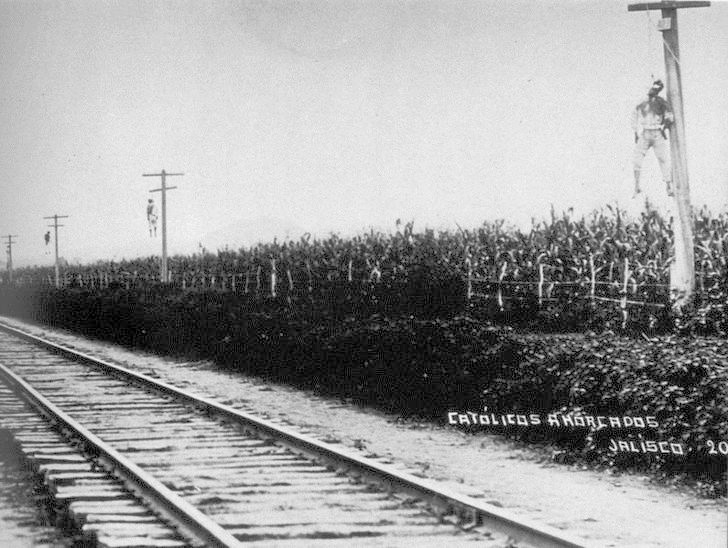
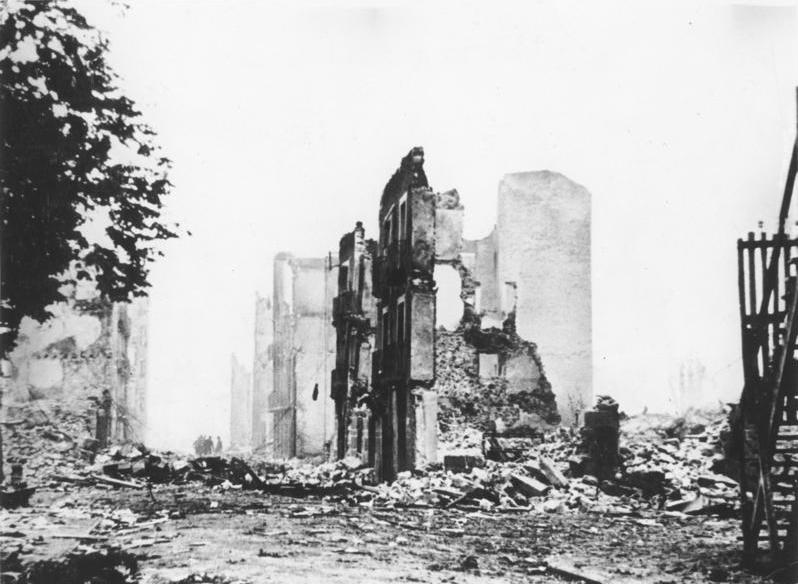
| That was then ... |
The time has come,
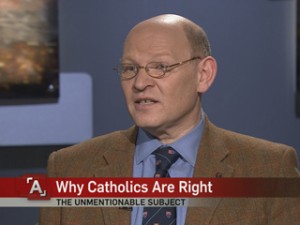
The Walrus says, to speak of Michael Coren. He has raised much fuss, in Canada and abroad, by recently converting from Catholicism to Anglicanism on the issue of homosexuality.
He has now explained his position in The Walrus.
I know how he feels. He is a part of literary Toronto. It is, in the end, a small place, and it would be socially terribly difficult to maintain Catholic teaching on the matter, surrounded by gay friends and colleagues. This, I think, the call of the world, is Coren's bottom line, and it shows in the way he begins and ends his
Walrus piece. He as much as admits it in so many words at one point, in a backhanded way: “A mingling of income, self-perception, and reputation made it difficult to say what I truly felt.” (Was that really then, or is that now?) I, too, have gay friends and colleagues, whom I dearly love—in, I guess I have to add, the true, non-sexual sense. It is a painful issue, in the current social climate.
But that is not, in the end, an excuse. We are all tempted by the world. We must not succumb, even if our social life, or indeed our livelihood, might suffer. And any of Coren's other justifications are unconvincing.
He begins with the profoundly non-Catholic argument that “times change.” Later, he refers to opposition to homosexual sex as “outdated.” As he must, as a former Catholic, know, that holds no holy water. Eternal truth, faith and morals, cannot change, or else it was never truth. As Coren himself has pointed out in a recent interview, the Catholic Church simply cannot change its teaching on homosexuality, for this reason.
What Coren really seems to be saying here is that the social costs of maintaining the Catholic teaching on homosexuality are getting too high.
His second argument is that fellow Catholics have been unkind to him over the issue. This is irrelevant for a couple of reasons. First, since it came after his conversion on gay marriage, it cannot be a reason for it. Second, it is
ad hominem. Truth is truth, quite apart from whether the person saying it is rude or gentle about it.
His third argument is that Catholicism has elevated homosexuality to an importance it does not deserve.
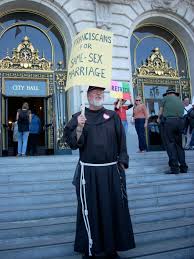 |
| ... this is now. |
This seems completely disingenuous. It is not the Catholic Church that has been saying for the past several decades that homosexuality is important. It is the homosexuals, along with the secular society. If you consult the
Catechism of the Catholic Church, you find homosexuality listed there right along with masturbation, fornication, and adultery. No worse, and no better. All four are wrong. But probably all Catholics have good friends who are guilty of at least one of these things, given the great improbability that they are not guilty of them themselves. Pope Francis sought to make the same point in his famous “Who am I to judge?” interview. So who exactly is pulling homosexuality out of the mix as some sort of poster child, and why? It is not the Church. Looks like it is Coren, for one, in his current conversion.
In any case, Coren is guilty of a big honking
non sequitor. The claim that homosexuality is a relatively minor sin, does not mean it is not a sin.
As I pointed out fairly recently on this blog, most Christians would have no problem with homosexual civil unions that gave homosexuals the same rights as married couples. Many would have no problem with gay marriage as a legal matter. I have myself been in favour of gay marriage for much longer than, say, Barack Obama. This is not the issue. The issue is saying that homosexual sex is morally okay. And, beyond that, not even permitting anyone to say it is not okay. That is where we are heading now. And, frankly, if its advocates really thought themselves that it was okay, they would not feel any need for this third, profoundly radical, demand.
Coren's next argument is that homosexual orientation is more central to the homosexual's identity than alcohol is to the alcoholic, or adultery to the adulterer, and therefore cannot be treated as parallel. But this is surely a straw man: the Church does not condemn homosexual identity, but only homosexual sex acts. It condemns it in the same way it condemns heterosexual sex outside of marriage, remembering that not all heterosexuals will ever marry, or heterosexual sex among the clergy. Is homosexuality then more a part of a homosexual's identity than heterosexuality is of a heterosexual's identity? Is that some new kind of equality?
His next claim is that homosexuals are “born that way.” He combines this with a jibe that Christians tend to deny this. Another straw man, surely. The Catholic Catechism points out, correctly, that we do not know the true roots of homosexuality—it does not deny the possibility that it is inborn. But that is of no relevance. Having a temptation to sin, inborn or otherwise, obviously does not absolve one of the sin. If there were no temptation, no one would ever sin.
To be fair, Coren's deeper point is that it is “theologically dubious” that God would create some people with an inborn tendency to sin. Yet how is this case any different from, say, causing some people to be born into a rich family, remembering that “blessed are the poor”? Or letting them, innocent, be born into an oppressive regime like Nazi Germany, or a libertine one like North American today, where temptations to sin are bound to be greater? We have here no more than one more formulation of the old Problem of Evil; we need not get into it here, for it has been addressed so often. It is remarkable if Coren has spent his entire spiritual life to now without having to deal with it.
Coren then accuses Catholics or Catholicism of “dishonesty” or “hypocrisy” because, he estimates, one third to one half of Catholic priests are gay, “and by no means are they all celibate.”
First, we can eliminate from his complaint any “gay” Catholic priests who remain celibate. In this case, being “gay” is of no consequence. So the “one third to one half” estimate is a red herring twice over. For the rest, no doubt there are some gay priests who violate their vows; does this discredit the Catholic Church? Has the Catholic Church declared somewhere that Catholics, lay or clergy, are sinless? Actually, just the reverse: Catholics say we are all sinners.
Coren then claims, tiresomely, that Bible scholars are coming to a “new understanding” of scripture suggesting that the prohibitions of homosexuality there found are not really prohibitions of homosexuality.
This is no doubt partly true; although on the evidence of Coren's own exegesis said new understandings do require a pretty supple imagination. In order for Protestant denominations to justify dropping their historical opposition to homosexual sex, after all, their theological supporters and operatives must indeed reinterpret scripture somehow. This is an ever-present temptation, in the face of our own perceived present wants and needs; notoriously, even the Devil can quote scripture to his purposes.
To prevent rationalizing one's way to any sort of immoral behaviour or theological error as convenience demands it, Catholicism precludes this gambit. You learn something in two thousand years or so. We are not free to reinterpret scripture at will. We are obliged to understand it broadly in the same way the Church has always understood it. We need to consult the church fathers. It is relevant, therefore, that, in addition to the obvious meaning of the actual words of the New Testament, theologians and Church councils all the way back to the Didache clearly understood homosexual sex to be forbidden. No fudge here, lads.
Coren's next claim is a familiar one, that “love” requires the acceptance of homosexual sex. This relies on a gross though common materialism, which equates love with the sex act. Enough said there.
In the end, if you will pardon the phrase—it seems impossible to avoid double entendres on this subject--I suspect that Coren has been terminally frightened by the very rapid success of the current and growing anti-Catholic pogroms. Can't blame him too much for that: he is right out there. Things are moving so quickly that, in just the past few days, we have seen the bizarre anomaly of a small private bakery in Northern Ireland being convicted and fined for refusing to bake a cake expressly celebrating gay marriage--in a jurisdiction in which gay marriage is illegal.
They are coming for the Catholics. Coren sees this. He does not want to be home on that dark night when the knock comes on the door.





 Posts
Posts