Playing the Indian Card

Showing posts with label Sunday reading. Show all posts

Saturday, December 01, 2012

News Flash: World Ends


Apocalypse in fresco: Macedonia


This Sunday's Gospel Reading:

Jesus said to his disciples:
"There will be signs in the sun, the moon, and the stars,
and on earth nations will be in dismay,
perplexed by the roaring of the sea and the waves.
People will die of fright
in anticipation of what is coming upon the world,
for the powers of the heavens will be shaken.
And then they will see the Son of Man
coming in a cloud with power and great glory.
But when these signs begin to happen,
stand erect and raise your heads
because your redemption is at hand.

"Beware that your hearts do not become drowsy
from carousing and drunkenness
and the anxieties of daily life,
and that day catch you by surprise like a trap.
For that day will assault everyone
who lives on the face of the earth.
Be vigilant at all times
and pray that you have the strength
to escape the tribulations that are imminent
and to stand before the Son of Man."
- Luke 21: 25-36


French Romanesque Apocalypse.

As you probably know if you follow this blog, I think it is absurd to worry about the end of the world. What difference does it make? The issues are the same issues we face at individual death, and that is certain to happen in our lifetimes. Moreover, for each of us, subjectively, the End of the World is functionally coterminous with our individual death.

So looking for signs in the sun, the moon and the stars is a fool’s game. There are always signs in the sun, the moon, and the stars. Nations are always in dismay. We need to always be prepared, regardless of such signs—because we could die at any moment, quite regardless of what happens in the world at large.

And I believe this is in fact what Jesus is talking about. This is the only way it is literally true that these things “will assault everyone who lives on the face of the earth.”

The exercise of keeping in mind our own death, on the other hand, is a very wise one, one that has always had an important part in the Christian world view. The “Memento Mori” is a traditional genre of art.

A memento mori from the ruins of Pompeii

One of the things that struck me as most deranged, when I returned to Canada after seven years overseas, was how death seems to be a taboo subject. Everyone speaks and acts as if it is something abnormal, something which should never happen to them.

Memento mori on an English tombstone.

I suspect the current preoccupation with the end of the world is a result of this. Everyone thinks the world is about to end. There is this silly rumour that the ancient Mayan calendar predicts the end of the world for December 21 this year. And there are any number of fundamentalist Christian groups who announce the end every few years. Not to mention Catholics relying on Fatima’s Third Secret or the prophecies of St. Malachi. But more pernicious are the global warming crew, the population bomb throwers, the peak oil pundits, and the like.


Memento mori, Uffington Church, England.

It will happen when it happens, and in the meantime, it doesn’t make any difference to you or me.

Sunday, November 11, 2012

Sunday Gospel Reflection; The Widow's Mite


Tissot: The Widow's Mite
In the course of his teaching Jesus said to the crowds,
"Beware of the scribes, who like to go around in long robes
and accept greetings in the marketplaces,
seats of honor in synagogues,
and places of honor at banquets.
They devour the houses of widows and, as a pretext
recite lengthy prayers.
They will receive a very severe condemnation."

He sat down opposite the treasury
and observed how the crowd put money into the treasury.
Many rich people put in large sums.
A poor widow also came and put in two small coins worth a few cents.
Calling his disciples to himself, he said to them,
"Amen, I say to you, this poor widow put in more
than all the other contributors to the treasury.
For they have all contributed from their surplus wealth,
but she, from her poverty, has contributed all she had,
her whole livelihood." – Mk 12: 38-44


da Costa: The Widow's Mite

It really is possible to derive a political message, of a sort, from the Gospel. It is not so simple as an advocacy for the poor over the rich. Here we see the poor praised, but it is not the rich who are condemned. All Jesus says here is that the widow’s contribution is worth more than the rich folks’. And in the famous story about the camel and the eye of the needle, Jesus first says the young rich man is doing fine so long as he has kept all the commandments. Only when he presses for what more he can do does Jesus ask him to give up his riches. Similarly, Jesus does not rail against the political rulers or the military. When prompted to, he will not condemn Caesar, nor tax collectors, nor soldiers.

But he does condemn others Here, we have an obvious comparison and a contrast: the scribes on the one hand, the poor widow on the other. This is emphasizes by the reference to “devouring the houses of widows” in the first part of the passage, linking it to the second. The poor widow is an image of moral goodness, and the scribes an image of moral evil.

And the scribes are in fact an identifiable class in the political sense. Along with Pharisees, and Sadducees, these are the bad guys in Jesus’s politics, his analysis of society. Who were, or are, the scribes? The Wikipedia article on the topic observes that “scribes” in ancient societies evolved directly into the lawyers, civil servants, accountants, and journalists of today. Broadly, the professions, the educated professional class; or what Coleridge called the “clerisy.” The “Pharisees,” in turn, were the teachers and academics. The “Sadducees” were the professional clergy.

Put them all together, and you have the educated class, the professions; what Coleridge called the “clerisy.” Marx has obscured the fact that it is this class, in fact, who runs society, everywhere and at all times. Which is why he is so loved by the clerisy. In the Estates General before the French Revolution, the First Estate, the top dogs, were the clergy, not the nobles; they were overthrown by the lawyers, not the bourgeoisie. In India, the top caste is and has always been the Brahmins, the educated priestly caste, not the rajas and maharajas. In China, everything was controlled by the Mandarins.

The New Testament understands this clearly, and condemns this class as essentially exploitative. There may be and, in the New Testament, are, good people in it, but the class as a class is an evil; so that both Jesus and John the Baptist consistently condemn it as a group. The relevant condemnation here, especially given the contrast with the widow, is that they live high by taking money from people who need it more than they do; and yet they claim some sort of moral superiority.

If I may be so bold as to extract a further political point here, this class sounds a lot, to me, like the class that backs the modern left. The support for and the actual leadership of the Democrats in the US, or the Liberals and NDP in Canada, comes from the educated professions: the lawyers, civil servants, accountants, journalists, academics, teachers, and mainstream clergy. Their common claim is indeed that they are morally superior: that they care for, and about, “the poor” and “minorities.” Unlike Republicans and Conservatives.

Jesus suggests that this is a sham. Those who gain moral credit from such programs, after all, are not the bureaucrats who administer them, the pundits who call for them, or even the voters who vote for them, but the ordinary taxpayers who pay for them. The many widows with their mites.

This should seem obvious, but apparently it is not. I recall a religion professor of my acquaintance introducing his wife as a Bodhisattva, a Buddhist saint. Why? Because she had a nice cushy job working for a charity.

That’s not a Buddhist saint. That’s a hypocrite. In the precise New Testament sense.

Monday, February 27, 2012

The Temptation in the Wilderness: This Sunday's Gospel


Russian icon


The Spirit drove Jesus out into the desert, 
and he remained in the desert for forty days,
tempted by Satan.
He was among wild beasts,
and the angels ministered to him.

After John had been arrested, 
Jesus came to Galilee proclaiming the gospel of God:
"This is the time of fulfillment.
The kingdom of God is at hand.
Repent, and believe in the gospel."

Monreale Cathedral mosaic
 

Jesus goes out into the desert. Why? Besides the obvious privations, as the passage notes, he risks being torn apart by wild beasts. And for what? For the opportunity of being tempted by Satan? Don't we pray, “lead us not into temptation?” Where's the upside here?

Yet all the prophets, up to and including John the Baptist, preceded him in this pilgrimage out into the barrens. So have many monastics after him, beginning with St. Anthony of Egypt. So, in fact, did the Native Americans—young men were supposed to spend a time exposed alone out in the wild on the cusp of adulthood.

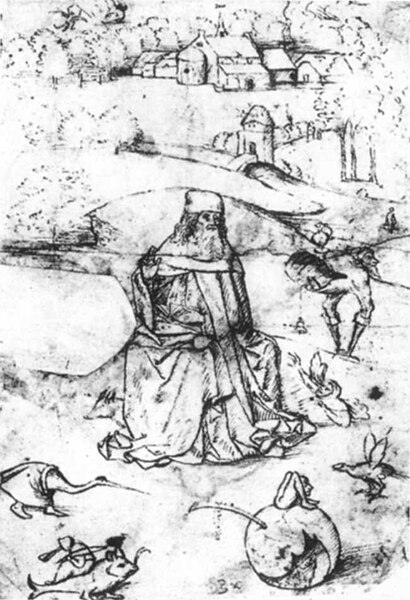
Temptation of St. Anthony attributed to Bosch.

The first moral I take from this is that the religious are not, contrary to much popular misconception, the shy wallflowers of the world. They are not the Father Mulcaheys. They are not ignorant of evil, and they do not avoid evil. Instead, virtue is heroic. It is a matter of meeting with temptation, and battling it eye to eye and hand to hand.

This only stands to reason. If one does not sin simply because one is not tempted, one is not acting morally. It is only with temptation that we have the opportunity to be moral beings.


Accordingly, it is only after a heated struggle with evil, with suffering, and with temptation, that one is ministered to by angels. It is in this solitary setting, along with the wilder spirits, Lilith and her kind, that God himself speaks clearly. It was in Sinai, in the desert, and alone, that Yahweh spoke to Moses. Artists, too, commonly find themselves liberated, and their muses made chatty, by solitude, or exile. Our Christian Lent is a reflection of this, and the Catholic tradition of penance, and the Catholic tradition of “retreat.”

There's more. In order to come into proper contact with the spirit, we first need to shut out the incessant din, not just of the material, but even more, of the social. The world of spirits, which we then contact, includes beings and experiences both good and evil. Rick Santorum, as it happens, is right. There really is a Devil. That's rough; that's what happens when you have free will; but the good includes the Highest Good.

Saftleven, Temptation of St. Anthony

This uncovers a tragic problem with modern psychiatry. The last thing in the world any psychiatrist or psychologist worth their degrees will tolerate is a patient's solitude. All solitude or desire for solitude is thought pathological. Never having been to the desert themselves, the good doctors see it as the typical townsman sees it, only as a barren and dark place full of dragons. They do not know what happens if you ever slay those dragons. They themselves have never ventured out of doors.

The result, I suspect, is often if not always to turn what should be a life-fulfilling spiritual quest, indeed, the point of life itself, into a state of life-long torture. Get repeatedly yanked back into town, and you just get the monsters, again and again and again.

Grunewald, Temptation of St. Anthony

The best treatment for “mental illness” might also be the cheapest. Basically, let the poor pilgrims work it out on their own, and stop harassing them.Take the welfare cheque they would be due in any event, and use it to rent a simple cabin somewhere in the woods. Not hard to find such a thing in Canada, especially in the winter, when the tourists have gone home. Instead of an expensive physician, who knows not what he does, just hire someone local with a truck to deliver the necessities of life to the cabin door weekly. I'd suggest stocking the cabin with a little bit of reading material as well—such as, oh, I don't know, say, a Bible. No problem if you want to get non-denominational and add a Book of Mormon, a Qur'an, the Bhagavad Gita, and the Tao Te Ching. The more, the merrier. A few psychiatric pills would probably do no harm.

Then just wait until the blessed hermit phones and says he's ready to rejoin the world.

Wijnen, Temptation of St. Anthony

In Canada, what could be simpler?

I have heard former schizophrenics claim they actually cured themselves with a procedure like this. I have heard many people who were mentally ill pine for this, saying they thought this would be the way they might be cured.

Why not?

Better yet, perhaps we could prevent much “mental illness” in the first place if, like the Native Americans, we all did this at a certain point in our lives, as a matter of course.

Bosch, Temptations of St. Anthon

Monday, February 20, 2012

Sunday's Reading


When Jesus returned to Capernaum after some days,
it became known that he was at home.
Many gathered together so that there was no longer room for them,
not even around the door,
and he preached the word to them.
They came bringing to him a paralytic carried by four men.
Unable to get near Jesus because of the crowd,
they opened up the roof above him.
After they had broken through,
they let down the mat on which the paralytic was lying.
When Jesus saw their faith, he said to the paralytic,
"Child, your sins are forgiven."
Now some of the scribes were sitting there asking themselves,
"Why does this man speak that way? He is blaspheming.
Who but God alone can forgive sins?"
Jesus immediately knew in his mind
what they were thinking to themselves,
so he said, "Why are you thinking such things in your hearts?
Which is easier, to say to the paralytic,
'Your sins are forgiven,'
or to say, 'Rise, pick up your mat and walk?'
But that you may know
that the Son of Man has authority to forgive sins on earth"
-he said to the paralytic,
"I say to you, rise, pick up your mat, and go home."
He rose, picked up his mat at once,
and went away in the sight of everyone.
They were all astounded
and glorified God, saying, "We have never seen anything like this."

--Mk. 2:1-12


Paralysed man flying.


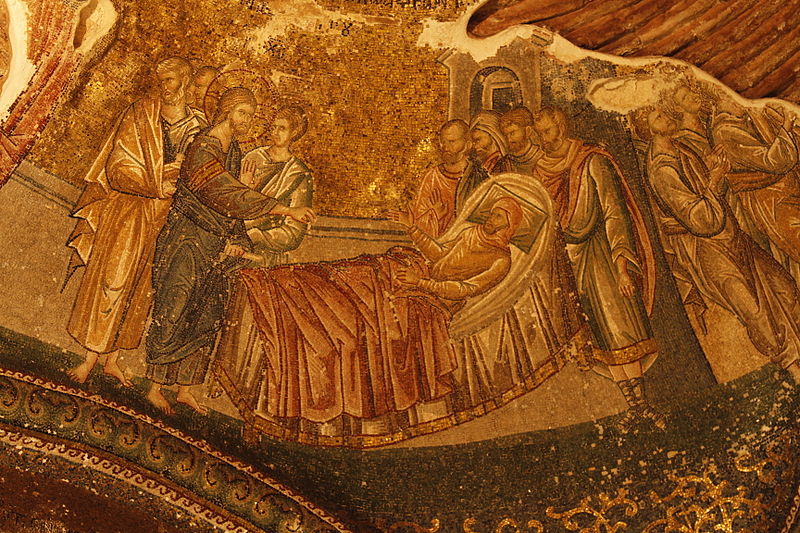
As usual, this Sunday's Gospel reading is pretty darned funny. Picture the remarkable detail of those four men, unable to get close to Jesus, actually climbing onto the roof of the house, pulling their paralysed friend up with them, breaking the roof open, and lowering him down. They were bound and determined to find that poor man a cure.

And then Jesus's reaction: he looks at the man, and says, “Child, your sins are forgiven.”

That's is. His sins are forgiven. Imagine the reaction of the four men who have lowered him down with such effort. That's it? His sins are forgiven? What about his blooming paralysis?

Consider just how much obvious sin a paralysed man is likely to be getting up to. Adultery? Gluttony? Armed robbery? Is it really likely this is a man lost in sin? Yet Jesus ignores the blindingly obvious physical limitation.

He does then cure him of paralysis, but, only to make a point—that he can forgive sins. It seems purely an afterthought.

Your sins are forgiven. Too bad about the paralysis, though.


There is a very good reason why miracles are trivial. God is good; and God made the world. It follows that the world is already set up for our benefit. Accordingly, no miracles will really make things better for us. We need no miracles. All we need, as St. Theresa of Avila said, is a relationship with God. Which is to say, all we need is to know that God forgives us our sins.

So why any miracles at all?

Miracles are God's reminders that he is there, and that he loves us. We should expect and accept them purely in these terms.

Saturday, February 04, 2012

Mark 1: 29-39


On leaving the synagogue
Jesus entered the house of Simon and Andrew with James and John.
Simon's mother-in-law lay sick with a fever.
They immediately told him about her.
He approached, grasped her hand, and helped her up.
Then the fever left her and she waited on them.

When it was evening, after sunset,
they brought to him all who were ill or possessed by demons.
The whole town was gathered at the door.
He cured many who were sick with various diseases,
and he drove out many demons,
not permitting them to speak because they knew him.

Rising very early before dawn, he left
and went off to a deserted place, where he prayed.
Simon and those who were with him pursued him
and on finding him said, "Everyone is looking for you."
He told them, "Let us go on to the nearby villages
that I may preach there also.
For this purpose have I come."
So he went into their synagogues,
preaching and driving out demons throughout the whole of Galilee.


What jumps up at Christian Scientists about this Sunday’s reading is that Jesus had the power to heal, and healing illness was a major part of his activity. What jumps out at me in the reading is that there were clearly a lot of people possessed by demons in First Century Judea. About as many, it sounds like, as people with physical illnesses, at a time when physical illnesses must have been more common than today.


So why do we not have many people possessed by demons today? What happened between then and now? Or do we?


After all, demons are real. That is non-negotiable for a Catholic. All things, visible and invisible, seen and unseen. Logically, then, demonic possession is also real, and the Church retains rites to deal with it. So, not incidentally, do the Orthodox Churches, Islam, and virtually all other religions. Can they all be wrong?


The obvious conclusion, and the one I make, is that what was then called demonic possession we now call “mental illness.” Freud even used the terminology: he speaks of “obsession.” “Obsession” originally meant “hostile action by an evil spirit,” one notch down from possession. What could be clearer? And this, of course, is why we, as if instinctively, fear the “mentally ill.”


A “schizophrenic” of my acquaintance keeps hearing metallic voices telling him to go jump off the balcony. Occam's razor: the simple and obvious explanation is that he is being tempted by an evil spirit. Anything else requires a good deal of mental gymnastics.


Another, to use the classic example, thinks he is Napoleon? The simple explanation is that he is possessed by the spirit of Napoleon, or of an evil spirit masquerading as the French Emperor.


So too with anxiety and depression. 1 Samuel 16:4: 14 “Now the spirit of the LORD had departed from Saul, and an evil spirit from the LORD terrified him.”


Given that “mental illness” is necessarily, by definition, mental or spiritual in nature, it seems only sensible and efficient to address it in mental or spiritual terms. In other words, if a person thinks he is being invested with an evil spirit, he is being invested by an evil spirit, because in this case the thought is the thing itself. And the most efficient cure is something that will drive out the thought of the evil spirit. If the thought is gone, the thing is gone.


How? How do you change hearts and minds?


Two ways: art and prayer.


Shamanic cultures use what seems to us very much like drama: a story which can engage the mind and concentration, Coleridge’s “willing suspension of disbelief,” and which then catches up and drives out, as Aristotle explained (it is the meaning of his term “cartharsis”), the evil spirits. This is how Korean mudangs, female exorcists, work, or the Native American “False Face Societies.” Other arts can also do this, in their various ways. David's harpistry drove the evil spirits from King Saul: “seek out a man who is a skilful player on the harp; and it shall be, when the evil spirit from God cometh upon thee, that he shall play with his hand, and thou shalt be well.”


Myths, two, are probably designed to do this. “Myth” literally simply means “story.” Make it a real stemwinder, and it should have the engaging power to chase off the plague dogs.


If so, it is a serious misunderstanding to suppose a myth is a serious, but mistaken, statement of “scientific” cosmology—that it is meant to be taken seriously as the scientific explanation of how the leopard got his spots. It is real and true to the extent that it is engaging and vivid. This is why, for example, the Greeks, the Egyptians, or the Indians, could happily accept several contradictory myths in this scientific sense: several different origins for the sun, for example, or for mankind. Not a problem.


This is not science, but spiritual technology. Myths make the world meaningful and significant, and so fend off the demons. Or, should a demon come, immersion in a suitable myth can heal.


Now, what happens when the old stories, or the art, breaks down? That is, either it is forgotten by a large portion of the people, or it loses its power to enthral, to suspend disbelief?


All hell should theoretically break loose. There should be a general sense of meaningless and barrenness to the world; what was once a garden of shining meanings becomes a desert or a wilderness. And then the demons, who dwell in the wild places, like Lilith, or Pan, or the djinn, will come.


And they do. The classic case where this can be expected to happen is during rapid cultural change; when, for example, a culture long isolated encounters a new culture suddenly and massively.


Think, for example, of the North American Indians: as is generally understood, as soon as the Spanish arrived on their shores, they started dying off in droves. The usual explanation is the contact with unknown diseases, and that is fair enough, but it does not fully explain the matter. For one thing, logically, that spread of diseases ought to have gone about equally both ways, so the Europeans should also have started dying off. There is, indeed, evidence that syphilis came to the old world from the New; but it hardly had the effect on Europe the Indians experienced. For another, it does not explain how the early Conquistadors, with only a handful of men, were able to conquer vast Empires, the Incans and the Aztecs, with little effort.


Darwin spends some time in “The Descent of Man” documenting many similar examples from around the world, from the many new contacts of the European age of exploration and colonization. He does not see the effects of new viruses so much as the sudden loss of fertility: people in these societies stop having, and caring for, children.


Why?


Not because they are ill, but because they are dispirited. As we see in microcosm whenever an individual has a case of culture shock, the encounter with a new culture throws all the old stories into question, all the meanings the human world has acquired for that individual or culture. The individuals in the culture become depressed, unable to go on because unable to see any point in their existence. In time, they may well also become possessed--mad.


Why did the same thing not happen to the Europeans? Because they were inoculated by already, rather recently, having had contact with other alien cultures. Notably, the Spanish only finally drove the Muslims out of Spain in the same year Columbus sailed. More notably, they had long ago been inoculated by a mythos developed during the Alexandrian and Roman Empires, with their mixing of peoples.


I suspect, indeed, that a milder version of this sort of cultural collapse with the loss of the old stories was the general condition in Palestine and in the Roman Empire at the time of Christ. The conquests of Alexander, followed quickly by the conquests of Rome, suddenly brought a wide variety of cultures into direct contact, Persians, Semites, Greeks, Egyptians, Celts, destroying the common heritage of the shared stories and psychic dramas that Homer, for example, would have known. As a result, the gods were no longer taken very seriously. And as a result, a sense of meaningless and then an epidemic of demonic possession should be expected to be extremely common at that time. And it was—we can trace the sense of meaninglessness, the general depression, in the writings of what is sometimes called the “Axial age.” circa 500 BC. 


Ecclesiastes is the perfect expression of depression. Buddhism, Pythagoreanism, the Tao Te Ching, and the Upanishads are of the same time, and of the same genre.


Then, we seem to see, in the New Testament, the upwelling of demonic possessions—of that madness beyond depression and anxiety.


This explains, in turn, how Christianity spread so quickly through the Empire: its ability to cast out demons. This is in fact what the ancient historians tell us: that first the Jews, and then the Christians, developed a huge prestige throughout the empire specifically for their ability to cast out demons. The powerful impression of its spiritual coherence, its spiritual truth, its vivid and compelling narrative, was strong enough to restore the shattered spiritual order. Later, it was strong enough to give Europe the upper hand in encountering alien cultures world-wide. Later still, its ability to drive out the demons and restore psychic order has led to its rapid adoption throughout the Third World: in the Americas, Africa, and now China.


Unfortunately, in the more developed parts of the world, we have recently seen another shattering: the one reported by Eliot in The Waste Land, or Yeats in The Second Coming. Things have again fallen apart, over the past century or so; again the spiritual centre cannot hold. Again what we see around us is no longer the shimmering garden of meaning, but a desert, the desert too of “Waiting for Godot.” Art has become derelict and morbid, and the incidence of mental illness seems, by many accounts, to be skyrocketing.


We are all going mad. We are all becoming possessed by demons. There is a spiritual catastrophe taking place.


This, I believe, is not because of globalization. That has been a relative constant for five hundred years. It is because our fascination with the material successes of science and scientific technology has caused us to neglect and to abandon our spiritual technology. We are no longer teaching our children the stories. We are no longer enthralled by the mystery of the Mass. We no longer believe in anything in particular.


As a result, we have stopped having children, or caring for them.


We are letting the demons in.