Playing the Indian Card

Showing posts with label Christian missions. Show all posts

Wednesday, July 06, 2016

Yoda: Not a Real Indian. Though He May Be Lutheran.


The revelation that most Indians are Christians may produce, for many who did not already know, some cognitive dissonance, some disorientation. After all, we all know an Indian elder is full of spiritual wisdom, posing koans like a Zen monk, or like Yoda or Obi Wan Kenobi. A lot more profound than the dull routine of weekly Christian church-going. Why, then, would the Indians prefer Christianity? Why would they abandon a superior spiritual wisdom for an inferior?

But then again, perhaps the first question should be: where did this general awareness of deep Indian spirituality come from?

Like so much else, it mostly showed up in the Sixties. Noble savage salad days again. It comes largely if not entirely from several books by Carlos Casteneda, best-sellers through the last Sixties and early Seventies. Casteneda was an anthropology student at UCLA. Prospecting for Indian herbs in the nearby desert, he met don Juan Matus, a Yaqui Indian shaman, who accepted him as his disciple. Don Juan introduced him, through the use of peyote, Jimson weed, and mescaline, to the awareness of a “separate reality” in which he could turn into a crow, fly, talk to coyotes, or jump off a cliff without being harmed. And, he gradually came to understand, these were not just hallucinations. Reality itself was an arbitrary construct; there was no objective reality. It was just the story we chose to believe in. It could, if one developed enough shamanic “power,” be altered at will.

Carlos Casteneda: selfie

You can see how this would have gone over well in the Sixties. Time magazine declared Casteneda the “Godfather of the New Age”; Salon calls him “the literary embodiment of the Woodstock era.” Much that we now call “postmodernism” can also be found here. And there is a good reason why don Juan seems reminiscent of Yoda or Obi Wan-Kenobi. George Lucas, creator of the Star Wars universe, claims to have been deeply influenced by the don Juan books. Casteneda was Skywalker, the original Jedi knight.

But it was all originally to do with Indians.

The books, presented as legitimate anthropological field esearch, have given “native spirituality” its immense current prestige. Behind that taciturn experior, those infinitely wise old Indians were hiding super powers. They've probably been laughing at us all along.

This presige is now so great that, according to a recent story in the National Post, the Canadian prison service, which funds chaplaincies, currently pays more for native spiritual services than for all other faiths combined. And this despite the fact that only five percent of federal prisoners identify with “native spirituality” (Marie-Danielle Smith, “Prisons pay more for native spiritual services than all other faiths combined,” National Post, June 8, 2016).

All this accepted as so, the fact that most Indians are Christians becomes a puzzle. And we have been able to discount the idea that this was somehow done by government compulsion. So how?

It must have been some kind of trick. For example, seeing the European wealth, perhaps they feigned conversion for material advantage. They are really all still secret pagans.

This is a charge often made against Christian missionaries. In China, the accepted term is “rice Christians”--locals who allegedly nominally converted to Christianity to get a daily dole of rice from the nearest mission.

This may sometimes have been true. The French gave Indians converting to Catholicism one great material advantage: a firearm. They would not even sell or trade a firearm with a non-Christian Indian. Convert, then, and you got a gun, for self-protection and for hunting. It could mean your life.

From the French government point of view, this was probably not intended mostly as an incentive to convert. It was more a matter of wanting to get weapons into the hands of your allies and not your enemies.

Still, it might have served that purpose.

Father Brebeuf also reports a Huron chief telling him, in so many words, "Echon, I must speak to you frankly. ...The people of Ihonatiria said last year that they believed, in order to get tobacco” (Jesuit Relations 13, p. 169). A pretty clear admission. This, however, was in reaction to the Jesuits warning the Indians that, to be Christians, they would have to give up polygamy and other pleasures. It might not have been strictly true—more a matter of asserting that the Indians cared more for their pleasures than for this new religion.

Our Jesuit correspondents maintain that this was at least not always so. “No one can say that this good neophyte,” they report of one convert, “has enrolled himself under the standard of Jesus Christ out of worldly considerations. ... [H]e has never asked, nor showed any inclination to get, anything from us ... We had neglected him for a long time, not even giving him anything to eat, or paying him much attention; .... Indeed, he often said to Father Brebeuf, 'I became a Christian, not for the body, but for the soul.'” (Relations 12, p. 257-9).

If the Jesuits were using material rewards to attract new Christians, it sounds as though they were doing a slipshod job of it.

Yet we cannot simply take the Jesuits' word on this. Honourable men, no doubt, but not disinterested parties. Whether true or not, they would want to believe that Indians were not converting for ulterior motives.

On the other hand, note that Brebeuf and his catechumen here are strictly correct in terms of Catholic theology. Although it finds a place in some forms of Calvinism, there is no room in Catholicism for the “prosperity gospel.” It would be bad theology, and the Jesuits always knew their theology. Even if some Jesuits wanted to falsify Catholic doctrine in order to attract converts—an achievement that would be meaningless in theological terms--they would have risked entangling themselves in theological and logical incoherence. It is hard to make the idea of material rewards mesh with much in the gospel or the catechism. A shrewd Indian could have brought them up short.

Given that Catholicism expressly denies offering material rewards, and promises its treasure “not in this world but the next,” the lure of material advantage through one's religion probably, on the whole, would have worked against the missionaries, not for them. If Christianity does not promise material benefits, their rivals, the shamans with their traditional native practices, did. As, indeed, does Casteneda's don Juan. Shamanism is mostly magical in nature: do this dance, and you get rain. Use this herb, and you get a pretty wife. This charm helps with the hunt. The early Moravian missionaries lament, of the Eskimos, “They could see no practical benefit from this new religion, which did not promise them any help in seal-fishing, or in building their kayaks” (Thompson, Moravian Missions, p. 232-3). "Do not speak to me about the soul," remarked one Indian to Father LeJeune, "that is something that I give myself no anxiety about; it is this (showing his flesh) that I love, it is the body I cherish; as to the soul, I do not see it, let happen to it what will" (Father LeJeune, Jesuit Relations 12, pp. 131-3).

Moravian mission, Labrador

It seems the spiritual message got through, but apparently not on this basis.

In any case, even if imagined material benefit was behind the original conversion, this could not explain the continuing Indian loyalty to Christian ideals since. There would be no reason now, with the immense prestige of native spirituality, and the government money lavished on it, to dissemble. The material incentives are clearly in the opposite direction.

Another theory sometimes heard is that it was all dumb luck. The missionaries, if inadvertently, brought the smallpox. The smallpox devastated Indian cultures, making many question established verities. The traditional shamans based much of their prestige on being able to cure illness. There is a reason why they are often called “medicine men.” Happening to be there when this void occurred, Christianity was able to benefit; even if it was really an inferior creed.

Elizabeth Fenn makes this claim. “Repeated bouts of pestilence shattered native tribal organization, disrupted kinship ties, undermined Indian belief systems, and called into question the skills of traditional medical practitioners. The chaos made many Indians more receptive to the alternative religious and social structures offered by Catholic evangelicals when they moved into disease-ravaged regions" (Elizabeth Fenn, Pox Americana, NY: Hill&Wang, 2002, p. 142).

This seems initially plausible as well. Father LeJeune claims, “These poor barbarians, perishing every day, say that there is no longer any real Manitouisiou [shaman] among them, that is to say, no genuine sorcerer” (Jesuit Relations 12, p. 7). The Jesuits record, of one Indian, “this poor barbarian did come to see ... [Govenor Montmagny], and asked him why they were becoming visibly depopulated, and we, on the contrary, lived so long. 'It must be,' said he, 'that you know some secret for preserving your people, and that you have an intimate acquaintance with the Manitou'" (Jesuit Relations 12, p. 183). Later, another delegation of Indians at Quebec say, “It must surely be, … that the God whom this Father announces to us, is powerful, since he so perfectly cures the greatest and the most contagious diseases,—which the Manitou or Genii, whom our sorcerers invoke, cannot do'” (Jesuit Relations 31. p. 199-201).

“On the first day of July,” Father LeJeune writes, “a Captain of the petite nation of the Algonquins brought me letters stating that this Captain [chief] was coming down to Kebec to see the Captain of the French. 'He is considered,' said this Savage, 'a grand personage in our country; they say he is a great friend of the Sun, and that he gives letters which prevent one from dying, at least soon. I am going to ask him for some of them,' said he” (Jesuit Relations 12, p. 181-3).

This was in line with pre-existing Indian expectations of spiritual practices: sing the proper medicine song, do the proper medicine dance, and you get well. And unlike the cargo cult notion, it was also reasonably in line with Christian traditions. One does not become a Christian for one's health; on the other hand, Jesus went about healing the blind and lame. Healing is the most common class of miracles attributed to the saints. It seems to be a traditional way for the Christian God to manifest his power. So it was proper for the Jesuits themselves to promise that God would give health. “Two or three persons, having had recourse to the superstitions of the jugglers,” one Jesuit reports, “died almost in their hands; and all those who addressed themselves to God were either cured or relieved in their diseases” (Jesuit Relations 31, p. 197). No scoffing at magical thinking here—it was how the Holy Spirit did his work. So too today: visit St. Joseph's Oratory in Montreal, or Lac Ste. Anne in Alberta, and count the discarded hearing aids and crutches on the wall.

Yet this factor too may have been, for the early missionaries a double-edged sword. After all, it was not likely to escape Indian notice that, wherever the black robes came, the smallpox seemed to come in their wake. Did this new religion cure disease, then, or did it cause it?

“I wish to say,” writes one Jesuit, “that the savages have all the reasons which purely human argument can suggest to them, for having an aversion toward the faith, or rather, for rejecting it; ... Since we have published the law of Jesus Christ in these regions, plagues have rushed in as in a throng. Contagious diseases, war, famine, — these are the tyrants that have sought to wrest the faith from the faithful, and that have caused it to be hated by the infidels. How many times have we been reproached that, wherever we set foot, death came in with us! How many times have they told us that they had never seen calamities like those which have appeared since we speak of Jesus Christ! 'You tell us' (exclaim some) 'that God is full of goodness; and then, when we give ourselves up to him, he massacres us. The Iroquois, our mortal enemies, do not believe in God, they do not love the prayers, they are more wicked than the demons, — and yet they prosper; and since we have forsaken the usages of our ancestors, they kill us, they massacre us, they burn us, they exterminate us, root and branch. What profit can there come to us from lending ear to the Gospel, since death and the faith nearly always march in company?’ There are Christians who generously answer these complaints: 'Though the faith should cause us to lose life, is it a great misfortune to leave the earth in order to be blest in heaven? If death and war slaughter the Christians, no more do they spare the infidels.' 'Yes, but,' answer the others, 'the Iroquois do not die, and yet they hold prayer in abomination. Before these innovations appeared in these regions, we lived as long as the Iroquois; but, since some have accepted prayer, one sees no more white heads, — we die at half age'” (Jesuit Relaions 25, p. 33-5).

"It is la prière that kills us” another informant maintained to the Jesuits. “Your books and your strings of beads have bewitched the country. Before you came, we were happy and prosperous. You are magicians. Your charms kill our corn, and bring sickness and the Iroquois. Echon (BrĂ©beuf) is a traitor among us, in league with our enemies" (Parkman, The Jesuits in North America, p. 272).

“There is no human eloquence,” laments another missionary, “which can persuade a people to embrace a religion which seems to have for companions only pestilence, war, and famine. It is God alone who causes the Faith to germinate, who preserves it, and who vivifies” (Jesuit Relations 31, p. 239).

So smallpox is unlikely to have been a critical factor leading to the general conversion. Christianity seems to have conquered as much in spite of, as because of it. In any case, as with material prosperity, if the Indians were “tricked” into becoming Christians by seeing it as medicine (and granted that Christian prayer really may heal), why their continued commitment today? The government gives them free health coverage.

We are left, then, with the disturbing likelihood that, to the minds of the Indians, who should know best, Christianity was simply superior as a spiritual doctrine to anything their traditional culture could offer.

In order to understand this, first it is probably important to know that Casteneda's don Juan, the wise Yaqui shaman on whom our high opinion of “native spirituality” is mostly built, was a fictional character—no more real than Obi Wan Kenobi. Casteneda was one more in a familiar line of charlatans who saw that, by putting their claims in the mouth of an imaginary Indian, they suddenly gained great credibility. Indians, we instinctively believe, cannot lie. Without this device, who was actually going to accept that Casteneda turned into a crow, or learned to fly? Yet they did in his day—up to and including his thesis committee at UCLA, and UC Press. In 1973, Time magazine discovered that most of Casteneda's public claims about his own biography were false, and for no particular good reason: he had lied about his military service, his father’s occupation, his age, his country of birth; possibly about his name. So others began to examine the details of his tales about don Juan. While don Juan supposedly presented “a Yaqui way of knowledge,” and was resolutely anti-Christian, it turned out that the real Yaquis were Catholic, so far as anyone could see. Unlike don Juan, even in their older pagan traditions, they did not use peyote or other psychoactive substances. In his 1980 piece “The Don Juan Papers,” psychologist Richard de Mille tracks down don Juan's spiritual sayings, and discovers they are generally taken more or less verbatum from familiar philosophers, spiritual writers, and anthropological literature. Either don Juan spent a lot of time in a college library, or Casteneda did.

Yaqui flag. Note the central cross.
“In one example, de Mille first quotes a passage by a mystic, Yogi Ramacharaka: 'The Human Aura is seen by the psychic observer as a luminous cloud, egg-shaped, streaked by fine lines like stiff bristles standing out in all directions.' In A Separate Reality, a 'man looks like a human egg of circulating fibers. And his arms and legs are like luminous bristles bursting out in all directions'” (Robert Marshall, “The dark legacy of Carlos Castaneda,” Salon magazine, Apr. 12, 2007).

To be fair, Casteneda was probably justified by his own stated beliefs in claiming that his experiences with don Juan were real. After all, if we can all just make our own reality, a fictional character is at least as real as you or I.

But it would be wrong to suppose that don Juan tells us anything about Indian culture. He, and Casteneda's claimed experiences, have clear antecedents, again, in the European romantic tradition of the noble savage. Casteneda more or less casts himself as the hero in Matthew Arnold's mid-Victorian poem “The Scholar-Gypsy.” The original setting is Oxford instead of UCLA, and the noble savages are gypsies instead of Indians, but the essential narrative is otherwise the same:


And near me on the grass lies Glanvil's book—
Come, let me read the oft-read tale again!
The story of the Oxford scholar poor,
Of pregnant parts and quick inventive brain,
Who, tired of knocking at preferment's door,
One summer-morn forsook
His friends, and went to learn the gipsy-lore,
And roam'd the world with that wild brotherhood,
And came, as most men deem'd, to little good,
But came to Oxford and his friends no more.

But once, years after, in the country-lanes,
Two scholars, whom at college erst he knew,
Met him, and of his way of life enquired;
Whereat he answer'd, that the gipsy-crew,
His mates, had arts to rule as they desired
The workings of men's brains,
And they can bind them to what thoughts they will.
"And I," he said, "the secret of their art,
When fully learn'd, will to the world impart;
But it needs heaven-sent moments for this skill."


Arnold was working from an earlier legend, dating back at least to the seventeenth century.

So real Indian religion, no relation, might well have been just as far behind Europe as Indian material technology was. Indeed, why would it not be so? A resistance to the strange or new would have inhibited innovation in spiritual just as much as material matters. The same need to focus on the daily stuggle, on war and subsistence, would have drained away time for quiet meditation as much on spiritual as on material affairs. And the lack of writing may have been crucial. There is a reason why religions are so often and so closely built around “The Book,” around some written scripture. If you have the essence written down, you have a firm foundation on which to build generation by generation, as great minds come along. If all must be transmitted orally, you have built on sand. You can retain, meditate, and build upon no more from one generation to the next than can be stored in one human memory. General understanding cannot surpass the best understanding in each small tribe in each generation. Matters well-resolved a thousand or a hundred years ago are likely to be utterly unremembered today.

Time and again, when the Jesuits or others ask the Indian elders a challenging question about this or that element of their beliefs, they seem obliged to answer, “about this, our ancestors did not say; we do not know.” There were, it seems, logical gaps in their traditions, fairly obvious questions left unanswered. If someone had somewhere once worked these out, the information was at least not reliably passed on.

Christian cosmology, after two or three thousand recorded years of dedicated scholarship, tested too in the rational fire of Greek philosophy, tends to be a rather complete, comprehensive, and defensible world view. It might easily have blown away traditional aboriginal understandings in any public debate.

In addition to this, there is the matter of “upaya.” This is a Buddhist concept, and a useful one.

Ontology, or cosmology, is only the starting gun. Right. God exists. The next question is, what are you going to do about it? Buddhism, usefully, understands religion not as a set of beliefs about the world, but primarily as “upaya,” literally, “skillful means.” Religion is spiritual technology—practical ways and means to achieve a full and true experience of the divine. God is not an abstract concept in a book: he is a living person with whom one wants a living relationship.

The most common observation made regarding the pre-existing native religion by the first missionaries was that they, the Indians, did not seem to have any. There was a near-complete lack of rituals, votive objects, prayers, any physical or visible evidence of religious concerns—of spiritual technologies, of “upaya.” “I cannot obtain the least insight into the religion of the Red Indians,” writes John Cartwright after his expedition to contact the Beothuk, “and have thought it very remarkable, that in a journey of about seventy miles through the heart of their winter country, not a single object should present itself that might be looked upon as intended for religious purposes or devoted to any superstitious practices of those people” (Captain Cartwright, head of the Palliser expedition, 1768. Quoted by Howley, p. 39). The Jesuits made similar comments of other tribes. “[T]hey have hardly any virtue or religion,” writes Brebeuf of the Hurons (Jesuit Relations 10, p. 115). “[T]he savages have no definite religion,” writes Father Biard of the Micmac (Jesuit Relations 2, p. 7). “There is among them no system of religion, or care for it,” writes Father Jouvency of the Algonquins (Jesuit Relations 1, p. 285).

Having more rituals, more symbols, more smoke and incense and hymns and forms of prayer, means more paths to the sacred. Christianity could in this regard have been as obviously technologically superior to traditional shamanism as the arquebus was to the bow and arrow. Or more so.

But there is yet another, and I suspect a more important, factor. Casteneda's fictional Indian spirituality shares at least a superficial resemblance to real Indian world-views: like the Indians, Casteneda maintains that the real world is the world as imagined, not as sensed. But note a critical difference. Casteneda believes, with New Age and postmodernism, that we can construct our own reality. With psychic “power,” we get, God-like, to choose for ourselves what is and is not real. This is entirely different from the Indian experience. To Indians, one did not choose the elements of the dream—they were objectively real, and no more readily manipulated than the visible world. You did not get to be God; you were obliged to obey. And this was as true of shamans as of laymen.

Yaqui Indians.


The source for Casteneda's doctrine that you get to choose what to believe is, again, not Indian, but European. The probable original source is Martin Luther. Luther introduced the doctrine of sola fides--”salvation by faith alone.” All very well if Luther by “faith” meant “trust.” But fides is not always understood so. Sola fides implies, at least in some interpretations, “belief,” in the sense that believing in the truth or reality of “A” instead of “B” is a moral act. Which is to say, it is a matter of free will. If one chooses what one will believe, one chooses, in that sense, one's reality.

This is not how the imagination is actually experienced, or indeed how belief actually works. We do not consciously decide what we are going to dream. That is exactly why the Indians considered the imagined world objective: it is not part of us, we did not make it. Nor does an honest man choose what to believe—he seeks truth, whatever it is, or seems to be.

Casteneda's separate reality looks appealing when you suppose it means you make your own reality: I choose not only to be able to fly, but also to have a million dollars in the bank. And, of course, to be dead handsome.

But, as we eventually discovered in the Sixties, not all trips are good trips. This, no doubt, is why there is not so much of a constituency for LSD any more.

The West Coast Salish, in common with apparently all Indian cultures, took dreams to be revelations of the greater reality. Sproat explains that for them, “Dreams are both good and bad, but oftener forebode evil than good. Almost equal to dreams in importance is the influence of omens. An eagle flying near the houses, the appearance of many seals, a watery moon, the presence of a white man, are the fancied causes of innumerable events; in fact, hardly a day passes in a native house without some fear being caused by dreams or omens. All the people live in constant apprehension of danger from the unseen world” (Sproat, Scenes and Studies of Savage Life, p. 175).

This does not sound like that much fun.

The pre-Christian Indian, other authors agree, lived in near-constant terror. “[T]he Indian lived in perpetual fear. The turning of a leaf, the crawling of an insect, the cry of a bird, the creaking of a bough, might be to him the mystic symbol of weal or woe.” (Parkman, The Jesuits in North America, p. 55).

The Indian inventory of supernatural beings includes many that would work well in a horror movie. The Abenaki had Atosis, a reptilian humanoid, who forces people to find a stick so that he can cook them on it. There was the Dzee-dzee-bon-da, so fearsome to look at that even he is terrified by his reflection in a still pond. There is M-ska-gwe-demoos, a moss-covered woman who lives in the swamp. She might turn into Maski-mon-gwe-zo-os, a giant toad who lures men and children into the depths of the bog, then drowns them. There is a vampire, the tsi-noo, whose heart is of ice, and who, having no soul, must eternally eat the souls of others to survive.

The Algonquins had a version of the sasquatch, called Bagwajiwininiwag, an ape-like being larger than a man. They knew of a flying skeleton called Bakaak, a giant horned panther called Mishibizhiw who caused unsuspecting travellers to drown, and the notorious cannibal spirit of the woods, the Wendigo.

Wendigo.


And so it goes, tribe by tribe. Fun, perhaps, for a Saturday matinee, but not fun to live near day to day.

Nor could the Indians turn to any trustworthy spiritual champion in times of peril. Chief among the gods, in the Eastern Woodlands, was Nanabozho or Nanabush, the creator or restorer. He is, like the Greek gods, not a moral being. “… [S]ometimes,” writes Parkman, “he is a vain and treacherous imp” (The Jesuits in North America in the Seventeenth Century, p. 45).

We have previously mentioned Father LeJeune's experience during a sojourn with the Innu. It is relevant here. “During the night, a woman who had gone out, returned, terribly frightened, crying out that she had heard the Manitou, or devil. At once all the camp was in a state of alarm, and every one, filled with fear, maintained a profound silence. I asked the cause of this fright, for I had not heard what the woman had said; eca titou, eca titou, they told me, Manitou, 'Keep still, keep still, it is the devil.'” (Jesuit Relations 7, p. 83).

Manitou, strictly speaking, means only “spirit.” Its use here unmodified implies that spirits generally were among Indians things mostly to be feared. So many dragons, so few beautiful princesses!

And here perhaps we see the most important advantage of Christianity.

“I began to laugh,” LeJeune continues, speaking like a Christian jedi, “and rising to my feet, went out of the cabin; and to reassure them I called, in their language, the Manitou, crying in a loud voice that I was not afraid, and that he would not dare come where I was. Then, having made a few turns in our island, I reĂ«ntered, and said to them, 'Do not fear, the devil will not harm you as long as I am with you, for he fears those who believe in God; if you will believe in God, the devil will flee from you.' They were greatly astonished, and asked me if I was not afraid of him at all. I answered, to relieve them of their fears, that I was not afraid of a hundred of them; they began to laugh, and were gradually reassured” (Jesuit Relations 7, p. 85).

Christianity protects you from demons. This should come as no great surprise. It was a prominent feature of Christianity in first-century Palestine, too: the ability to cast out devils.
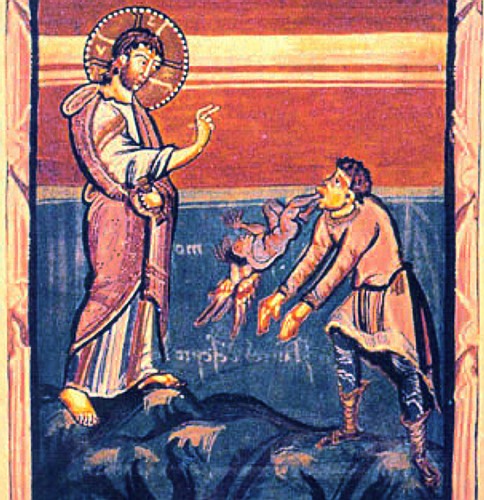
Jesus casts out a demon
Jesus went up on a mountainside and called to him those he wanted, and they came to him. He appointed twelve that they might be with him and that he might send them out to preach and to have authority to drive out demons. (Mark 3: 13-5; NIV).

It may have also been the feature that allowed Christianity to spread throughout the Roman Empire. Historian Ramsay McMullen has called Christian exorcism “the chief instrument of conversion” throughout the ancient world (McMullen, Christianizing the Roman Empire. New Haven: Yale University Press, 1984, p 27).

This works on the premise that the omnipotent God is necessarily more powerful than any other spiritual beings. Hold fast to him, and you have complete protection from the beasts and demons of the night. And he loves you.

Modern psychiatrists would no doubt instead tell the Indians that these spirits of the night did not exist, were only in their heads. That might work for some; but not likely for most Indians, who fully understood that the imagination was real. And there is no good logical reason to say they are wrong, is there? Other than arbitrary prejudice, why suppose the material world is any more real than the one we see in dreams? Saying it is “unreal” then sounds like whistling past the graveyard. “I don't believe in ghosts, because if I don't believe in them, they can't hurt me.” Not terribly logical. How well does it work for Revenue Canada?

It has been claimed that Indian medicine men regularly faked madness, to demonstrate their supposed contact with the spiritual world. “The Neutral nation,” writes Parkman, “was full of pretended madmen who raved about the villages, throwing firebrands, and making other displays of frenzy” (Parkman, op. cit., p. 80).

Two logical problems here: first, it assumes that other Indians were stupid, and could not tell real from faked madness. This is not plausible. Second, it assumes that modern psychiatric professionals too cannot tell real from fake madness. For many years, up to the middle of the twentieth century, the traditional Algonquin shamans, the waabanowin, were commonly put into mental hospitals by American mental health authorities.

If this was not madness, I think we need to qurestion whether we know what madness is.

Oxford defines “psychosis” as a state in which “contact is lost with external reality.” Merriam-Webster says it is a state in which you “believe things that are not true.” If for “external reality” or “truth” you read “physical reality,” as I suspect most of us do, then any genuine Indian shaman was, in fact, by this measure supposed to be psychotic. When at the height of his trade, he was fully in the spirit world, the world of the imagination.

You can argue that, in this event, traditional shamanic beliefs are superior to modern psychiatry. Instead of being locked up and drugged to semi-consciousness, the native psychotic remained within the community and had a ready means to support himself—although at the same time, he risked sudden murder by anyone who suspected he had laid a curse on them.

But Christianity's answer is surely better still. It is all very well to let psychotics be productively psychotic, but, as noted, this can often be terrifying and excrutiatingly painful. Ask any schizophrenic. Yet unlike modern medicine, Christianity does not deny the traditional Indian world view. Instead, it allows it, but introduces a new spiritual technology that can protect from any harm.

We really ought to try it on psychosis generally.

Why not share this vital piece of traditional Indian spiritual wisdom we call Christianity?


Monday, July 04, 2016

What Cultural Genocide Does Not Look Like


A potlatch. Edward Curtis.
“It is a strict law that bids us to dance.”- Chief O'wax̱a̱laga̱lis of the Kwakiutl, speech to anthropologist Franz Boas.

There was, we discover, no genocide of the Indians, at least by Europeans or European Canadians. We have to accept that. But at least, there was a “cultural genocide,” wasn't there? A deliberate attempt to wipe out Indian culture?

Wait. First of all, calling something “cultural genocide” is what they call in formal debating “prejudicial language.” There is probably no such thing, properly speaking, as “cultural genocide.” The suffix “-cide” means you killed someone. You cannot, except metaphorially, kill a culture. And even in this metaphorical sense, you probably cannot “kill” a culture, that is, make it cease to be, without killing everyone who even knows about it. Changing it in some aspects is not killing it; otherwise Canadian mainstream culture is murdered about every year.

Still, a culture can indeed be broadly suppressed.

This sort of thing can often happen. My Irish ancestors knew something about it. Education in the Irish language was forbidden; practice of the Catholic religion was forbidden; the traditional Irish Brehon law system was banned; the Irish could hold no responsible positions in their own government; and so forth. If the motive was not simple hate for the Irish, as it may have been, then it was to turn them into proper Englishmen—“nation-building.” The Highland Scots culture was similarly suppressed in many parts by law. So, in a less systematic fashion, and more obviously out of practical contingency rather than hostility, were the cultures of Brittany, Languedoc, Catalonia, or the Basques, to cite a few: collectively, the ancestors of perhaps a preponderance of Canadians today. Indeed, such cultural suppression has been a common experience even within the borders of Canada: to every new wave of immigrants from any non-English- or French-speaking country, compelled to swear an oath to some foreign Queen, and to learn a new language and laws.

If the same thing happened to the Indians too, it would not be suprising.

But did it? Aren't they, in fact, the one group of Canadians to which it has not? The one minority group whose traditional culture has been supported and preserved, if unevenly, by governments?

Even if it has, the suppression of specific elements of a culture is not always bad. Cultures are not morally equivalent. Cultures can and should change, if something better comes along. Cultures can include objectively immoral paractices. To say so is, really, only to admit the doctrine of human rights: it was not okay to kill Jews in Nazi Germany, or Croats in Bosnia, just because it was legal and socially acceptable. We generally agree, as a matter of international and natural law, that in such cases, foreign intervention is not only justified, but morally required. Historical cultures or cultural practices that could rightfully have been suppressed might include slavery in the antebellum US South, the Imperial Shintoism of Japan, apartheid in South Africa or Rhodesia, the exposure of unwanted infants in ancient Greece, the seigniorial “right of first night.” The Old Testament, one recalls, was not terribly keen on the Canaanite tradition of child sacrifice, or on the common hospitality of Sodom and Gomorrah, the cities of the plain.

Moloch.

If ending these were “cultural genocides,” there is certainly a rational and moral argument for cultural genocide.

Accordingly, we must allow that there might have been specific aspects of Canadian indigenous cultures that ought to have been suppressed. And, as we have already seen, there were: slavery, the torture of prisoners, constant war, the exposure of the elderly, sick, or young if their care became a burden, widespread poverty, periodic starvation, that sort of thing.

But other than that, no doubt, aboriginal cultural practices no doubt ought to be preserved. Culture is a thing of beauty in itself. And as a result, we condemn the residential school system, for example, for supposedly trying to “take the Indian out of the child.”

With apologies, let's leave aside for now the residential school system—to be dealt with it later. It is too large a topic. Let's just note in passing that it was the Indians who wanted it.

Aside from the residential schools, the usual villain in the charge of cultural suppression is or are the Christian missions. They somehow forced the poor natives to give up their spiritual traditions and embrace Christianity. Douglas Todd, writing in the Vancouver Sun, blames the sad current state of Canadian Indians on the colonization of Canada by, as he puts it, “European missionaries and settlers” (Douglas Todd, “Aboriginals surprisingly loyal to Christianity,” Vancouver Sun, August 28, 2009). If missionaries are not held solely to blame, they do get a call-out. And pride of place.

There is an obvious immediate problem with this charge. Religion tends to be voluntary in nature. How did the evil Christians manage to force their ugly culture down the throats of the noble savages?

Easy enough, I suppose, to see if you accept the fundamental unspoken premise that the Indians, being purely natural beings, had no free will. But if you accept them as unromantically human, with the ability and the right to make up their own minds, it is hard to fault the missionaries for simply spreading the good news—giving them the information to make an informed choice.

It is possible to force an outward change of religion by legal fiat. We have mentioned the outlawing of Catholicism in Ireland—and, indeed, across the United Kingdom, for centuries. Similar legal bans, as often against Protestantism, were once common across Europe.

But did it ever happen in Canada, and to the Indians? After all, Canada was, in its early days, a beacon of religious tolerance, a reproach to old intolerant Europe, and indeed even to the Thirteen Colonies below. It was the first portion of the British Empire in which Catholics were fully enfranchised. Attempts to establish the Anglican Church in Upper Canada, as in England, were early opposed and soon overthrown by the Methodists and the Presbyterians. It seems unlikely, on its face, that the same tolerance was not extended to the native people. To suppress their religion would have gone against longstanding Canadian traditions, traditions on which the nation was even founded. Moreover, if you were going to launch a government-backed effort to convert the heathen to the one true religion, which religion would that be? To pick one over another would have been hugely controversial, in a nation usually split about 50/50 between Protestant and Catholic faiths.

So, was there ever any compulsion among Indians to become Christian? Was there ever any legal compulsion, more generally, for Indians to assimilate?

Two letters: No.

Those who want to make the charge most often refer to the Gradual Civilization Act, passed by the Canadian Parliament in 1857, later supplanted by the Indian Act: formally, “An Act to Encourage the Gradual Civilization of the Indian Tribes.”

That sounds like an attempt to assimilate, doesn't it?

At least, if you do not take the trouble to read the text.

In fact, it simply outlines the legal method by which a status Indian, if he wishes to, may leave his tribe and become an ordinary Canadian citizen. In doing so, he waives his treaty rights, and in return is given his own plot of land. The crucial wording is this: “Indians who may desire to avail themselves of this act.” Such process was purely voluntary, at the request of the Indian. The act of assimilation was permitted, not required, by government.

Indeed, the emphasis of the act is not on the “encourage,” but on the “gradual” in the title. The overall thrust is really to put speed bumps in the road to emancipation. To legally renounce Indian status, individuals had to undergo an examination by an Indian agent or a local missionary, who were to certify that they could speak, read, and write either French or English tolerably well, were tolerably well-educated, and were of good moral character.

One might well suspect that the government did not particularly want Indians to assimilate.

Those crying cultural genocide could next turn to the incontrovertible fact that specific elements of traditional Indian culture have indeed been legally banned. As we have seen in an earlier chapter, for example, the Indians of the Pacific Northwest were thoroughly upset when their traditional practice of slavery was outlawed by the US government, some decades after it was outlawed for whites. And any two tribes going to war, today, would probably draw down the Mounties well before it even got to the torture of prisoners. Do we really have a problem with that?

A potlatch ceremony.

Perhaps the best case for suppression of an Indian tradition on the grounds of sheer prejudice, rather than out of a proper respect for human rights and morality, is the matter of the potlatch. In Canada, the Indian Act was modified in 1885 to prohibit traditional “potlatch” ceremonies among the Kwakiutl and other tribes in the Pacific Northwest. Later the sun dance of the Plains tribes fell under the same prohibition.

In the third section of the Indian Act, signed on April 19, 1884, it was declared that:

"Every Indian or other person who engages in or assists in celebrating the Indian festival known as the “Potlatch” or in the Indian dance known as the “Tamanawas” is guilty of a misdemeanor, and liable to imprisonment for a term of not more than six nor less than two months in any gaol or other place of confinement; and every Indian or persons who encourages… an Indian to get up such a festival… shall be liable to the same punishment."

Even at the time, this seemed to many an unnecessary interference in Indian affairs. Potlatches were just big parties at which everyone exchanged lavish gifts, right? So what's wrong with that? Isn't generousity a good thing? Should we outlaw Christmas?

But wait. What exactly was a potlatch?

The original statute did not say. This made the ban in practice meaningless; it was never enforced. Anyone charged with holding a “potlatch” could simply claim that the ignorant pale-skinned judge did not understand Indian traditions, that whatever they did last Friday night was not a “potlatch.”

Accordingly, the section was later rewritten as:

"Every Indian or other person who engages in, or assists in celebrating, or encourages, either directly or indirectly, another to celebrate, any Indian festival, dance or other ceremony of which the giving away or paying or giving back of money, goods or articles of any sort forms a part, or is a feature, whether such gift of money, goods or articles takes place before, at, or after the celebration of the same, and every Indian or other person who engages or assists in any celebration or dance of which the wounding or mutilation of the dead or living body of any human being or animal forms a part or is a feature, is guilty of an indictable offence and is liable to imprisonment for a term not exceeding six months and not less than two months; but nothing in this section shall be construed to prevent the holding of any agricultural show or exhibition or the giving of prizes for exhibits thereat." 

 That ought to nail it down. It gives us at least a glimpse of an idea what it is about the potlatch that the authorities found troublesome. If it involved cruelty to animals, mutilating people, or indignity to corpses, we might not welcome it into our neighbourhood.

Potlatch participants. Edward Curtis.

Yet the bit about exchanging gifts still seems strange. Strange enough that they even need to add a rider to exempt country fairs. 

Those in close contact with the Indians, like George Blenkinsop and Gilbert Sproat, argued that the ethic of the potlatch made it impossible for Indians to better themselves. As soon as they made more than their neighbours, they were socially obliged to give it all away. There was, therefore, no incentive to work hard, to take risks, no way for an enterprising individual to advance. As Sproat wrote to John A. Macdonald, “It is not possible that the Indians can acquire property, or can become industrious with any good result, while under the influence of… [the Potlatch]” (Douglas Cole and Ira Chaikin. An Iron Hand Upon the People: The Law Against the Potlatch on the Northwest Coast. Seattle: University of Washington Press, 1990, p.15).

If this was the reason, one cannot, at least, charge government authorities with hating or seeking harm to the Indians. They would have seen themselves as acting in the Indians' best interests. Nevertheless, this hardly seems sufficient reason to interfere with the Indians' right to decide things for themselves. Even the charge that this practice would impoverish Indians seems debatable: the given gift subtracts from the wealth of one Indian, but adds to the wealth of another. If Indians choose to work for one another jointly as a community, rather than only for themselves and their immediate family, why not? Granted, capitalist theory might suggest a general loss of work incentives, but couldn't you make the same argument about sharing income within a family? To many of us, affection for others close to us is a stronger incentive than a second car. To many others, social prestige is the great goal, and a potlatch could be seen as purchasing social prestige. 

It begins to look, at least, like an errant bit of government paternalism—another sad example of Europeans supposing that Indians could not be allowed to think for themselves. 

However, J. B. McCullagh, an Anglican missionary and staunch opponent of the potlatch, protests that this is not the real problem with the potlatch. He laments the wording of the ban for missing the point. In some potlatch ceremonies, he points out, goods were not given away. Instead, they were thrown into the nearest fire.

“There is ... liable to be considerable wanton (from our point of view) destruction of property if the friends of the chief ... take it into their heads to do him honor. This they do by making him presents of articles of clothing, etc., but instead of putting them in his hand they put them in the fire, where they are quickly consumed. The chief then and there makes return presents also putting them in the fire, amid rounds of applause” (Rev. J.B. McCullagh, The Indian Potlatch, Substance of a Paper Read Before C.M.S. Annual Conference, Metlakatla, B.C., 1899, p. 14).

This does not seem likely to benefit the material well-being of even the community as a whole.

In another form of the ceremony, McCullagh says, the “Unana,” housewares are broken throughout the settlement.

“The Unana is a crockery-breaking honor The candidate having been artistically painted, kilted and feathered, is armed with a club, works himself up into a towering rage, and then proceeds on his mission of destruction, stepping like a high-mettled charger. Entering into each house he goes foaming around breaking basins, plates, lamps, or anything he sees, and having completed his tour makes a grand display of recompensing the owners” (McCullagh, p. 12).

Dorothy Johansen, corroborating McCullagh, describes the destruction of property as a feature of at least some potlatches. "In the potlatch, the host in effect challenged a guest chieftain to exceed him in his 'power' to give away or to destroy goods. If the guest did not return 100 percent on the gifts received and destroy even more wealth in a bigger and better bonfire, he and his people lost face and so his 'power' was diminished" (Dorothy O. Johansen, Empire of the Columbia: A History of the Pacific Northwest, 2nd ed., New York: Harper & Row, 1967, pp. 7–8).

And this at a time when many Indians risked starvation.

We have not dealt, yet, with the reference, in the revised legislation, to the mutilation of animals. McCullagh explains:

“The Lu'lim is a dog-eating degree, when the candidate, having made himself sufficiently mad in the woods — naked and fasting for several days--joins the ceremonial dance and tears a dog to pieces with his teeth before the assembled company, after which he distributes as much property as he is able” (McCullagh, op cit., p. 11).
Would Pocahontas's forest buddies Meeko and Flit approve?

Note too the reference in the legislation to the mutilation of humans. McCullagh again:

“The Ulala is a cannibal degree, that is to say, the eating of human flesh is its leading feature. It is not so bad as it used to be when slaves were killed, I am told, and dead bodies exhumed for the purpose. The modern method is to get together as much property as possible, fix the date for the dance, then disappear into the woods for a few days cloaked in a bearskin with a bellows-whistle under each arm, and then when the dance is on turn up in a fine frenzy and start in biting those present. On some the biter only leaves the marks of his teeth, from others he will draw blood, while perhaps from others, if he can afford it, he will tear a piece of flesh away. After this beastly fit of voluntary insanity ... he will distribute his property among those he has bitten according to the nature of the bite inflicted” (McCullagh, op. cit., p. 11).

The great anthropologist Franz Boas, who did much of his work among the Kwakiutl, notes that during a potlatch, "any mistake made by a singer or dancer is considered opprobrious. At certain occasions the dancer who makes a mistake is killed" (Boas, Journal of American Folklore 1. p. 51).

There may indeed be some human rights issues here.

If McCullagh is correct, then, the essential fault of the Ottawa legislators and bureaucrats was not an unwarranted interference with traditional native culture. It was an abominable job of drafting legislation.

Sun dance.

The issue is clearer for the sun dance, an annual ceremony among the Assiniboine, Crow, Gros Ventre, Plains Cree, Plains Ojibway, and Blackfoot, among others. Although not mentioned in the legislation, it automatically fell under the same prohibition, because it featured human mutilation.

The Reverend John McLean describes a Blackfoot sun dance he attended:

“As I stood outside the lodge, a young Indian friend of mine, went to an old medicine woman and presented his sacrifice to Natos [the sun god]. During the year he had gone on a horse-stealing expedition and as is customary on such occasions had prayed to Natos for protection and success, offering himself to his god if his prayers were answered. He had been successful and he now presented himself as a sacrifice. The old woman took his hand, held it toward the sun and prayed, then laying a finger on a block of wood she severed it with one blow from a knife and deer's horn scraper. She held the portion of the finger cut off toward the Sun and dedicated that to him as the young man's sacrifice" (Rev. John McLean, The Blackfoot Sun Dance, Proceedings of the Canadian Institute, p. 235).

The centrepiece of the sun dance was the “making of braves,” an adolescent rite of passage. McLean describes its Blackfoot version:

“He lay down, and four men held him while a fifth made the incisions in his breast and back. Two places were marked in each breast denoting the position and width of each incision. This being done, the wooden skewers being in readiness, a double edged knife was held in the hand, the point touching the flesh, a small piece of wood was placed on the under side to receive the point of the knife when it had gone through, and the flesh was drawn out the desired length for the knife to pierce. A quick pressure and the incision was made, the piece of wood was removed, and the skewer inserted from the underside as the knife was being taken out. When the skewer was properly inserted, it was beaten down with the palm of the hand of the operator, that it might remain firmly in its place. This being done to each breast, with a single skewer for each, strong enough to tear away the flesh, and long enough to hold the lariats fastened to the top of the sacred pole, a double incision was made on the back of the left shoulder, to the skewer of which was fastened an Indian drum. The work being pronounced good by the persons engaged in the operation, the young man arose, and one of the operators fastened the lariats giving them two or three jerks to bring them into position.
Shoshone sun dance.
“The young man went up to the sacred pole, and while his countenance was exceedingly pale, and his frame trembling with emotion, threw his arms around it, and prayed earnestly for strength to pass successfully through the trying ordeal. His prayer ended, he moved backward until the flesh was fully extended, and placing a small bone whistle in his mouth, he blew continuously upon it a series of short sharp sounds, while he threw himself backward, and danced until the flesh gave way and he fell. Previous to his tearing himself free from the lariats, he seized the drum with both hands and with a sudden pull tore the flesh on his back, dashing the drum to the ground amid the applause of the people. As he lay on the ground, the operators examined his wounds, cut off the flesh that was hanging loosely, and the ceremony was at an end” (Clark Wissler, The Sun Dance of the Blackfoot Indians, Anthropological Papers of the American Museum of Natural History, 16:3, p. 264; McLean, op. cit., pp. 5-6).

I think we can grant that these ceremonies were painful for those involved, and we ourselves might not want to participate. Still, an obvious question remains: why can't the Indians decide this for themselves? If they really want to maim and kill one another, between consenting adults, wasn't that their business?

Sioux sun dance

Perhaps not. If young Somali women want to mutilate their genitals, after all, isn't that also their business? From the standpoint of the individual, especially a young individual, a Somali teenager or a young Blackfoot “brave,” how much is really voluntary, and how much is social pressure? 

According to McCullagh, the call to outlaw the potlatch came at least in part from the Indians themselves, and from a majority of them. “[T]he civilized Indians,” he asserts, “wish to see the Potlatch abolished” (McCullagh, op. cit., p. 12). Yes, they could refuse to take part. But all rights within the tribe were assigned and publicly recognized through potlatch. On potlatch depended any rights to hunting, fishing, and berrying territories within the tribe. Without a potlatch, even the birth of a child was not recognized. 

So, if one did not join in the proceedings, and in holding potlatches, one lost all standing within the community. “If, after an Indian leaves the Confederacy to join a mission, the potlatch would let him alone all would be well,” laments McCullagh. “But it does no such thing. If the man be a chief the potlatch immediately usurps his chieftainship, promotes another chief in his place, takes away his name and title, and ignores him. This is very hard for some men to bear, not so much because of the humiliation as because of the injustice” (McCullagh, op. cit., p. 16). 

The only option was to leave the tribe altogether, abandon your Indian identity, and assimilate with the cultural mainstream, surrendering treaty rights. If, that is, the government would let you—there were, remember, rigorous tests to pass. 

The laws against potlatch and sun dances, therefore, seem as much or more tailored to encourage Indians not to assimilate as to encourage them to do so. They remove compelling arguments for leaving the reserve.

Why couldn't a majority of Kwakiutl or Blakfoot or Cree have abolished the potlatch or the sun dance themselves? It might not indeed have been possible, at least not without bloodshed. Indian tribes were not democracies, and there would have been a problem even in a democracy. These were elements of tribal government, of tribal structure. To abolish the potlatch would have been roughly equivalent to abolishing parliament. There was no mechanism, short of revolution, to do this. 

McCullagh claims the Indians tried:

“The civilized Indian finds himself in a majority of two to one on the Naas, and yet he cannot get a hearing. He has appealed vainly to the authorities to be relieved from the tyranny of the potlatch, but he has not been understood, and it has not been thought advisable to give him relief, hence it is that the potlatch in a modernized, though no less injurious form, is now becoming as it were a necessity among the civilized Nishgas” (McCullagh, op. cit., p. 17).
If a majority of the Indians opposed and refused to participate in potlatch, that simply meant the remaining minority, however small, inherited all the tribe's titles, rights, offices, and land. It is as if a majority of elected members of parliament refused to take their seats. With no rules even requiring a quorum.

By now, it should be clear at least that this was not a matter of banning some Indian “spiritual” practice in support of Christian evangelization. McCullagh stresses that the potlatch is not religious in nature. “[I]t is not a religious rite or ceremony, even though there may seem to be a strain of ancestral worship in it ; ... it is a systematized form of tribal government based upon the united suffrages of the clans” (McCullagh, op. cit., p. 2). 

James Deans, writing in the American Antiquarian at the turn of the nineteenth century, not long after the original potlatch ban went into effect, notes: “patlatches [sic] are time-honored festivals of our aborigines, and probably existed before the adoption of Christianity” (Deans, The American Antiquarian and Oriental Journal, Vol. 18, 1896). This passing reference demonstrates that this was not a question of government suppressing some rival religion to promote Christianity. The Indians were already mostly Christian when it was banned. For all anyone knew at the time, they were already mostly Christian when the potlatch practice began. It cannot, therefore, have been understood as a religious issue. 

And to recap, even if the potlatch and the sun dance had indeed been thoroughly “religious,” or at least, expressions of Indian “spirituality,” there are circumstances in which a liberal democracy is justified in banning a religious practice. The British encountered two clear examples in India: the tradition of suttee, in which a widow was burned to death on her husband's funeral pyre, and the Thuggi ritual of strangling unsuspecting train and coach passengers as a human sacrifice. The child sacrifices of the ancient Canaanites, too, were to their god Moloch.

Suttee.

Among the ethical monotheisms, Judaism, Christianity, and Islam, objectively immoral rites rarely arise; it would go against the fundamental assumptions of the faith. (And, for the record, no, female genital mutilation is not a Muslim practice. It is an African tribal custom.) But among shamanic or magical traditions, given no ethical component, rites and religious practices can themselves be unethical. They are simply technologies; purely scientific and objective, as it were. For this reason, it would seem wise as a matter of public policy to distinguish, as we currently do not, between “shamanism” and “religion.” They are apples and oranges, pomegranites and plums.

Thuggi

One is entitled to freedom of religion, it is a human right, because it involves freedom of conscience. One does not obviously, on the other hand, have a human right to consult a fortune teller, curse someone with boils, or sell love potions. Indeed, such things have often been made illegal. They are not done out of conscience, and so no violation of conscience is involved. 

“Religion” originally and literally means something like “binding.” As in committing oneself to a set of actions, a personal oath of conduct. Shamanism is not, therefore, a “religion.” One makes no commitments to anything to be a shamanist, although one may to be a shaman. One does not sacrifice to the pagan gods because the gods deserve it, but because they demand it, and may hurt you if you don't. 

A law prohibiting the potlatch or the sun dance could therefore honestly be seen as a benevolent gift to the Indians. Now they had a legitimate excuse to not do it. The gods, if angry, could not properly fault them, but would go after Sir John A. Macdonald. 

Do Hindus resent the ban on suttee or on thuggery? I note that independent India has not yet reinstated them. 

Father Lalemant, in the Jesuit Relations, gives some idea of the social pressure and fear behind such observances among the Hurons, from his own Christian perspective:

“When a prisoner is burned, if the young men are turbulent thereat, some old man begins to exclaim and storm because they are risking the ruin of the country, saying that this is a matter of importance and that they do not behave seriously enough in it. ...
In short, it is the strangest servitude and slavery that can be imagined; and never did galley slave so fear to fail in his duty as these peoples dread to fall short in the least detail of all their wretched ceremonies — for there would follow from this omission, not only the privation of what they were expecting, but even physical punishment, which the devil for this reason exercises upon these poor wretches. The more thoughtful among them freely admit their misery, and frankly say that the demons alone are the real masters of the country, — that it is they who regulate and decree everything, whether in dreams or otherwise; that they see this plainly, but that there is no remedy for it; that they have always lived in this way, and that there is no prospect or means of living differently, —in other words, that were any detail omitted all would be lost” (Lalemant, Jesuit Relations 17, p. 159).

Some aspects of any given culture might be better dispensed with. Culture is for man, not man for the culture. 

Accept, therefore, that with the possible exception of the residential schools, not yet discussed, there was never any Canadian government action or intent to suppress Indian culture. 

Indeed, why would there have been? Human nature works entirely against it. If you are a bureaucrat in the Department of Indian Affairs, or any of its other incarnations under other names, and you encourage the assimilation of Indians, you only reduce your own power and risk losing your job. Better to keep them Indians, and keep them apart, so they remain within your charge. 

Without government action, it is not right to speak of suppression. Aboriginal cultural practices may, of course, have withered due to natural causes. That does not mean that the International Catholic Conspiracy was behind it. They may have been too busy infecting smallpox blankets.


St. Katherine (Kateri) Tekakwitha, based on the only portrait taken from life.


Shocking as it may seem to some, completely counter to the cultural genocide accusation, most Canadian Indians are and long have been resolutely Christian. 

I once lived, too briefly, in Kamloops, home to the Kamloops (Tk’emlups) Indian reserve. With our young son, we attended the local Santa Claus parade. I was beginning to be annoyed by all the secularism and commercialism, when at last, the float presented by the local band appeared. They, and they alone, gave us a nativity scene--the only plain, unambiguous reference in the whole parade to the religious nature of the holiday. The Kamloops reserve also features a lovingly-restored mission church, which has become a local attraction. St. Thomas Anglican is similarly a landmark in Moose Factory, the Cree settlement in Northern Ontario. The oldest surviving church in Ontario is Her Majesty's Royal Chapel of the Mohawks, in Brantford. I suspect this is common.

St. Thomas Anglican, Moose Factory

Real Indians are real Christians. And rather more devout than the average European Canadian. 

There was of course opposition when the first Christian missionaries appeared. If no one else, the established shamans were sure to resent this intrusion on their market; Christians scoffed at and discouraged magical practices. But in relative terms, there was suprisingly little, considering that Indian cultures are deeply conservative and wary of the strange and new. In the words of one early Jesuit, “the beliefs and superstitions of the savages are not very deeply rooted in their minds; ... they fall of themselves, and suddenly disappear, or are dissipated by the rays of the truths, entirely conformable to reason, that are proposed to them” (Jesuit Relations 16, p. 198). 

No doubt the black-robes would say that; they cannot have been disinterested. However, of the Micmacs around Port Royal, the Sieur de Poutrincourt, a somewhat more detached observer, also remarks: “they seemed to wish for nothing better than to enroll themselves under the banner of Jesus Christ” (Jesuit Relations 1, p. 69). The Micmac flag is dominated by a cross. To be Micmac, then, is to be Christian. Christianity is a part of their ethnic identity.

Flag of the Micmac.


The Abenaki next door, not having been sent a missionary, Christianized themselves, and then went to Quebec to request one. Repeatedly. 

“One sagamo, or chief, accompanied Meiaskwat to Quebec, and, after instruction, embraced the faith. Others followed his example, and in a few years each Abenaki village could count several Christians. At last two sagamos came on Assumption Day to ask for black-gowns to instruct the tribe…. Charmed by the happiness they had enjoyed, the Abenakis sent in September for their missionary, and again in the two following years; but were unable to obtain him, so limited was the number of missionaries for the stations then under their charge. In 1650, their assiduity and fervor was rewarded by success, and [Father] Druillettes set out with a party on the last day of August” (John G. Shea, Catholic Missions to the Indian Tribes of the United States, NY, 1857, p. 136, p. 138). 

Nearby Indian bands appealed for their own black-robe. “Soon after beginning his labors here, [Father] Rale beheld a new tribe approach his mission. The Amalingans came to ascertain the truth of what they had heard. Struck by all that they saw at the mission, they solicited instruction, listened to his teaching, and embraced the faith when, at the next season, he visited their camp” (Shea, op. cit., p. 144). 

Nor was this an isolated incident. It seems almost the usual thing. The Jesuit Relations report, “The Onnontaeronnon Iroquois invite us of their own accord, and solicit our coming by presents; they have assigned a place to us, and have described it to us as the finest spot in all those regions” (Jesuit Relations 40, p. 219). Hurons spread the word to the Neutral nation: “Éstienne Totiri, of the village of St. Joseph, accompanied by one of his brothers, stopped in one of their villages nearer the frontier, and found ears so well disposed to listen to them that they had barely three or four hours at night for sleep” (Jesuit Relations 27, p. 19). 

An Abenaki chief described his own conversion, in his own words: 

“One day my canoe missed the route; I lost my path, and wandered a long way at random, until at last I landed near Quebec, in a great village of the Algonquins, where the black-gowns were teaching. Scarcely had I arrived, when one of them came to see me. I was loaded with furs, but the black-gown of France disdained to look at them: he spoke to me of the Great Spirit, of heaven, of hell, of the prayer, which is the only way to reach heaven. I heard him with pleasure, and was so delighted by his words, that I remained in the village near him. At last the prayer pleased me, and I asked to be instructed; I solicited baptism, and received it. Then I returned to the lodges of my tribe, and related all that had happened. All envied my happiness, and wished to partake it: they, too, went to the black-gown to be baptized. ... Now I hold to the prayer of the French; I agree to it; I shall be faithful to it, even until the earth is burnt and destroyed" (Shea, op. cit., p. 146-7).
Not a lot of principled resistance there.

Nor was this a strictly Catholic phenomenon. Protestant missionaries had similar success in New England.

“Thirty years after … [Rev. John Eliot] … entered on his missionary work, twenty-four regular congregations had been gathered in Massachusetts, with the same number of native preachers [this circa 1675]; fifty years from the same date [circa 1696] there were thirty Indian churches, in some of which a native pastorate had been established, and three fourths of the whole Indian population ... were accounted Christians” (Augustus C. Thompson, Moravian Missions. New York: Charles Scribner's Sons 1883, p. 274-5). 

 At least one entire new congregation every two years. The main thing holding up Christianity's advance seems to have been only a shortage of missionaries. 

The Moravians met a similar welcome among the Labrador Eskimo. “In 1809, a small hymn-book and a few tracts were ready, which the converts, both in Greenland and Labrador, received with delight. One year later, a Harmony of the Gospels was in readiness. Eighteen hundred and twenty-one, the first jubilee of the mission, was signalized by the distribution of the entire New Testament in the vernacular. At once the poor people, without suggestion from any one, began to collect what they could, and forwarded the same to England as a thank-offering to the society which had bestowed so invaluable a treasure upon them” (Thompson, op. cit., p. 235).

The Reverend Peter Jones, 1845. THis is believed to be the first photograph ever taken of a North American Indian.

The Methodists were as successful when they evangelized the Ontario Ojibwe (Mississauga): “The word of the Lord spread very rapidly from one tribe to another; so much so, that within a very few years [from 1823] fifteen Christian settlements were formed among those very people” (Rev. Peter Jones, [Kahkewaquonaby], History of the Ojebway Indians; With Special Reference to Their Conversion to Christianity. Wesleyan Methodist Missionary Society. London: 1861, p. 4).

The Reverend Jones, a.k.a. Kahkewaquonaby, himself an Ojibwe chief, cites a newspaper report that the Salish of the West Coast “had arrived at some western towns, enquiring after the white man's religion, saying that ... they had come to ask for a missionary to tell their people the words of that good book." To do this they had, he observes, “travelled between two and three thousand miles on foot” (Jones, op. cit., p. 226-7).

 Indian Christians have always also been especially devout. Hearing that the good old loyalist government of Upper Canada, in one of the earliest of its notorious “blue laws,” had banned hunting on Sundays, the Ojibwe grand council of 1840 lodged their protest with the Supervisor of Indian Affairs. They had a problem with that.

“Father, — Last winter an act was passed by the Parliament of this country for the preservation of game and for the better observance of the Sabbath day, imposing fines and penalties upon any person or persons shooting game on the Sabbath. It is our desire that our Great Father may be pleased to recommend that the said Act may be so amended as to impose the same fines and penalties upon any person or persons fishing on the Lord's Day” (Jones, op. cit. p. 128).
Sillery church.

Back in Quebec, back in the early seventeenth century, the Jesuits marvelled at the eagerness of their new acolytes.

“[T]he desire of the savages, great and small, to learn the catechism and the prayers, often makes a chapel and a school of the sick ward as well as of our house at Sillery. They enter incessantly, and say: 'Teach me; have me pray to God.'” (Jesuit Relations 24, p. 185).
Among the Abenaki, Father Druillettes reports,
“Their ardor was so great… for retaining the prayers or the truths that I taught them, that they spent the nights in repeating their lessons. The old men became pupils to their little children. The catechumens, very little versed in our science, were forced to play the doctor. Some would write their lessons after a fashion of their own, using a bit of charcoal for a pen, and a piece of bark instead of paper. ... They carried away these papers with them, to study their lessons in the quiet of the night. Jealousy and emulation sprang up among them: the little ones vied with the older ones who should soonest learn his prayers; and those to whom I could not give all the time they asked me for, reproached me therefor” (Jesuit Relations 38, p. 25).
We who claim to be so should all be such good Christians.

When Father Druillettes was obliged, following the traditional missionary rotation, to leave the Abenaki, they expressed great remorse. “A general grief prevailed. 'You grieve our minds to talk of your going, and the uncertainty of your return.' 'We must say,' said others, 'that Father Gabriel does not love us: he does not care, though we shall die, as he abandons us.'” On Druillettes's return, years later, “All the tribe were forthwith in motion, and, amid a volley of firearms, the chief embraced the missionary, crying: 'I see well that the Great Spirit, who rules in the heavens, deigns to look favorably on us, since he sends us back our patriarch.' Universal joy prevailed: men, women, children, all sought to express their happiness at the missionary's return. A banquet was spread in every cabin, and he was forced to visit all. 'We have you, at last,' they cried; 'you are our father, our patriarch, our countryman. ...We had thought of leaving this land to seek you, for many have died in your absence. We were losing all hopes of reaching heaven. Those whom you did instruct, performed all they had learnt, but their heart was weary, for it sought and could not find you" (Shea, op. cit., p. 139).

Despite all the anti-Christian sentiments they now absorb from the popular culture, the media, the political left, and indeed often from those who claim to speak in their behalf, Indians remain today more Christian than the general population. According to Census Canada, three out of four Canadian aboriginals list themselves as Christian (Douglas Todd, “Aboriginals surprisingly loyal to Christianity,” Vancouver Sun, August 28, 2009). For the population as a whole, that figure is 67.3%. Reginald Bibby, Canada's best-known sociologist of religion, finds that 54% of aboriginal teenagers say they trust in church and other religious leaders. For non-aboriginal teenagers, the figure is 39%. Among aboriginal teenagers, 78% believe in a creator God; 11 percentage points higher than the national average (Todd, op. cit.; Bibby, The Emerging Millennials).

Most actual Indians it seems do not buy the standard “cultural genocide” line.

The charge that the missionaries committed cultural crimes against the natives is actually deeply ironic. The Jesuits who first catechized most of the tribes of Eastern Canada were commonly accused in their own day, here as in most other parts, of “going native,” of not doing their bit to introduce the Indians to the benefits of European civilization. “[I]t was the reproach of the Jesuit missions,” Francis Parkman writes, “that they left the savage a savage still, and asked little of him but the practice of certain rites and the passive acceptance of dogmas” (Parkman, A Half Century of Conflict, Vol. 1, p. 50). Instead of teaching the natives French, the Jesuits studied the Indian languages. The Sieur de Cadillac complained that the Jesuits were not even converting Indians fast enough. Rather than pushing their religion on the Indians, they commonly refused baptism until they were certain their neophytes were properly catechised, and understood what they were getting into (Parkman, op. cit., p. 52).

Real missionaries actually had every reason not to assimilate the Indians to European culture. First of all, the more things they demanded that the Indians change about their existing culture, the harder a sell Christianity, their own concern, became. Why fuss? Who cares on which side one puts the spoon for a formal meal? Second, the missionaries worried that introducing Indians wholesale and without preparation to the new European culture was dangerous to their morals—something they cared about intimately. Alcohol was the obvious example. Governor Callieres also noted that “the Indian girls brought up at the Ursuline Convent led looser lives than the young squaws who had received no instruction” (Parkman, op. cit., p. 53). Champigny agreed: “[A]ll intimacy of the Indians with the French is dangerous and corrupting to their morals” (Parkman, op. cit., p. 54).

This, I suggest, was culture shock. We probably know a little more about it today. Even any college freshman who moves away from home experiences a little of it. Immersing oneself suddenly in an unfamiliar milieu, and discovering that so many old, assumed rules no longer apply, leads to a natural sense of liberation, an impression that here no rules any longer hold, that one can now do whatever one wants. The experience must be particularly powerful in a particularly conservative and communal society such as the Indians knew.

I submit, however, that the Jesuit prescription for it was unfortunately, tragically, wrong. The proof is that, many generations later, we still see the same culture shock among Canadian aboriginals. Those with some experience of living abroad know that the way to conquer culture shock is not to wall oneself up in one's room, not to hang out only with other expats—not, in sum, to remain on the reserve. The remedy is to make full contact with the new culture, and, over time, one begins to see the underlying logic in its ways. The universe comes gradually back into focus, and the attractions of sitting in an expat bar complaining and knocking back firewater grow less.

There is a third consideration pushing missionaries towards advocating segregation over assimilation. Even assume, if you like, that the missionaries were all scoundrels and hypocrites, had no real ethics, and looked out only for themselves. Even so, even on this cynical basis, they had every reason to resist the assimilation of their flocks. Keeping the Indians an arm's length away from other Europeans increased their own power and influence. If the Indians could not speak French or English, and had little or no contact with other outsiders, the missionary became a needed advisor, intermediary and interpreter for both the Indians and the authorities.

Forced assimilation, then, was never the problem. It may instead have been the greatest tragedy of the Indians as a group that the leaders and authorities who had the most dealings with them all along the line have had it in their interest to promote segregation, never assimilation: the missionaries, the elders and band leaders, the sagamos and medicine men, and all the busy paper-pushing bureaucrats in the Bureau of Indian Affairs. All had all their power and emolument to lose to the extent that Indians embraced the cultural mainstream.

You want a problem never to be solved? Form a government bureaucracy to address it.

And Canada has always had a Department of Indian Affairs.

As for the fate of traditional Indian culture, if we really want to preserve the beauty of it, the best thing to do is to find more Christian missionaries. It is likely that, without the missionaries and their manly efforts, we would know little or nothing now about it. In order to evangelize, the first thing missionaries had to do was to learn the Indian languages. To learn the Indian languages, one of the first things was to create a written form, collect its vocabulary in writing, and analyse its grammar. No small benefit to the survival and propagation of any language. The Abenaki dictionary complied by Father Rale, S. J., for example, “has since been regarded as one of the most precious remains of the early philological labors on the Indian languages. The original is still preserved with the greatest care in the safe of the library of Harvard College ....” (Shea, op. cit., p. 144-5). And Rale was not working alone. Missionaries did the same thing everywhere, with every Indian and aboriginal language. Canadian Aboriginal Syllabics were invented in 1840 by Methodist missionary James Evans; they now supply a written form for a broad range of Indian languages. Without this painstaking labour, most such languages would probably by now have been lost; or at least altered by loan words and loan grammar beyond recognition. With it, Indian cultures for the first time enter history. For the first time, we have records of Indian folkways, Indian affairs, Indian thought, and Indian literature. Without it, we have nothing but bleached bones and ambiguous shards of stone.

Plains Cree inscription in Canadian Aboriginal Syllabics.

Almost the next thing the missionaries naturally needed to do was collect any information they could about pre-existing Indian spiritual beliefs. They had to understand the context in which they were preaching: what concepts pre-existed, for example, and could be used in explaining Christianity. Did the Indians have a conception of the afterlife? Of the soul, and of its immortality? Did they have an idea of a supreme being?

Accordingly, if today we still have some idea of what “traditional native spirituality” is, if native spirituality continues to exist, this is probably mostly due to early Christian missions. Yes, there were also Indian oral traditions, but oral traditions are malleable, and forgettable. Epidemics and wars might easily have wiped out anyone with an accurate memory of them. European influence might have wiped out any interest in preserving the memories, for a generation or two, after which it would have been impossible to recover anything.

“Native spirituality” as we know it today, is largely formed from elements of the pop culture, of “New Age” beliefs. To the extent that it is, it is, like modern “paganism,” really a back-formation from Christianity, a reaction to it. But to the extent that anything authentic endures—then this, too, is thanks to Christianity. Such things may be known reliably almost exclusively from the records of early Christian missionaries. Either way, it is child, heir, and beneficiary of the Christian missions.

To the extent that Indians have tried assimilation, and only to that extent, has Indianness itself survived to this day. Only a dead or dying culture does not change.